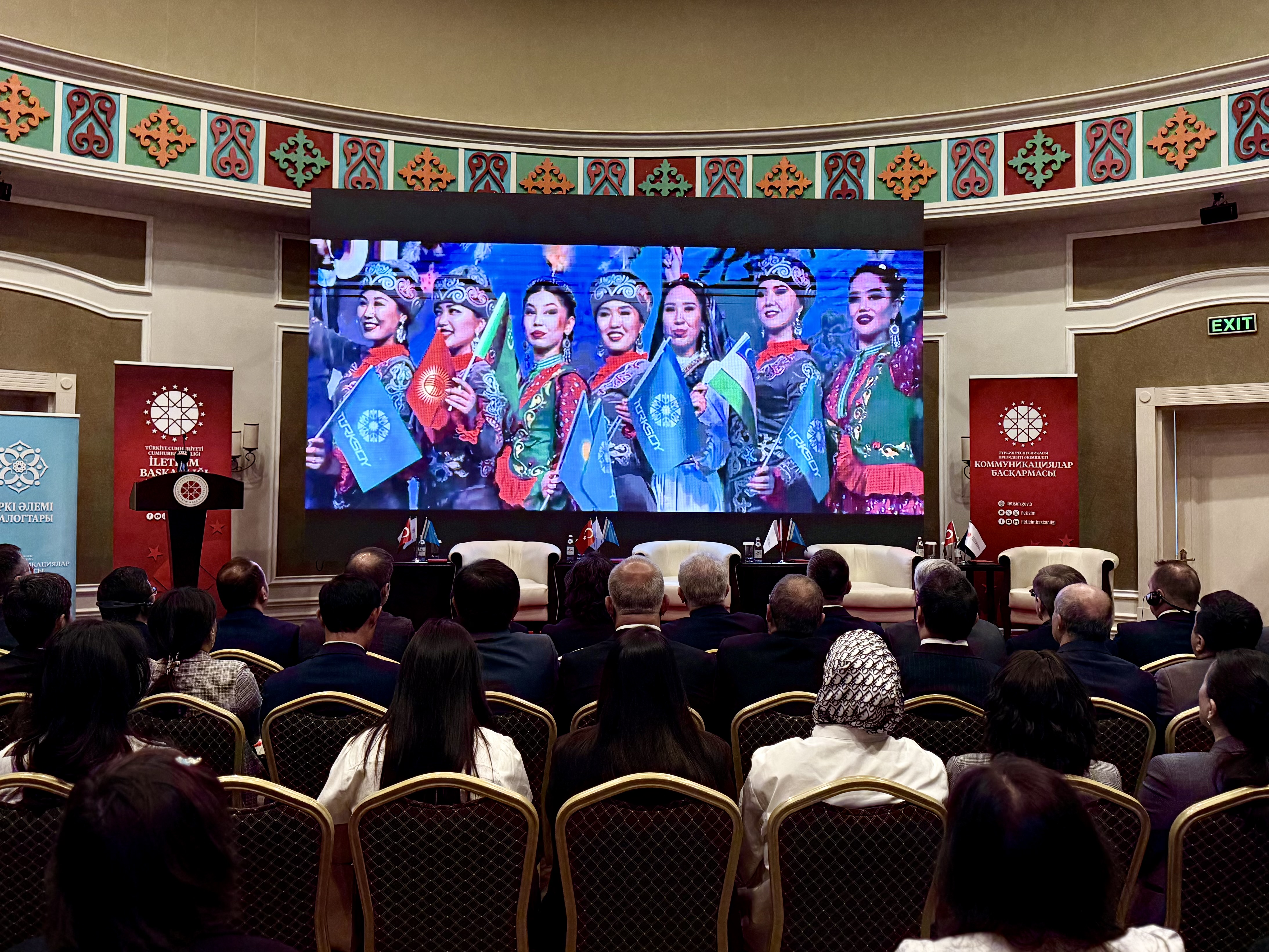
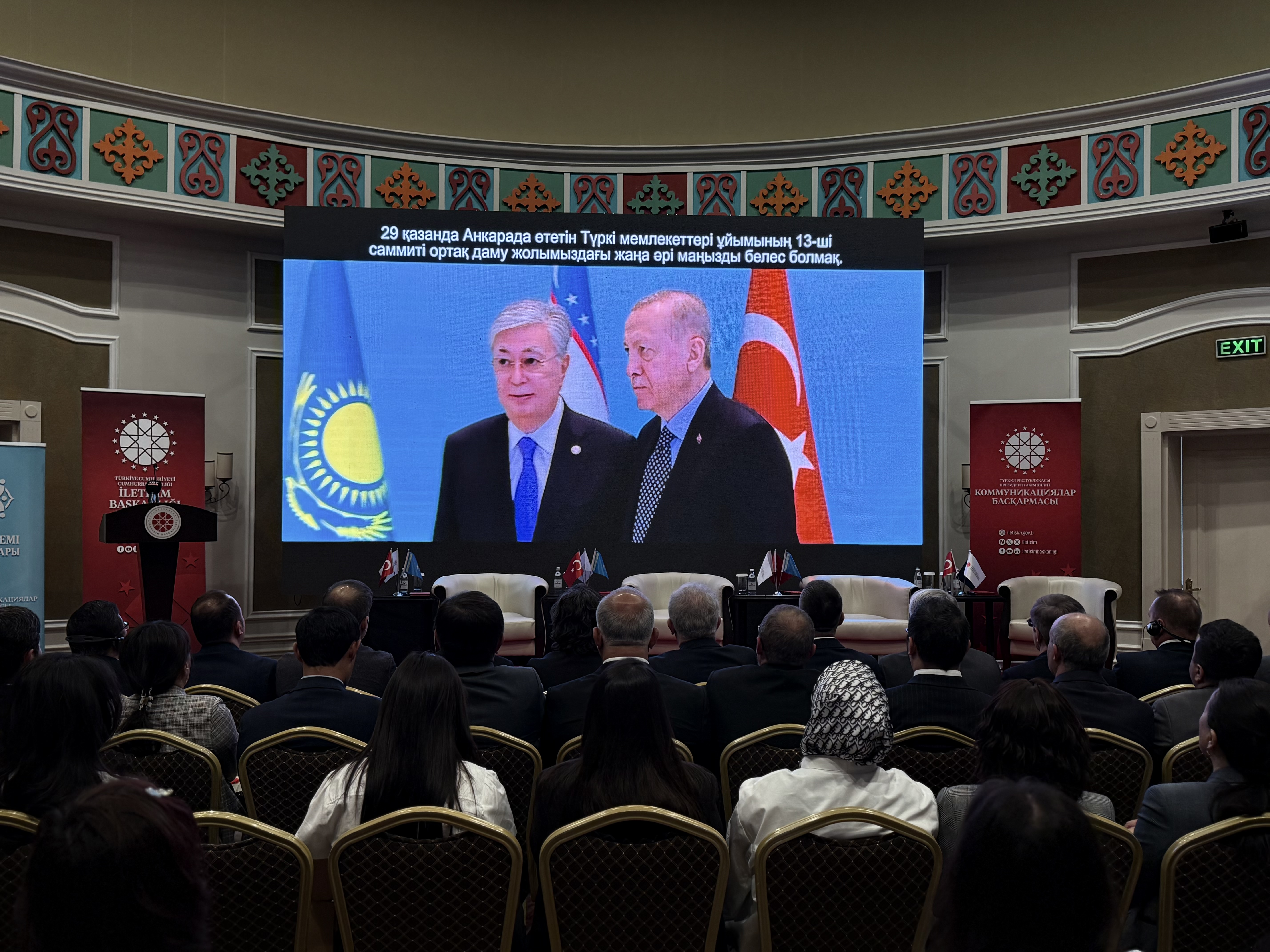
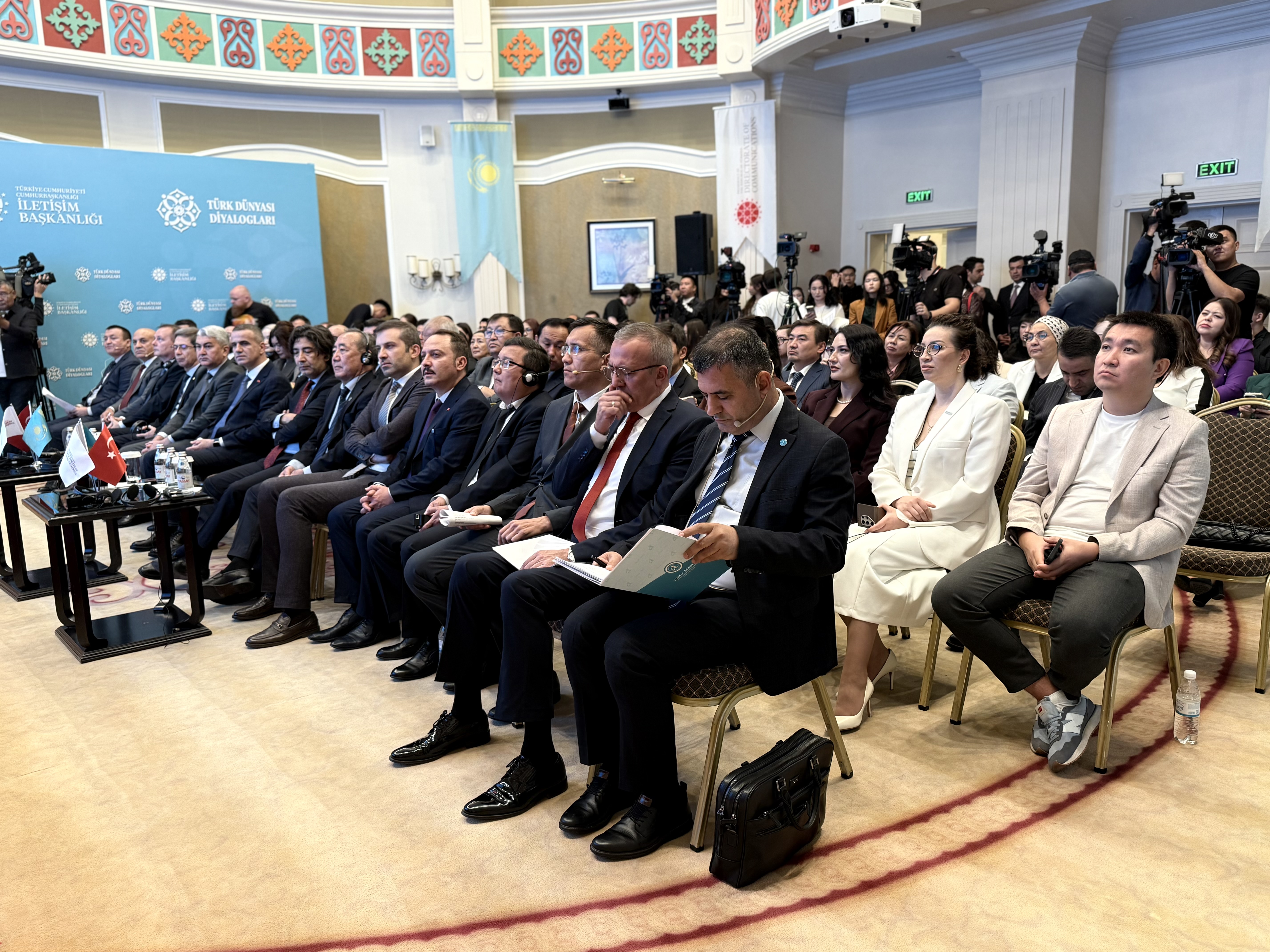
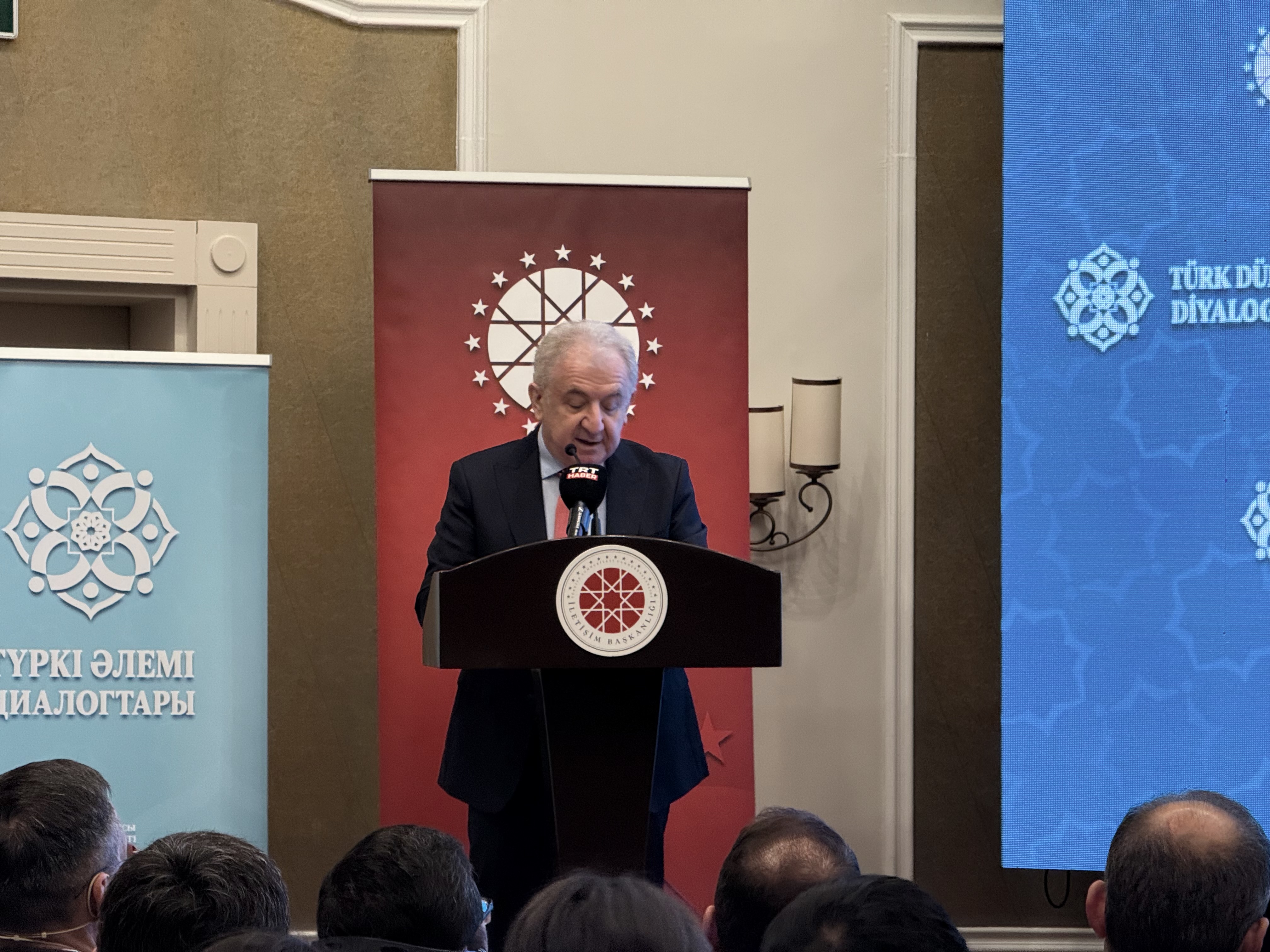
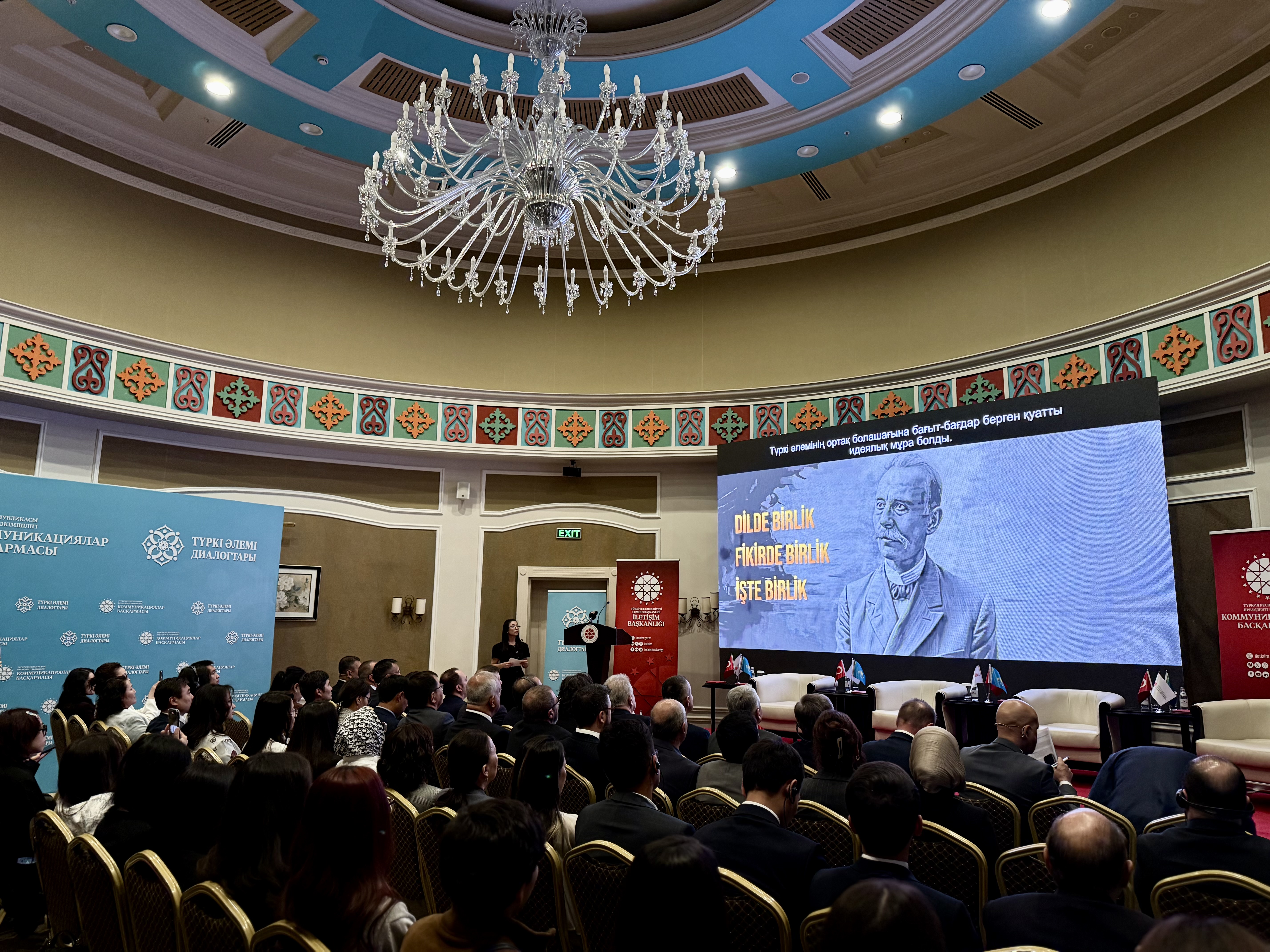
Ahead of the 13th Summit of Heads of State and Government of the Organisation of Turkic States (OTS), to be held in Ankara on 29–30 October 2026, the Directorate of Communications is organising a series of panels in OTS member and observer countries. The first event in the series took place today in Astana, the capital of Kazakhstan.
As part of the programme, the first event was a panel discussion entitled ''Turkic World Dialogues: Shared Future, Shared Vision". The programme’s opening remarks were delivered by Türkiye’s Ambassador to Kazakhstan, Mustafa Kapucu, while the Presidency’s Head of Communications, Prof. Burhanettin Duran, addressed the participants via video message.
In his video message, Head of Communications Duran emphasised the importance Türkiye attaches to strengthening unity, solidarity, and cooperation in the Turkic world under the leadership of President Recep Tayyip Erdoğan, and noted that their shared history, language, and cultural heritage form a strong bond that brings the Turkic world together.
Emphasising the need to further develop joint efforts within the OTS in the face of global crises, Head of Communications Duran pointed to the strategic importance of cooperation in the fields of media and communications and called for greater joint capacity in combating disinformation, artificial intelligence and digital communication.
Head of Communications Duran said the upcoming Ankara Summit would mark an important turning point in strengthening the institutional integration and global visibility of the Turkic world.
The panel, moderated by Prof. Bülent Bayram, Vice President of the Turkic Academy, featured insights by Prof. Hasan Ali Karasar, Rector of Cappadocia University; Prof. Zhanat Momynkulov, Faculty Member at L.N. Gumilyov Eurasian National University; Assoc. Prof. Talgat Moldabay, Faculty Member at L.N. Gumilyov Eurasian National University; and Assoc. Prof. Suat Beylur, Director of the Eurasian Research Institute at Khoja Akhmet Yassawi International Kazakh-Turkish University.
The panel addressed multifaceted cooperation among the Turkic states, current challenges, the progress made by the Organisation from past to present, and the common alphabet. The panel also discussed developments in the economic and political spheres, as well as views on issues related to communications and artificial intelligence, specifically in the context of the Turkic states.
Prof. Bülent Bayram, Vice President of the Turkic Academy and moderator of the panel, emphasised the need to diversify and strengthen cooperation among the Turkic states in the changing world order. Bayram emphasised that there was considerable potential for further cooperation among the Turkic states across a broad range of areas, from communications and the economy to diplomacy and the digital sphere, and drew attention to the importance of different Turkic societies getting to know one another socially and culturally.
Rector of Cappadocia University Prof. Hasan Ali Karasar pointed out that some Western-based communication channels had long reported that Turkestan would become a new centre of crisis, but this did not happen; instead, stability and development came to the fore. Noting that a significant stage in institutionalisation had been achieved through the Organisation of Turkic States, he highlighted the contributions of the numerous institutions established within the Organisation to the idea of unity. Emphasising that each capital in the Turkic world has its own distinctive historical experience and accumulated knowledge, Karasar said that this strategic experience should be shared on a common platform.
Prof Zhanat Momynkulov, a Faculty Member at L.N. Gumilyov Eurasian National University, stated that international cooperation represents an asset for the Turkic states, addressing the question, "What are the opportunities and threats facing the Turkic world amid the changing global landscape?'' Noting that differences are the strength of the Turkic peoples, Momynkulov said, ''All Turkic states are transit countries connecting Eurasia to Europe. The Turkic states should make use of their status as transit countries.'' He said Türkiye’s diversification of partnerships across the East and West has further strengthened its position in the Turkic and Islamic worlds. He noted that Kazakhstan had likewise diversified its cooperation in this regard, developing economic, diplomatic and trade relations with various countries, particularly China.
Assoc. Prof. Talgat Moldabay, a Faculty Member at L.N. Gumilyov Eurasian National University, emphasised that shared history is the fundamental bond among the Turkic states. Emphasising that the Huns, Göktürks, Uyghurs and Karakhanids are the fundamental historical components that unite us, Moldabay noted that our shared history and a common political and state culture have also brought us shared traditions. Referring to Ismail Gaspıralı’s emphasis on unity in language and education, Moldabay stated that a common pool of terminology should be established from the Turkic languages and that a common language could be developed on this basis.
Assoc. Prof. Suat Beylur, Director of the Eurasian Research Institute at Khoja Akhmet Yassawi International Kazakh-Turkish University, said in his speech on mobility and communication issues in the Turkic world that the strong foundations of communication in the Turkic world date back to the 9th century. Beylur stated that a Renaissance period took place in the Turkic world between the 8th and 12th centuries, noting that prominent thinkers, men of letters and scientists such as Al-Farabi, Mahmud al-Kashgari and Yusuf Khass Hajib emerged during this period, and emphasised that this period constituted a significant stage in terms of mobility in communication and scientific development in the Turkic world. He also noted that Ismail Gaspıralı and the prominent intellectuals who emerged after him further increased interaction in the Turkic world in the modern era. Beylur stated that following the dissolution of the Soviet Union, this mobility accelerated in the form of interstate communication and noted that communication is not a one-way process. Referring to the need to expand communication centres in the Turkic world, Beylur said that the large number of students from the Turkic world studying in Kazakhstan is an important development.
A press conference was held in the second part of the panel programme. At the meeting, the panellists answered questions from journalists and shared their insights, particularly on the role of the Organisation of Turkic States (OTS) in enhancing cooperation among the Turkic states and in efforts to establish a common alphabet. At the press conference, held in a question-and-answer format, the academics shared their views on the OTS's current and future role from the perspectives of Türkiye and Kazakhstan. The panel programme, which attracted a large turnout, also received considerable attention from the Kazakh media.