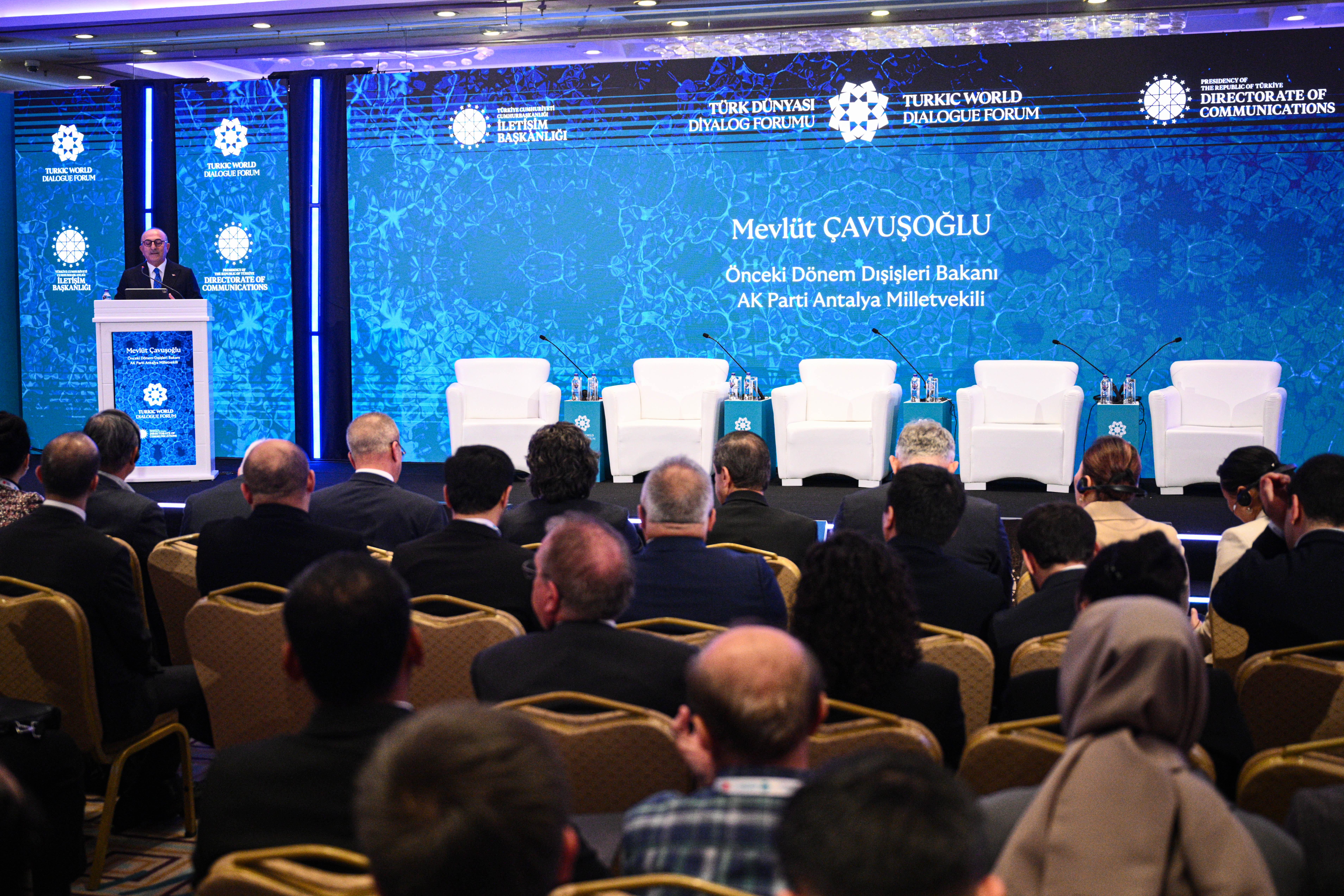
A panel entitled “The Geopolitical Role of the Turkic World in an Age of Global Transformation” was held in Ankara as part of the Turkic World Dialogue Forum, organised by the Directorate of Communications.
Speaking at the opening of the panel, Mevlüt Çavuşoğlu, Former Minister of Foreign Affairs and AK Party Member of Parliament for Antalya, stated that the international system was undergoing a profound transformation, noting that countries’ standing in the international system was also determined by their diplomatic influence, economic resilience, positions within transport and energy networks, technological capabilities and capacity to develop reliable partnerships.
Çavuşoğlu emphasised the importance of assessing the geopolitical significance of the Turkic world from this broader perspective, stating, "The Turkic world is directly affected by global developments while also emerging as a significant geopolitical actor with the potential to influence the course of these developments. With the rise of Asia, Eurasia has become one of the principal arenas of interaction in global politics and the economy.”
“Our goal today is to transform our common will into collective strength”
Emphasising that geographical location alone did not confer strategic power, Çavuşoğlu said, "What truly matters is the capacity to harness the opportunities offered by geography through a shared vision. Transforming our potential into lasting influence requires trust, solidarity, institutional cooperation and a common determination to act together. The Organisation of Turkic States is the institutional expression of this determination.”
Çavuşoğlu pointed out that the transition from the Turkic Council to the Organisation of Turkic States was an important manifestation of how their shared identity had been brought together with institutional cooperation, and continued:
“Our goal today is to take our existing cooperation further and transform our common will into collective strength, concrete projects, lasting mechanisms and initiatives that deliver results at the international level. It would not be right to measure success here solely by trade volumes or by the number and quality of projects implemented. True success lies in deepening the trust established among our countries, developing joint solutions to common challenges and enhancing our capacity to act in coordination in response to international developments.”
Stressing that Türkiye regarded its relations with the Turkic world as one of the fundamental priorities of its foreign policy, Mevlüt Çavuşoğlu said that they attached great importance to strengthening the bonds of brotherhood among Turkic states through concrete cooperation projects.
Expressing his desire for the Turkic world to have a greater say not only in regional developments but also in global affairs in the period ahead, Çavuşoğlu said, "As Türkiye, our approach is to keep channels of cooperation open in a world where competition is turning into conflict, to strengthen dialogue in the face of divisions, collective wisdom in the face of uncertainty, and institutional solidarity in the face of shifting balances. I believe that, to the extent that we reinforce our understanding of unity in language, thought and deed through concrete steps, the Turkic world will not only contribute to the prosperity of its peoples but also play a more effective role in strengthening peace, stability and cooperation across Eurasia.”
“The Organisation of Turkic States is a truly valuable union at a time of prevailing global uncertainty”
Prof. Hasan Ali Karasar, Rector of Cappadocia University, who moderated the panel, pointed out that 35 years had passed since the dissolution of the Soviet Union, saying, "If there has been no bloodshed, no wars and no ethnic or religious conflicts in the Turkic world over these 35 years, we have leaders who deserve our gratitude. Thanks to the brotherhood fostered by all the leaders who have governed the Turkic world over the past 35 years, including those of Türkiye, our region has evolved from what it was 35 years ago into an important actor on the world stage today.”
Drawing attention to the different geopolitical circumstances facing the world today, Karasar said: “The Organisation of Turkic States is a truly valuable union at a time when uncertainty prevails across the world.”
“I believe the Turkic world will become increasingly important”
The panel also featured Prof. Eunkyung Oh, Director of the Institute for Eurasian Turkic Studies at Dongduk University; Prof. Nur Köprülü, Head of the Department of Political Science and Public Administration at Near East University; Qamariddin Shaykhov, Journalist and Editor-in-Chief of Qalampir.uz; and Dr Kaan Kutlu Ataç, Faculty Member at Mersin University.
Prof. Eunkyung Oh, Director of the Institute for Eurasian Turkic Studies at Dongduk University, expressed her belief that the Turkic world would become increasingly important, emphasising the significance of history in strengthening civilisational ties.
Oh stated that countries could act together in areas of common interest, engage with external partners and expand the range of options available to them, explaining that this could facilitate more comprehensive cooperation in areas such as transport.
Emphasising that regional solidarity could be utilised to address common challenges, Oh delivered a presentation focusing on civilisational ties and collective capacity.
Oh also stressed the need to explore how the historical ties connecting countries could be transformed into a framework for cooperation.
“Regional diplomacy is something we need more than ever”
Prof. Nur Köprülü, Head of the Department of Political Science and Public Administration at Near East University, expressed her pleasure at participating in such an inclusive programme.
Highlighting the transformation of the international system, Köprülü said: “I believe we are witnessing changes that can no longer be interpreted through the old codes."
Köprülü stated that multipolarity was creating room for key actors, emphasising that “connectivity” had become one of the most widely used concepts in recent times.
Drawing attention to conflict zones around the world, Köprülü highlighted the significance of the role the Turkic world had assumed within the international system.
Underscoring the importance of consultation and coordination, Köprülü said: “Regional diplomacy is something we need more than ever.”
“Raising a united voice in defence of human dignity is more important than ever”
Qamariddin Shaykhov, Journalist and Editor-in-Chief of Qalampir.uz, stated that certain opportunities had been missed during periods when the peoples of the Turkic world had been separated throughout history, emphasising that the Turkic world was more than merely a geopolitical concept.
Pointing out that the world was undergoing an uncertain transformation, Shaykhov said: “Global balances of power are being reshaped.”
Stressing the need to consider where the Turkic world would stand in this transformation, Shaykhov drew attention to innocent people caught in the midst of wars and conflicts, noting that everyone was witnessing violations of the right to life.
Shaykhov emphasised that, at this critical juncture, it was more important than ever for the Turkic world to raise a united voice in defence of human dignity.
Stating that lessons had been learned from the losses suffered when the countries of the Turkic world had been divided in the past, Shaykhov said: “History offers us an opportunity to build our common future.”
Dr Kaan Kutlu Ataç, Faculty Member at Mersin University, stated that the world was experiencing a geopolitical tsunami and explained that he was conducting research into how Türkiye could better prepare for it.