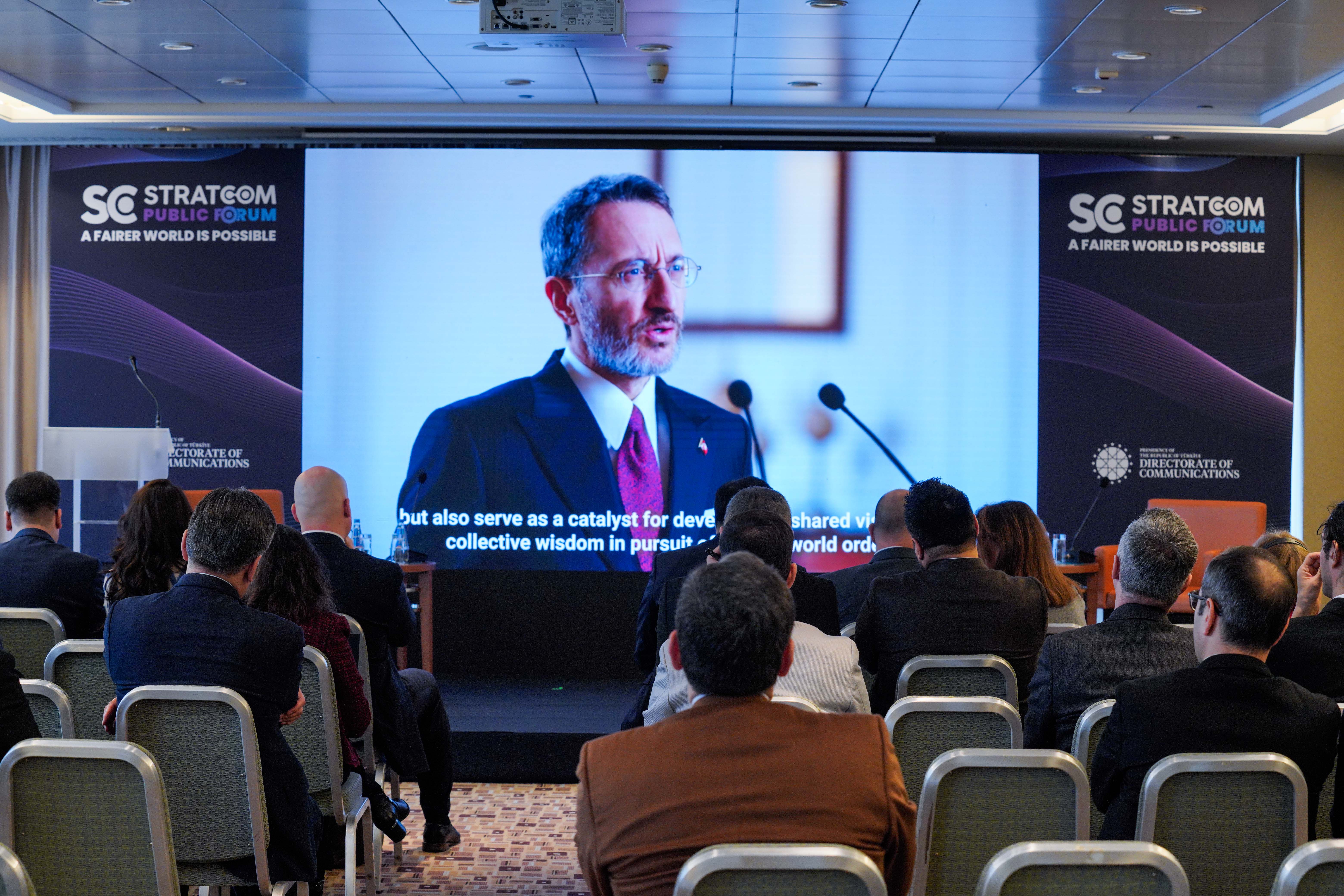
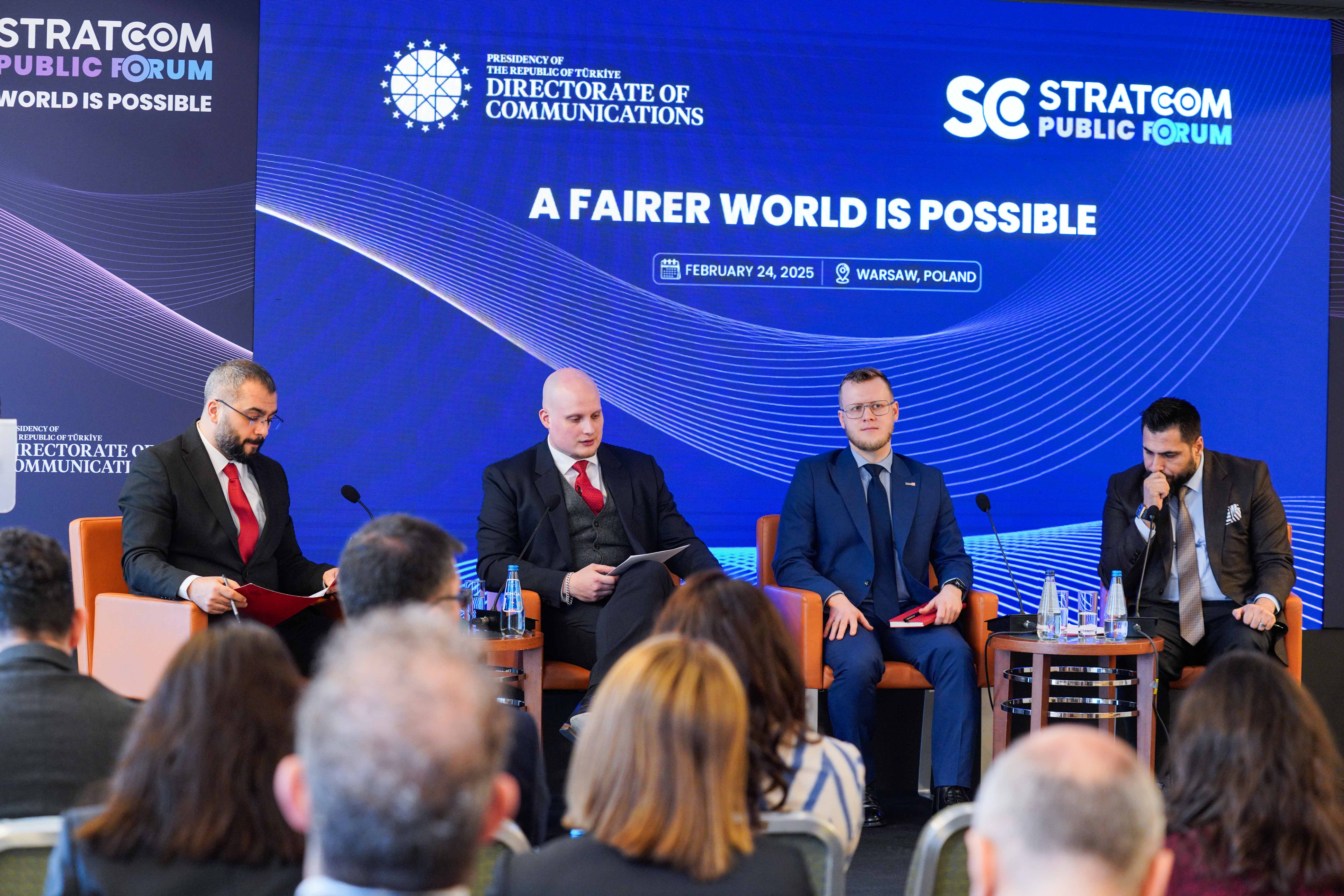
The panel titled "A Fairer World is Possible" was held in Warsaw, the capital of Poland, by the Presidency's Directorate of Communications as part of the "StratcomPublic Forum."
A large number of academics, journalists, representatives of non-governmental organisations, and bureaucrats attended the panel.
The Presidency's Head of Communications, Fahrettin Altun, sent a video message to the panel, and the Ambassador of Türkiye to Poland, Rauf Alp Denktaş, delivered the opening remarks.
In his speech, Denktaş stated that in addition to the COVID-19 pandemic, rising populism, and increasing racism over the past five years, the world has also witnessed developments that violate international law, such as the occupation of Ukraine and Gaza, along with the debt spiral that developing countries find themselves in.
Denktaş stated that the UN, WTO, and other global organisations have been inadequate in responding to these challenges and that multilateralism has lost strength in this process. He emphasised that the need for reform in the international system is clear, both in terms of responsibilities and structures.
During the panel discussion, Adam Michalski, Research Fellow in the Department for Türkiye, Caucasus and Central Asia at the Centre for Eastern Studies, highlighted the role of the UN Security Council (UNSC) and emphasised the necessity for reform, noting that the UN often struggles to resolve crises because of the veto power held by the five permanent members.
Michalski contended that the UN's structure requires reform for a fairer world and highlighted the importance of granting regional actors a greater voice.
Michalski highlighted the significance of Türkiye, Poland, and other regional powers adopting a more independent and autonomous approach to their foreign policy within the global system.
"Poland should assume the same role in Ukraine that Türkiye took in Syria"
Alexander Olech, Head of International Cooperation at Defence 24, remarked that Türkiye plays a significant role as a balancing power through its diplomatic efforts and humanitarian assistance in regions such as Syria, Ukraine, the Caucasus, and Africa.
Olech expressed that the existing structure of the UN Security Council fails to represent the realities of the contemporary world and requires reform and highlighted that Türkiye's military, economic, and diplomatic strength serves as an exemplary model for developing nations.
Pointing to the importance of Türkiye-Poland cooperation, Olech said that Poland should play a role in the reconstruction of Ukraine.
Olech stated, "Just as Türkiye has assumed responsibility as a regional power in Africa, Poland should pursue a similar strategy in Ukraine."
Olech added that a fairer world is possible, but in addition to strengthening regional cooperation, it requires reform in the UN and the effective implementation of international law.
"Türkiye is taking concrete steps for a fair world order"
Gaziantep University Faculty Member Recep Şehitoğlu (PhD) stated that global peace is not possible without ensuring justice, equality, and inclusiveness and that the structural issues of the UN Security Council (veto right, unfairness in representation) leave the crises in the world unresolved.
Pointing out that an unfair system persists against weak and developing countries while developed countries maintain their power, Şehitoğlu underlined that the UN should be reformed and more democratic.
Stating that for a fairer world, developing countries should be strengthened, global economic justice should be ensured, humanitarian aid activities should be increased, and wars should be ended, Şehitoğlu added that Türkiye has set an example, especially with its stance on Syria.
He emphasised that Türkiye continues to take concrete steps beyond rhetoric for a fair world order.
Following the event's conclusion, the attendees engaged in the screening of a documentary that highlighted the life and artistic career of painter Devrim Erbil.
A roundtable discussion on the current crises in the international system was conducted prior to the panel, featuring academics who are experts in their respective fields. The causes of global inequalities and problems, as well as potential solutions, were identified during the roundtable discussion.