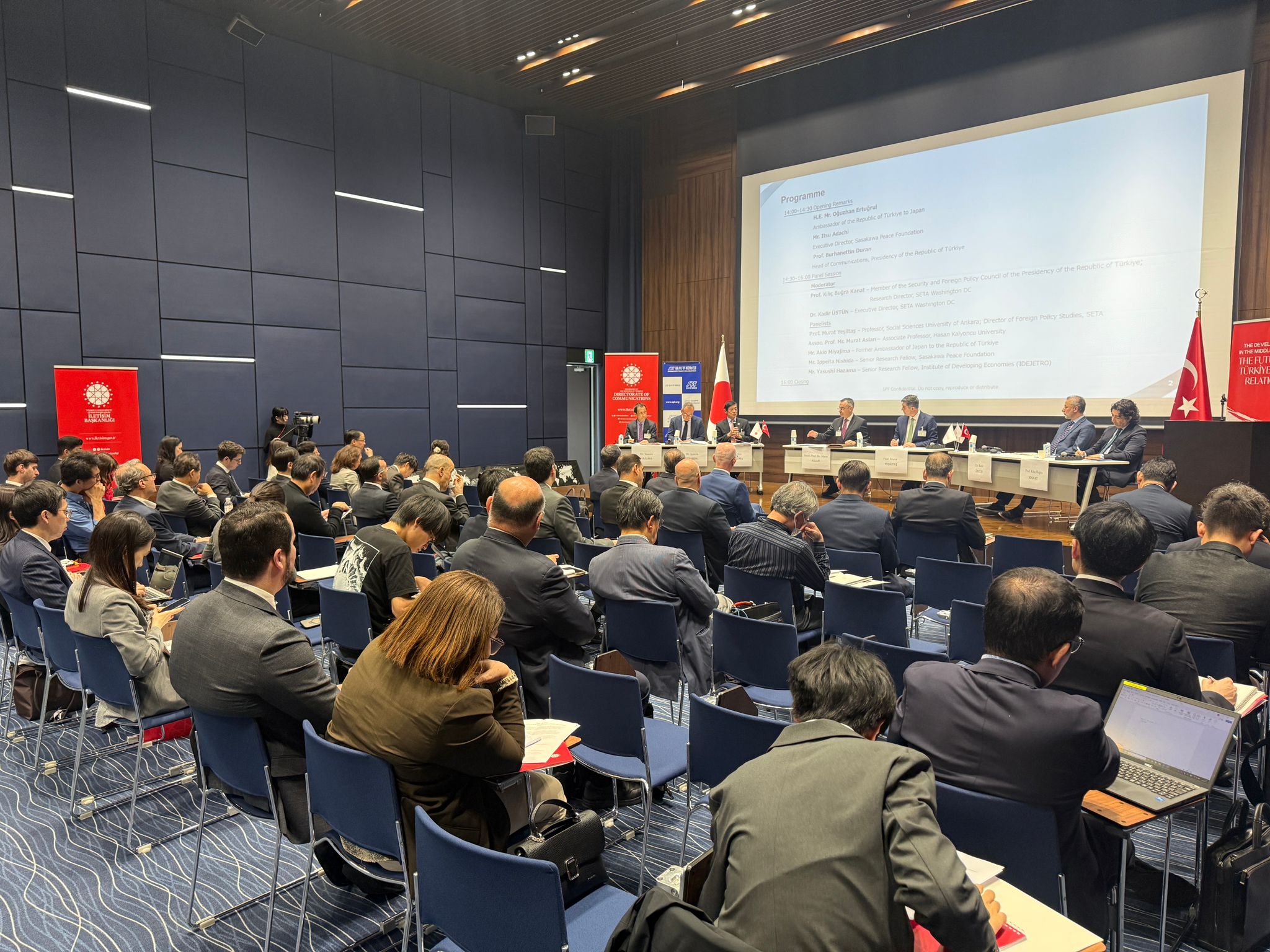
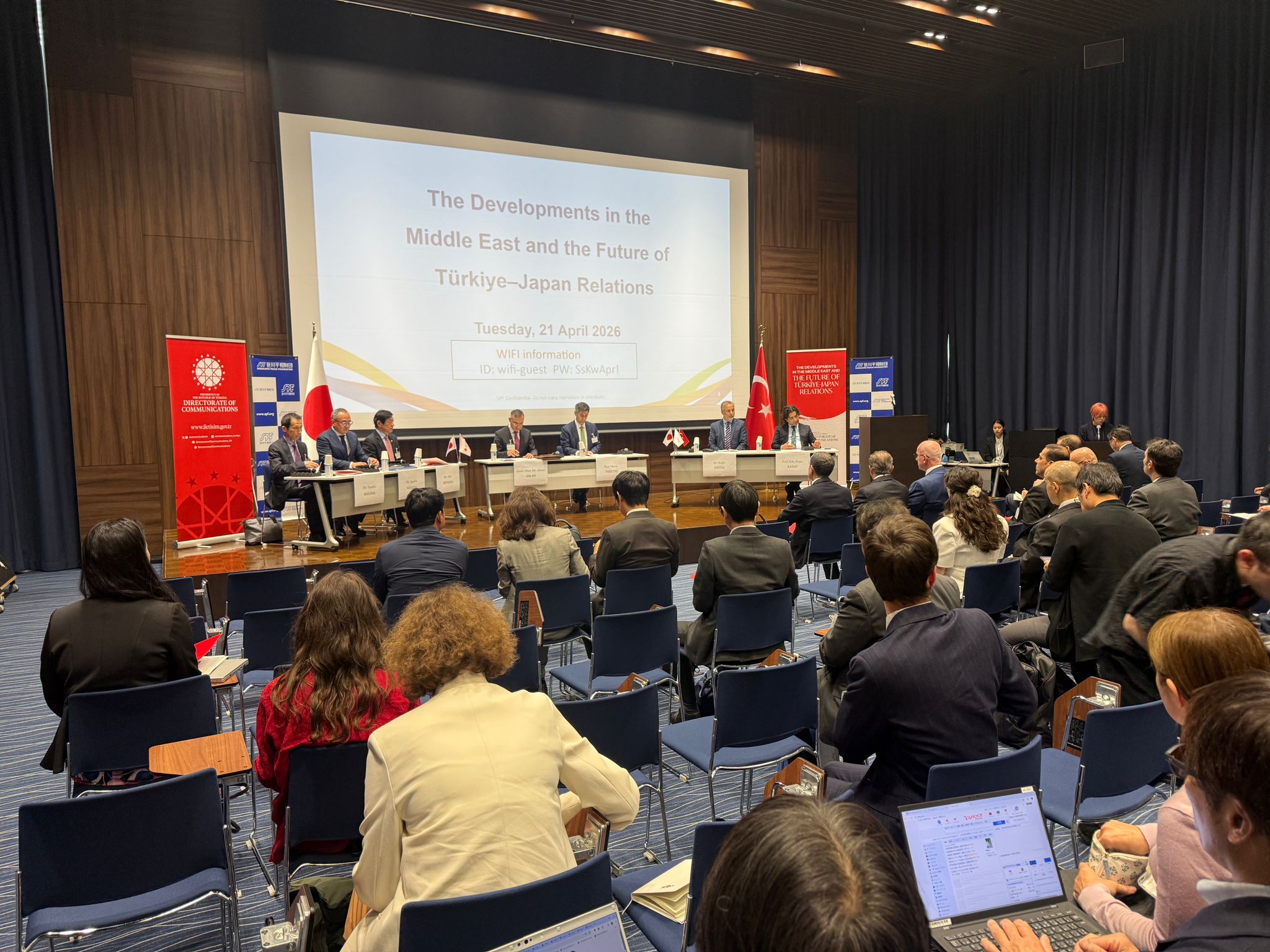
The Presidency’s Directorate of Communications, the Foundation for Political, Economic and Social Research (SETA), and the Sasakawa Peace Foundation co-organised a comprehensive programme comprising a panel session, a roundtable discussion and a meeting with members of the press on 21 April 2026 in Tokyo, the capital of Japan, under the title “The Developments in the Middle East and the Future of Türkiye–Japan Relations.”
Within the framework of the programme hosted by the Sasakawa Peace Foundation, opening remarks were delivered by the President of the Sasakawa Peace Foundation, Atsushi Sunami, and by the Ambassador of the Republic of Türkiye to Japan, Oğuzhan Ertuğrul. The panel session, moderated by Prof. Kılıç Buğra Kanat, Member of the Council of Security and Foreign Policies of the Presidency, academic, and Research Director at SETA Washington D.C., featured Former Japanese Ambassador to Ankara Akio Miyajima; Faculty Member at Ankara Social Sciences University and Director of Foreign Policy Research at SETA Prof. Murat Yeşiltaş; Senior Research Fellow at the Sasakawa Peace Foundation Ippeita Nishida; Senior Research Fellow at the Institute of Developing Economies (IDE), Japan External Trade Organisation (JETRO) Yasushi Hazama; Faculty Member at Hasan Kalyoncu University and SETA researcher Assoc. Prof. Murat Aslan and SETA Washington D.C. Coordinator Dr. Kadir Üstün as speakers.
In the programme, which commenced with opening remarks, emphasis was placed on the historical foundations of the deep-rooted friendship between Türkiye and Japan, while it was underscored that bilateral relations should be further advanced across trade, culture, science, and diplomacy. It was noted that historical events, such as the Ertuğrul Frigate incident, have reinforced the strong bonds between the two nations and that mutual humanitarian assistance and solidarity have further deepened these ties.
Speakers also highlighted that Türkiye and Japan, as two pivotal actors located at the eastern and western extremities of Asia, possess complementary characteristics. In this context, it was noted that there is strong potential to enhance cooperation in investment, tourism, higher education, and science and technology. At the regional and global levels, Türkiye’s emphasis on ensuring stability and security in the Middle East was underscored, while Japan’s calls for peace and de-escalation were welcomed.
Taking the floor during the panel, Assoc. Prof. Murat Aslan stated that NATO constitutes a structure that balances differing national security priorities and provides a common ground for political consensus, underlining that Türkiye’s role within NATO is critical for maintaining stability. Drawing attention to Türkiye’s significant strides in the defence industry in recent years, Aslan emphasised that this capacity has been developed in line with NATO standards and that Türkiye is a contributing actor within the Alliance.
Dr. Kadir Üstün, evaluating regional developments centred on Iran, pointed to the ongoing reshaping of power balances in the Middle East. While it was noted that Israel’s military gains on the ground may be difficult to translate into long-term strategic success, it was assessed that Iran, despite a weakening in its military capacity, may sustain its regional influence through its internal dynamics and diplomatic capabilities. It was further emphasised that Türkiye stands out as a middle power capable of playing a balancing and mediating role in regional crises.
In his remarks, Prof. Murat Yeşiltaş underlined that the international system is undergoing a significant transformation process, noting that existing global governance structures fall short in terms of representation and effectiveness. Stressing the need for reform of international institutions, particularly the United Nations, Yeşiltaş highlighted that Türkiye supports the resolution of crises by local actors within the framework of its regional ownership approach.
Former Japanese Ambassador to Ankara Akio Miyajima stated that relations between Türkiye and Japan could be further enhanced particularly in the fields of defence industry, economic development and education. Drawing attention to Türkiye’s capacity in reconstruction and infrastructure, Miyajima noted that increasing cooperation in technology and defence between the two countries would contribute to regional stability.
Ippeita Nishida emphasised that relations between Türkiye and Japan could be further institutionalised through think tank and academic cooperation, noting that joint policy production and knowledge-sharing would strengthen strategic dialogue between the two countries.
Yasushi Hazama, for his part, highlighted the need for Türkiye and Japan to develop closer cooperation in investment and trade within the context of global economic transformation, underlining that joint projects, particularly in developing regions, offer significant opportunities.
The panel also underscored the importance of strengthening people-to-people ties between Türkiye and Japan, highlighting the need to enhance education, academic cooperation and youth-oriented programmes.
The programme concluded with productive discussions addressing concrete areas of cooperation aimed at advancing the multifaceted relations between Türkiye and Japan. The panel session, which comprehensively addressed the international security architecture, regional developments and Türkiye’s global role, is expected to contribute to deepening the strategic dialogue between Türkiye and Japan and to identifying new avenues for cooperation.