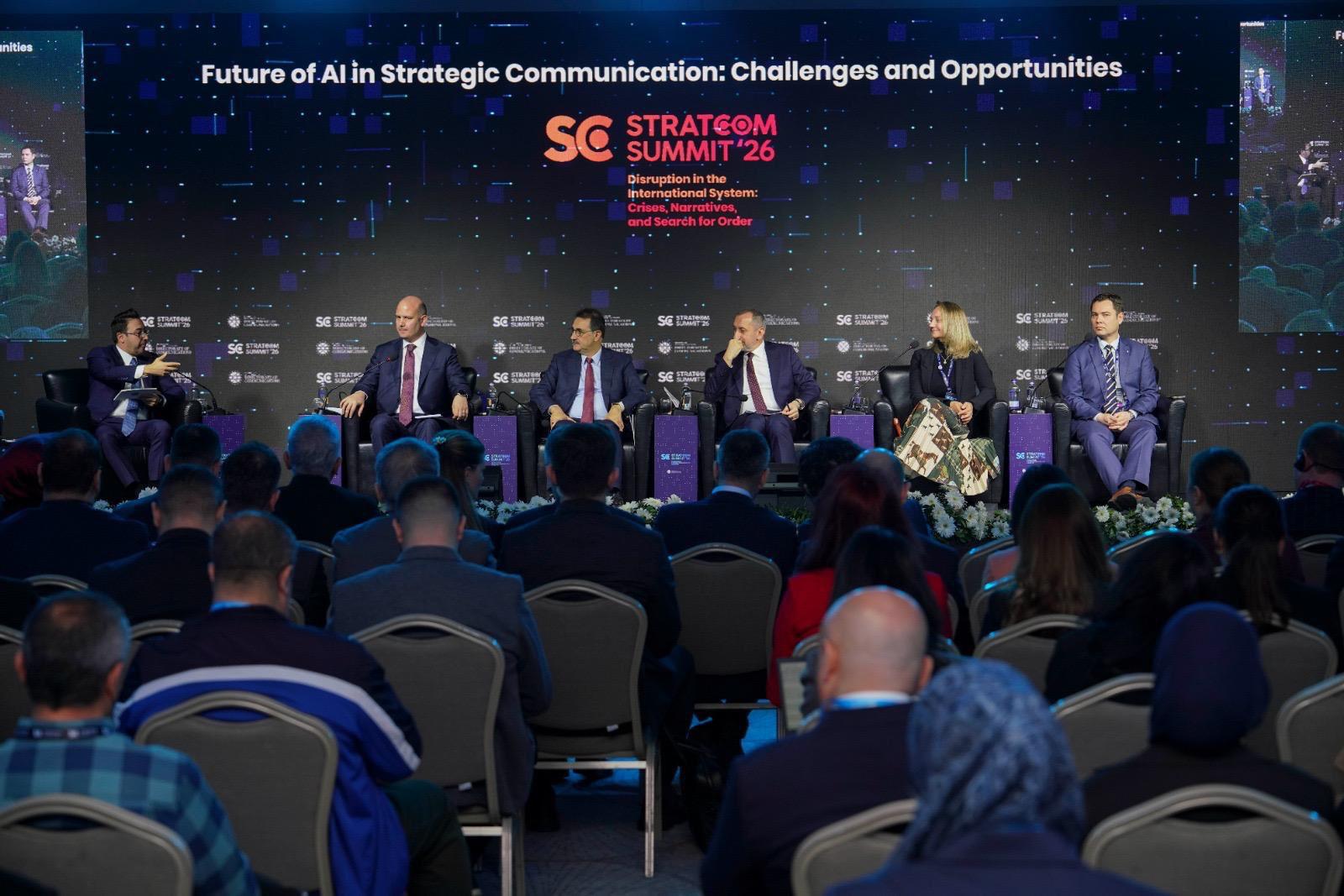
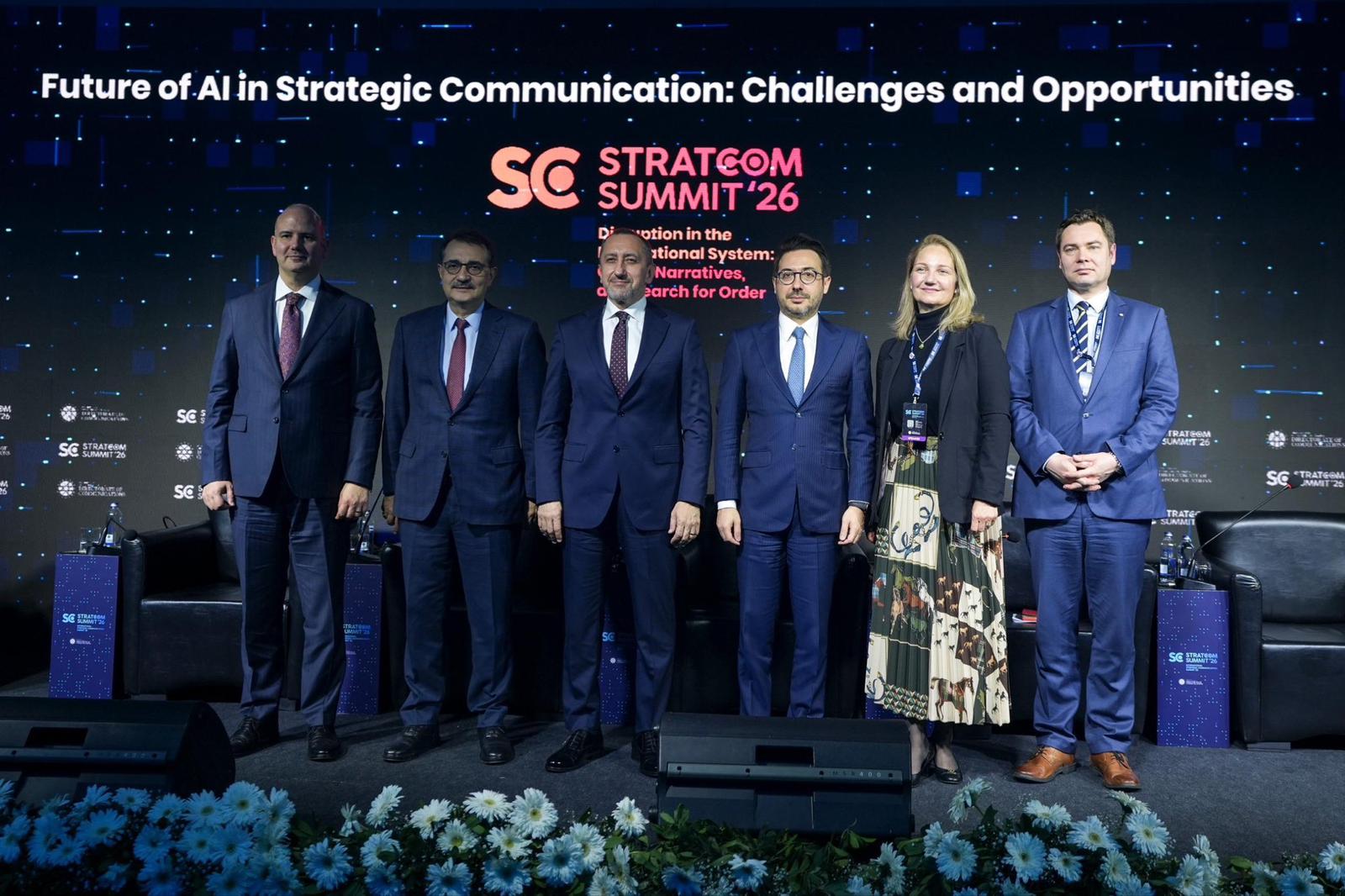
Held under the theme “Disruption in the International System: Crises, Narratives and the Search for Order”, the International Strategic Communication (STRATCOM 2026) Summit featured a panel titled "Future of AI in Strategic Communication: Challenges and Opportunities".
The panel, moderated by Anadolu Agency (AA) President and Chief Executive Officer Serdar Karagöz, featured AK Party Eskişehir MP and Chair of the Parliamentary Committee on Artificial Intelligence Fatih Dönmez, Head of Cyber Security of the Republic of Türkiye Ümit Önal, Kompass Education Co-Founder and Executive Director Clara Hawking, AK Party Ankara MP Ömer İleri (PhD) and Hungary Today Editor Daniel Deme (PhD) as speakers.
AA Director General Serdar Karagöz stated that artificial intelligence is reshaping communication processes at a fundamental level—from the production of information to its dissemination—adding that this transformation constitutes not only a technological shift but also an economic and societal disruption.
Highlighting that artificial intelligence enhances both the speed and effectiveness of communication, Karagöz underlined the growing importance of key issues such as trust, data security and control. He also noted that artificial intelligence is expected to contribute significantly to the global economy while simultaneously altering the structure of the workforce.
“Regulation and innovation must advance together”
AK Party Eskişehir MP and Chair of the Parliamentary Committee on Artificial Intelligence, Fatih Dönmez, stated that regulatory frameworks in the field of artificial intelligence are unavoidable, noting that throughout history, rules have played a key role in reducing uncertainty and improving predictability.
Stating that technological developments follow a similar trajectory, Dönmez said that artificial intelligence is no longer merely a technology but has become a field that affects a significant portion of human activity.
Highlighting that three different approaches have emerged globally—namely those of the United States, the European Union, and China—Dönmez noted that Türkiye aims to develop its own hybrid model by drawing on these approaches.
Emphasising that regulation and innovation must progress in a balanced manner, Dönmez stated that excessive regulation may constrain innovation, while a completely laissez-faire approach may generate risks.
Pointing to the importance of transforming data into added value, Dönmez noted that unprocessed data may lead to economic losses and stressed the need to strengthen data infrastructure.
“Data sovereignty will determine the future”
Presidency's Head of Cyber Security Ümit Önal stated that in the age of artificial intelligence, data directly means sovereignty, saying, “If you do not own the data, you do not own the decision; if you do not own the decision, you do not own your future either.”
Önal stated that a balanced approach is required between security and transparency, articulating the serious risks borne by unchecked artificial intelligence systems.
Highlighting the necessity of transparency and accountability for algorithms, Önal drew attention to the importance of raising awareness among citizens about data rights.
Önal noted that artificial intelligence not only generates misinformation but also creates a more persuasive environment for disinformation by personalising information, bringing about new risks.
"Artificial intelligence also shapes perception"
Clara Hawking, Co-Founder and Executive Director of Kompass Education, stated that artificial intelligence not only generates information but also determines what will be seen and remembered.
Hawking noted that the current global system is evolving rather than collapsing, and the main problem is the insufficient application of existing values to new technologies.
Emphasising that education plays a critical role in this process, Hawking warned that children are particularly more vulnerable to digital systems, requiring the improvement of societal awareness.
Hawking noted that privacy is no longer just a technical issue but has become one of the fundamental elements of individual freedom and decision-making capacity.
"Artificial intelligence is central to global competition"
AK Party Ankara MP İleri stated that artificial intelligence is a core element in the transformation of the international system, with technological change and global power balances concurrently being reshaped.
İleri underscored that not only the use of artificial intelligence but also its design processes need to be regulated, stating that this field has now become a significant aspect of competition among states.
İleri mentioned that the culture of technology production needs to be redefined, indicating that in the future, merely adapting to technology will not be sufficient, and societies that drive it will stand out.
"New Dimension in Countering Disinformation"
Daniel Deme, Editor-in-Chief of Hungary Today, remarked that countering disinformation in international media becomes even more critical during times of crisis.
Deme stated that misinformation can set lasting perceptions about countries, underlining that disinformation is not only a matter of information but also a matter of reputation.
Deme drew attention to the importance of fact-checking mechanisms in the field of media, stating that artificial intelligence presents itself with both opportunities and new debates in this process.