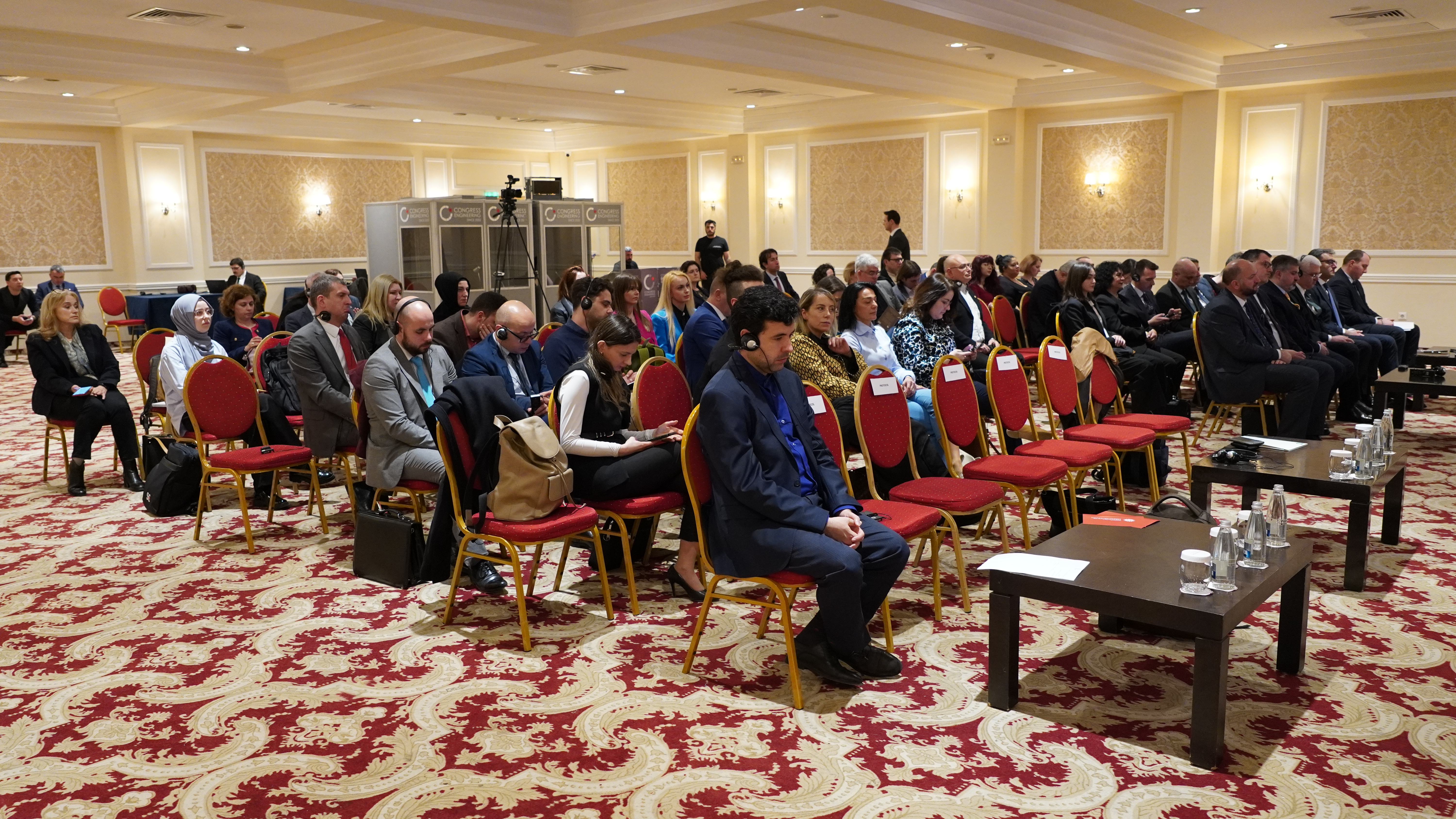
The Directorate of Communications held the fourteenth panel titled "Stratcom Public Forum: A Fairer World is Possible" in Sofia, the capital of Bulgaria.
Held under the theme “A Fairer World is Possible,” the event in Sofia, Bulgaria, attracted significant interest from academics, journalists, politicians, diplomats and executives. The discussions focused on the challenges within the international system while emphasising the necessity of a sustainable and fair world order.
During the event in Sofia, part of the panel series, a video themed "Stratcom Public Forum" was screened following the opening speech by Turkish Ambassador to Sofia, Mehmet Sait Uyanık. A video message from the Presidency's Head of Communications, Prof. Fahrettin Altun, was also screened.
The panel was moderated by Dilek Kütük, Communications Counsellor of the Directorate of Communications of the Republic of Tükiye to Sofia. Among the speakers of the panel were Seda Kuzucu, UNHCR representative in Bulgaria; Maya Tsenova, Arabic literature expert, poet, translator and academician; and Asen Ivanov, Editor-in-Chief of BTV News.
Delivering the opening speech, Turkish Ambassador to Sofia Mehmet Sait Uyanık underlined Türkiye's contributions to international peace and security and stated that Türkiye is an exemplary country in terms of demonstrating its entrepreneurial and humanitarian foreign policy.
Ambassador Uyanık noted that President Recep Tayyip Erdoğan highlighted the injustice within the global decision-making system and the disparities in representation in the UN Security Council, advocating for the principle that "The world is bigger than 5." He stressed the necessity for a framework that fosters hope in the face of despair, prosperity over poverty, justice over injustice, and peace over violence, aiming to generate collective solutions to our global challenges. Continuing his remarks, Ambassador Uyanık stated that Türkiye has been engaging in active diplomacy on the international stage to promote peace and stability while offering humanitarian aid and solution-focused initiatives in Ukraine, Palestine, and Syria. He emphasised the significance of Türkiye in maintaining stability in the Balkans through collaboration with its neighbour and ally Bulgaria and concluded by affirming that our country remains committed to creating a more liveable world.
Seda Kuzucu, the first speaker of the panel, addressed the refugee crisis, a significant issue facing today's world. Kuzucu highlighted international conflicts as the primary cause of the refugee crisis, asserting that achieving peace and enhancing global cooperation and coordination are essential for resolving it. He stressed the significance of educational activities in the context of humanitarian aid, drawing on the examples of Rwanda and Syria, and highlighted Türkiye's contributions to addressing the refugee issue. Stating that the solution to the refugee issue would be possible through a multi-stakeholder approach, Kuzucu underlined that humanitarian, development, and peace actors sometimes act with different objectives, which limits achieving lasting peace. He also emphasised that local actors play a critical role in solving this problem.
Maya Tsenova, in her speech, highlighted the deficiencies of the international order and the international law that underpins it, particularly regarding the Palestinian issue. She assessed the Palestinian issue by examining its historical roots. Tsenova emphasised that the double standards in applying international law within the Israeli-Palestinian context represent its most significant shortcoming, asserting that this diminishes the law's effectiveness to nothing and that certain international legal entities, such as Israel, perceive themselves as above the law. She clarified the UN's double standards on the Palestinian issue, particularly in favour of Israel, especially in the context of anti-Semitism. She stated that although the Palestinian state received recognition, Palestine was denied its sovereign rights. Stating that the UN has not taken any action against the occupying Israel, Tsenova noted that there should be a mechanism for the implementation of the law within the framework of equality for all subjects without exception.
In her speech, Monika Manolova discussed the advantages and disadvantages of technology in the international justice system. Speaking about the downsides of technological innovations, Manolova emphasised the potential of technology to ensure justice, transparency and equality while highlighting its risks, such as digital inequality, cyber threats and ethical issues. She noted that tools like blockchain and artificial intelligence are increasing transparency while emphasising the dangers of the digital divide and the dominance of large technology companies. Manolova stated that humans are still at the centre of economic systems, emphasising that the priority is to protect humans and that technology should not overshadow human existence. She highlighted the investments in artificial intelligence in Türkiye and Bulgaria, expressing her support for such initiatives. However, she emphasised that the key focus should be enhancing communication and upholding ethical principles.
Asen Ivanov shared his views on the role of media in global power struggles. Ivanov highlighted the necessity of justice for all, underscoring the significant role of the media in achieving this goal. He discussed the recent evolution of the media landscape and the adverse impacts of social media and artificial intelligence within this context. He mentioned that artificial intelligence is used for political interests through disinformation, forcing governments to make certain decisions by creating public pressure. Ivanov said that the only way to prevent the spread of misinformation through the media is to adhere to journalistic standards. In this context, he predicted that people will rely on fast information providers such as social media in the future, as they will trust them to obtain accurate information. He concluded by emphasising the significance of global media literacy in this context.
As part of the event, a roundtable discussion titled Stratcom Public Forum “A Fairer World is Possible” was held. In the roundtable meeting organised on the sidelines of the Stratcom Public Forum panel series in Sofia under the theme "A Fairer World is Possible", international issues, global crises and solutions were discussed.
A photo exhibition titled "Century of Türkiye" was organised as part of the Stratcom Public Forum panel series, which focused on the theme "A Fairer World Is Possible." Additionally, a documentary was screened, chronicling the life of painter Devrim Erbil, which spanned over 60 years. Numerous guests attended the screening.