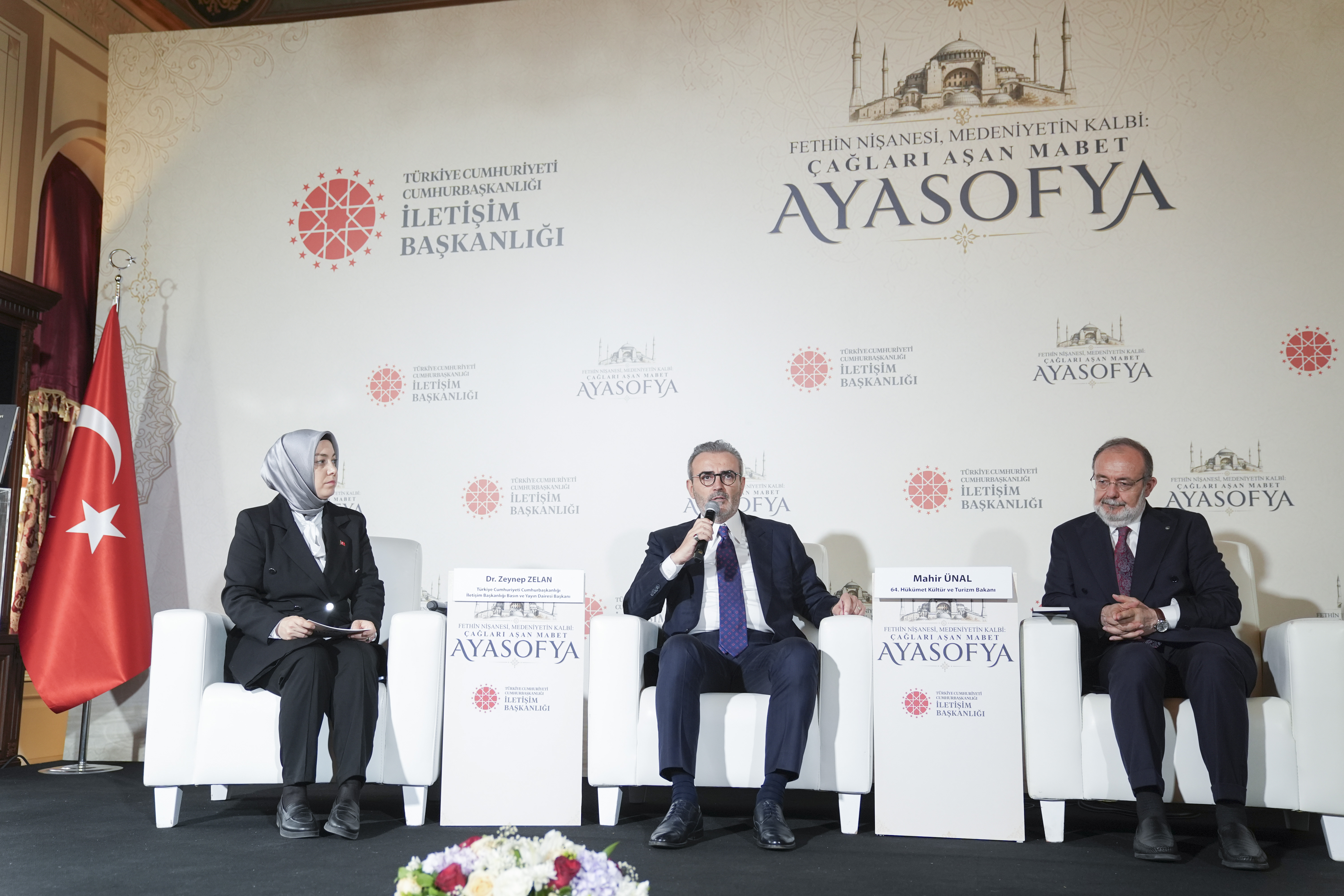
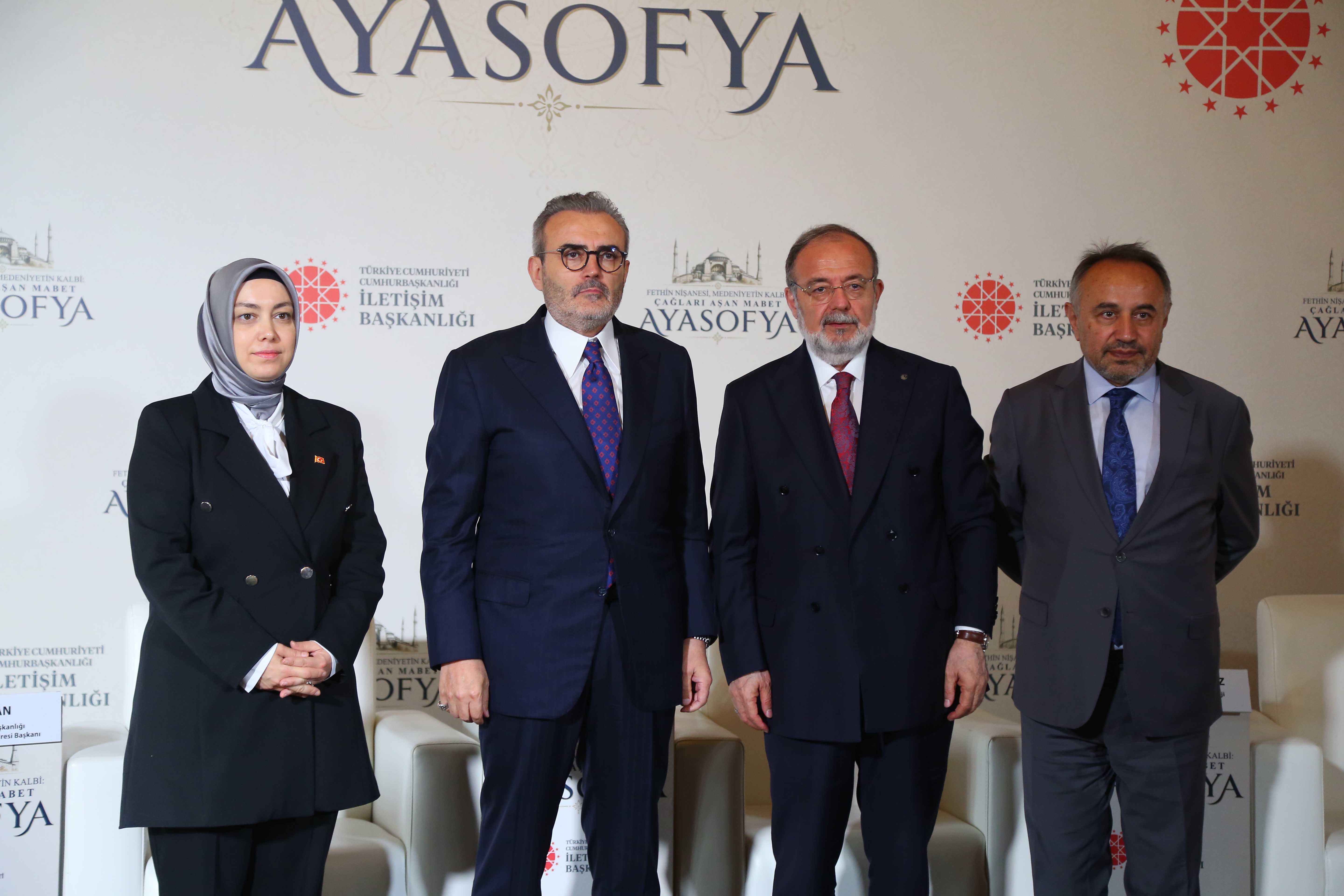
The Directorate of Communications organised a panel titled “Hagia Sophia: A Monument of the Conquest, the Heart of a Civilisation That Transcends the Ages" to mark the sixth anniversary of the reopening of the Hagia Sophia Grand Mosque for worship.
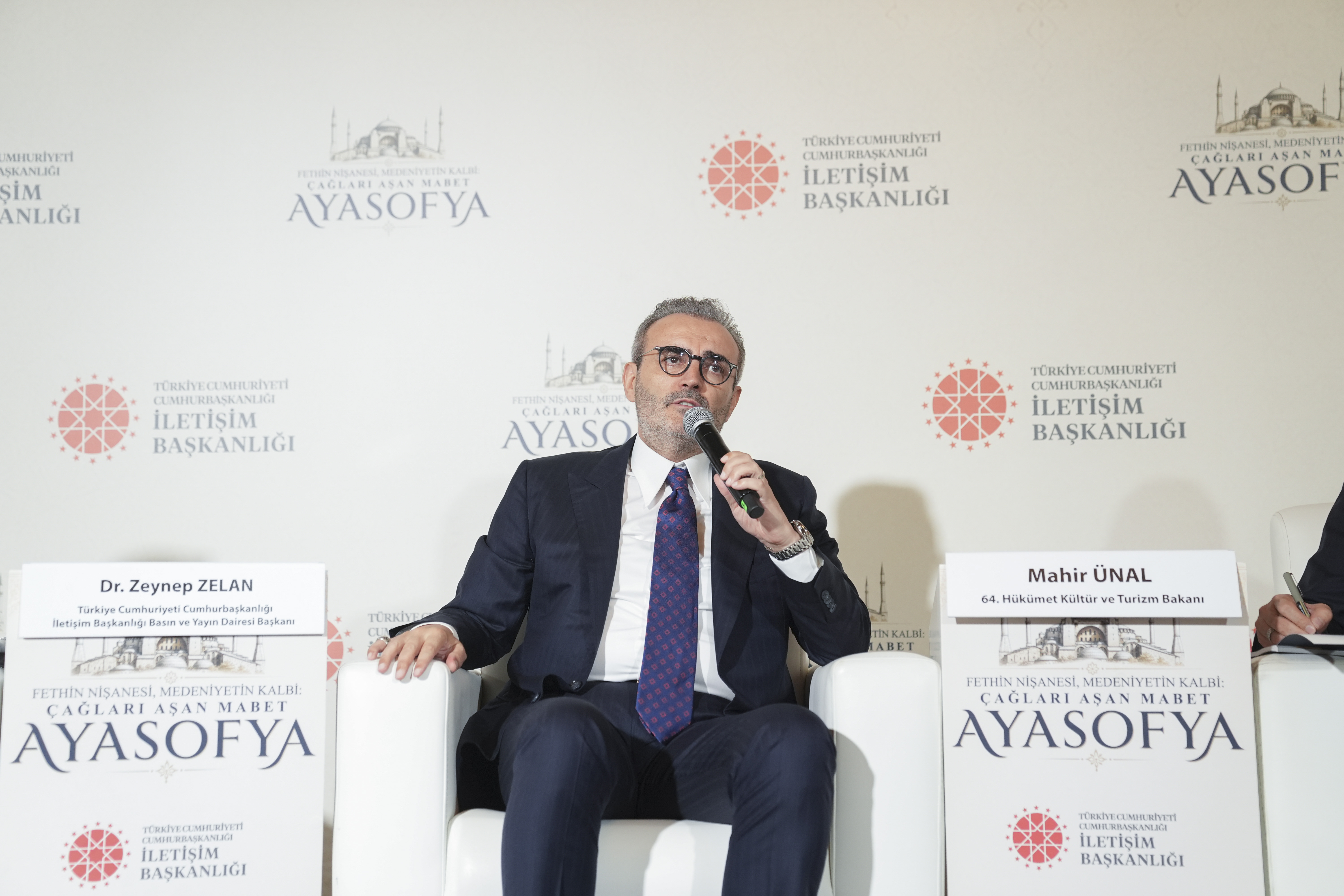
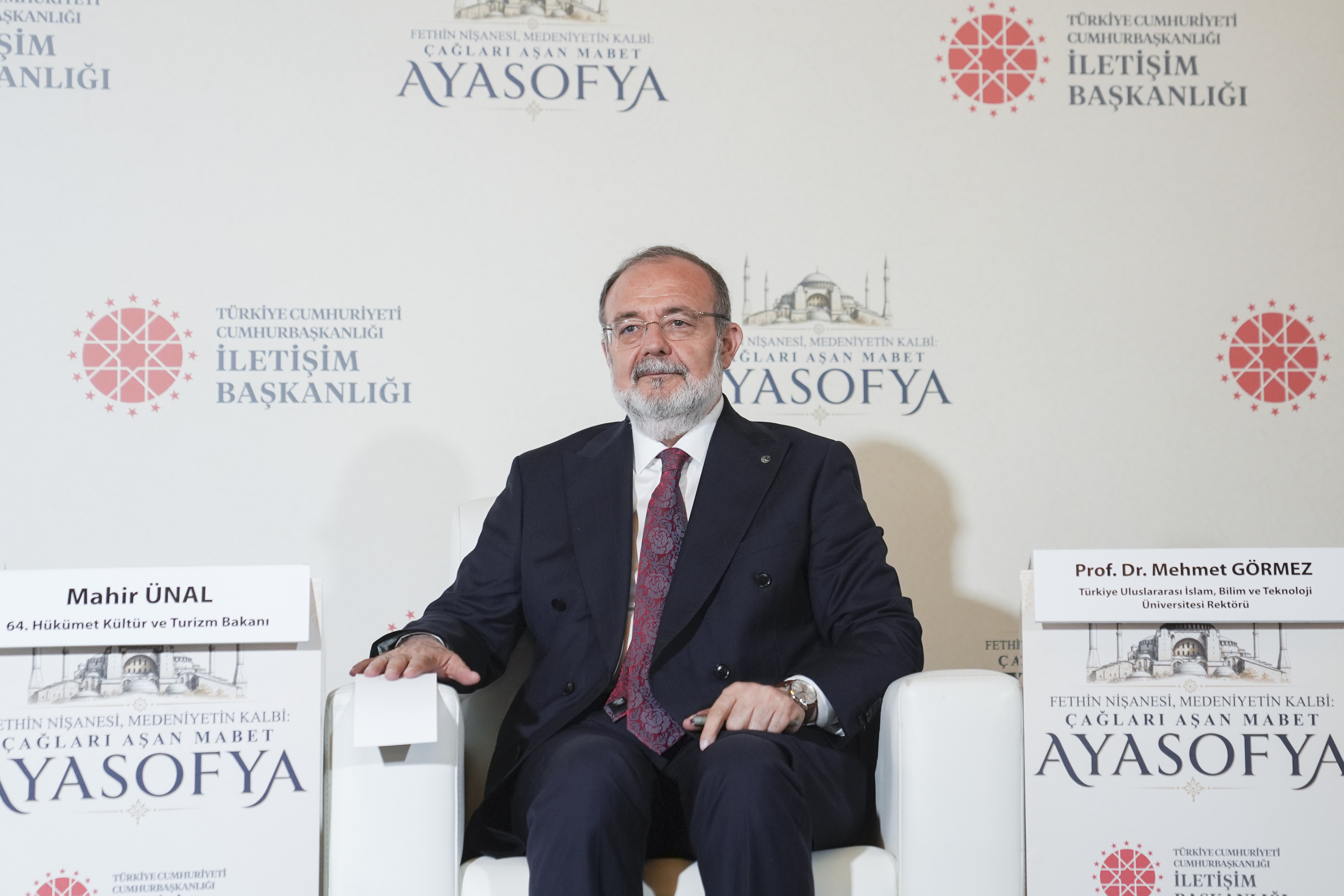
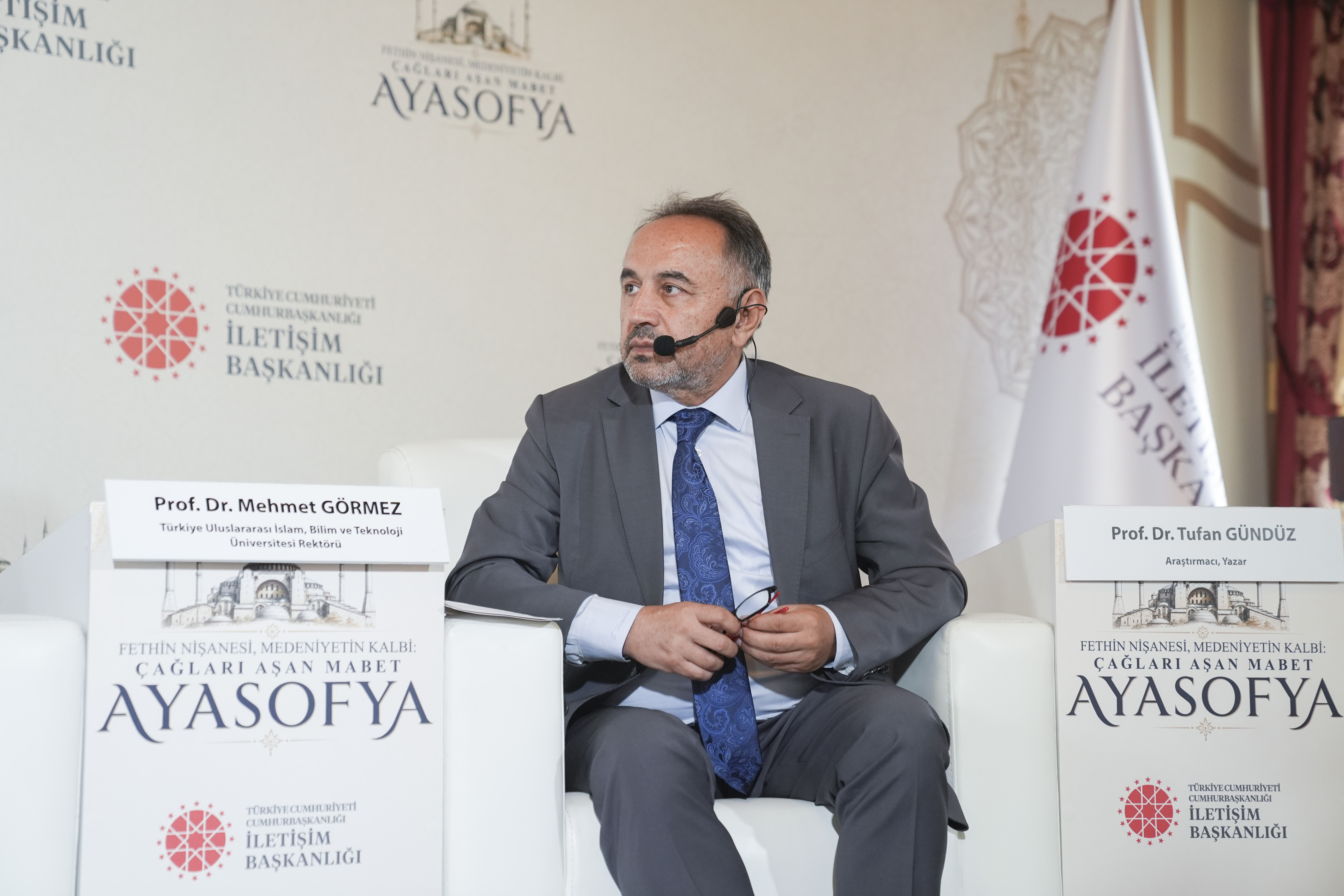
Among the speakers at the panel titled “Hagia Sophia: A Monument of the Conquest, the Heart of a Civilisation That Transcends the Ages,” held at the International University of Türkiye for Islam, Science and Technology and moderated by the Head of the Press and Publications Department at the Directorate of Communications, Dr Zeynep Zelan, were the Minister of Culture and Tourism in the 64th Government, Mahir Ünal, the Rector of the International University of Türkiye for Islam, Science and Technology, Prof. Mehmet Görmez; and the academic and author Tufan Gündüz.
Highlighting that the reopening of Hagia Sophia for worship was a landmark event, panellist Mahir Ünal drew attention to the distinction between conquest and occupation.
Ünal indicated that the Ottoman State was never a colonial power, that it did not occupy İstanbul but brought it within the 'Circle of Justice' (daire-i adalet), adding, "As a monument of that just order, Hagia Sophia became our symbol, our Kızılelma—a long-cherished national ideal."
Ünal said, "Our culture and faith are founded upon the principles of tawhid (the oneness of God), mizan (balance), and the responsibility of safeguarding what has been entrusted to us. The earth is a trust, humankind is a finite being bound by measure and moderation, and all creation originates from a single divine source. It is through this lens that we must understand the Seljuks, the Ottoman State, Islamic civilisation, and the foundations of our civilisational outlook. Likewise, Hagia Sophia should be regarded as the symbol of the Circle of Justice."
Noting that they remembered the deep longing for Hagia Sophia's reopening for worship, the demonstrations in Sultanahmet Square, and the takbirs and chants of Muslims, Ünal said, “When politics and politicians are entrusted with the will of the nation, they must show the courage to turn that will into action. Our President, Recep Tayyip Erdoğan, demonstrated the courage to translate the will entrusted to him by the nation into a decision and to assume the responsibility that came with it. The reopening of Hagia Sophia for worship is also about translating the nation's will into a political decision and having the courage to make that decision and accept the risks it entails. Thus, I would like to congratulate our President and those who stood alongside him for courageously and resolutely turning the nation's aspirations, longings, and demands into reality while accepting the risks involved."
"What is important is to revive the spirit of the Hagia Sophia"
Panellist Mehmet Görmez began by saying, "I would like to express my gratitude to our esteemed President, and to all those who contributed, for restoring this great sanctuary of tawhid, this monument of the conquest, from a tourist attraction walked upon for 86 years to a place where the foreheads of believers once again meet the ground in prostration. I regard this as a debt of gratitude owed under the guidance of Hagia Sophia's mihrab (prayer niche) and minbar (pulpit)."
Prof. Mehmet Görmez underscored that Sultan Mehmed the Conqueror regarded Hagia Sophia not as the spoils of conquest but as a great legacy entrusted to him, adding, "Our nation, too, embraced it as a legacy entrusted to its care and enriched it. As a nation, a civilisation, and a history, we did not merely receive this trust; we communicated with it. From this engagement came the Süleymaniye Mosque, the Selimiye Mosque, and the Blue Mosque Complex. It is our collective responsibility to carry this trust into the future and to keep that dialogue alive."
Prof. Görmez stated that when he took up the post of President of Religious Affairs in 2010, his first discussions with President Erdoğan centred on the Hagia Sophia, and that preparations for its reopening had been on people’s minds for 10 years.
Emphasising that the Hagia Sophia is not merely a place of worship, Prof. Görmez said, "We would be doing Hagia Sophia a disservice if we regarded it merely as a mosque where prayers are performed. For the sake of Allah, when you visit the Blue Mosque and Hagia Sophia, take the time to explore their surroundings. Imagine how many madrasas, waqf (Islamic endowment) buildings, public soup kitchens, darüşşifas (hospitals), orphan houses and lodgings once stood there."
Prof. Görmez assessed, "I cannot and do not accept the conversion of the Hagia Sophia into a museum as the deliberate act of any mind in these lands. However, I believe it may have been the outcome of challenging circumstances in which people found themselves. Otherwise, I cannot imagine that a will rejecting this historical memory would belong to these lands. Those hardships may have compelled people to act in that way."
Noting that the reopening of the Hagia Sophia for worship provided an opportunity, Prof. Görmez concluded his remarks, saying, "What is important is to revive the spirit of the Hagia Sophia. Only by reviving in Hagia Sophia not merely the spirit of worship, but also the spirit of learning, wisdom, and spiritual insight, together with its life-giving role within the city, can we truly fulfil our duty to this trust. May Allah grant us the ability to do it."
"Hagia Sophia is the symbol of the conquest, the end of an era"
Panellist Tufan Gündüz discussed the significance of Hagia Sophia being reopened for worship, examining the issue through the lens of Turkish Islamic law.
Describing Hagia Sophia as an important monument for the Catholic world, Gündüz noted, "During the early years of its foundation, İstanbul was still Catholic. It later became the principal symbol of the Orthodox world, representing Eastern Christianity. Following the Latin occupation of İstanbul in 1204, the church was subsequently converted into a Catholic place of worship. So, such a transformation has always been part of Hagia Sophia’s destiny. However, the arrival of Muslims in İstanbul marked the end of these conversions. To put it another way, the nature of Hagia Sophia as a place of worship has remained constant."
Gündüz stated that by having the first call to prayer recited in Hagia Sophia, Sultan Mehmed the Conqueror was able to declare, "Yes, we are the owners of Hagia Sophia, the owners of İstanbul," adding that Hagia Sophia was on the brink of destruction at the time of the conquest of İstanbul.
Gündüz described the efforts carried out in Hagia Sophia throughout history, stating, "The Ottomans consistently worked to preserve the building, ensuring that it remained structurally sound and well maintained. Sultan Mehmed the Conqueror's waqfiyya (foundation's charter), is not merely a foundation's charter. It also represents a commitment to how Hagia Sophia should endure."
Gündüz stated, "The nature of Hagia Sophia as a place of worship has remained constant since 1453. It is the symbol of the conquest, the end of an era. It stands as one of the symbols of sovereignty, first of the Ottoman Empire and later of the Republic of Türkiye."