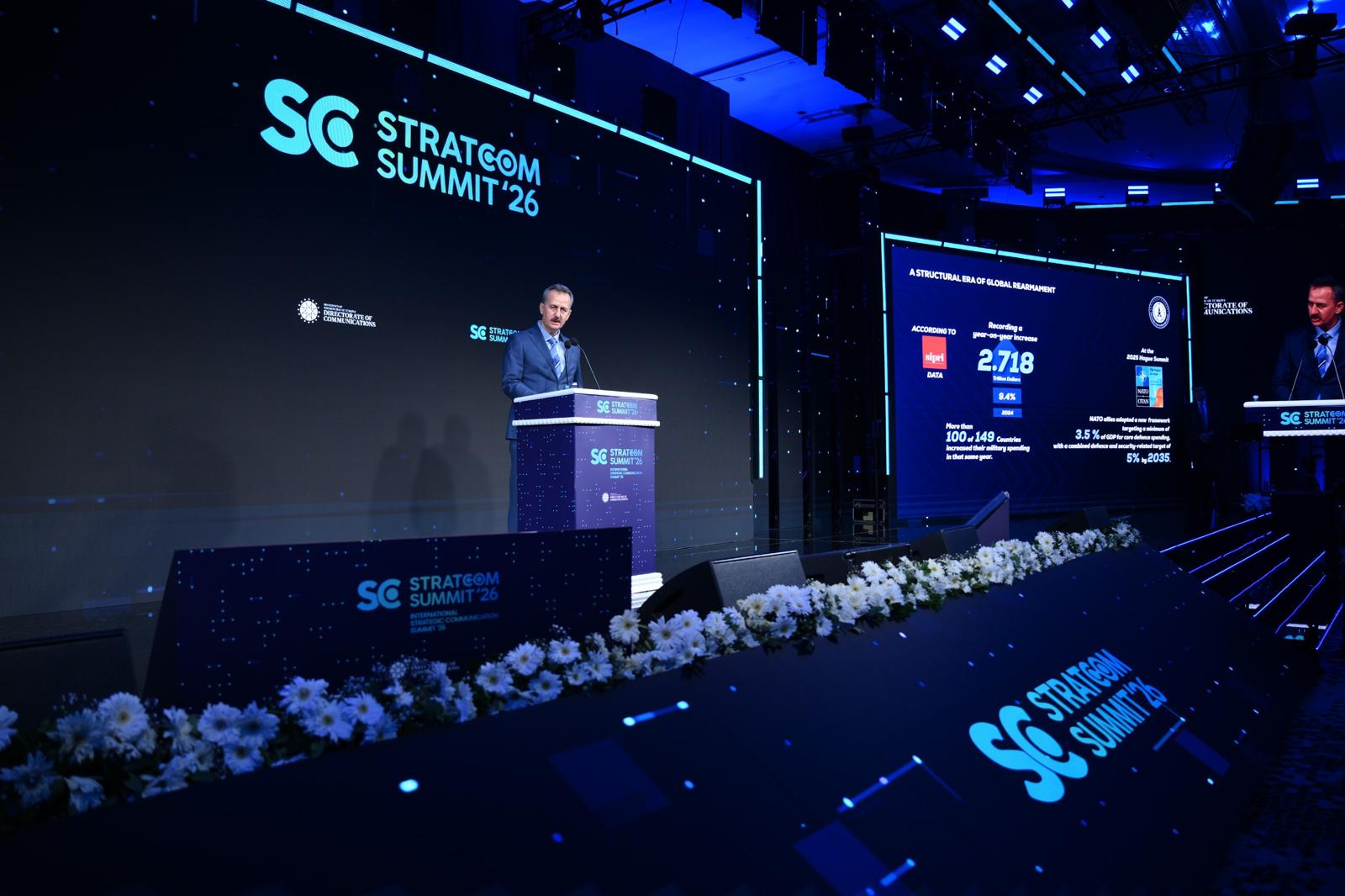
Haluk Görgün, Secretary of Turkish Defence Industries, delivered a speech at the International Strategic Communication Summit (STRATCOM), held under the theme “Disruption in the International System: Crises, Narratives, and Search for Order,” entitled “Shaping the Security Architecture of the Future: The Role of the Turkish Defence Industry.”
In his speech, Haluk Görgün stated that information is now a weapon of war and that for this reason, the defence industry and strategic communication are no longer separate domains; they are both constitutive elements of the security architecture.
Drawing attention to the fact that what sustains a frontline is not only military doctrine but also industrial capacity, Görgün said, “Replenishment timelines, production speeds and stockpile depth have proven to be decisive.” Countries are not simply fielding platforms; they are deploying their entire industrial ecosystems.”
The continuous dialogue between the field and industry is one of the fundamental elements of Türkiye’s success in the defence sector.
Görgün stated that the defence industry is not merely a component of war, but rather the measure of a nation’s capacity to fight and to endure.
Görgün said that the conflicts of recent years have also laid bare how profoundly the concept of warfare has been transformed and said:
"Unmanned systems have redrawn the boundaries of the battlefield. From land to sea, from the air domain to the information space, small, fast and cost-effective platforms have challenged the dominance of conventional heavy forces — and forced every major military in the world to rethink its doctrine. At this point, Türkiye’s UAV and UCAV platforms did not merely achieve export success — they played a pioneering role in reshaping the very concept of modern combat."
Görgün stated that artificial intelligence is enhancing situational awareness, accelerating decision cycles and optimising logistics chains, adding that software has now become a strategic variable of equal weight to hardware.
Görgün pointed out that today’s defence industry architecture is being shaped on the battlefield itself and said, “One of the most fundamental factors behind Türkiye’s success in the defence industry is precisely this close and continuous dialogue between the field and the industry.” Agile approach! We all withness that, those who adapt rapidly endure. Those who are slow to adapt do not merely fall behind in competition — they become strategically vulnerable.
"Türkiye’s transformation in the defence industry is far more than a quantitative expansion"
Haluk Görgün stated, “Resilience in defence industry does not emerge from a single measure. It requires layered capacity built simultaneously across production methods, supplier networks, strategic stockpiles, financing support and workforce development.” This is precisely the model Türkiye has been building — not as a response to crisis, but as a deliberate long-term strategy."
Görgün stated that Türkiye’s transformation in the defence industry is far more than a quantitative expansion and that it is a qualitative and structural transformation in the fullest sense and continued:
"In the final quarter of the twentieth century, our domestic content ratio stood below 20 per cent. Today, that figure exceeds 80 per cent. This is not a change in numbers — it is a transformation narrative stretching from strategic dependency to strategic autonomy. Today, Türkiye’s defence and aerospace ecosystem encompasses more than 4.000 companies, over 100.000 direct jobs, a turnover exceeding 20 billion dollars and exports surpassing 10 billion dollars to 185 countries in 2025 alone. They are the tangible reflection of a national capability architecture, an original design capacity and a sustainable depth of industrial competence. I wish to respectfully acknowledge the decisive role of His Excellency President Recep Tayyip Erdoğan’s leadership, guidance and unwavering support in making this transformation possible.''
Stating that recent reports characterise Türkiye as a ‘rising agile player’ in the evolving global defence power map, Görgün said, ''These reports define Türkiye as a country with battlefield proven systems, a flexible production model and the capacity to offer defence capability as an‘operational package’ rather than a standalone platform.''
Explaining that by 2035, a defence industry power will not be determined by who spends the most, but by who produces the fastest, who builds the deepest supply chains, who translates battlefield lessons into products most rapidly and who can convert alliance networks into industrial strength, Görgün said that Türkiye is building precisely along these lines.
''The Turkish defence industry will continue as a constructive contributor to regional and global stability''
Görgün stated that decision speed, R&D and investment in future, supply chain depth, and human capital are mechanisms that enable adaptation to a rapidly evolving operational environment.
Conveying that at the core of Türkiye's defence transformation is the National Technology Initiative, Görgün said, ''Artificial intelligence, cyber security, space systems, advanced materials and software-intensive platforms form the focal areas of this initiative. We are not merely producing equipment. We are building the concepts and infrastructure of the future. The most powerful fuel driving this initiative is our human capital.''
Stating that alongside technological depth, they are also acutely aware of the global supply chain vulnerabilities that have come to define this era of strategic competition, Görgün added:
One of the most critical underlying factors is the growing dependence on rare earth elements. These materials, indispensable to advanced defence systems, are sourced from a very limited number of countries worldwide. Türkiye is fortunate to be among them. Among the rare earth elements identified in this roadmap, several carry particular significance for the defence industry: praseodymium, neodymium, samarium, terbium and dysprosium. Türkiye is actively advancing the necessary work to develop its domestic capacity in these materials.''
Stating that Türkiye’s understanding of defence industry cooperation is founded on a long-term model of capacity-building that extends far beyond platform sales, Görgün said that this model of cooperation makes mutual benefit, long-term value creation and the building of strategic trust possible.
Conveying that a strong defence industry does not threaten peace — it fortifies the ground upon which peace stands, Görgün concluded his remarks by saying:
''Türkiye places regional and global peace as its foremost priority. Our defence capacity is positioned as the guarantor of that peace — in the past,today and in the future. The Turkish defence industry, guided by this understanding, will continue to serve as a strong pillar of national security, a trusted partner for friendly and allied nations and a constructive contributor to regional and global stability.''