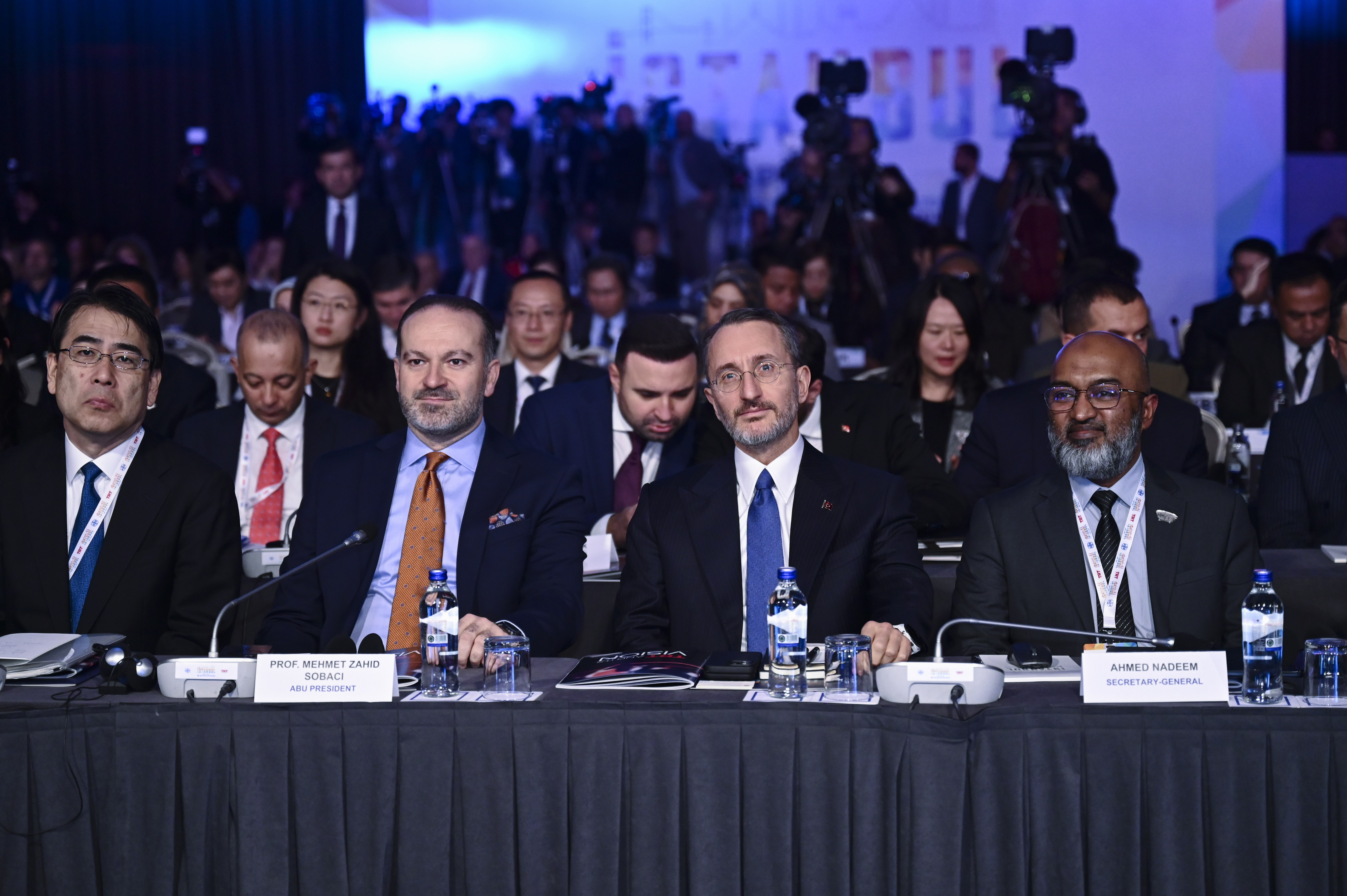
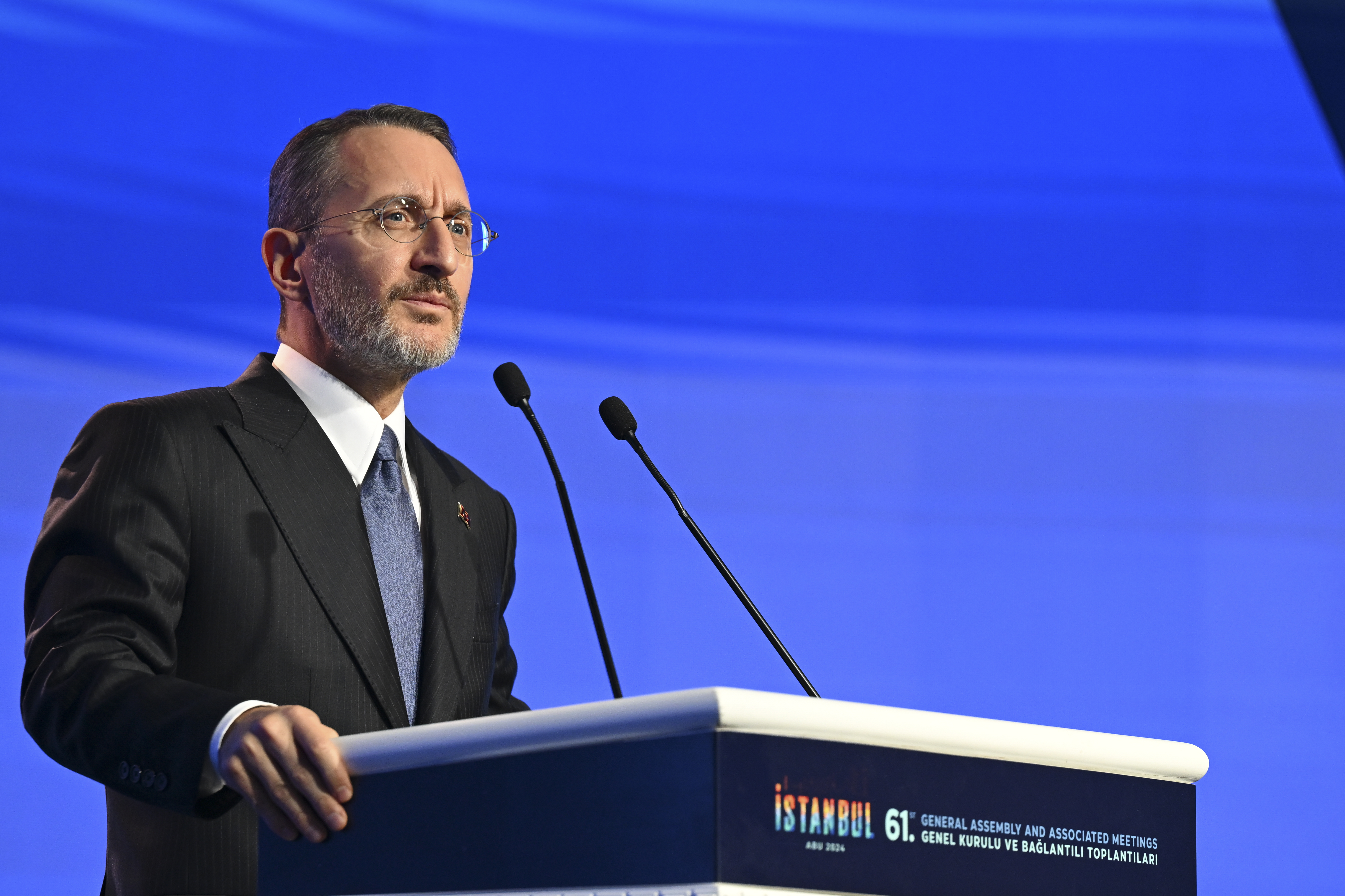
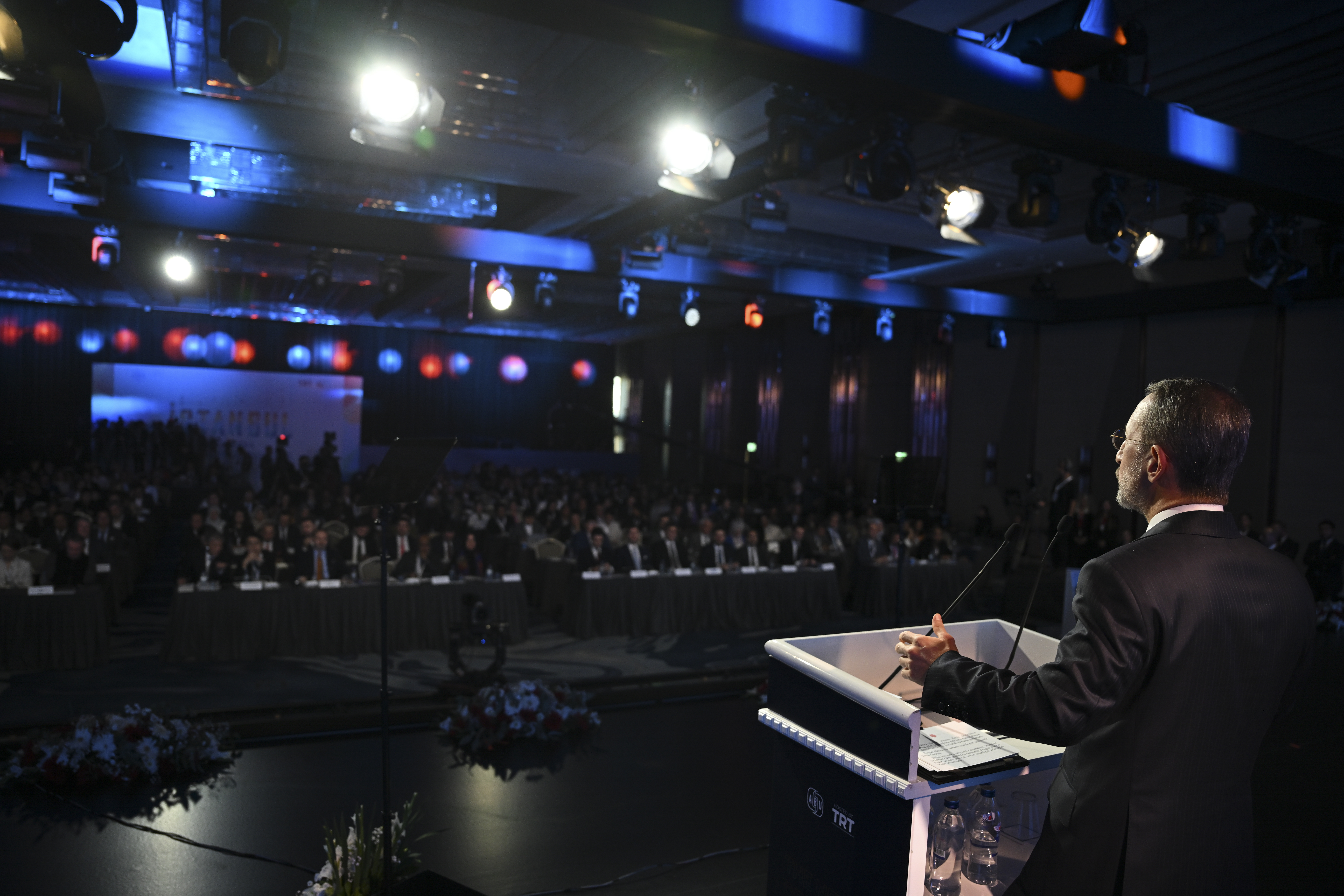
Presidency's Head of Communications, Fahrettin Altun, attended the official inauguration of the 61st General Assembly of the Asia-Pacific Broadcasting Union (ABU) held in Istanbul and delivered a speech.
Head of Communications Altun noted that ABU has filled a critical gap, and its activities encouraged the expansion of the broadcasting sector in the Asia-Pacific region over the course of its 60-year history and emphasised its critical role in the promotion of media freedom and diversity.
Mentioning rapid transformations and changes the world had experienced since the 1960s when ABU began its operations, Head of Communications Altun stated that the established order and international status quo, which were constructed in accordance with the interests and demands of Western states following World War II, have failed to deliver the peace and prosperity that were promised to the world and humanity and that, currently, the world is grappling with numerous crises and issues at once, which pose a threat to humanity.
Stating that the current landscape causes more bloodshed and tears to flow for humanity day by day, Head of Communications Altun continued as follows:
"As you know, there is the Russia-Ukraine war on the one hand, the atrocities and genocide committed by Israel in Palestine on the other, and now the attempts to spread these atrocities and cruelty to Lebanon and the entire Middle East. Consequently, and unfortunately, people are losing their lives and getting injured. Thousands of innocent civilians, babies, children, and women are losing their lives. In this process, tens of thousands of migrants and refugees are unfortunately being displaced, and we are witnessing great suffering. The primary factor contributing to the widespread pessimism surrounding all these crises is the fact that we are living in an inadequate and dysfunctional international order which, regrettably, serves no purpose other than exacerbating crises, and the presence of international actors trying to sustain the very international system that produces these atrocities. This situation, unfortunately, drives us towards pessimism, alongside the scale of the problems we face. Today, the old world is dying, and the new world is struggling to emerge precisely for these reasons."
"The truth is our most effective weapon against disinformation as well as deception networks."
Pointing out that, in addition to the humanitarian crises that are unfolding on a regional and global scale, people are currently facing yet another severe disaster, the Head of Communications Altun said, "This is a crisis of truth. On the one hand, we are facing a crisis of justice, and on the other, all of humanity is afflicted by a crisis of truth that exacerbates this crisis of justice. Today, we live in an age in which the industry of lies aims to dominate; the truth is diminished, marginalised, and undervalued. We are facing a flood of disinformation. The truth is our most effective weapon against disinformation as well as deception networks. Our first and most critical objective should be to keep all avenues to the truth open."
Highlighting the strategic importance of global platforms like ABU in this context, the Head of Communications Altun said that the ABU could and should represent a global truth bloc against disinformation and the industry of lies.
Stating that the balance of power across the world is gradually shifting to Asia and that Asia's rising economic and political influence plays a decisive role in shaping the future, Head of Communications Altun said: "The Eurocentric world, which our President Recep Tayyip Erdoğan has consistently pointed out for its shortcomings and failure to address almost any global crisis, is collapsing. In contrast, Asian countries are on the rise. As the Western-centred world crumbles, so does their dominance in the media and communication fields. Alternative news centres are emerging in place of Western media outlets and news centres. In other words, new mainstream media unions worldwide are gaining prominence."
Head of Communications Altun stated that the developments clearly demonstrate a specific point and continued:
"The period of Western ideology's supremacy in Asia and the Third World, as it was once commonly known, has come to an end." Each country must navigate this era of chaos and uncertainty with both independence and responsibility while safeguarding its own interests. The most significant attitude for countries today is to contribute to global peace and stability. Within this framework, Türkiye plays an active and proactive role as a stabilising power in crises and conflicts that affect both its region and the global system. For instance, Türkiye is a country that can engage in talks with both sides of the Russia-Ukraine War. Türkiye played a significantly active role in securing the grain deal, which has the potential to affect millions of people. In this context, Türkiye is actively engaged in intensive diplomatic efforts to halt Israel's acts of genocide and massacre in Palestine and to prevent the war from escalating throughout the region. Above all, Türkiye, under the leadership of President Recep Tayyip Erdoğan, speaks out against the unbalanced international system on every platform with the slogans "A Fairer World is Possible" and "The World is Bigger than Five," seeking to mobilise the global community of conscience."
"The use of artificial intelligence and digitalisation in journalism offers enormous potential and opportunities"
Announcing this year's theme of the 61st General Assembly of ABU, the most important alternative broadcasting union of the non-Western world, to be artificial intelligence, Head of Communications Altun said, "It is evident that we have moved on to a new phase in the ecosystem of communications and media with the advancements in artificial intelligence technologies in recent years. Each technological development affects and transforms the way media disseminates content and even the content itself."
Noting that the use of artificial intelligence and digitalisation in journalism offers enormous potential and opportunities, the Head of Communications Altun listed them as follows:
"The reporting, generation and dissemination of news become easier. Additionally, news organisations and institutions can engage in effective and efficient operations. It is possible to search faster and obtain more information. Time-consuming tasks such as editing, colour adjustment, and sound synchronisation that make up visual media products are accelerated, and news can now be presented in a variety of formats, including video, audio, infographics, animations, augmented reality, and podcasts. Through analyses conducted on massive datasets, it is possible to identify and address previously overlooked issues in journalism."
"The artificial intelligence-enabled media landscape brings certain risks along with it."
Head of Communications Altun highlighted the importance of addressing certain challenges that artificial intelligence technologies bring in addition to their opportunities in the media and communication sectors, stating, "First of all, the artificial intelligence-enabled media landscape brings certain risks, such as generating disinformative content that misleads society, the lack of transparency in artificial intelligence, bias and misinformation in generated news, and manipulative content that causes social polarisation and discrimination. In this sense, artificial intelligence technologies can also exacerbate hybrid threats. Artificial intelligence-generated voices and images and deepfake applications also demonstrate the artificial intelligence's potential to threaten individuals, our political and social system, as well as our rights and freedoms."
Underscoring the issue of dehumanisation in communication and media through digitalisation and artificial intelligence, Head of Communication Altun continued: "As an individual working in the fields of communication and an academic who conducts research in this field, I would like to specifically state that no technology can replace the human factor in media activities, reporting, and journalism. What matters are the works and efforts of individuals. The value of the human mind and creativity surpasses all the possibilities that technology can provide. On the one hand, we are discussing the risks of artificial intelligence, and on the other hand, we explore the possibilities it offers. In reality, the stance we need to take is clear: We must be aware of and manage the risks. We must be both courageous and cautious."
Head of Communications Altun stated that Türkiye is striving for growth and preparing for a more prosperous future for its people while also fighting for rights and justice on a global scale.
Highlighting their commitment to global cooperation in strategic communications that promote rights and justice, Head of Communications Altun noted:
"Our commitment to ABU is a concrete example of this. The Association of Balkan News Agencies-Southeast Europe (ABNA-SE), founded in 1995 to enhance coordination and cooperation among Balkan news agencies, is a platform we value and support on an international level, with Anadolu Agency serving as one of its founding members. Similarly, Anadolu Agency's pioneering efforts in establishing the Alliance of Turkic News Agencies in 2023 to strengthen cooperation and coordination in the field of media and information across the Turkic world is one of our initiatives to which we attach importance in this context. Our public broadcaster TRT's membership in the European Broadcasting Union (EBU) and as an associate member of the African Union of Broadcasting, along with the ABU, where TRT Director General Zahid Sobacı also serves as President, reflects the importance we place on international broadcasting unions.
Stating that as the Directorate of Communications of the Republic of Türkiye, they valued and supported these initiatives and strived to enhance both their quality and quantity, Head of Communications Altun said that they have developed regional cooperation and dialogue channels by leading organisations such as the Conference of Information Ministers of the Organisation of Islamic Cooperation, the Meeting of the Ministers and High Officials in Charge of Media and Information of the Organisation of Turkic States, and the Türkiye-Africa Media Summit.
Head of Communications Altun noted that they aim to contribute to the global communication and media landscape through the International Strategic Communication Summit (STRATCOM), which will be held for the fourth time this year.
Head of Communications Altun recalled that at STRATCOM 2023, they aimed to discuss how technological opportunities, particularly artificial intelligence, could be utilised to inform the global community accurately, actively, and promptly through various examples. He emphasised the importance of diversifying dialogue mechanisms and fostering joint efforts in the global struggle for truth at the summit.
Head of Communications Altun stated that this year's meeting will bring together the world's prominent leaders, experts, and professionals in strategic communication under the theme ‘Artificial Intelligence in Communication: Trends, Pitfalls, and Transformation’ and invited the participants to STRATCOM 2024.
A call to strengthen coordination across the Turkic world
In his social media post following the meeting, Head of Communications Altun said:
"At the official inauguration of the 61st General Assembly of the Asia-Pacific Broadcasting Union (ABU), we met with prominent publishers from all over the world.
As Türkiye, we fight for the truth and justice in the global arena. In line with this fight, we value global collaborations in strategic communication advocating for truth and justice.
We consider the ABU's role as an alternative global union that symbolises diversity in broadcasting to be extremely valuable, particularly at a time when a few Western corporations dominate the world of communication and media.
In the same spirit, we attach great importance to the Association of the Balkan News Agencies-Southeast Europe (ABNA-SE), founded in 1995 with the Anadolu Agency as a co-founder, with the goal of enhancing coordination and collaboration among Balkan news agencies.
The same should be said about Anadolu Agency's pioneering efforts in establishing the Alliance of Turkic News Agencies in 2023 to enhance coordination and collaboration in the field of media and information across the Turkic world.
We deem the membership of our public broadcaster TRT in the European Broadcasting Union (EBU) in addition to the ABU, of which TRT is the term president, and its associate membership in the African Broadcasting Union of paramount significance.
We endorse such initiatives as the Directorate of Communications of the Republic of Türkiye.
Efforts are in progress to establish regional cooperation and dialogue channels by leading organisations such as:
* the Conference of Information Ministers of the Organisation of Islamic Cooperation,
* the Meeting of the Ministers and High Officials in Charge of Media and Information of the Organisation of Turkic States, and
* the Türkiye-Africa Media Summit.
We provide a global contribution to the communication and media industry by organising the International Strategic Communication Summit (STRATCOM) for the fourth time this year.
We will persist in our support of media and communication collaborations, such as ABU, and in our pursuit of enhancing the international dialogue in the field of communication through organisations like STRATCOM.
I hope that the 61st ABU General Assembly will be auspicious and provide useful outcomes."