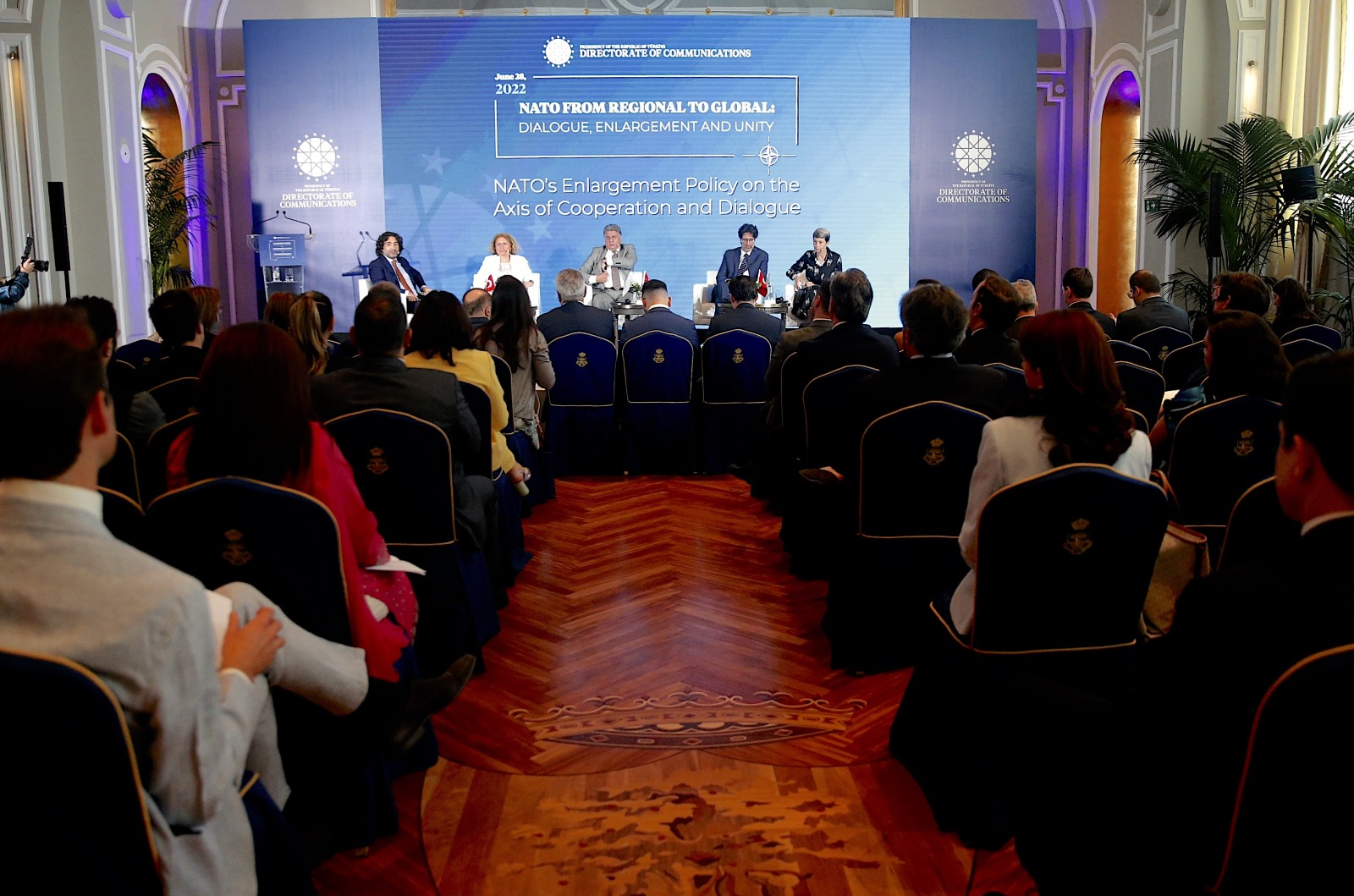
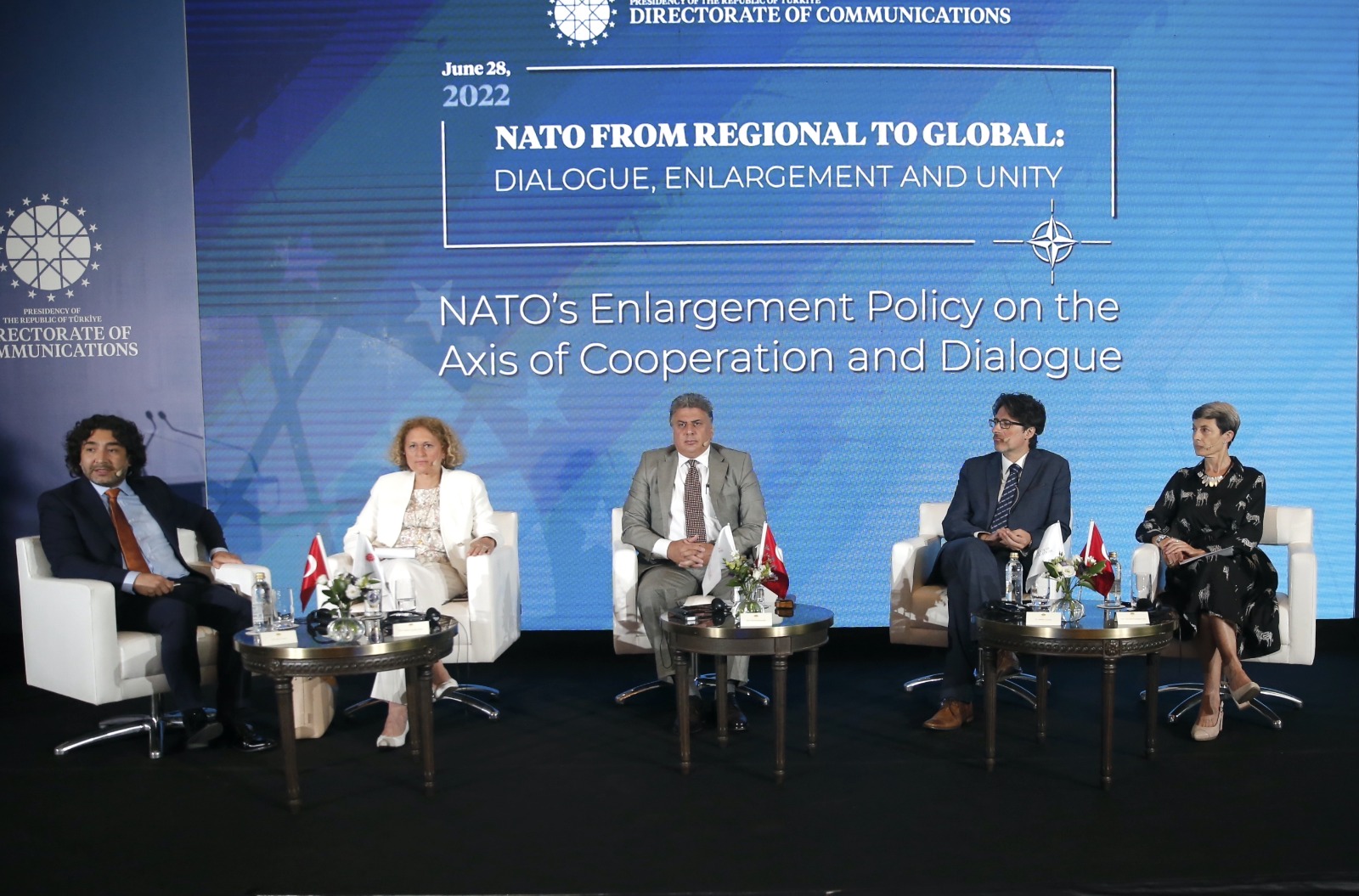
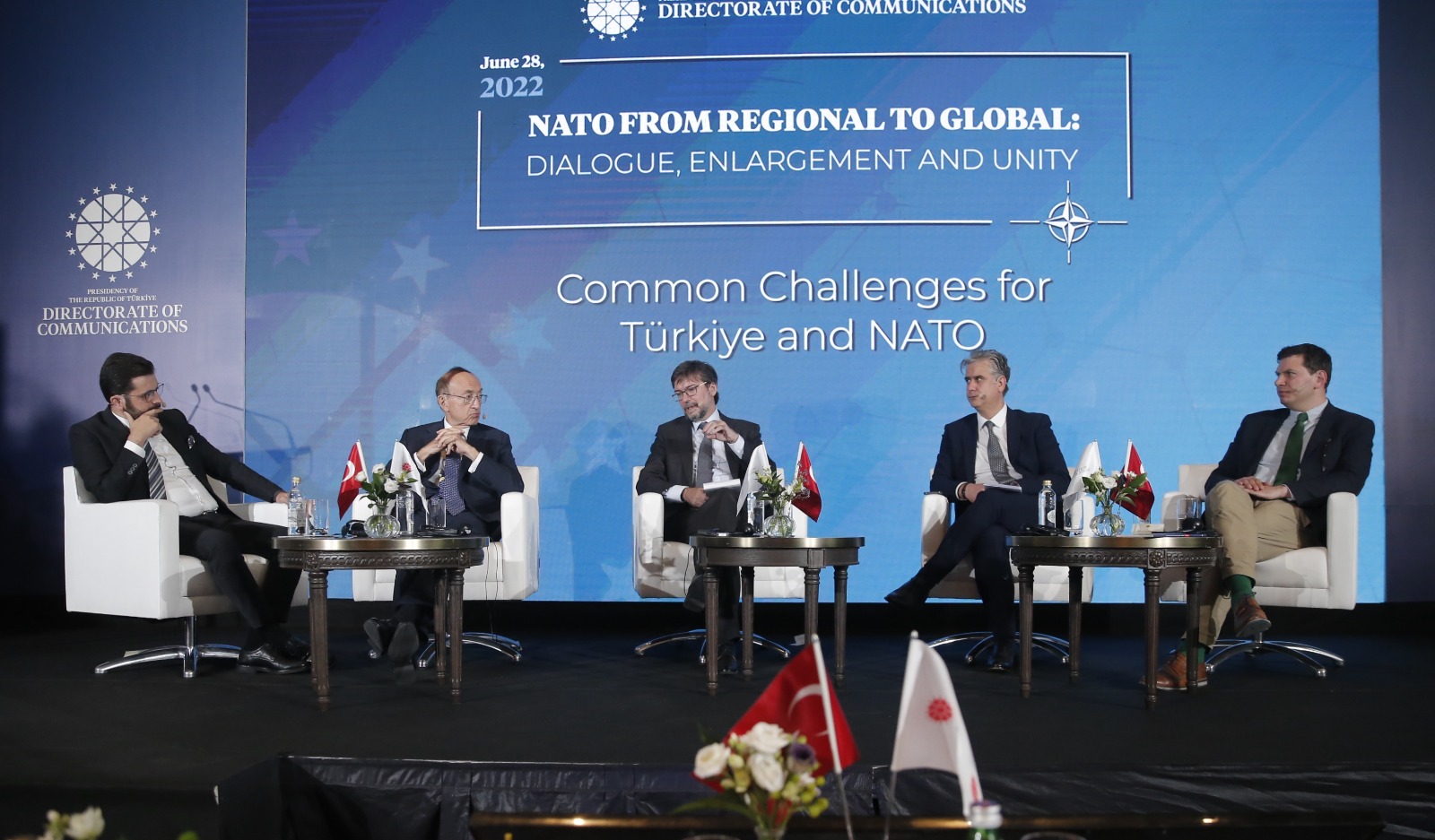
The Directorate of Communications organised a panel titled "NATO from Regional to Global: Dialogue, Enlargement and Unity" in Madrid, the capital of Spain, the host country of the 32nd NATO Summit.
"NATO should not set a date for Finland and Sweden in its expansion vision. This process should be allowed to unfold naturally. The concerns of Türkiye should be viewed as an opportunity to bring up issues NATO has shelved," said Carlo Marsili, former Ambassador of Italy to Ankara, at a two-part panel organised by the Presidency's Directorate of Communications at the Ritz Hotel.
Asking, "How can Sweden become a member of NATO if its goal is to protect Türkiye's territorial integrity?" Marsili added, "How is Sweden hosting PKK leaders, those who threaten Türkiye's territorial integrity? Sweden and Finland must make compromises if they wish to join NATO. We should ask Sweden. How do you allow the PKK to raise money and recruit its militants?"
Marsili accused the European Union of "refusing to distinguish between Kurds and the PKK, failing to recognise that enlargement is impossible without Türkiye, underestimating Türkiye's diplomatic success in Libya, and not realising that the disputes on the island of Cyprus, where the EU has been behaving indifferently, can only be resolved with an approach with two independent countries."
I am glad Türkiye brought terrorism to NATO's agenda
Michele Testoni, Professor of Global and Public Affairs at the Instituto de Empresa (IE) University, said: "I am glad Türkiye brought terrorism to NATO's agenda by expressing its reservations against the membership of Finland and Sweden."
Testoni stated that Türkiye's concerns about terrorism are well-founded and that this issue should be of particular importance to NATO's security and reliability, as well as to other NATO members like Spain and Italy.
Noting that Russia's attack on Ukraine transformed everything in international relations, Testoni argued that NATO might restructure the Brussels-Washington-London triangle and that some Mediterranean countries, including Türkiye, need to pay attention to this initiative.
"NATO's security principle should not be an open-door policy for any country whose border is threatened"
Presidential Security and Foreign Policy Council Member Prof. Nurşin Ateşoğlu Güney also stressed the necessity for NATO to return to its core after Russia's invasion of Ukraine.
Noting that Europe has become the focal point due to the energy, refugee, and food crises caused by the Ukraine war, Güney emphasised that it is critical that NATO "stands on a solid foundation and is consistent" in its membership application for Finland and Sweden, both of whom have renounced their policies of remaining independent until now.
Opining that "NATO's security principle should not be an open-door policy for any country whose border is threatened", Güney stated that the security of NATO's southern borders, particularly Türkiye, should never be overlooked.
NATO should reconsider how it defines "alliance" and "armament"
Prof. Mustafa Kibaroğlu, Dean of the Faculty of Economics, Administrative and Social Sciences at MEF University, also pointed to how several major issues inside NATO were "thick with smoke" as a result of the Ukraine war and that "the concepts of alliance and weaponry should be revised extensively." Kibaroğlu said, "Türkiye has always stayed true as an ally and fulfilled its obligations, as seen by its track record. However, I do not see other alliance members doing the same to ensure Türkiye's safety. For many years, Türkiye has been subjected to intense terrorist strikes ranging from ASALA to the PKK. We couldn't find anyone to lean to or feel any support in Iraq or Syria. In fact, the PKK casually received backing. I would like NATO to understand what an alliance means."
Kibaroğlu remarked that it is critical to collaborate on topics such as alliance, armament, counterterrorism, and intelligence sharing.
NATO is heading toward becoming a "hollow and meaningless organisation"
Prof. Hasan Basri Yalçın, a faculty member at Istanbul Commerce University, on the other hand, argued that NATO's statements and deeds contradict each other and that it is heading toward becoming "a hollow and meaningless organisation."
Yalçın said NATO's security organisation phenomenon had been severely damaged and that distrust among its members cannot be overlooked, adding, "How can the US expect Türkiye to trust them when it is evident that the PKK's Syrian offshoot, PYD/YPG, is backed by the US? Give me a break, for God's sake. NATO members' security interests should not be so unbalanced. Türkiye's primary demand of Sweden and Finland is that they 'stop providing direct support to the terrorist organisation.' However, Sweden responded 'No.' How can Türkiye be partners with a country that backs a terrorist organisation against which it fights? Unfortunately, NATO is not a security organisation, but rather an administrative organisation led by the United States."
Prof. Natividad Fernández Sola, Professor of Public International Law and International Relations at the University of Zaragoza, emphasised that Finland and Sweden's membership applications should not be treated as a fait accompli and said, "It is not fair for NATO to recruit new members before their current borders are made more secure. It is critical to assess how existing members are carrying out their obligations."