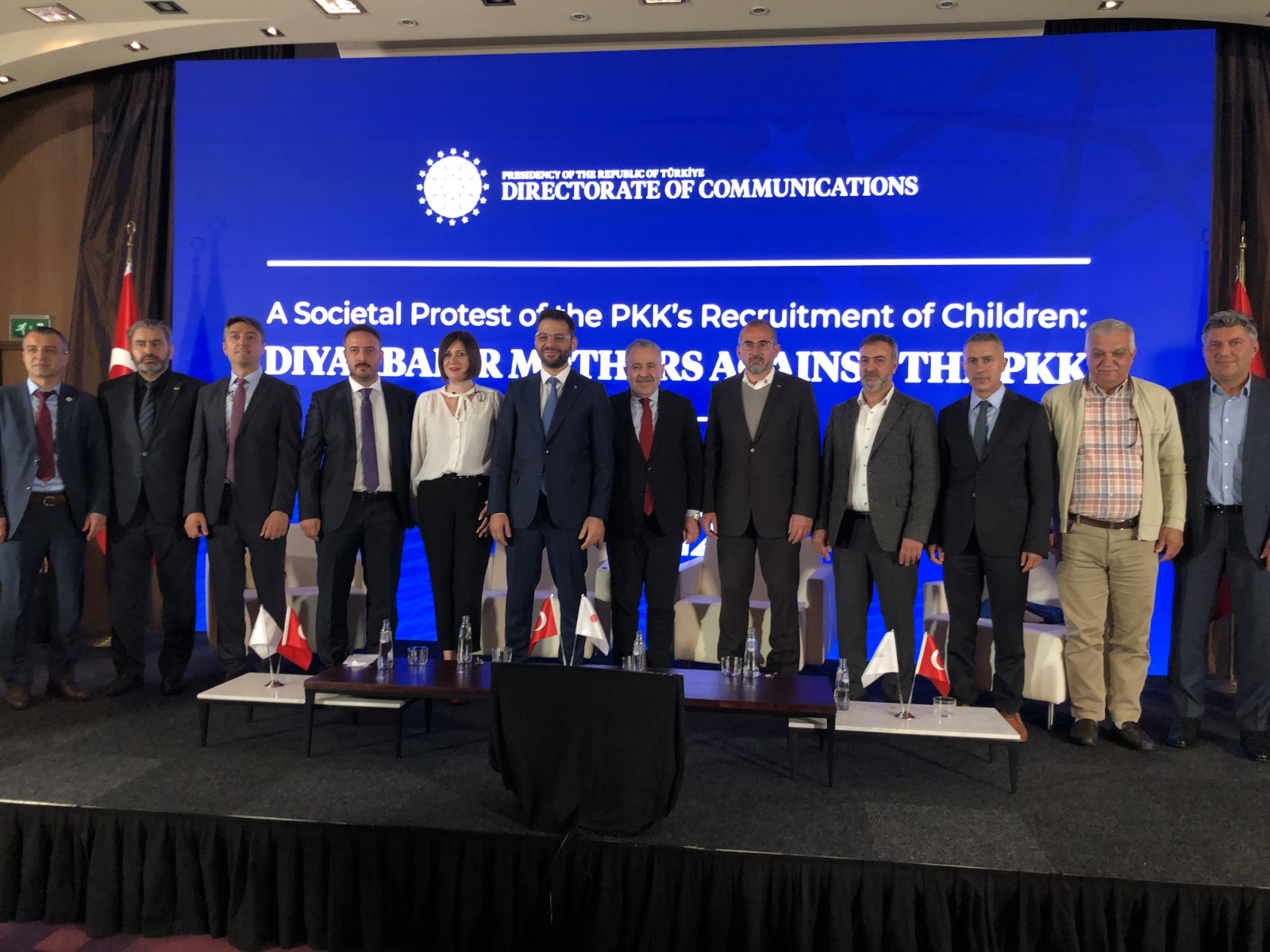
Many foreign speakers, NGO members, and audience attended the "A Societal Protest of the PKK’s Recruitment of Children: Diyarbakır Mothers Against the PKK" panel, which was held in The Hague, Netherlands, by the Directorate of Communications in reference to a sit-in protest of Diyarbakır mothers in front of the HDP Diyarbakır Provincial Directorate in an attempt to reunite with their abducted children taken to mountains.
The moderator of the panel and a faculty member in the Department of Political Science and Public Administration at Istanbul Medipol University, Assoc Prof Hüseyin Alptekin, pointed to the fact that the Diyarbakır mothers' sit-in protest has now lasted for 1,000 days, and that the mothers whose children were abducted and sent to the mountains hold HDP responsible, saying, “The sit-in that started on September 3, 2019, has turned into a societal protest."
"YPG/PKK is not as democratic as they try to make it seem"
One of the panellists, Dutch journalist Rena Netjes, spoke on the oppression and human rights violations perpetrated by the terrorist organisation YPG/PKK against the locals of the region.
Netjes recounted accounts from conversations she had with Kurds in Deir ez-Zor, Raqqa, Haseke, and Qamishli, pointing out that the YPG/PKK is attempting to gain control of the region by reaching an arrangement with the Assad regime.
The Dutch journalist added that residents of northern Syria are hesitant to speak out against the YPG/PKK, that the minors who are kidnapped and forced to commit terrorist acts are prevented from interacting with their families, and that her colleagues in the region also suffer similar issues.
Netjes stated that allowing EU funding to slip into the hands of the YPG/PKK would be a grave mistake, adding, "The YPG/PKK is not democratic as they try to make it seem."
Netjes went on to note that the US and France also provide substantial support to the terrorist organisation.
“The West must recognise that the PKK does not represent the Kurds”
An academic and author from Italy, Valeria Giannotta, called attention to the PKK's presence in Italy and the Netherlands, citing the support the YPG/PKK receives from European countries.
Bringing into question the support for the PKK despite the EU’s and UN’s official recognition of it as a terrorist group, Giannotta said that the YPG/PKK is tried to be depicted in a positive light particularly by leftist organisations in Europe.
Giannotta reiterated that the PKK does not represent the Kurds in Türkiye, that the Kurds are the ones who suffer the most because of this organisation, and that the West must recognise this.
"A station leading to terrorist camps"
International relations expert and journalist Klaus Jürgens, who began his speech by quoting President Recep Tayyip Erdoğan, who praised the courage of Diyarbakır mothers, emphasised the fact that the PYD, YPG, and PKK are all the same terrorist organisation that merely goes by different names.
Jürgens said, "The true face of this organisation is hidden and presented as democratic governance."
Expressing that it is rather meaningful for Diyarbakır mothers to choose the front of the HDP Diyarbakır Provincial Directorate building for the protest, Jürgens said, "The mothers are aware of what's happening. The HDP provincial building is used as a stop or a station leading to terrorist camps."
Referring to the relationship between the YPG and the PKK, Jürgens said that the word "democratic" and similar expressions were purposefully inserted into the names of these organisations to hide the truth.
Emphasising that the Western media ignores the negative aspects of YPG/PKK news, Jürgens said, "I don't know if the Western media will conduct any investigations to catch on the situation."
"Diyarbakır mothers will wait until the PKK returns their children"
International relations expert Abdullah Erboğa (PhD) also shared the results of his research on Diyarbakır mothers.
Describing the meeting with the family of the 9-year-old boy abducted by the PKK in front of the school, Erboğa said, "Diyarbakır mothers do not plan to leave the HDP building until the PKK returns their children."
"This event was organised to shed light on the brave struggle of mothers"
After the panel, a round table meeting was held with the participation of Presidency’s Deputy Director of Communications Çağatay Özdemir, Ambassador to The Hague Şaban Dişli, speakers and members of the press.
Özdemir, who also met with the heads of non-governmental organisations in the Netherlands and representatives of the Dutch Turkish community, said, "This event was organised to shed light on the brave struggle of mothers who continued their protests for 1,000 days despite the numerous threats from the PKK terrorist organisation."
In his remarks during the evaluation meeting, Dişli stressed the importance of bringing up the YPG/PKK crimes in The Hague because of the city's status as a home to international courts and institutions.
Dişli said they informed the Dutch parliament and non-governmental organisations about the 1000th day of the Diyarbakır mothers' sit-in.
Today is the 1000th day since September 3, 2019, when the mothers of abducted children staged a protest in front of the HDP Diyarbakır Provincial Directorate.
Thirty-five families were reunited with their children as a result of the protests that spread across the country and around the world.