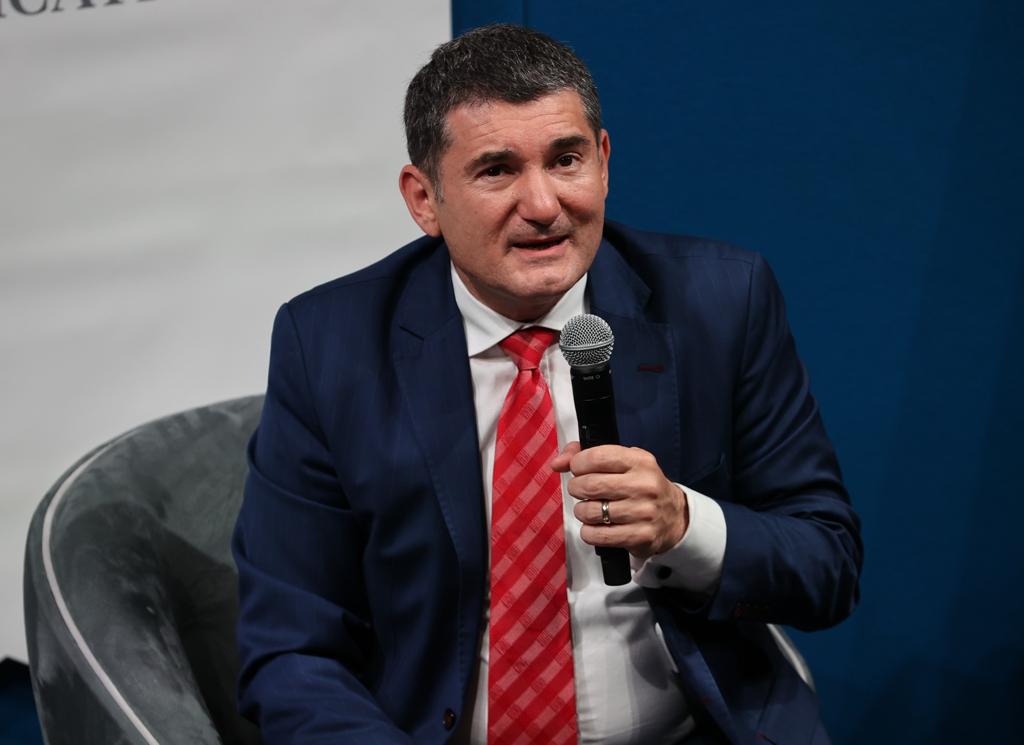
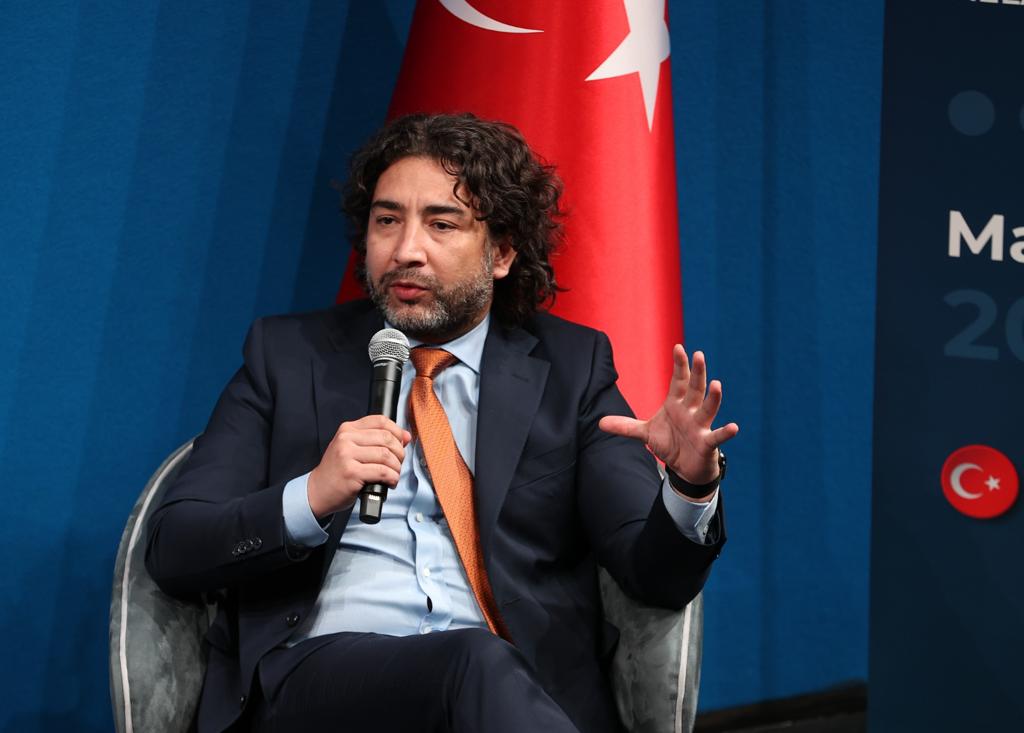
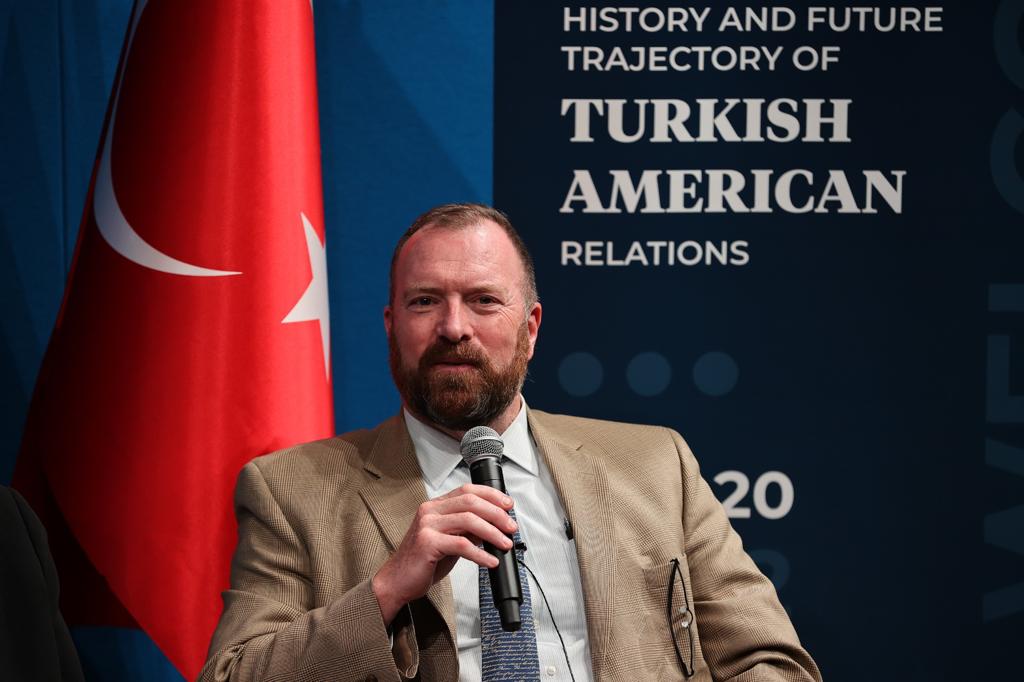
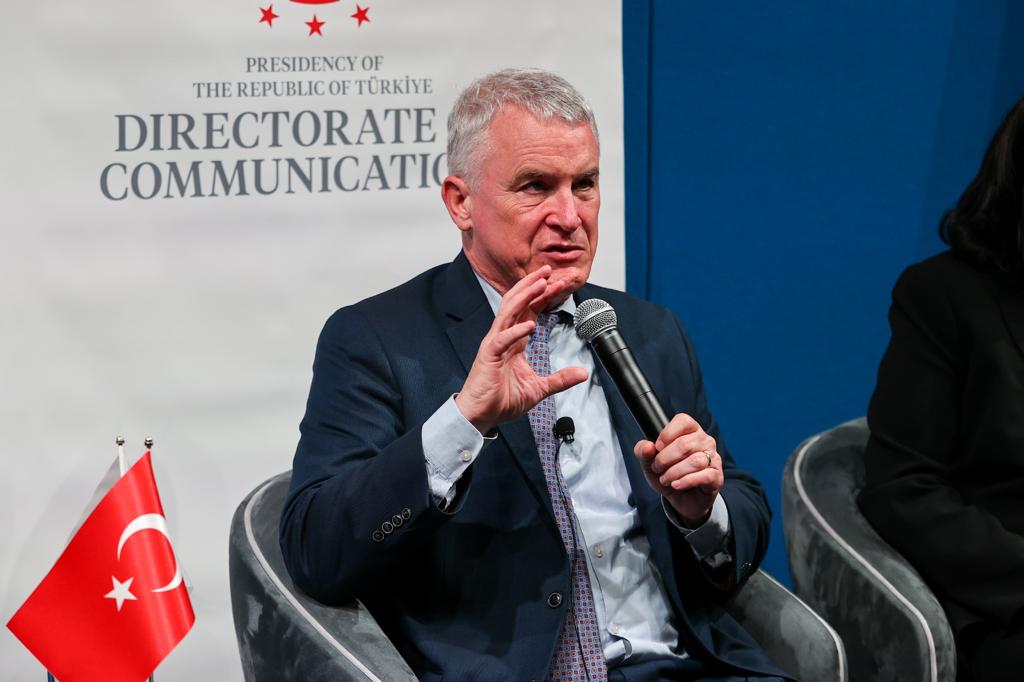
The relations between Türkiye and the US were addressed at a panel on the “Past and Future of Türkiye-US Relations", organised by the Presidency's Directorate of Communications at the Türkevi in New York.
Deputy Director of Communications Çağatay Özdemir (PhD) moderated the panel, in which the historical, political and economic aspects of the relations between the two countries were discussed with the participation of local and foreign academics.
Speaking at the first session of the panel, Altınbaş University Rector and Faculty Member at the International Relations Department, Prof Çağrı Erhan addressed how the relations between the two countries started in the Ottoman period. Erhan stated that relations with the US date back to the end of the 18th century and said, "The first engagement between the two states was not over military issues, but rather commercial ones."
Demonstrating the historical maps on the slide, Erhan said, "The Turks were aware of the existence of the new continent from the very beginning, but it was not the Turks who first sent their ships to the US ports and met with the Americans. For the first time, Americans came to Turkish ports with British flags in the 1770s, even before declaring their independence. And they started to ship grapes and figs from the Ottoman ports on the Aegean coast to the ports in Boston and New York."
Erhan stated that trade between the Ottoman Empire and the US was the most important agenda item in the early periods, and later on, with the wars erupted in North Africa at the beginning of the 19th century, a negative perception against the Turks raised for the first time in the US public. Stating that despite the ups and downs in the two countries’ relations, military cooperation has been established over time, Erhan also explained that the US manufactured 11 warships for the Ottoman Empire in the 1830s.
The other speaker in the panel was Research Director at the SETA Foundation in Washington DC Assoc Prof Kılıç Buğra Kanat, and he evaluated the state of relations between the two countries in the last century.
Expressing that the two countries made significant attempts for trust building until World War II, Kanat said, "The period immediately after the World War II was the beginning of the strategic relations between the two countries. And since then, Russia, which was the Soviet Union at the time, has sometimes served as a fault line in relations and sometimes the glue that binds the two countries together".
Underlining that cooperation in the field of defence continued throughout the 1980s, although the relations between the two countries deteriorated from time to time due to problems such as Cyprus and the arms embargo in the 1970s, Kanat emphasised that turmoil in strategic relations began in the 1990s with the Gulf War. Kanat stated that lobbies in the US are the most significant fault lines in the relations between Türkiye and the US.
"More and more people are realizing that relations with the PKK have been a strategic mistake"
Foreign academics took the floor during the second session of the panel, which was moderated by Assoc Prof Oğuz Güner, Head of Public Diplomacy Department of the Directorate of Communications.
Mike Doran, Senior Fellow at Hudson Institute, noted that he has been closely observing the two countries' relations since 2016, adding, “When I first briefed the Ministry of Defence, I told them that we had left our strongest ally alone in Syria, and that Türkiye would remain there and fight the PKK. In the long term, it was a loss.” Doran went on to explain:
“Despite their unwillingness to admit it, more and more people are realizing that relations with the PKK have been a strategic mistake. I’m not sure if Americans will stay focused in this manner, or if they will usher us in a new era of creativity, but I'm more optimistic than ever. There is now a genuine chance to completely reimagine everything.”
Prof Brenda Shaffer, Director of Georgetown University's Center for Eurasian, Russian, and Eastern European Studies, discussed the relations between two countries within the energy sector.
Shaffer indicated how the European energy crisis caused by Russia's invasion of Ukraine highlights the relevance of Türkiye and the south corridor alternatives. She argued that the ideal route for Israeli exports to Europe would be via Türkiye, and that Türkiye, as a diversified market with approximately six different supply projects, could serve as a model for many countries.
Former US State Department Advisor Rich Outzen, who delivered the final remarks at the panel, stated that Türkiye and the United States are two good but complicated long-term allies, "This is a complex relationship, and Washington has unrealistic expectations of the allies," he said.
Outzen, noting that there are primarily political and cultural differences between the two countries, stressed that although Americans live as a civilisation that is generally closed to the rest of the world, Türkiye's traditions are deeply anchored in a dynamic geography that stretches from Asia to the Middle East. Emphasising that the two countries share interests in a variety of areas, Outzen said, "At this time, it is vital to set aside the problematic areas and concentrate on the areas where the two countries share overlapping interests, which is a vast area, particularly Ukraine."
At the end of the event, the panellists were presented with Piri Reis' historical map of the Americas and a souvenir photograph was taken.