Director of Communications Fahrettin Altun said, “It is unthinkable that we would favourably approach the membership of countries that have not been able to or have not taken a sufficiently stable stance on terrorist organisations. The admission of countries that have not taken a clear stance on the fight against terrorism into the alliance will also pose a threat to the future of NATO.”
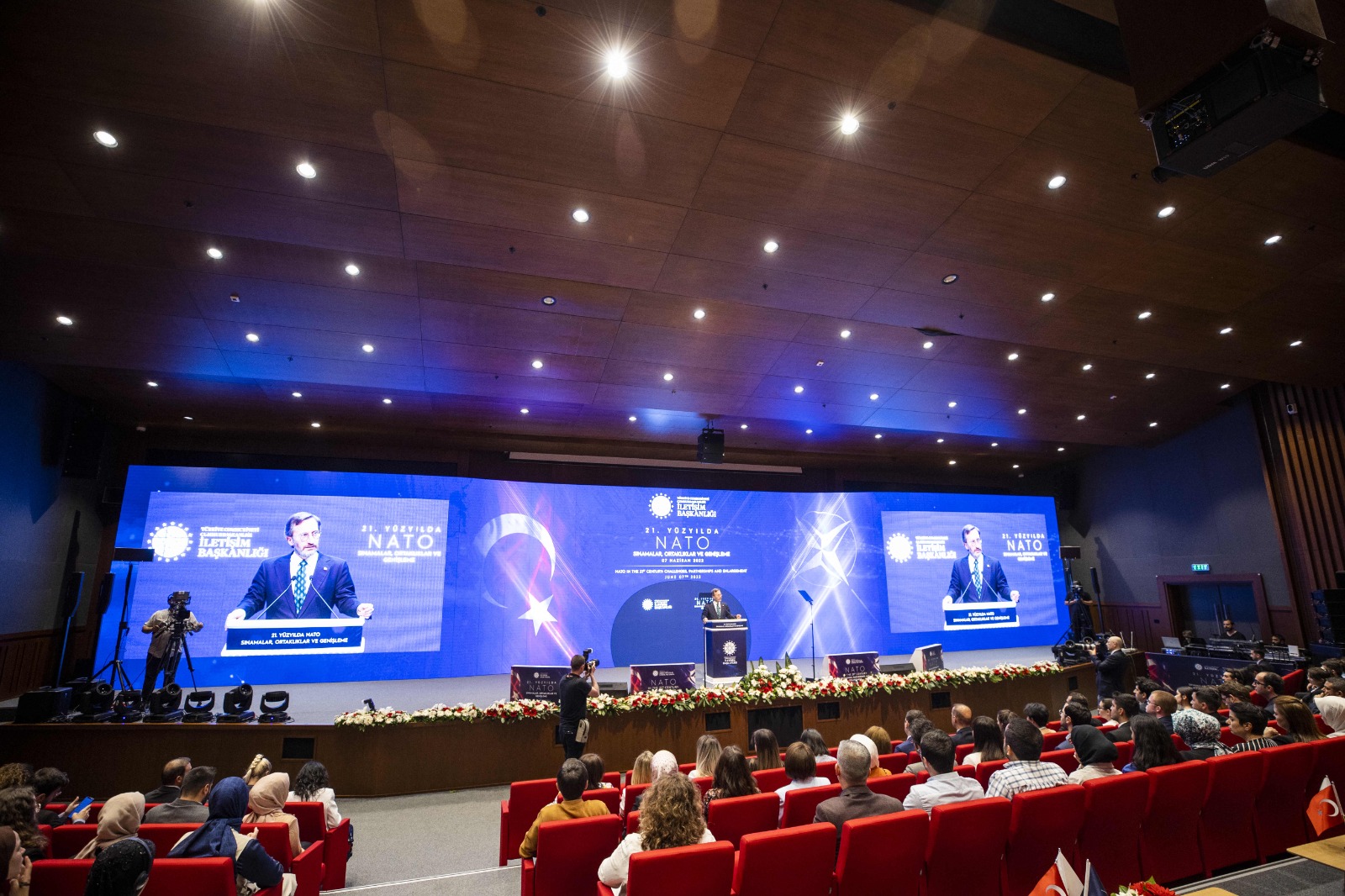
In his opening speech at the “NATO in the 21st Century: Challenges, Partnerships and Enlargement” Panel, Presidency’s Director of Communications Fahrettin Altun said that they are going through the days when it is once again revealed how important and indispensable the value of Türkiye as a NATO ally is.
Stating that they are organising this event at such a time to discuss NATO’s future vision and enlargement policy in the face of current global threats and new challenges, Director of Communications Altun wished that the panel would lead to auspicious results.
Pointing out that Türkiye is going through a very critical period for its region, as well as for Europe and NATO member states, Director of Communications Altun continued as follows:
“The process that began with the Russian attack on Ukraine clearly demonstrated that the alliance could very quickly find itself in the middle of a geopolitical conflict. This has caused a serious debate among European countries and also raised new security concerns within NATO. Of course, today’s security concerns are not limited to geopolitical threats from other states. These threats are accompanied by national and international terrorism, pandemics, irregular migration, cyber security, climate change, energy supply security, and global issues such as the economic and political stability of states. Without a doubt, this makes the international security environment even more complex. All of these threats and risks force NATO to change its security parameters. Today’s global threats are far more complex, transitive and mutually exacerbating than the threats and issues that existed when the alliance was formed. For this very reason, it is of critical significance that NATO strengthens its internal solidarity and cohesion while considering member states’ security concerns in a way worthy of the alliance.”
Drawing attention to the report entitled “NATO 2030: United for a New Era”, which was drafted with the contributions of member states on November 25, 2020, Director of Communications Altun said that in the report, they see that the most notable goal of NATO for 2030 is to “strengthen the unity, solidarity and cohesion of allies.”
“Türkiye is an indispensable ally of NATO”
Underscoring Türkiye earnestly desires and emphasizes the stated goal on all platforms, Director of Communications Altun said, “At international meetings, our President Recep Tayyip Erdoğan has stated, and continues to state, that ‘the strength of NATO “originates from” the unity and solidarity of the allies.’ Therefore, NATO should show the same level of sensitivity to security threats directed at each country while focusing on identifying common enemies. The significance of the “indivisibility of security” within the Alliance must be precisely comprehended. According to this principle, a joint fight against terrorism should definitely be conducted.”
Stating that they can see that some NATO member states have opposing views on Türkiye’s rightful fight against terrorism, Director of Communications Altun said, “We observe that the sensitivity displayed to security threats directed at other members is unfortunately ignored when it comes to Türkiye. This approach contradicts the spirit of alliance and harms both the alliance and the member states' spirit of solidarity. Undoubtedly, Türkiye is an indispensable ally of NATO. This remains true today, just as it did in the past. As you are well aware, we continue to support NATO's peacekeeping missions in various parts of the world. We are making significant contributions to the stabilising role of the alliance and its security. Türkiye improves the impact of NATO missions not only militarily but also in terms of soft power in the eyes of host countries, thanks to its resources and capabilities. Türkiye, under the leadership of our President, is strengthening its importance and weight within the alliance through reliable mediation initiatives, as evidenced by the most recent Ukrainian crisis."
The Director of Communications stressed that Türkiye has the second-largest military in NATO and stated, "Our country is one of the top five contributors to NATO missions and operations, one of the top four providers of early warning and tanker aircraft, and one of the top eight contributors to NATO's collective budgets. In addition, our country is among the countries that contribute the most to the alliance in NATO's international missions. Türkiye is one of the top five contributors to NATO's "out-of-area" missions, particularly in the Balkans and Afghanistan. Furthermore, through its maritime activities in the Mediterranean, our country contributes to the functioning and spirit of NATO."
"Türkiye is also a member of the alliance that is most actively fighting against global terrorism. "
Director of Communications Altun emphasised that Türkiye is one of the three countries contributing the most, especially to NATO's Standing Naval Forces and maritime commands, and added:
"Türkiye is the country that has contributed the most to the Operation Maritime Guard. Our country also provides logistical support for these efforts through the Aksaz Naval Base. Türkiye is also a member of the alliance that is most actively fighting against global terrorism. Our country has fought DAESH on the alliance's southern border, and it has also made significant contributions to the preservation and maintenance of regional and global peace through its fight against the PKK/YPG terrorist organisation, which has gravely affected regional stability. Most of the time, our nation's national security concerns are disregarded, which is utterly unacceptable, especially given Türkiye's significant contributions to NATO. We expect our allies to be as concerned as we are about security threats to member nations."
Director of Communications Altun stated that President Recep Tayyip Erdoğan voiced this expectation in an article he penned for The Economist magazine a few days ago, in the following lines: "Türkiye's importance to NATO should be recognised at all the times, not just during turbulent times, in recognition of Türkiye's great military, political, and geopolitical power. When there were no challenges to their national security, our allies soon forgot about Türkiye's contributions to the collective security missions of NATO, which are highly respected when the situation is reversed."
"Türkiye is both able and determined to ensure its national security"
Director of Communications Altun remarked that he was disappointed to see that certain member states had taken acts that might impair alliance solidarity, and he added:
"We have all witnessed how certain NATO allies directly or indirectly support terrorist organisations, particularly in Türkiye's fight against terrorist organisations such as the PKK, PYD, and FETO. The fact that the PKK and FETO exist and are permitted in both Europe and the United States undermines the basis of NATO's collective defence. Again, support for the PYD, the Syrian extension of the PKK terrorist group, contradicts the Allies' solidarity and jeopardises Türkiye's core security interests. We would like to remind our Allies once again from here: Such unfortunate approaches are more damaging to NATO than to our country. Fortunately, under the leadership of our President, our country has the power and capability to tackle the threats to its national integrity and political sovereignty on its own. Türkiye is both able and determined to ensure its national security."
Emphasising that Türkiye has repeatedly demonstrated its military strategy and capability to respond to all challenges in its region, particularly with the recent advancements in the defence industry, Director of Communications Altun said, "Our country is one of the members with the greatest military capability and awareness as a stabilising actor in both the fight against terrorism and the resolution of other regional issues. It should be borne in mind that the strength of NATO depends on the strength of its members. Türkiye's military capacity, which has been steadily increasing in recent years, contributes significantly to NATO's military force. This capacity also allows and ensures that our country plays a stabilising role in its region and on a global scale."
Pointing out that the applications of Finland and Sweden for alliance membership have recently occupied the agendas of both our country and NATO, Director of Communications Altun said, "Through this panel, I would like to reiterate our country's stance on the enlargement of the alliance. Our country's stance on NATO enlargement is related to both the organisation's future from the principal perspective and Türkiye's security concerns. Our country has traditionally supported NATO’s enlargement."
"We will maintain our principal stance on Finland and Sweden joining NATO"
Reporting that Türkiye has pursued an “open-door policy” both during the enlargement process that began immediately after the Cold War and later by fully supporting countries that wanted to join NATO, Director of Communications Altun noted:
"However, while doing so, it has also demonstrated sensitivity in ensuring that NATO's corporate identity and internal cohesion are not jeopardised. Without a doubt, every international organisation establishes minimum requirements and standards for membership. It is a legitimate expectation that countries that want to join NATO, which was built as a collective security organisation, will likewise be sensitive to the security concerns of each member of the organisation. Especially on an issue that has seriously threatened the international system and states' national security in recent years, such as terrorism and the fight against terrorism, it is an inevitable requirement that a candidate country co-ordinates with existing members. We make it quite clear that we would never favourably approach the membership of countries that have not taken a sufficiently stable stance against terrorist organisations. The admission of countries that have not taken a clear stance on the fight against terrorism into NATO poses a threat to the future of the alliance as well. The membership of Finland and Sweden in NATO is a principal issue for us, and we still have reservations. Our country expects concrete steps and concrete assurances from Finland and Sweden within the framework of NATO's principle of collective security. These steps are the termination of political support for terrorism, the elimination of the source of financing for terrorism, the cessation of arms support for the PKK/PYD/YPG, and the lifting of embargoes and sanctions on our country. We will maintain our principal stance on the issue of Finland's and Sweden's NATO memberships."
Director of Communications Altun recalled President Erdoğan's previous remarks, citing, "Türkiye's objection to the admission of Sweden and Finland represents a decisive step taken on behalf of all nations that have been targeted by terrorist organisations to date," and added, "Our President stated that one of the most important missions of the alliance is for NATO member states to stand firm against terrorist organisations, underlining that no country possesses special privileges in this sense. Our President further emphasised that the path to good faith under the aegis of collective security begins with good faith in the struggle against terrorism, in explicit terms.”
“NATO membership is not a right, but a privilege”
Director of Communications Altun referred to an additional aspect of the issue that demonstrates the futility of the criticisms levelled against Türkiye during these discussions by emphasising that Türkiye took a firm stance with its allies against all elements that NATO considered a threat after the formation of the Alliance, even before becoming a member of the Alliance; and it has consistently maintained and adopted this stance for every crisis, from South Korea to Kosovo.
Director of Communications Altun continued, "As a prerequisite of the collective security principle and as the long-standing security supplier of the Alliance's southern flank, Türkiye has been one of the Alliance's strongest and most dependable members in this regard. Since joining the Alliance, Türkiye has not withdrawn from one of the Alliance's flanks, advocated that the Alliance should be dissolved, or stated that the Alliance had become "brain dead" in the same manner as other members. Moreover, while Sweden and Finland avoided taking responsibility for collective security through their neutrality policy, Türkiye has always sided with NATO. Aside from that, Türkiye has exerted significant efforts to assist NATO in its development, strengthening, and preparation for new threats.”
Director of Communications said that Türkiye sided with the members of the Alliance in both good times and bad, as well as when threats and risks arose and went on to say:
"Türkiye's approach to NATO has always been consistent contrary to that of countries attempting to join the Alliance in a rush in response to a new crisis. For the sake of national security and the organisation's future, Türkiye takes a principal stance toward the excessively status quo-based and last-minute membership efforts of certain candidate countries. Those who criticise a dependable ally like Türkiye in the context of relations between these candidate countries and NATO are experiencing an "eclipse of reason." I would also like to clarify that NATO membership is not a right, but a privilege and that specific prerequisites must be satisfied to earn this privilege. As long as these requirements are not satisfied, Türkiye will maintain its position on this matter. Our President has made this point perfectly clear at the highest level to his counterparts and the international public. I would like to reiterate that our stance on the NATO memberships of Finland and Sweden affects not only our national security but also that of the entire Alliance. As a result, I believe NATO's enlargement concept will be shaped in a more realistic framework. In this panel where the outlook for NATO enlargement will be discussed, I believe it will be crucial to elaborate on this issue from this perspective.”