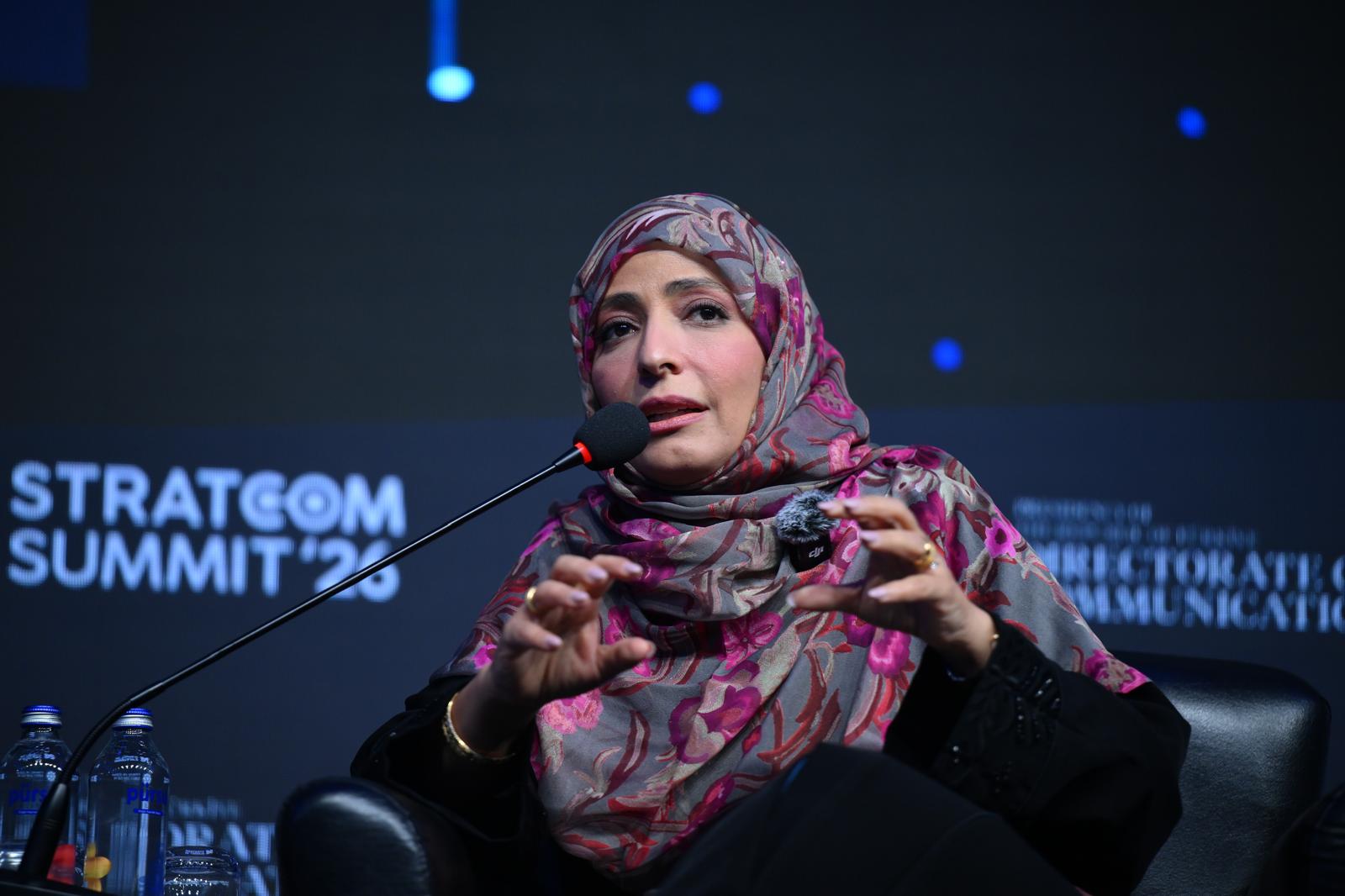
Held under the theme “Disruption in the International System: Crises, Narratives and Search for Order", the International Strategic Communication Summit (STRATCOM 2026) featured a one-on-one session titled “Being the Voice of Conscience Amidst Conflicts.”
The session was moderated by Prof. Kılıç Buğra KANAT, Member of the Presidential Security and Foreign Policy Council, featuring Tawakkol KARMAN, Journalist and Human Rights Activist from Yemen and Nobel Peace Prize Laureate, as a speaker.
Presidential Security and Foreign Policy Council member Prof. Kılıç Buğra Kanat touched upon the various definitions as to the developments in the international system, noting that some circles describe the process as "transformation", some as "fracture", and others as "erosion".
Kanat underscored that, despite the lack of a common definition of what is happening in the world as yet, the current process clearly represents a historical turning point.
Recalling that the reform of the United Nations (UN) has been a current topic of debate for many years, Kanat noted that these discussions are now being voiced not only on high-level platforms but also among broader segments of society.
Kanat stated, "The world is undergoing an unnamed but unambiguously historical global turbulence."
"The current system serves the interests of the major powers."
Yemeni journalist and human rights activist Tawakkol Karman stated that the current global order is facing serious criticism, noting that the situation is also regarded as an opportunity to establish a new world order.
Noting that the post-Second World War international system was built on rules and institutions, Karman argued that this structure has failed to function as intended and contains double standards.
Karman said, “The current system is viewed as a structure that serves the interests of major powers.”
Emphasising that the challenges facing the international system are not new but stem from deep-rooted structural problems that have existed since its establishment, Karman noted that the concentration of critical issues such as human rights, peace and security in the hands of a limited number of actors constitutes a major shortcoming.
Karman also stated that international institutions have failed to deliver justice at the expected level, adding that even mechanisms such as the International Criminal Court have fallen short in this regard.
Stating that the current situation goes beyond a crisis of global order, Karman said, “This is also a crisis of values, conscience and purpose.”
Emphasising that societies that have long been subjected to injustice must now raise their voices more strongly, Karman pointed to the need for a fairer and more inclusive global system.
She further stated that the tendency of major technology companies to treat users as commodities and advertising targets poses serious challenges for the digital ecosystem, while also drawing attention to the powerful role of social media in mobilising societies.
Noting that the global response to developments in Gaza clearly demonstrates this power, Karman stated that digital platforms carry both risks and opportunities.
“Women emerge in times of crisis but are sidelined afterwards”
Karman emphasised that women often display strong leadership during periods of war, crisis and revolution, but noted that this role is not adequately sustained once stability returns.
Stressing that women must be actively involved in decision-making processes at all times—not only during crises—, Karman highlighted the need for greater visibility and influence of women at the global level.