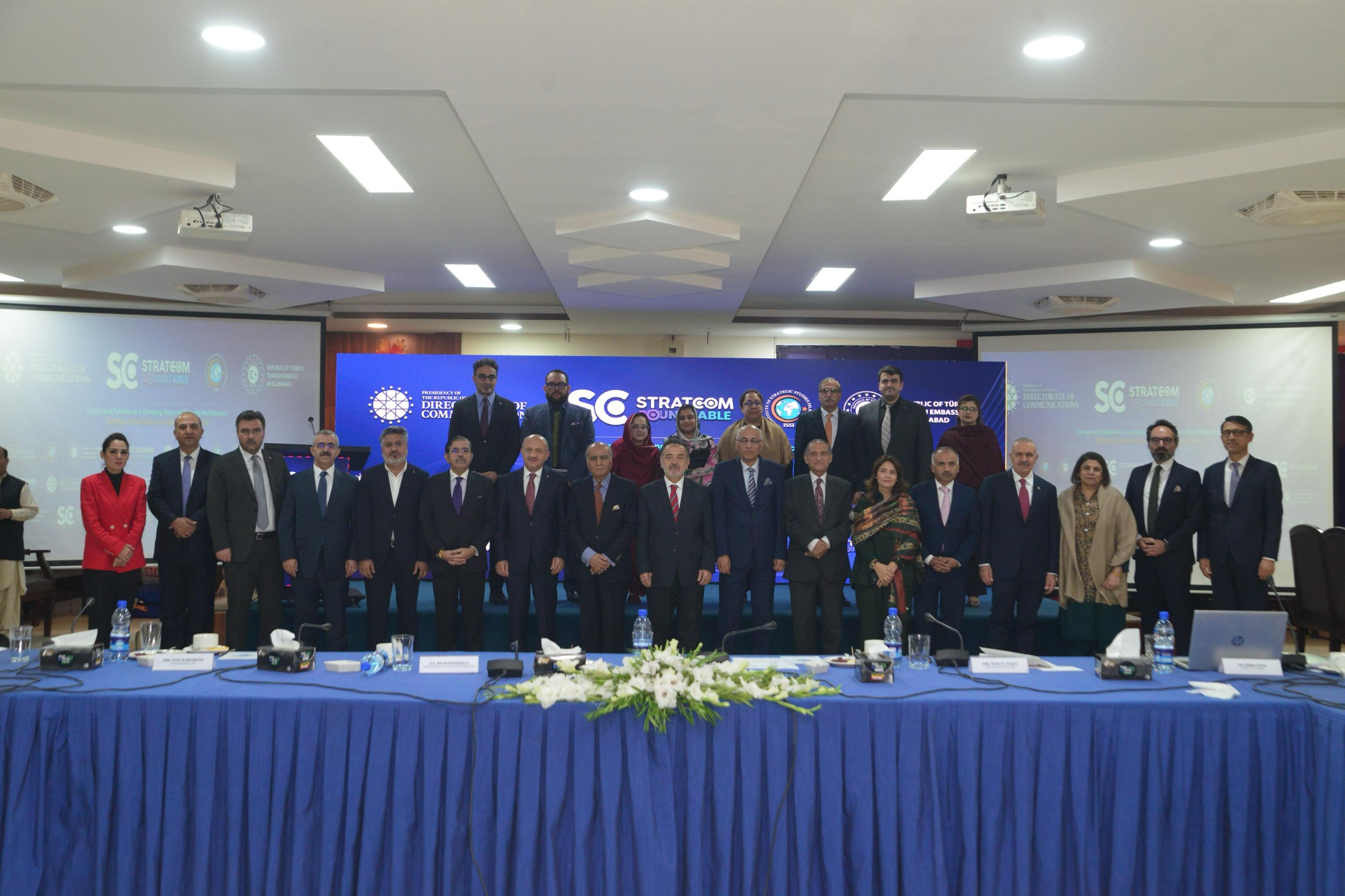
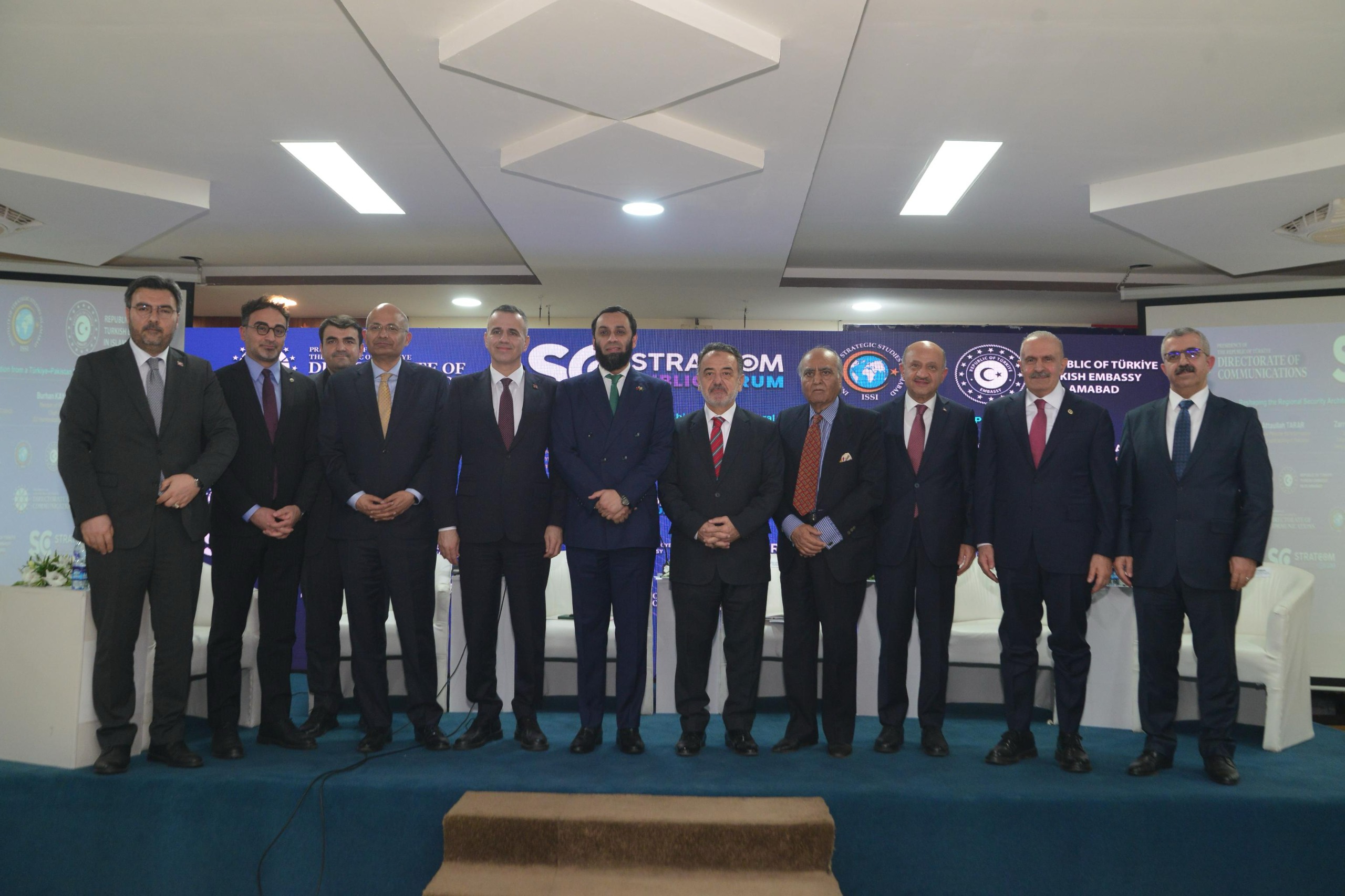
The STRATCOM Public Forum, held in Islamabad, the capital of Pakistan, under the coordination of the Presidency’s Directorate of Communications, addressed ways to strengthen the strategic partnership between the two countries, the evolving security environment and opportunities for multilateral cooperation.
Numerous senior officials and experts came together at the STRATCOM Public Forum and Roundtable, organised by the Directorate of Communications in cooperation with the Embassy of the Republic of Türkiye in Islamabad and the Institute of Strategic Studies Islamabad (ISSI).
The Presidency's Head of Communications Prof. Burhanettin Duran addressed participants via video message. Head of Communications Prof. Burhanettin Duran addressed participants via video message. Noting the growing importance of strategic communication at a time of geopolitical and technological transformation, Head of Communications Duran highlighted the critical role of international cooperation in addressing the challenges posed by disinformation and digital manipulation. Emphasising that STRATCOM serves as a platform for strengthening international dialogue, information sharing and cooperation, Duran underscored its significance in safeguarding information integrity and enhancing societal resilience.
The STRATCOM Public Forum, entitled "Reshaping the Regional Security Architecture: Strategic Partnership and Multilateral Cooperation from a Türkiye–Pakistan Joint Perspective", focused on strengthening the strategic partnership between the two countries, the evolving security environment and opportunities for multilateral cooperation.
Speakers at the STRATCOM Public Forum included Federal Minister for Information and Broadcasting of Pakistan Attaullah Tarar; former Minister of National Defence and Member of the Presidential Security and Foreign Policies Council Fikri Işık; Chair of the EU Harmonisation Committee of the Grand National Assembly of Türkiye and AK Party MP for Van Burhan Kayatürk; Federal Secretary for the Ministry of Information Technology and Telecommunication of Pakistan Zarrar Hasham Khan; and Member of the Presidential Security and Foreign Policies Council Prof. Muhittin Ataman. Opening remarks were delivered by Ambassador Khalid Mahmood, Chairman of the Board of Governors of the Institute of Strategic Studies Islamabad (ISSI), and Türkiye’s Ambassador to Islamabad İrfan Neziroğlu.
In his address, Ambassador Mahmood said that Türkiye-Pakistan relations, rooted in the Ottoman era, have evolved into a comprehensive strategic partnership, pointing out that both countries share a vision of a balanced and multipolar international order amid the global transformation process.
Highlighting Türkiye's support on the Kashmir issue and Pakistan's steadfast stance regarding Türkiye's sovereignty and territorial integrity, Mahmood noted that deepening cooperation in the defence industry, economy, technology, and regional connectivity contributes to regional stability and prosperity.
Foundation of Türkiye–Pakistan relations: Eternal brotherhood
Ambassador Neziroğlu described the relations between Türkiye and Pakistan as an "eternal brotherhood" and said that the bonds between the two countries rest not merely on shared interests or geographical proximity, but on a historical collective memory, mutual understanding, and a culture of solidarity.
Noting that the peoples of Türkiye and Pakistan have stood by one another in both joyful and difficult times, Neziroğlu said that in the current environment, where regional crises are increasingly intertwined and pressure on the international system is mounting, the trust-based relationship between the two countries has become even more valuable.
Neziroğlu recalled that Türkiye's support was clearly and strongly demonstrated during the period of heightened tensions for Pakistan in May 2025, underscoring that the Türkiye-Pakistan brotherhood fosters predictability, mutual trust, and strategic solidarity. He further said that Türkiye-Pakistan relations are not conjunctural or temporary but an enduring and deep-rooted brotherhood.
Proposal for institutional cooperation in strategic communication
Attaullah Tarar, the Federal Minister for Information and Broadcasting of Pakistan, said that relations between Pakistan and Türkiye are grounded in historical, cultural, and social ties predating Pakistan's founding.
Stressing that disinformation, misinformation, and cyber threats pose new challenges for both countries today, Tarar pointed to the need for more systematic and institutional mechanisms in the field of strategic communication. In this regard, he proposed drafting a cooperation agreement on strategic communication between the Ministry of Information and Broadcasting of the Islamic Republic of Pakistan and the Directorate of Communications of the Presidency of the Republic of Türkiye.
Tarar also highlighted the importance of forming joint working groups comprising public institutions, academia, and think tanks, coordinating communication efforts across digital platforms, and developing common verification mechanisms. Tarar also proposed strengthening cooperation between TRT and Pakistan Television (PTV), noting that tools such as AI-powered analysis and information monitoring could be used to combat disinformation. Tarar also put forward proposals including the creation of joint social media accounts by the two countries, closer ties and increased exchanges between media organisations, and greater involvement of young people in strategic communication activities. He noted that joint working groups could eventually evolve into a permanent Pakistan–Türkiye Strategic Communication Secretariat.
Former Minister of National Defence and Member of the Presidential Security and Foreign Policies Council, Fikri Işık, emphasised the need to step up cooperation between Türkiye and Pakistan amid the evolving global security landscape. Işık stressed the importance of a holistic approach to security, noting that current threats extend beyond conventional warfare to include cyber operations, technological competition, economic vulnerabilities, information manipulation, and critical infrastructure attacks.
Drawing attention to the need to move defence cooperation between the two countries beyond traditional procurement and technology transfer models, Işık proposed expanding joint research, development and production capacity. Işık noted the need to strengthen existing cooperation among universities, research centres and relevant institutions, emphasising the importance of expanding bilateral cooperation into broader regional partnerships with friendly and partner countries.
AK Party MP for Van and Chair of the EU Harmonisation Committee of the Grand National Assembly of Türkiye, Burhan Kayatürk, stated that Türkiye-Pakistan relations are rooted in historical, cultural and social solidarity, adding that the strong ties between the two countries constitute one of the key foundations of these ties. Kayatürk highlighted the importance of developing economic ties between Türkiye and Pakistan, stating that the goal of raising bilateral trade volume to 5 billion dollars should be achieved.
Zarrar Hasham Khan, Federal Secretary of Pakistan's Ministry of Information Technology and Telecommunication, stated that the concepts of sovereignty and security are changing in the digital age and emphasised the strategic importance of protecting critical information infrastructure as part of national security. Khan noted that disinformation, cyberattacks, and the manipulation of information flows pose new threats to societies and public opinion, and stressed the need to strengthen institutional cooperation between Türkiye and Pakistan on cybersecurity.
Prof Muhittin Ataman, a member of the Presidential Security and Foreign Policies Council, assessed the role of Türkiye–Pakistan relations in new security initiatives. Ataman highlighted the potential of such initiatives, particularly trilateral defence cooperation among Türkiye, Pakistan, and Saudi Arabia, to shape the security architecture, stressing the importance of countries with common interests cooperating across platforms and combining their military, political, and economic capabilities.
Ataman stated that the Türkiye–Pakistan partnership could extend beyond defence and develop into a broader framework of cooperation encompassing political and economic dimensions. He stated that developing joint defence capabilities is important both for preparedness against existing security threats and for deterrence.
Regional security architecture was also discussed at the Roundtable
Prof Ferhat Pirinççi, Deputy Head of Communications of the Presidency of the Republic of Türkiye, and Ambassador Moin ul Haque, Director General of the Institute of Strategic Studies Islamabad (ISSI), addressed participants at the opening of the STRATCOM Roundtable, held under the theme “Türkiye and Pakistan in the Evolving Regional Security Architecture: Strategic Cooperation in an Era of Global Crises”.
The Roundtable addressed Türkiye–Pakistan relations, the Makkah Agreement and regional developments. The session highlighted the impact of growing geopolitical competition on traditional multilateral mechanisms and emphasised that security threats now extend beyond conventional domains to include hybrid warfare, terrorism, cyberattacks, systematic disinformation and attacks targeting critical infrastructure, including energy and connectivity corridors
It was stated that the longstanding strategic partnership between the two countries should be strengthened by developing joint capabilities to counter new-generation threats.