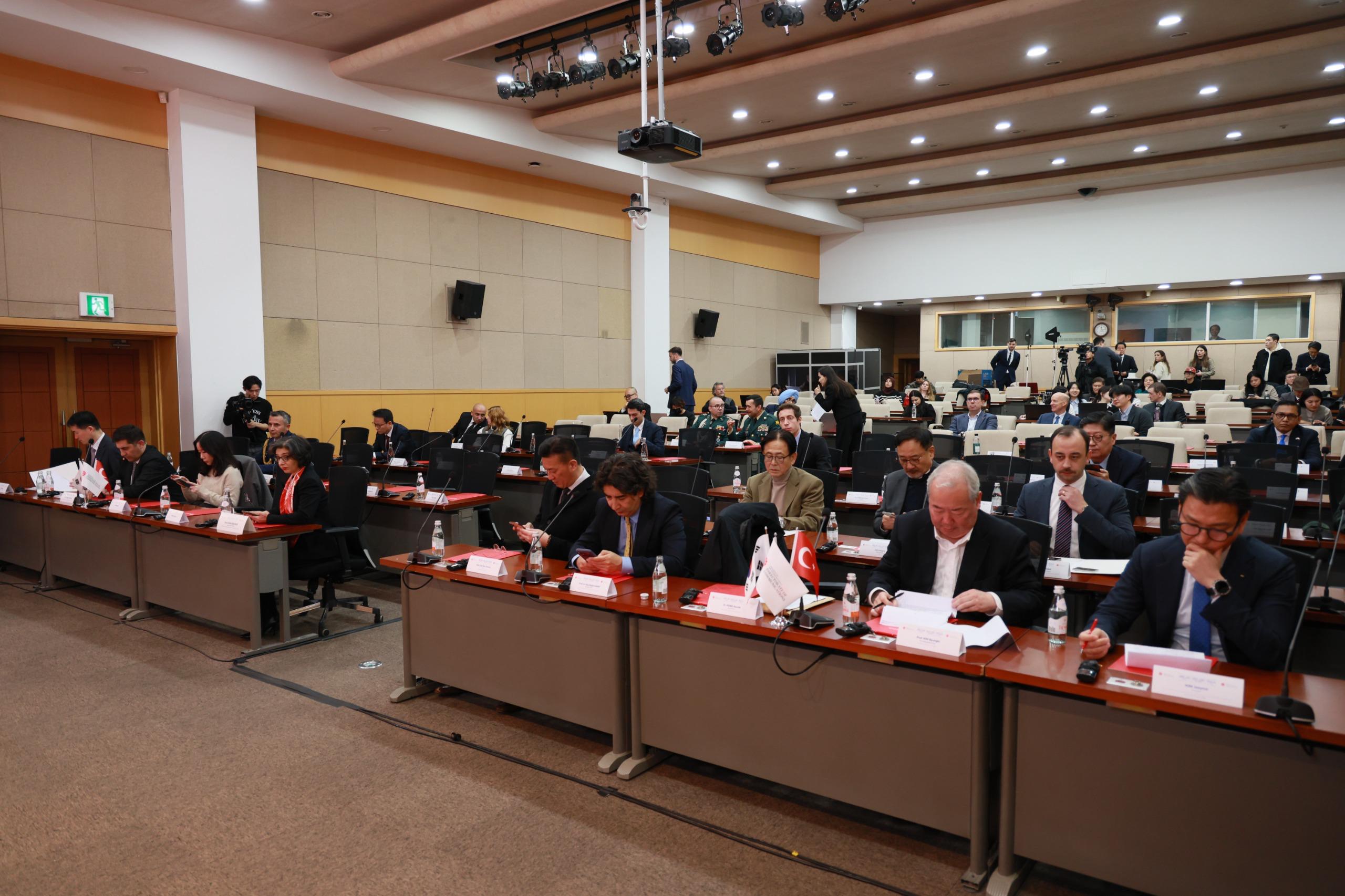
On 15 December 2025, the Directorate of Communications organised a round table and the Türkiye-Korea Strategic Partnership and Beyond Panel to commemorate the 75th Anniversary of Türkiye's participation in the Korean War.
As part of the "Türkiye Meetings" held in Seoul, the capital of the Republic of Korea (ROK), a roundtable, exhibition opening, and panel programme were organised to commemorate the 75th anniversary of Türkiye’s participation in the Korean War. The event addressed the historical friendship forged during the Korean War and its current and strategic dimensions between the two countries.
At the roundtable meeting, participants emphasised the need to transform the strong bond, rooted in the "blood brotherhood" narrative from the Korean War, into a more institutional and sustainable framework through scientific, cultural, and academic collaborations in line with contemporary realities.
The meeting also underlined the need for digital communication targeting younger generations, enhancing mutual understanding, and establishing channels of regular interaction.
The opening speech of the panel held as part of the event was delivered by Prof Kim Byungki. In his speech, Byungki noted that the legacy of Türkiye–Korea relations, which is rooted in the historical friendship shaped by the Korean War, should be carried forward into the future through a strategic partnership approach.
Subsequently, the President of the Samsung Global Strategy Group (GSG), a Samsung business group, and Member of the International Olympic Committee, Kim Jae-Youl, commented on the deepening of economic and strategic cooperation between the two countries.
“Turkish military left an ever-lasting mark on people’s memories through its humanitarian and conscientious stance."
A message from the Presidency's Head of Communications, Burhanettin Duran, was read at the panel. In his message, Head of Communications Duran emphasised that the Korean War marked a historical turning point for the bilateral relations, noting that Türkiye stood in solidarity with the Korean people by answering the United Nations’ call and made significant sacrifices on the battlefield, deploying more than 21,000 troops.
Head of Communications Duran highlighted that the Turkish military is recognised not only for its military accomplishments but also for its humanitarian and conscientious approach, pointing out that in the post-war period, Türkiye-Korea relations flourished based on friendship, solidarity, and mutual trust, achieving the status of "brother countries." Vice Minister Oh Kyungjun delivered a message on behalf of Minister of Patriots and Veterans Affairs Kwon Oh-Eul.
Addressing the panel session, Prof Murat Yeşiltaş highlighted that the relationship between Türkiye and South Korea has evolved from a foundation of historical brotherhood to a strategic partnership defined by security and multidimensional cooperation, emphasising that, in light of a changing international system, this relationship has taken on a more practical dimension in areas such as defence, technology, and security. Yeşiltaş explained how Türkiye has the capacity to engage actively in regional security and crisis management, underscoring the significance both countries attribute to multilateralism as middle powers within MIKTA.
Kadir Üstün (PhD) emphasised that Türkiye’s foreign policy is based on striking a balance among major powers and pursuing stability and peace, adding that Türkiye has consolidated its regional role through increased military, economic, and diplomatic capacity. Emphasising how Türkiye–South Korea relations are founded on a strong awareness of national security, Üstün pointed out the importance of cooperation prospects in the defence industry and multilateral diplomacy.
Hyunik Hong (PhD) noted that the relations that emerged from symbolic brotherhood following the Korean War have, in recent years, matured into strategic cooperation as a result of sustained summit-level and diplomatic engagement. Referring to the increase in trade relations following the Free Trade Agreement, Hong noted that the complementarity of the two countries’ industrial and economic infrastructures offers new opportunities for cooperation in the fields of defence, energy, and high technology.
Sung-Wook Nam (PhD) said that the complementary capabilities Türkiye and South Korea possess in the defence industry have been translated into concrete joint projects, adding that there is long-term cooperation potential in areas such as technology transfer, joint production, and human-resource exchange.