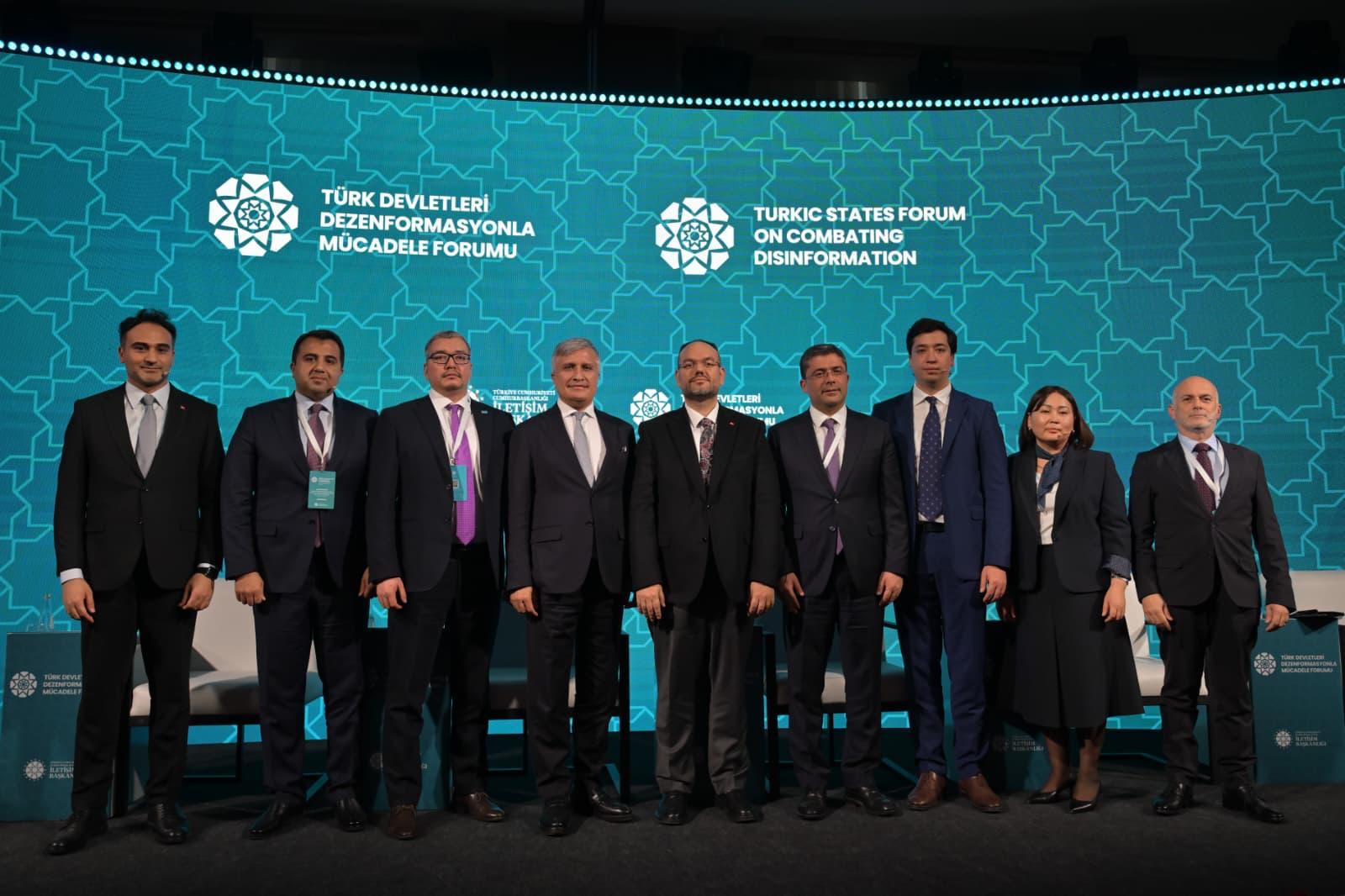
As part of the Turkic States Forum on Combating Disinformation, the Directorate of Communications hosted a panel on "Examples of Disinformation Targeting the Turkic World and Counter-Disinformation Efforts".
Speaking at the panel moderated by the Coordinator of the Centre for Combatting Disinformation at the Presidency's Directorate of Communications, Deniz Demir, were Head of the Communication Policy Division of the Department for Work with NGOs and Communication of the Presidential Administration of the Republic of Azerbaijan, Javid Musayev; Deputy Chairman of the Information Committee of the Ministry of Culture and Information of the Republic of Kazakhstan, Ilyas Yesmagul; Chief Specialist of the Information Policy Department at the Ministry of Culture, Information, and Youth Policy of the Kyrgyz Republic, Zarina Tashtanovna Kalmuratova; Head of Department at Centre for the Production of Content for Mass Media under the Administration of the President of Uzbekistan, Tokhir Umarov and the Director of the Turkish News Agency (TAK) Fehmi Gürdallı.
In his speech, Musayev thanked those who contributed to the organisation of the forum. Highlighting that the world is changing and that one of the greatest threats to a nation today is information interference, Musayev stated, "Every country must be individually prepared for these attacks."
Musayev stated, "Information security is an integral part of national security," and elaborated on how Azerbaijan has recognised the significance of combating disinformation, drawing on its experiences during the Second Karabakh War.
Musayev noted that during this period, leading international press organisations prioritised witnessing events firsthand, and that President Ilham Aliyev of Azerbaijan served as the official source of information on the battlefield, emphasising the significant support provided by media organisations and institutions in Türkiye.
Yesmagul emphasised the influence of the information environment on political and other processes, highlighting the significance of advancing media literacy and information security.
Noting that young people make up the most active segment in the media sphere, Yesmagul added that initiatives like expert verification and the adoption of modern data analytics methods are part of systematic efforts.
The Deputy Chairman stated that his country is actively pursuing joint initiatives and enhancing media literacy and information security, emphasising that Kazakhstan is highly open to cooperation aimed at promoting both regional stability and global information security.
The importance of media literacy
Kalmuratova highlighted the significant value of representatives from Turkic States exchanging their knowledge and experiences in the field of media literacy with one another as part of the forum.
Noting that a significant volume of both accurate and false information circulates through smartphones on social media in the digital age, Kalmuratova highlighted the crucial role of media literacy in everyday life, particularly in light of interactions established with unfamiliar individuals online.
Citing the fraud cases within Kyrgyzstan during 2021, Kalmuratova said that the Ministry of Culture, Information and Youth Policy launched training programmes aimed at enhancing media literacy across the country as of 2025.
Media content-related efforts in Uzbekistan
Head of the Content Production Department for Media at the Presidential Administration of Uzbekistan Umarov also emphasised that their centre operates as both a content-creating and capacity-building organisation, adding that their primary objective is not only to counter misinformation but also to limit the areas in which such information can have an impact.
Umarov indicated that their efforts concentrate on the training of media professionals and content creators, adding that they collaborate closely with digital content creators. Umarov noted that their centre actively endorses the creation of high-quality, credible, and engaging content, emphasising that misinformation can disseminate rapidly.
Highlighting the significance of network literacy in their efforts, Umarov noted that they are designing educational materials and methods for students, educators, and the general public. Pointing to the significance of the event, Umarov expressed gratitude to the officials of the Directorate of Communications.
"Disinformation has made societies more vulnerable to provocation"
Gürdallı said that this era is widely seen as one in which intercultural dialogue will deepen, communication will become faster and people will connect more easily, but added that fake profiles and false news have emerged alongside these developments.
Highlighting how fear, insecurity and polarisation have become dominant sentiments in societies, Gürdallı said, “Disinformation, information pollution and organised false news have made societies more vulnerable to provocation, particularly during times of crisis.”
Gürdallı said that false news spreads six times faster than accurate information, adding that even when accurate information is published, it is often unable to curb its spread.
Drawing attention to the critical significance of media literacy and information security, Gürdallı emphasised that disinformation encompasses more than just false or fake news, pointing out that news blackouts also represent a form of disinformation.
The panel concluded with a session dedicated to questions and answers.