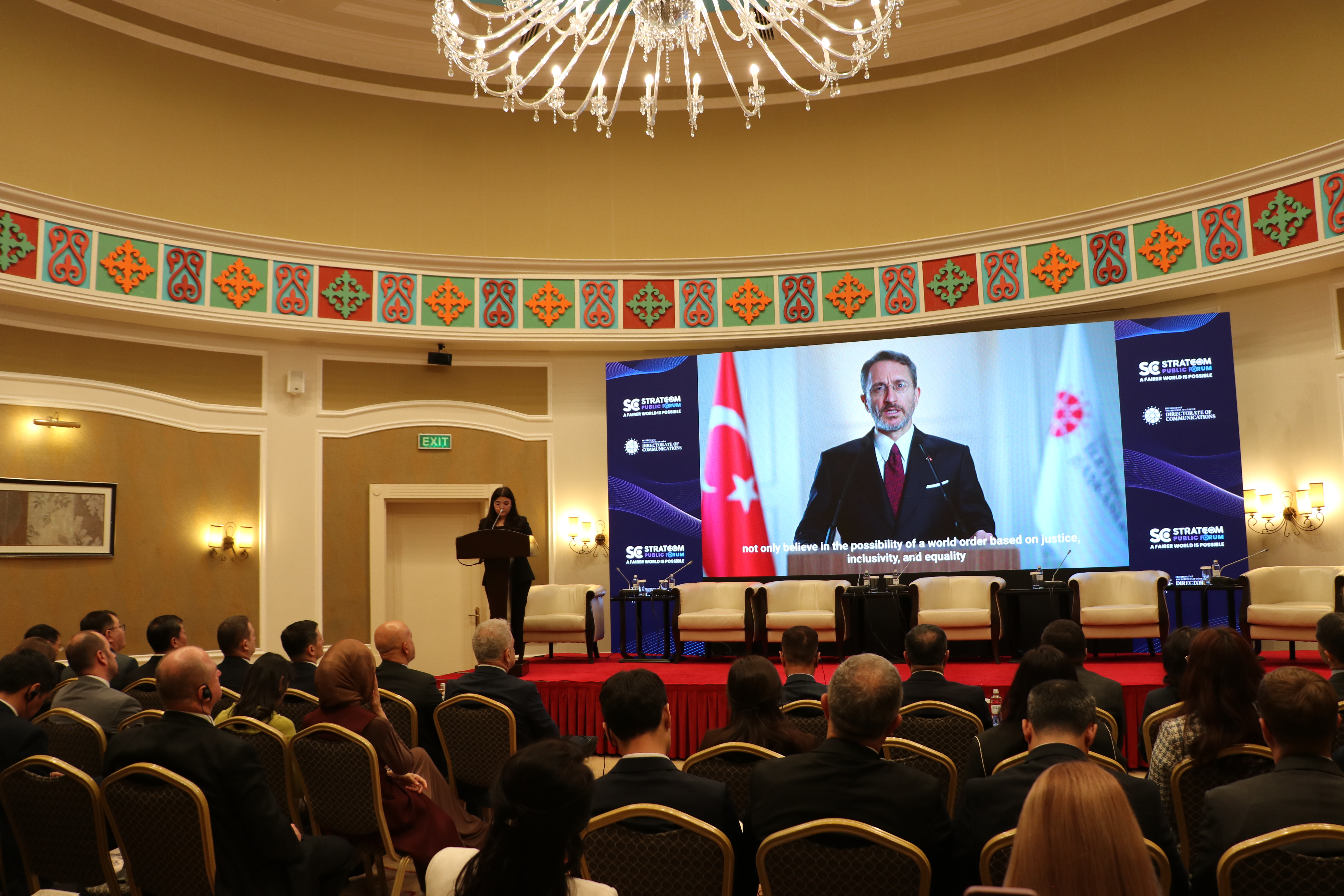
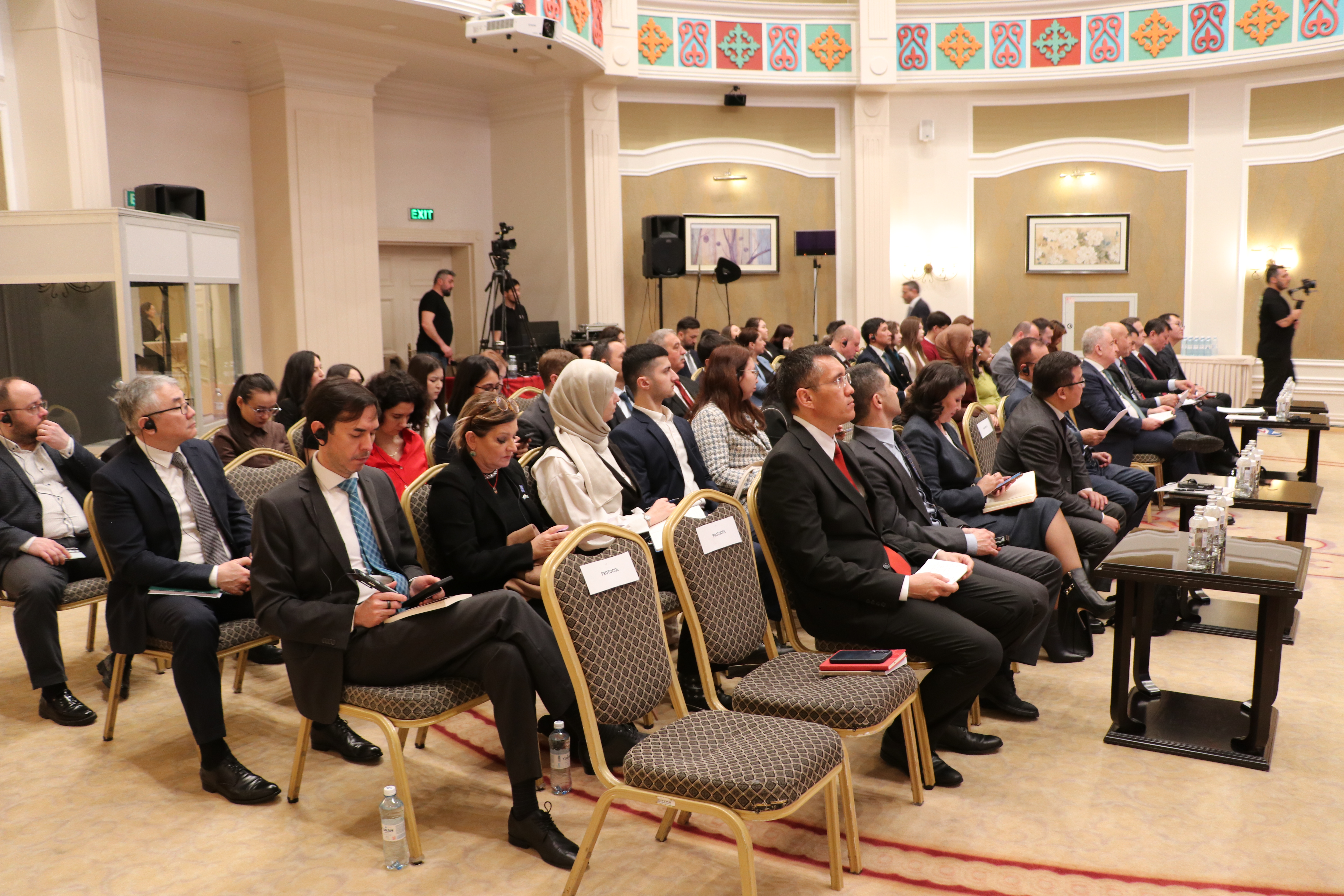
The "A Fairer World is Possible" panel series launched by our Directorate was held in Astana, the capital of Kazakhstan.
The panel kicked off with the screening of the video "A Fairer World is Possible" and was attended by Kazakh academics, representatives of the country's leading research centres, political and international relations experts, ambassadors, members of the press and university students.
This was followed by the delivery of a video message from the Presidency's Head of Communications, Fahrettin Altun.
Moderated by the Director of the Eurasian Research Institute, Assoc. Prof. Suat Beylur, the panel's opening remarks were delivered by the Turkish Ambassador to Astana, Mustafa Kapucu.
Attending the panel as speakers were the Head of the UN Resident Coordinator's Office in Kazakhstan, Kurtmolla Abdulganiyev; a faculty member from the Department of Political Science at L.N. Gumilyov Eurasian National University, Prof. Janat Momunkulov, and its Head of the Department of International Relations, Assoc. Prof. Gulsum Kenzhalina; the Head of the Department of International Security at the Kazakhstan Institute for Strategic Studies under the President of the Republic of Kazakhstan, Dauren Aben; and the Editor-in-Chief of Aiqyn Newspaper, Amangeldi Qurmetuly.
In his opening address at the panel, Ambassador Kapucu argued that the world is experiencing a significant era in history, one involving global turning points, saying, "The international community and its members, the United Nations, are going through a historical test."
Kapucu pointed out the growing disparities in income distribution and the decreasing capacity to address crises and conflicts, stating: "Our experience in recent years has clearly shown us that no country can tackle the challenges of the modern era in isolation. In this regard, Türkiye has always been a strong advocate of multilateralism. Founded with great aspirations, the UN has upheld its central position at the core of multilateralism for almost 80 years. However, as pointed out by our President's address to the 79th session of the UN General Assembly, the UN has failed to fulfil its founding mission in recent years."
Kapucu highlighted the world's need for a multilateral system that is simultaneously more inclusive and sensitive to global problems and stated, "We must reorganise the multilateral system to pass down a 'fairer world' for future generations."
Reminding that Türkiye is a founding member of the UN, Kapucu added, "Türkiye is ready to fully support all efforts to bring forth a UN that will lead and inspire. We believe that Security Council reform is one of the most crucial steps in this process."
Pointing out that the UN Security Council's ongoing paralysis prolongs deadly conflicts—claiming the lives of millions of civilians— and undermines the credibility of the UN system as a whole, Kapucu said:
"Consider the situation in Gaza; since October 7, 2023, over 50,000 Palestinians have lost their lives, millions have been forcibly displaced from their homes, the region is in a state of complete ruin, and genocide is being perpetrated in full view of the public while the UN Security Council remains idle, turning a blind eye and a deaf ear. It has been approximately 62 years since the sovereignty rights of the Turkish people on the island of Cyprus were usurped, accompanied by crimes against humanity committed against the Turkish community. At that time, the UN Security Council's inaction facilitated the commission of unprecedented atrocities on the island. Fifty-one years have passed since our operation that ensured peace between the two communities on the island of Cyprus. The island is home to two separate states and two separate peoples. The international community must now recognise Turkish Cypriots' vested rights, which are sovereign equality and equal international status. It is necessary to build diplomatic, political, and economic ties with the Turkish Republic of Northern Cyprus."
The Head of the UN Resident Coordinator's Office in Kazakhstan, Kurtmolla Abdulganiyev, underscored the significance of the leadership of all member states and Türkiye in enhancing the multilateral role of the UN, stating that this panel and similar events serve as a critical platform for the exchange of ideas.
Abdulganiyev noted that the current state of affairs is characterised by climate change, food security, migration, and displacement crises, and the number of displaced individuals has surpassed that of World War II.
In this light, Abdulganiyev emphasised the critical role of the "Pact of the Future," which has the capacity to influence the resolution of current global crises and outlines resolutions on the engagement of all member states in implementing the UNSC reform.
Momunkulov remarked that the question of how the Turkic world should chart a course in the emerging world order has become prominent.
The strategic role of Central Asia, a key region of the Turkic world, has grown in this order, according to Momunkulov, who also noted that Türkiye's military wing has been strengthened, turning it from a soft power to a militarily stronger nation. He argued that Kazakhstan and Azerbaijan are also middle powers, so they should collaborate on projects in the fields of economics, the Middle Corridor, military and defence, culture, and education.
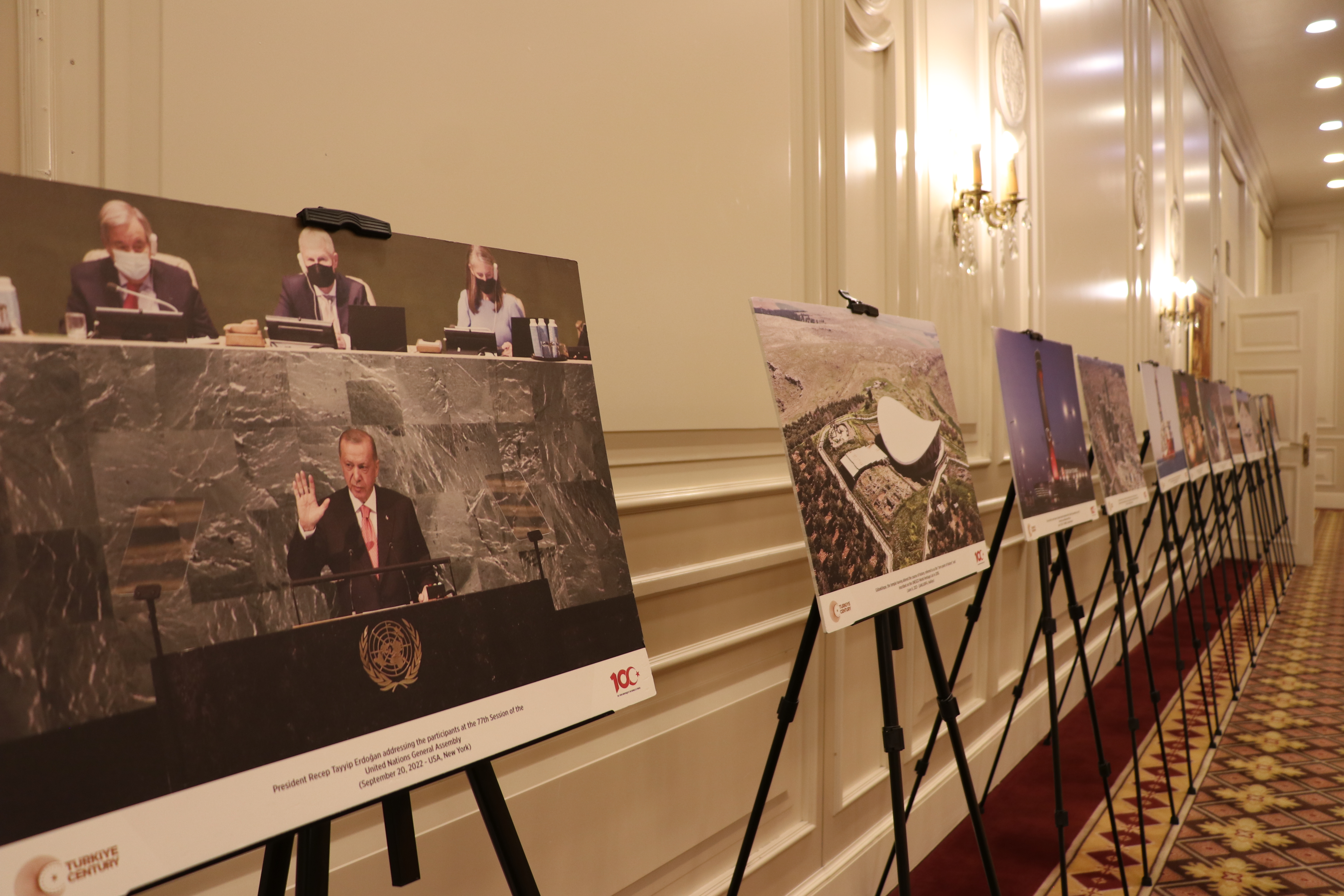
The panel concluded with the tour of the "Century of Türkiye" photo exhibition, the screening of the documentary "Devrim," which follows the life of painter Devrim Erbil, and the giveaway of President Recep Tayyip Erdoğan's book "A Fairer World is Possible," which was published in Kazakh by the Communications Counselor's Office of the Turkish Embassy in Astana.