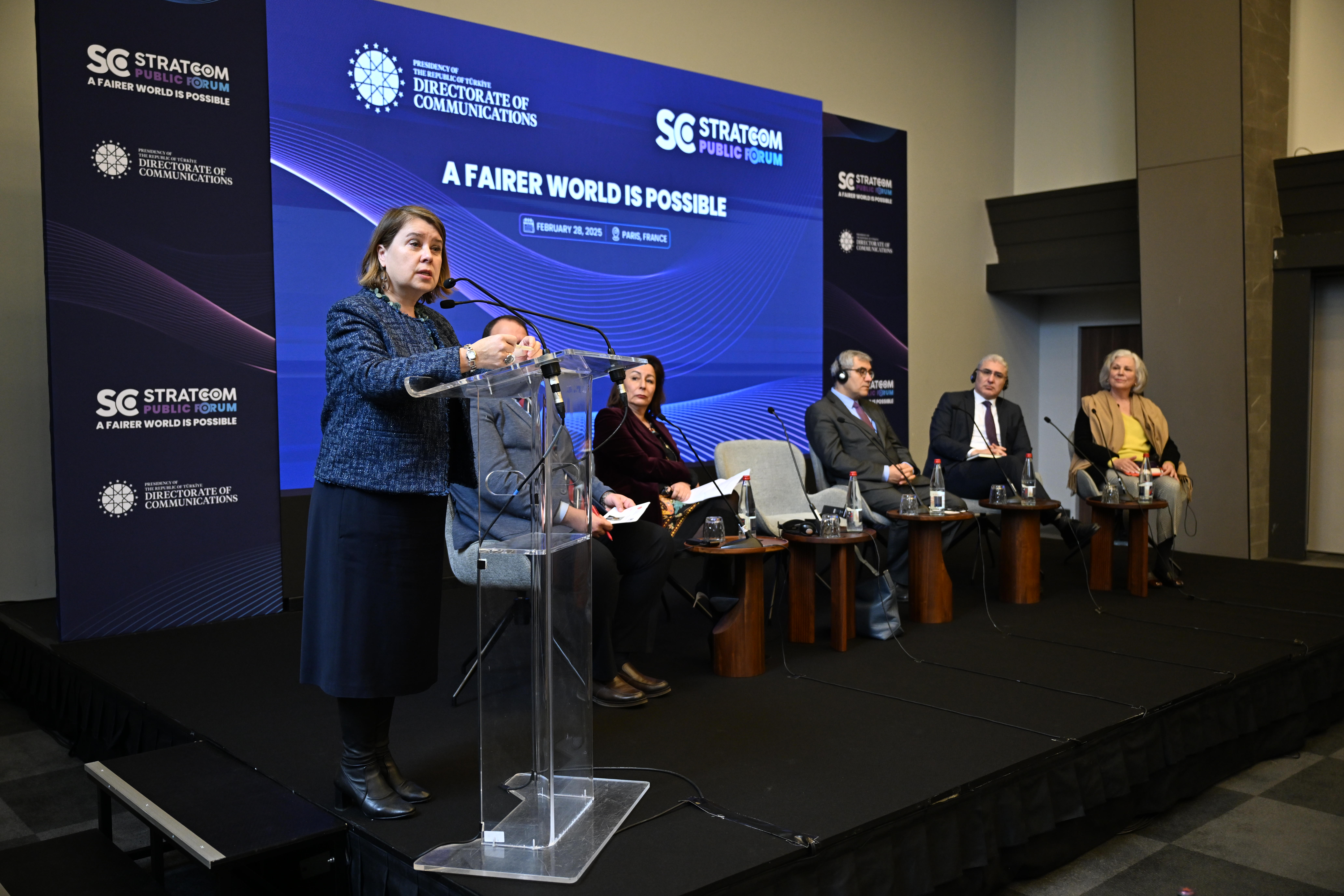
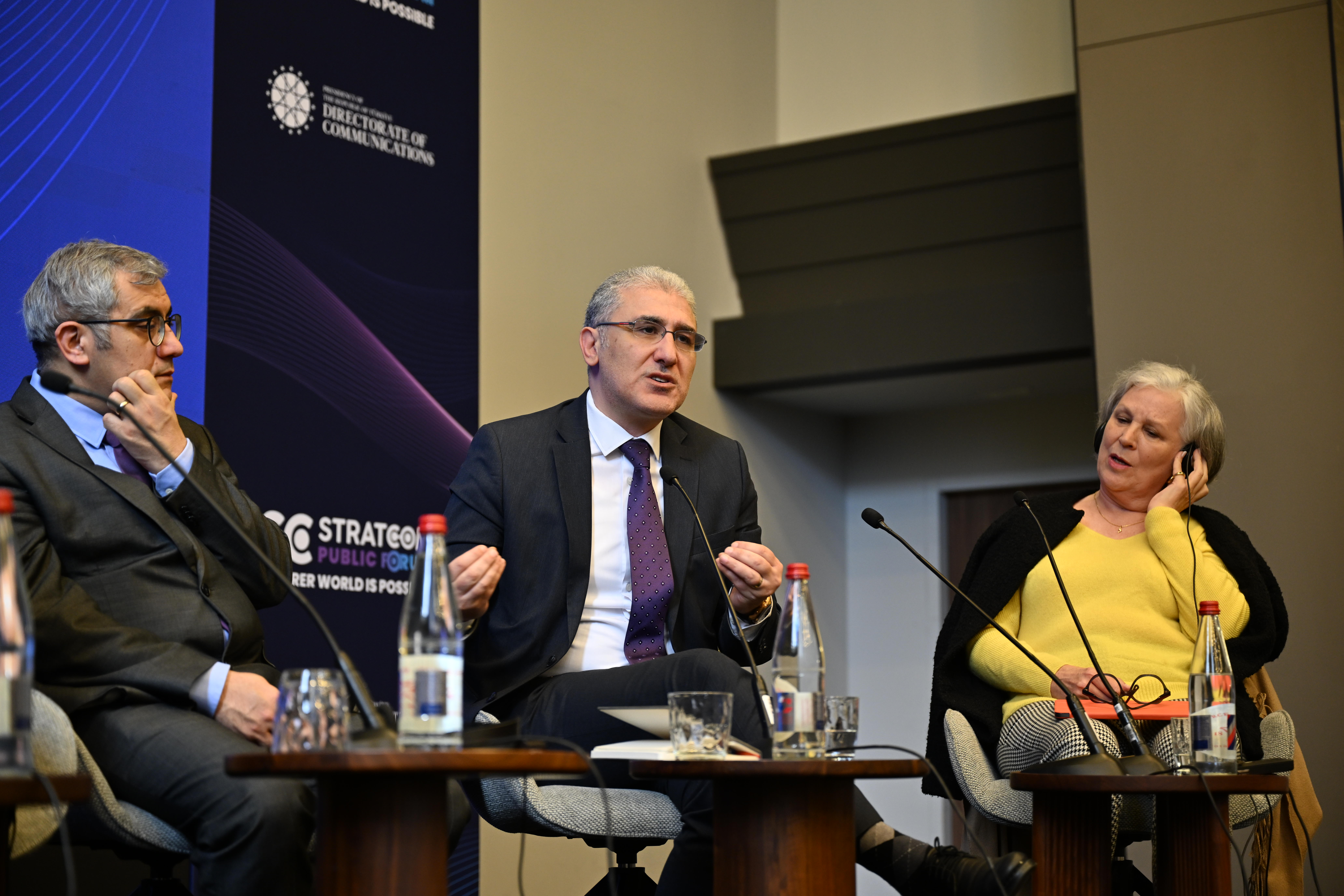
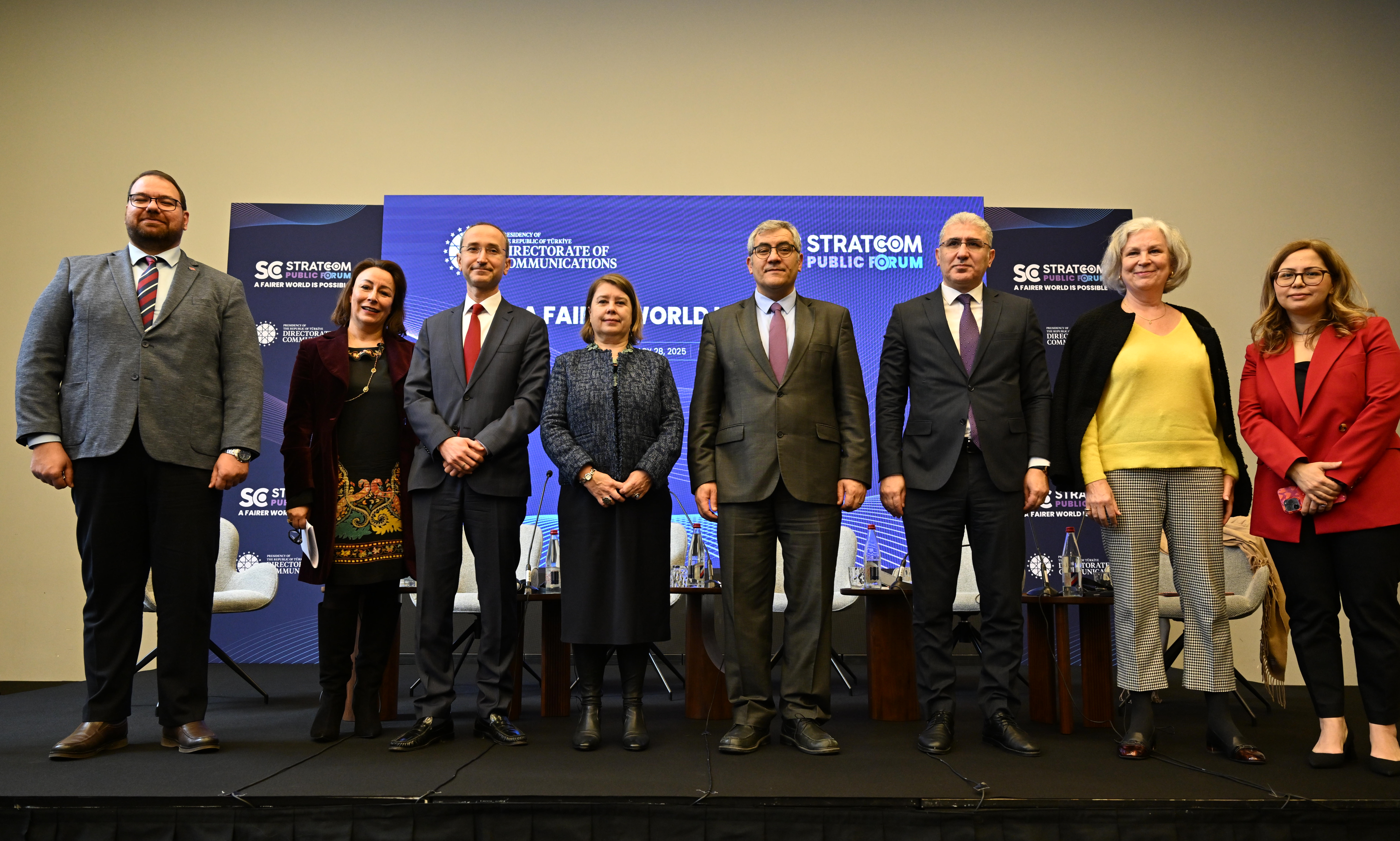
Our Directorate held a panel titled "Stratcom Public Forum: A Fairer World is Possible" in Paris, the capital of France.
The Pullman Paris Tour Eiffel Hotel in Paris hosted the panel discussion attended by Türkiye's Consul General in Paris, Kerem Yılmaz, along with journalists, academics, members of non-governmental organisations, and numerous guests.
The panel, moderated by Prof. Erman Akıllı from Ankara Hacı Bayram Veli University, focused on exploring the ways to achieve a fairer world.
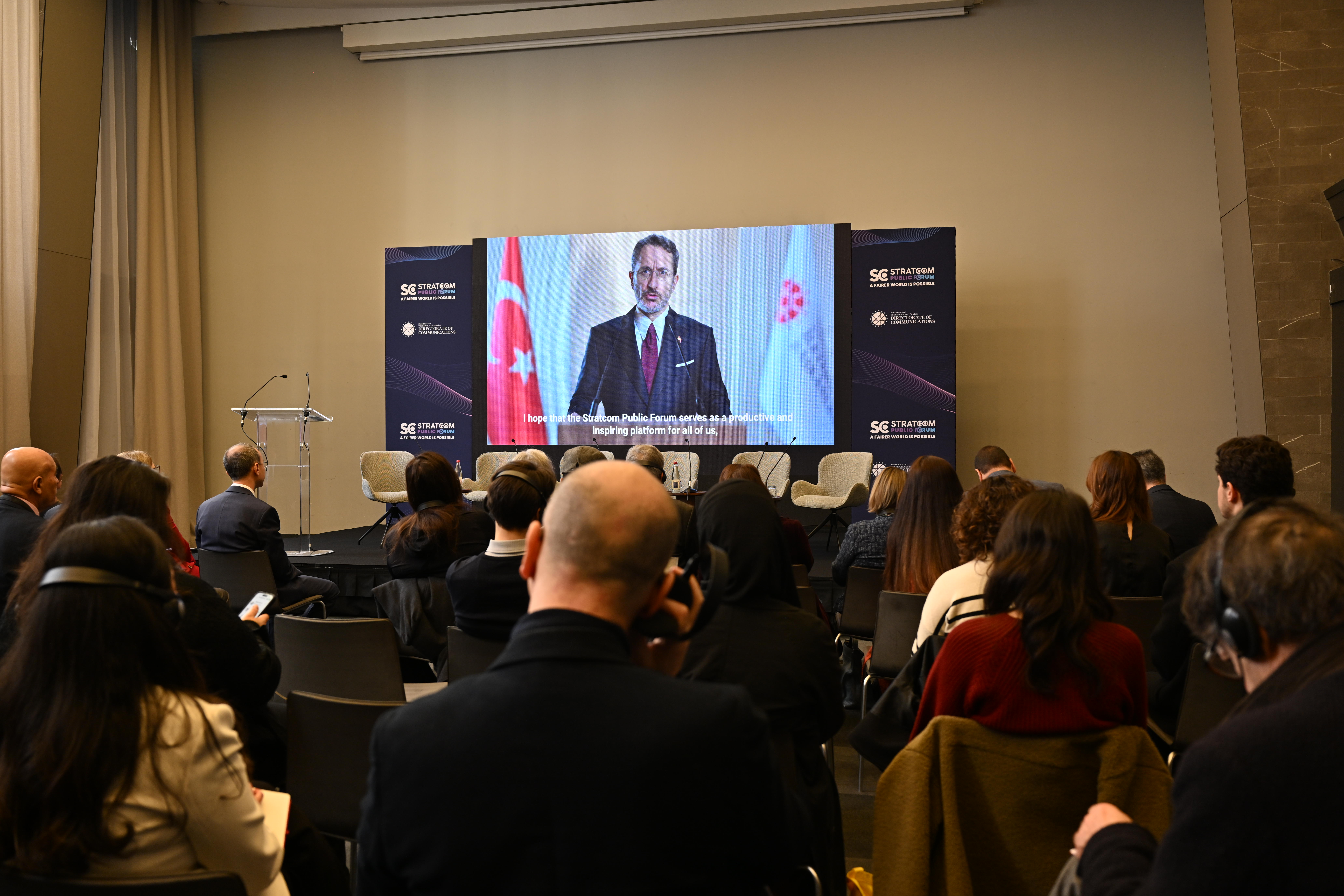
The panel opened with a video message from the Presidency's Head of Communications, Fahrettin Altun.
Addressing the opening session, Local Clerk at the Office of Communications Counsellor at the Turkish Embassy in Paris, Şelale Sarıtaylı-Alvado, pointed out that the panel aimed to contribute to the discourse on the reform of international institutions and to highlight Türkiye's vision of "A Fairer World."
"As global issues persist, international organisations have become increasingly less effective in developing sustainable solutions. Through its enterprising and humanitarian foreign policy approach, Türkiye advocates for a more inclusive, transparent, and accountable multilateral system to address these issues," said Sarıtaylı-Alvado.
Sarıtaylı-Alvado expressed that the panel seeks to highlight the necessity for transformation within the current international system to achieve fair resolutions to global and regional crises, adding:
"Türkiye offers a distinctive viewpoint on enhancing the participatory and responsive nature of international institutions. This argument is part of a more comprehensive effort advocating that a global governance structure that is fairer and more effective is not only possible but also essential. We intend to engage the international public, decision-makers, and stakeholders in meaningful dialogues and increase awareness of Türkiye's proposal for change in international institutions by holding these panels in different parts of the world."
"Türkiye is a nearly perfect candidate for the UNSC given its geographical position"
Associate researcher at the Centre Thucydide at Paris-Panthéon-Assas University (Paris II), Alexandra Novosseloff, noted that the debate surrounding the United Nations Security Council (UNSC) reform has been ongoing for an extended period; however, there is a discrepancy between theory and practice.
Novosseloff highlighted the failure of the five permanent members of the UNSC to settle on a solution for Gaza and underscored the significant contribution of the ten non-permanent members in brokering a ceasefire in the region.
Novosseloff expressed that a new question is currently on the agenda: "Should new permanent members be granted veto power for UNSC or not?" adding that India, Japan, and Indonesia—the country with the largest Muslim population—are among the candidates for permanent membership.
"A country that is perpetually embroiled in conflict should not have the legitimacy of becoming a permanent member (of the UNSC) in any way," Novosseloff remarked, noting that various states oppose, for various reasons, those countries aspiring to become permanent members of the UNSC.
"To my knowledge, Türkiye has not officially declared its candidacy for the UNSC. However, I can confidently say that it is a nearly perfect candidate given its geographical position," Novosseloff stated, emphasising the need to respect the Security Council's resolutions.
"Unfair global governance complicates the resolution of issues such as climate change"
Prof. Oktay Tanrısever from the Department of International Relations at Middle East Technical University emphasised that reforming UN institutions would enhance the effectiveness of measures to address common challenges, such as climate change.
"The world is currently experiencing a severe crisis in global governance. Various countries, writers, and circles have been emphasising the necessity of reform since the 1960s," Tanrısever said and emphasised the necessity of making efforts to ensure that global governance is more equitable, quoting President Recep Tayyip Erdoğan's motto, "The world is bigger than five."
Tanrısever noted that fairer governance will be possible through collaborative efforts.
Tanrısever underlined that fairer global governance will also benefit the five veto-wielding countries in the UNSC, noting that in a world where countries like Japan, Türkiye, and Brazil are increasingly involved, these countries with veto power can achieve their objectives "more effortlessly."
Tanrısever emphasised that unfair global governance adversely impacts the resolution of global issues such as climate change, stating, "Climate change is a challenge for all, both wealthy and underprivileged countries. Despite widespread complaints, it is clear that the UN vision established by those five countries prevails over the global one regarding both problem analysis and resolution strategies."
Tanrısever noted that developed countries, which accomplished the industrial revolution, should contribute more significantly to addressing climate change while contending that developing countries "do not contribute sufficiently" to the regulations concerning these matters, adding, "There is plenty of talk, but little action is taken."
Tanrısever underscored that, as a signatory to the Paris Climate Agreement, Türkiye is making significant efforts to develop new technologies and produce new solutions in energy transformation through its own means.
"It has started to become an institution where everyone has to make sacrifices, except for the five permanent members."
The Founder and Chairwoman of the Board of Directors of the think tank Geopragma, Caroline Galacteros (PhD), expressed her pleasure at being invited to the event.
Galacteros explained that the world shifted towards realism following World War II, and the United Nations (UN) was established as a "revolutionary" organisation in the process.
Noting that a consensus was reached regarding the necessity of UN reform over time, Galacteros mentioned that proposals were made regarding the veto power and the number of members in the UNSC.
Galacteros pointed out that many of the resolutions adopted at the UN General Assembly no longer have the potential to generate a solution, emphasising that institutions such as the UN should be overhauled to solve today's problems.
"All of this raises the question, 'What is the UNSC good for?' because there is a crisis of representation, influence, and therefore credibility," Galacteros said.
Galacteros, considering the UN Security Council and General Assembly, noted that especially the permanent member states have found a way to impose their own interests on other countries, saying, "It has started to become an institution where everyone has to make sacrifices, except for the five permanent members." regarding the UNSC.
Reminding that many countries, such as Kosovo and Iraq, have experienced wars in the last 20-30 years, Galacteros pointed out that the UN has failed to generate an effective solution in this regard. Galacteros argued that this is not a minority opinion and noted that people no longer take the UNSC seriously.
Galacteros indicated that as the gap between words and actions in the international arena widens, countries unable to counterattack are forced to strengthen themselves, and a new power model is being imposed on the world.
Underlining that the world needs to undergo an adaptation process, Galacteros said that the idea of representing the African continent with two permanent seats in the UNSC has been proposed; however, uncertainty remains as to which countries would represent the continent.
Galacteros expressed that she is not in favour of France preserving its permanent seat at the UNSC and continued, "Finally, I would like to touch on an important issue. In the event of a UN reform, the framework of the Security Council's right to veto must be established."
"The EU must view Türkiye as a partner rather than a rival or threat"
Prof. Gültekin Yıldız from the National Defence University said that, for the past two centuries, Western modernity has promised to civilise the rest of the world and bring civilisation to these regions. Still the tragedies in Gaza, Ukraine, and East Turkistan contradict this promise.
Yıldız said, "In Gaza in 2024, we saw human corpses lying on the streets, uncollected and consumed by dogs, as the Red Cross and Turkish Red Crescent were not allowed to enter. Likewise, for the first time, we have seen that more than half of the 45,000 casualties in an armed conflict are children."
Yıldız mentioned that in the history of the world, there have never been so many child casualties in a conflict; similarly, many children were abducted and separated from their families in Ukraine, and children in East Turkestan and Tibet in China were taken to concentration camps, pointing out that the US, supporting Israel in Gaza, Russia, invading Ukraine, and China, where these atrocities are taking place, are permanent members of the UNSC.
Yıldız noted that in the 1980s, people believed that "the great Western countries were producing values that would modernise us or elevate us to a more advanced human condition despite everything," but this notion has been shaken.
Stating that Europe is one of the world's leading regions in terms of value production, Yıldız remarked, "On the ground, Europe is far from reflecting the values it claims to advocate for because it lacks military power within both the UN and NATO, meaning it does not wish to intervene militarily in conflicts."
Yıldız indicated that Türkiye, which he described as "neither Eastern nor Western, neither fully European nor fully Asian," is aware of the necessity to defend humanitarian values on the ground, not only as a rising country but also as a nation that has been hosting diverse cultures for centuries.
Yıldız mentioned that there have been atrocities in different parts of the world for years, but situations in Gaza and Ukraine show that "at least three of the five permanent members of the UNSC have now given up on defending universal values" and said that the EU should also be "alarmed" by the extent to which the US, in particular, has given up on the defence of universal values.
"EU member states must make a decision and review their relations with Türkiye. This could involve the EU membership for Türkiye or another form of relationship. However, the EU must now view Türkiye as a partner that will significantly increase its global power rather than a rival or threat. Because Türkiye adheres to EU values." said Yıldız.
"We have to work on preserving multilateralism to prevent future wars"
The founder and CEO of the Trocadero Forum Institute, Ellen Wasylina, said that the world order, international law, and security have once again been tested by the war in Ukraine.
Wasylina noted that the Western powers ostracised post-war Russia and "pushed it into the arms of China" and added, "These attempts to establish hegemony pose serious threats to global and regional peace and stability, weakening the world order."
Wasylina also pointed out that the events in the Democratic Republic of the Congo, where conflicts with armed groups are occurring, large numbers of people have been displaced, and sovereignty is not respected, necessitate a "rethinking of the multilateral system."
"Accountability is that which is lacking in international order" We have to work on preserving multilateralism to prevent future wars," said Wasylina, featuring in her speech Türkiye's declaration at the UN General Assembly, which convened urgently in March 2022 to cease Russia's aggression against Ukraine.
The Century of Türkiye Photography Exhibition was showcased as part of the event.
The panel was followed by the screening of the documentary "Devrim" on the life and painting style of artist Devrim Erbil.