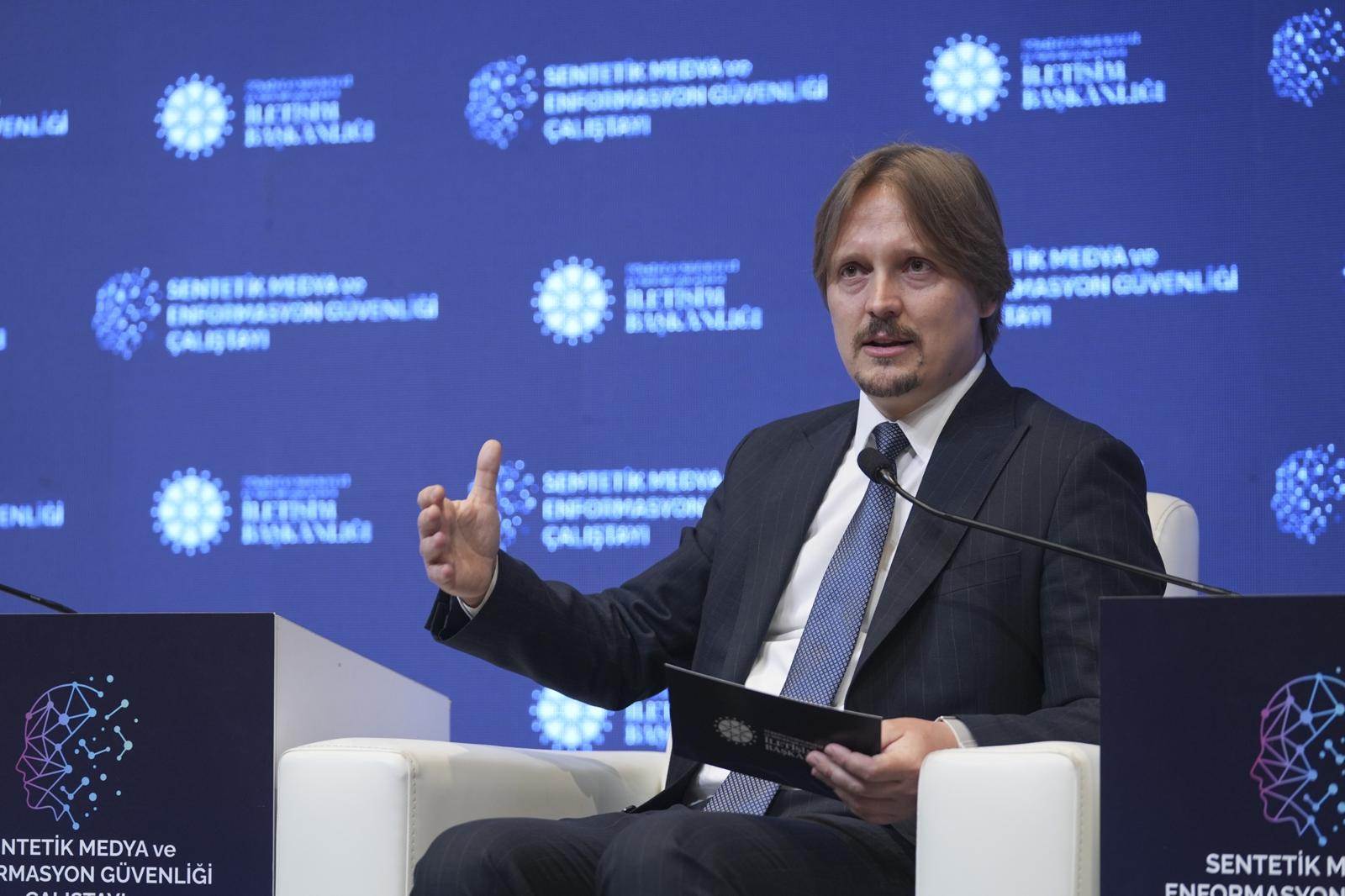
The first session of the "Synthetic Media and Information Security Workshop", by our Directorate and titled "New Media and Risks in the Age of Artificial Intelligence", was held.
The panel discussed the potential for artificial intelligence to replace humans, how it works, and the associated risks and opportunities.
During the panel moderated by Aslan Değirmenci, the Digital Media Coordinator of the Presidency's Directorate of Communications, speakers included Buğra Ayan, Head of the Department of Information Technologies of the Directorate of Communications, Doğukan Gezer, Editor-in-Chief of GZT, and Assoc. Prof Betül Ay from the Fırat University Department of Computer Engineering.
During the panel discussion, Aslan Değirmenci, the Digital Media Coordinator for the Directorate of Communications, remarked, "How can we discuss artificial intelligence as a domain of freedom when the proprietors of social media platforms lead the charge of digital fascism?" Değirmenci emphasised the notable changes and transformations occurring in the media sector, highlighting the role of artificial intelligence in cinema, sports news, and weather forecasts. He raised concerns about the associated risks, stating, "While you are completely unaware, your password is captured by artificial intelligence, a post is made from your account, and your post is deleted 10 seconds later."
Aslan Değirmenci went on to say, "Artificial intelligence can deliver spectacular outcomes by learning from big data sets and analysing specific patterns. Natural language processing and machine learning have also enabled the development of systems capable of sentiment analysis and human behaviour predictions. However, these algorithms draw conclusions merely based on data and do not truly experience emotions.
News is more than simply information; it is also a narrative. This is where human emotional intelligence and intuition come into play — and they can outmatch artificial intelligence. Human judgement is essential for in-depth analysis and investigative journalism. Artificial intelligence, on the other hand, struggles to grasp historical and cultural context. Artificial intelligence can never fully understand the human dimension of events. It may use inaccurate or callous language regarding sensitive matters."
GZT Editor-in-Chief Doğukan Gezer, one of the speakers, highlighted that trust in content, information, and truth has begun to wane with the rise of artificial intelligence, noting, "The prevalence of anonymous content has also emerged as a major threat due to the lack of specified sources."
Head of the Department of Information Technologies of the Directorate of Communications, Buğra Ayan, stated in his address, ''We are working on extracting all threads of work from the Directorate of Communications and transferring them to artificial intelligence.'' Ayan said that by vectorising the contents, they rendered them usable— not only for humans but also for artificial intelligence.
Deputy Head of the National Intelligence Academy (NIA) Assoc. Prof Yenal Göksun also spoke at the "New Media and Risks in the Age of Artificial Intelligence" panel.
Göksun said that artificial intelligence feeds on humans and recognises and reads them extremely well, which is frightening.
Göksun argued that artificial intelligence is highly sensitive to human psychological needs and tendencies, pointing out that a lot of data, including digital footprints and credit card spending, is processed into more valuable information through machine learning.
Noting that this situation poses a vulnerability, Göksun said, "States that are more adept at controlling and utilising artificial intelligence are at a higher level in the information hierarchy, which enables them to conduct more effective operations and interventions against other countries."
Göksun explained that, from a security and intelligence standpoint, such actions fall under the category of "covert actions," which are meant to influence hostile and rival countries, cause political and economic crises, exacerbate polarisation by fuelling social and cultural disputes, and undermine those countries.
Göksun remarked that the Cold War-era concept of "destructive activities" is being revisited with artificial intelligence.
In the panel, Assoc. Prof Betül Ay from the Fırat University Department of Computer Engineering delivered a presentation on the transition from typesetting and typewriter technology to "Artificial General Intelligence" using the "Intelligence Ladder" framework.