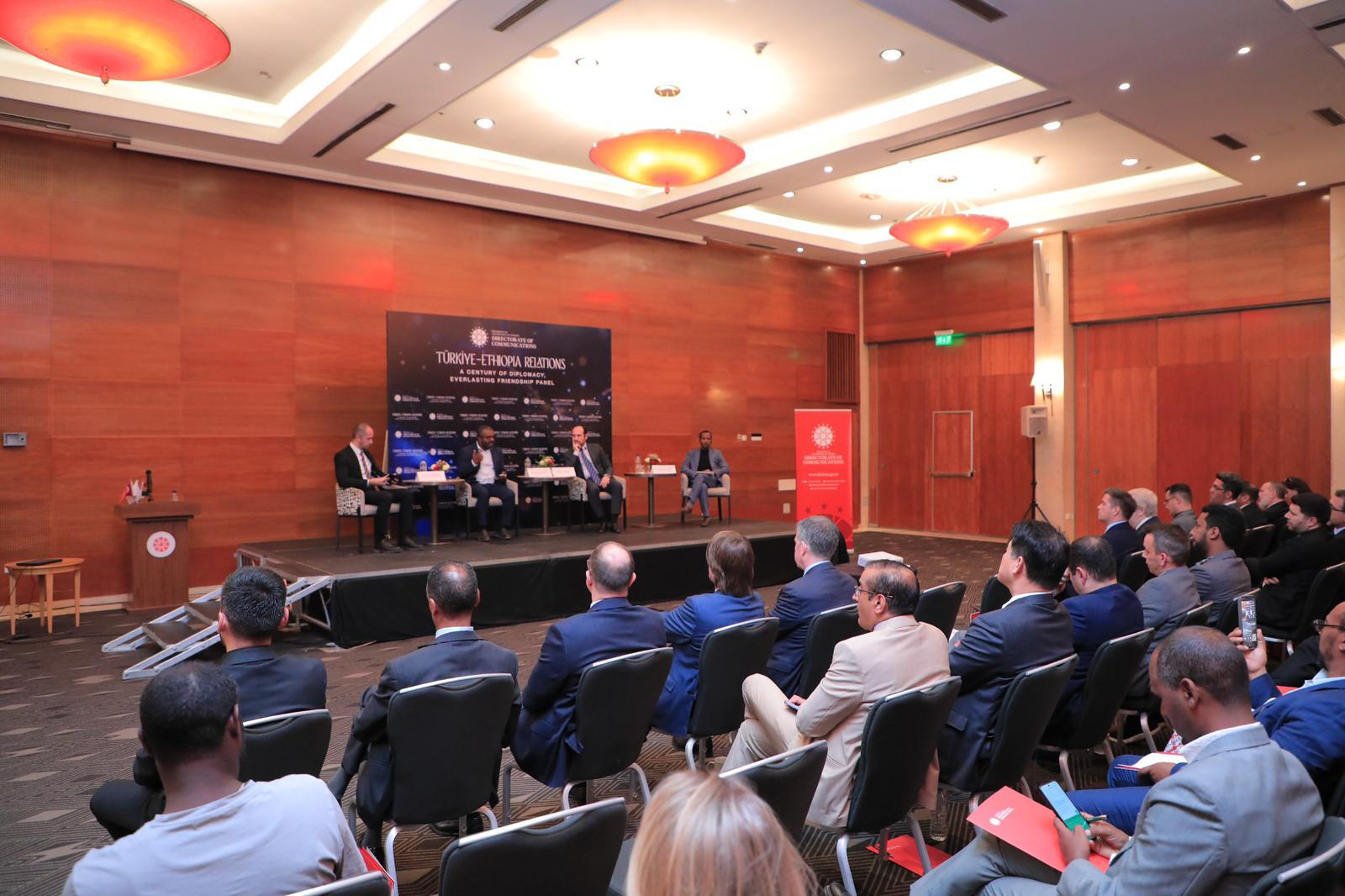
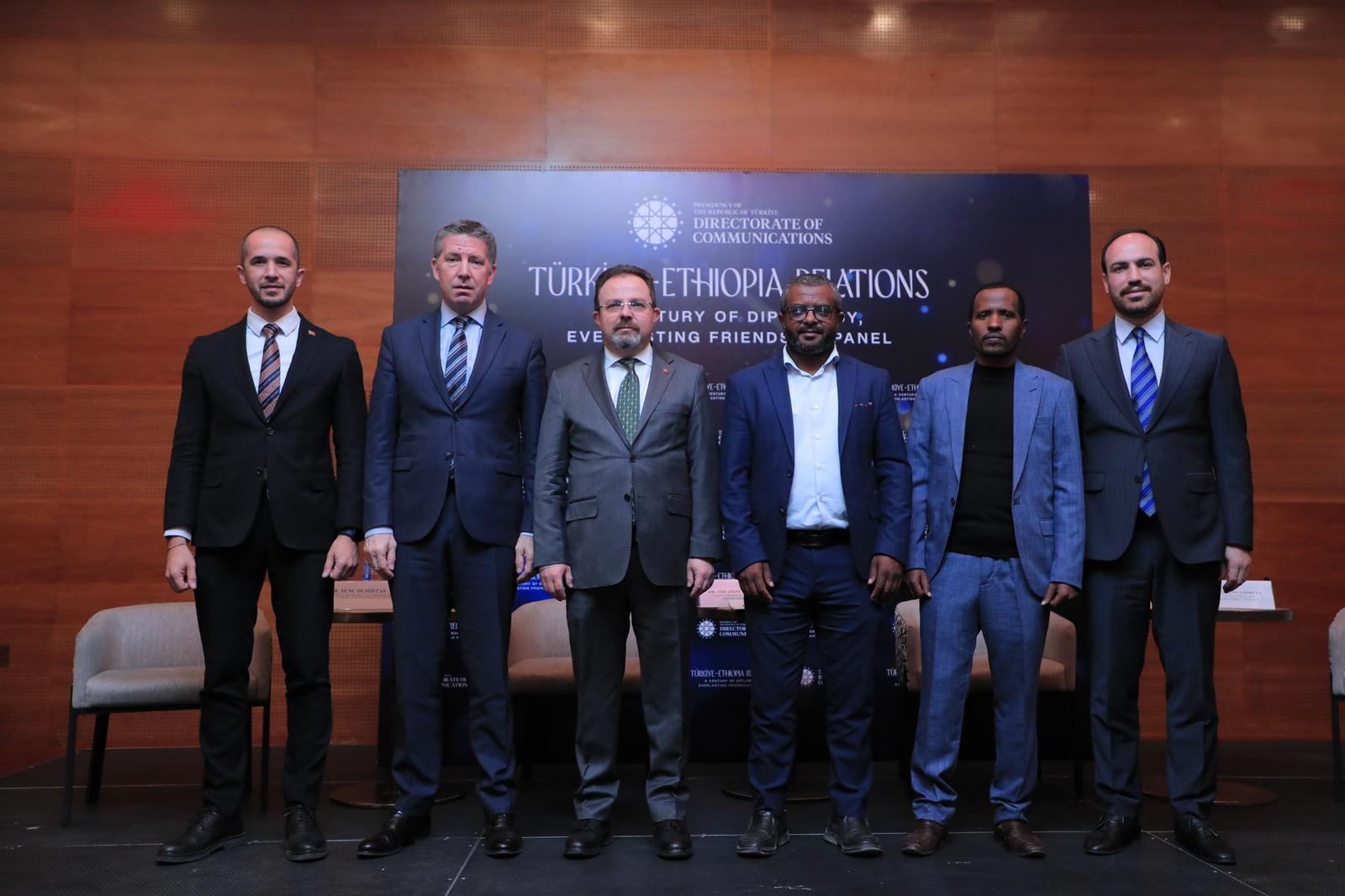
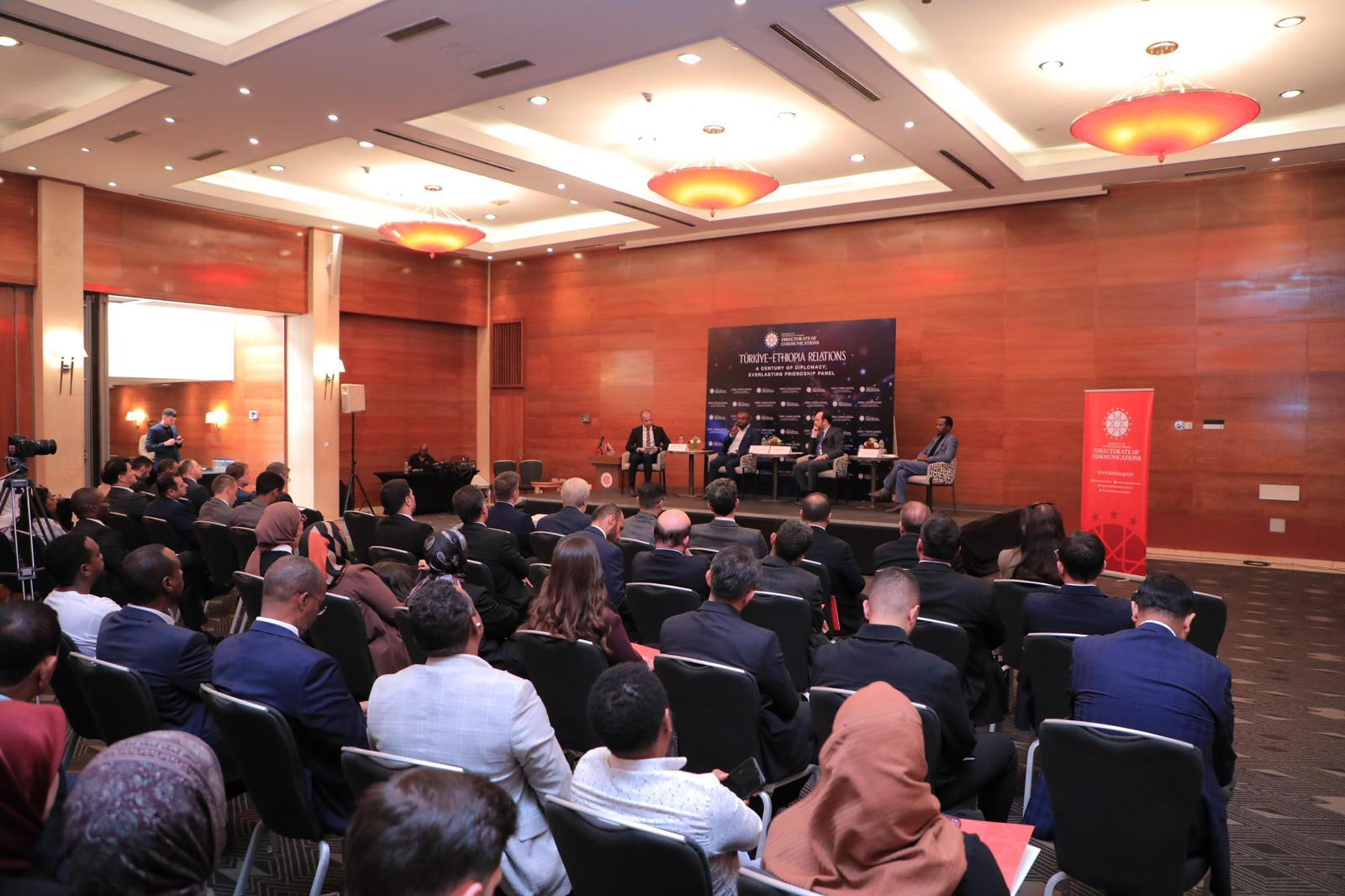
On 16 February 2026, the Directorate of Communications held a panel titled "Türkiye-Ethiopia Relations: A Century of Diplomacy, Everlasting Friendship" in Addis Ababa.
The panel featured Türkiye’s Ambassador to Addis Ababa, Berk Baran, along with academics, bureaucrats, journalists, representatives from international and non-governmental organisations, and numerous other distinguished guests.
Speaking at the opening of the programme, Ambassador Baran noted the deep-rooted history of Türkiye-Ethiopia relations, highlighting the significance of the historical ties between the two countries. He noted that the panel serves as a crucial platform for exchanging ideas to reflect on this profound historical legacy and forge a more solid foundation for future cooperation.
Highlighting the strategic role of Ethiopia, which holds an important position in the Horn of Africa, Baran said that the region is increasingly vital in terms of trade, security, and regional stability. Baran noted that relations between Türkiye and Ethiopia create value not only at the bilateral level but also on a regional scale.
A message from the Presidency's Head of Communications, Burhanettin Duran, was read at the panel. In his message, Head of Communications Duran underlined that the uninterrupted relations between Türkiye and Ethiopia continue along the line of mutual strategic partnership and have further intensified after our President Recep Tayyip Erdoğan's vision for opening up to Africa in 2005 and noted that the number of our embassies in Africa, which was 12 in 2005, has reached 44 as of 2026.
Duran stated in his message that they view Türkiye-Ethiopia relations as a means of reinforcing peace in the Horn of Africa, promoting stability, and fostering shared prosperity, adding that Addis Ababa, as the host of the African Union headquarters, occupies a distinctive place in multilateral diplomacy. He emphasised the immense value of the panel, noting that it offers a holistic platform for assessing the historical continuity between the two countries together with current regional dynamics, encompassing the political, economic, and cultural dimensions.
Moderated by Tunç Demirtaş (PhD), a foreign policy researcher at the Foundation for Political, Economic, and Social Research (SETA), the panel featured İbrahim Mulushewa (PhD), Executive Director of the Centre for National and Regional Integration Studies (CeNRIS); Emir Yasin Kekeç, Independent Researcher; and Abdulaziz Dino Gidreta (PhD), Faculty Member of Addis Ababa University, as speakers.
Tunç Demirtaş (PhD) began his address by emphasising that it was no coincidence that Türkiye established its first permanent embassy in Sub-Saharan Africa in Addis Ababa in 1926. He noted that this step was an early and strong indicator of a long-term and strategic vision for Africa. Recalling that diplomatic contacts date back to 1896, Demirtaş stated that Türkiye–Ethiopia relations have a deep-rooted, institutional, and solid historical memory based on mutual respect. He noted that the centenary of diplomatic relations signifies not only a historical watershed moment but also an understanding of a relationship built on equal partnership and mutual trust.
Ibrahim Mulushewa (PhD) stated that to establish effective cooperation mechanisms in international relations, both common ground and mutual understanding between the parties are essential, noting that Türkiye–Ethiopia relations constitute a positive example in this regard. He emphasised that despite occasional differences of opinion and variations in policy-making, the two countries share several common characteristics, such as being significant regional actors in their respective regions, possessing geopolitically strategic locations, and having substantial military capacities.
Mulushewa further underlined that the alignment in strategic objectives, along with the mutual prudence and constructive approach demonstrated by both sides, are among the principal factors strengthening Türkiye–Ethiopia relations. He also drew attention to the need to develop concrete instruments and institutional mechanisms in order to further deepen the already advanced level of bilateral relations and cooperation.
In his remarks, Emir Yasin Kekeç underscored the historical depth and strategic partnership dimension of Türkiye–Ethiopia relations, noting that the relationship has been shaped on the basis of mutual respect, trust, and diplomatic integrity. Emphasising that the progress achieved in the fields of education, economic cooperation, and military capacity-building constitutes the core pillars of the partnership, Kekeç stated that this multidimensional framework of cooperation is of critical importance for regional stability.
Abdulaziz Dino Gidreta (PhD) highlighted the strategic importance of media and communication within the framework of the new and evolving relations between Türkiye and Ethiopia, stating that communication channels are among the most fundamental instruments shaping mutual perceptions between the two countries. Noting that a robust, balanced, and mutually respectful media cooperation could create a regional foundation of resilience against global communication disorder, Gidreta stated that joint media projects, academic collaborations, and journalist exchange programmes would make tangible contributions to this process.
Gidreta concluded his speech by pointing out that information pollution is one of the most important challenges of our time, emphasising that combating disinformation is crucial for both the future of the global order and the sustainability of Türkiye-Ethiopia relations.