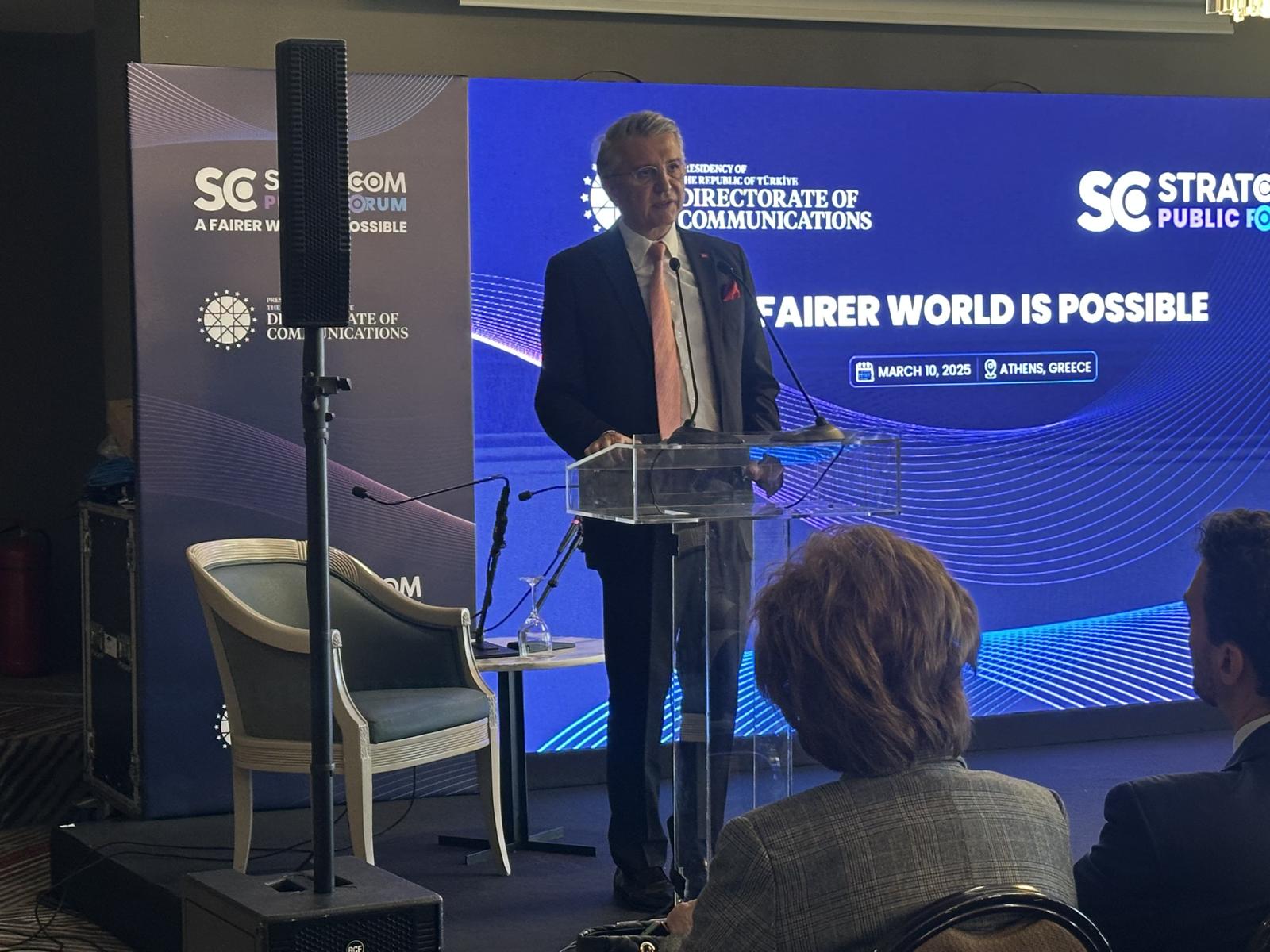
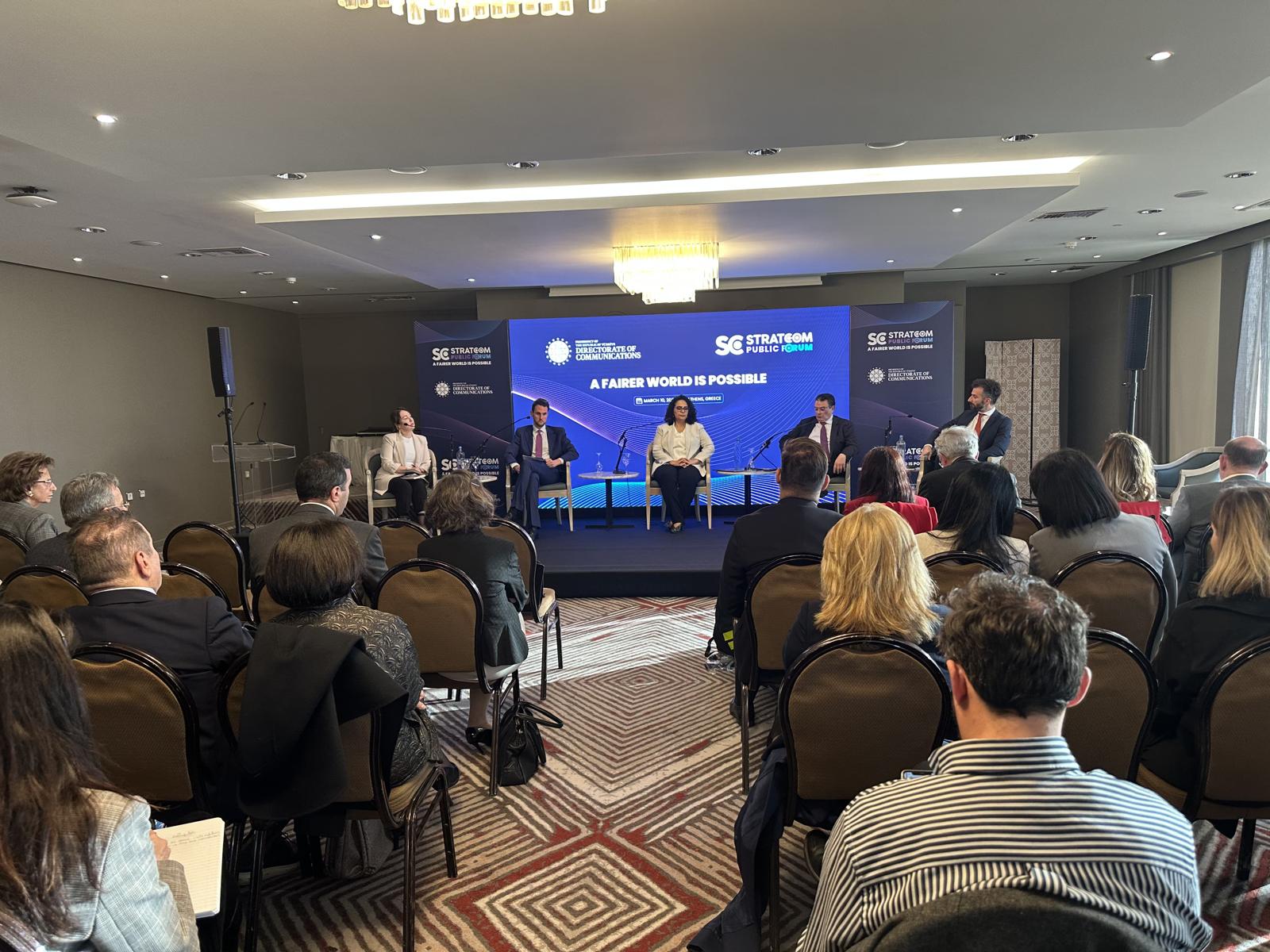
The Directorate of Communications and the Embassy of Türkiye in Athens organised a panel titled "Stratcom Public Forum: A Fairer World is Possible" in Athens, Greece.
The panel, which was attended by Türkiye's Ambassador to Athens, Çağatay Erciyes, academics, journalists, and many other guests, started with a video message by Fahrettin Altun, the Presidency's Head of Communications.
Delivering the opening speech of the panel, Ambassador of Türkiye to Athens Erciyes expressed his pleasure to deliver the opening speech of this meaningful event organised by the Presidency's Directorate of Communications at a time of major global changes.
Erciyes emphasised that the world today is undergoing a series of complex crises, ranging from pandemics to climate crises, armed conflicts, wars, terrorism, economic inequalities, and humanitarian disasters. He noted that no nation, regardless of its strength, can tackle these challenges alone.
Highlighting the necessity of international cooperation, mutual respect, and solidarity, Erciyes stated that the international system must undergo changes to become more inclusive and effective.
Erciyes pointed out that multilateralism requires a renewal centered around the United Nations (UN), saying, "Türkiye remains a steadfast advocate for making the UN more effective and better aligned with the realities of the 21st century. The reform of the UN Security Council is a crucial component of this transformation."
Stressing that the current structure of the UN Security Council does not reflect today's geopolitical and economic realities, Erciyes stated that recent crises have demonstrated that the Council, in its existing form, often fails to take decisive action when the world needs it most.
Erciyes stated that the Council's paralysis in handling the Ukraine, Gaza, and Syria issues underscores the urgent need for reform, adding, "Türkiye envisions a Security Council that is more democratic, representative, transparent, and accountable."
Erciyes stated the issue of the veto power, which obstructs critical global actions, is one of the most pressing problems requiring resolution, and emphasised that President Recep Tayyip Erdoğan is a clear advocate of reform with his principle of "The world is bigger than five."
Erciyes noted that the vision of "A Fairer World" resonates particularly among developing nations striving for a more just and equitable international order. He stated, "As President Erdoğan expressed in his book, we must strive for a system where righteousness holds power, rather than one where the powerful dictate what is right."
Describing the pursuit of a fairer world as an ethical duty, Erciyes affirmed that with determination, cooperation, and unity, this goal is attainable.
Pointing out that Türkiye and Greece share a common understanding regarding the necessity of UN Security Council reform, Erciyes stated that Greece, as a non-permanent member of the Council, could play a constructive role in the reform process.
Noting that Türkiye and Greece are two neighboring countries facing common challenges, Erciyes underscored that these shared challenges necessitate deeper cooperation.
The Century of Türkiye Photography Exhibition was also showcased to the participants within the framework of the event.
Session 2: "The UN has numerous problems, such as the veto issue"
The panel, moderated by Assoc. Prof. Esra Özsüer from Istanbul University, discussed how the world could become fairer.
Prof. Zuhal Mert Uzuner from Marmara University drew attention to the chaotic environment created by the crises occurring around the world, stating that the first solution that comes to everyone's mind to cope with this situation is the United Nations (UN), but she emphasised that the UN solution is not as easy as it seems to meet expectations.
Prof. Uzuner stated that it is unrealistic to expect the UN to solve all problems like a hero, and she pointed out that the different expectations of numerous countries bring along the concept of injustice. Prof. Uzuner conveyed that if the expectation from the UN is only to prevent war, it will not lead to disappointment, adding, "You cannot establish a sustainable peaceful order despite the desires of the great powers." Prof. Uzuner emphasised that UN reform cannot be seen as a luxury, stating, "The UN has numerous problems, such as the veto issue. The UN needs a reform."
Prof. Uzuner highlighted that reform is not only necessary for countries like Türkiye, Greece, or Italy. As the pandemic affected the economy, it was necessary for all countries. She added, "We have many common problems. We have only one mechanism. We need to reform this. This is one of the most important agenda items in international relations."
Türkiye's reform proposal
Prof. Dimitris Triandafilu, who works at Panteion University, pointed out that Türkiye's proposal for UN reform is a viewpoint that no country would oppose. Emphasising that the world is going through a period with multiple crises occurring simultaneously, Prof. Triandafilu also pointed out that the world has undergone significant changes since the end of the Cold War.
Prof. Triandafilu stated that the solution to the flaws in the current system is multilateralism, noting that this is particularly important for smaller countries. Prof. Triandafilu stated that there is consensus on Türkiye's view of increasing the representation of underrepresented countries in the international system, adding, "Both Greece and Türkiye are countries that believe in the UN system, so there could be significant agreement between the two countries on this reform."
Clarifying the concept of fair
Dr. Yorgos Cogopulos, who works at Dimokretio University, stated that when talking about a fairer world, the concept of "fair" needs to be clarified, and criteria must be established. Emphasising that different countries hold different views on UN reform, Dr. Cogopulos said, "The reality we face is this: Although all UN member countries agree in principle on the need for reform, they do not agree on how it should be done." Dr. Cogopulos emphasised that a fairer world is a necessity, stating that he believes the five permanent members of the UN Security Council, with their veto power, can block this process.
Dr. Spiros Kaçulas, who works at the American College, stated that the idea of a fair world is a beautiful ideal, adding, "A fair world is a necessity, but I don't think any of us know exactly how to achieve it."
As part of the event, a documentary about the life of famous Turkish painter Devrim Erbil was also screened.