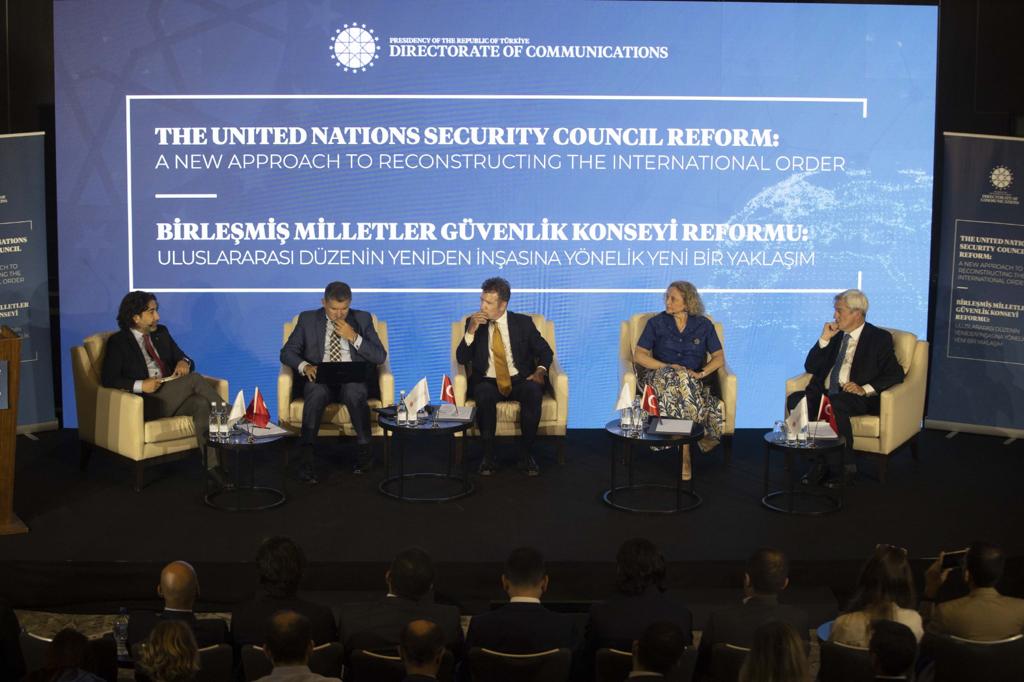
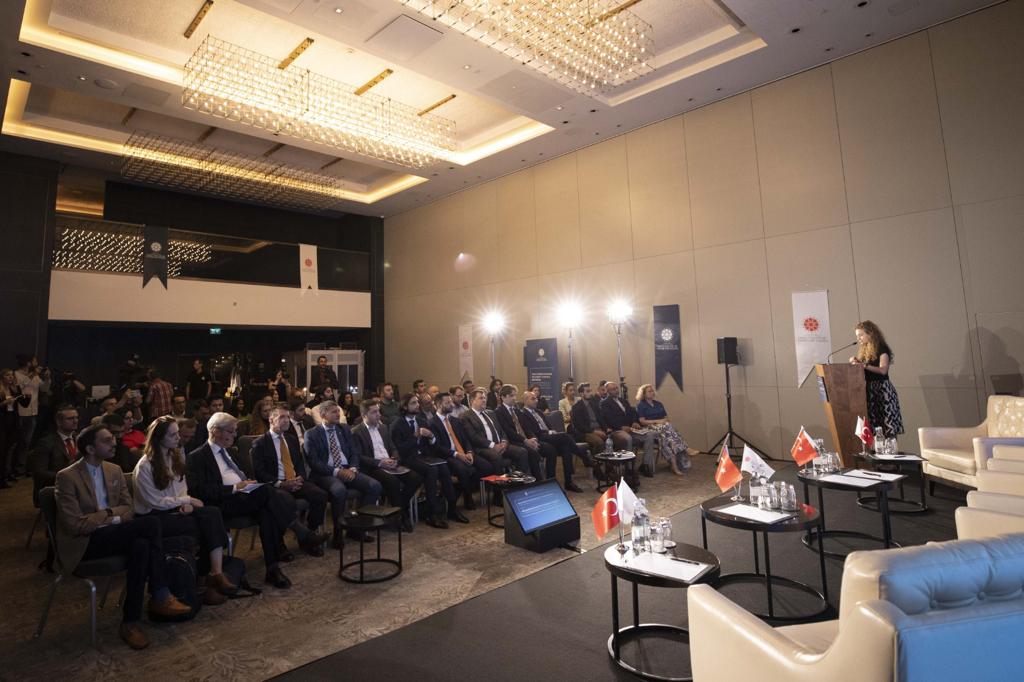
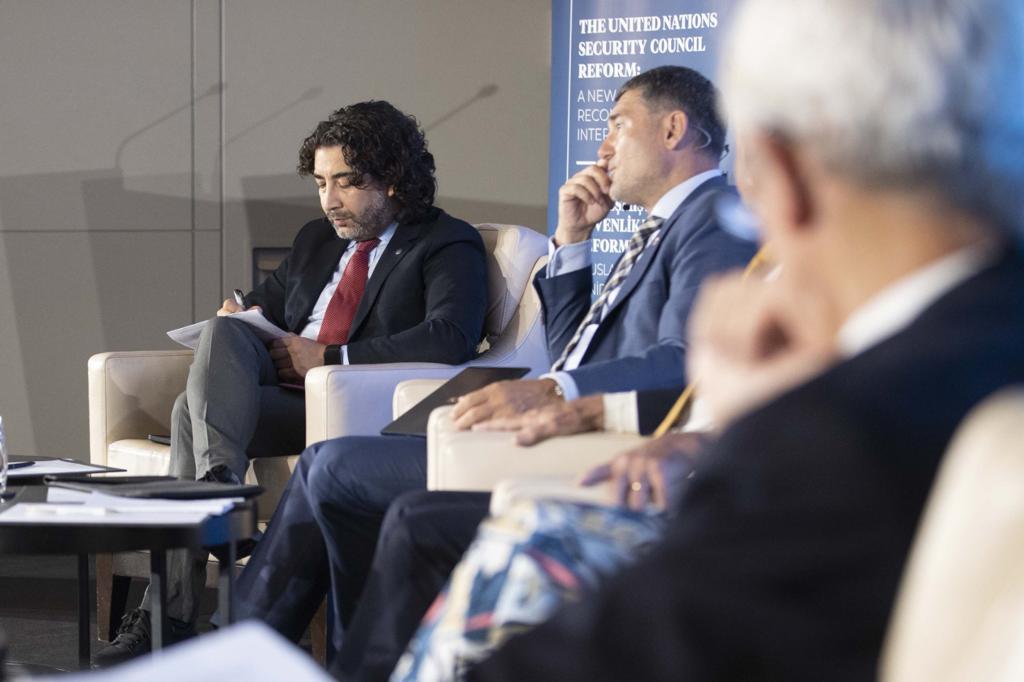
Presidency's Directorate of Communications held a panel with the theme "United Nations (UN) Security Council Reform: A New Approach to Reconstructing the International Order" in London.
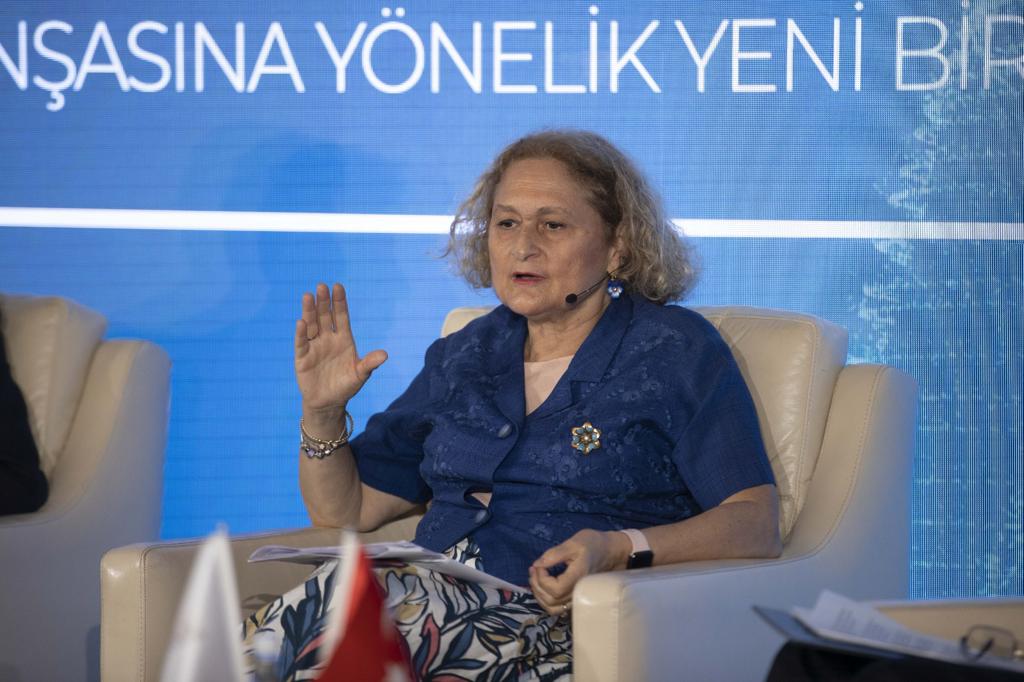
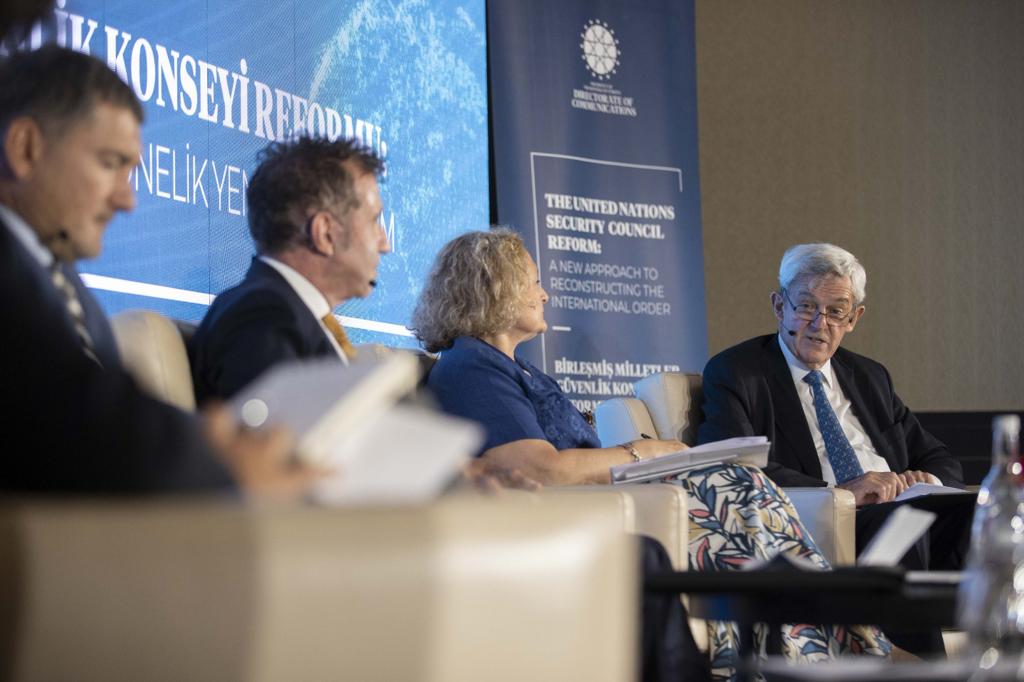
Altınbaş University Rector and Member of the Presidential Security and Foreign Policy Council Prof Çağrı Erhan, Faculty Member of İstanbul Nişantaşı University and Member of the Presidential Security and Foreign Policies Council Prof Nurşin Güney, founder and director of the think tank Forward Thinking Oliver McTernan, and author, analyst, and former faculty member Paul E. M. Reynolds attended the panel moderated by Assoc Prof Kılıç Buğra Kanat, Foundation for Political, Economic and Social Research (SETA) Washington DC Research Director.
Kanat said that they initiated a project six months ago to reform the UN, and in this context, they collaborated with academics on how to determine an international roadmap.
Stating that an international network of policymakers, practitioners and academics was established in a short time to examine how the structure of the UN could be transformed and decision-making mechanisms could be made more effective, Kanat noted that in the last four months, they have held panels on this issue in major cities of the world such as Rome, New York and London and exchanged perspectives with various stakeholders of the process.
Altınbaş University Rector and Member of the Presidential Security and Foreign Policy Council Prof Çağrı Erhan stated that holding the panel in London was even more significant since the UK is one of the five countries having veto power in the UN Security Council.
Reiterating that the world has changed considerably economically and politically since the establishment of the United Nations in 1945, Erhan stated, "The world's population was 2.5 billion in 1945. At that time, 51 sovereign countries were members of the United Nations. On the African continent, there were only six sovereign countries."
Citing the Ukraine crisis as an example, Erhan emphasised that the current structure of the UN hardly allows the resolution of an international crisis involving one of the five member states that have the right to veto in the Security Council.
Erhan said, "We witnessed this mistake before when President Bush invaded Iraq with the United Kingdom based on utterly unfounded assertions."
Prof Çağrı Erhan noted that in light of changing global conditions, the stance put forward by President Recep Tayyip Erdoğan with the phrase "The world is bigger than five" about ten years ago has begun to gain traction all over the world.
"Currently, there are ongoing conflicts in 27 different parts of the world"
Paul E. M. Reynolds, author, analyst, and former faculty member, stated that although the United Nations was founded after World War II with the purpose of building a safer, war-free world, merely a portion of that goal has been realised in the ensuing years.
Reynolds said. "This vision only applies if you live in Europe. You may thus argue that broadly speaking, we have experienced both peace and prosperity since 1945. However, this is not the case in a large number of other parts of the world."
"Currently, there are ongoing conflicts in 27 different parts of the world," said Paul E. M. Reynolds, citing data from the US-based think tank The Council on Foreign Relations (CFR), indicating that there have been more than 100 wars in different parts of the world since 1945.
Reynolds, who noted that roughly 822 million people in the world are still suffering from hunger, added that 9 million people die annually from starvation-related diseases worldwide.
Reynolds recalled that the UN had also failed to resolve the Palestine issue and opined, "It might have been resolved if the UN had worked with international political will. The United Nations was created specifically to prevent or resolve such protracted conflicts. Their (the UN's) failure to uphold norms and values, as in the case of Palestine, undermines the urgent need for reform."
Faculty Member of İstanbul Nişantaşı University and Member of the Presidential Security and Foreign Policies Council Prof Nurşin Güney remarked that Türkiye made major strides in settling international conflicts by acting as a mediator between Ukraine and Russia.
Regarding the grain corridor deal, Güney said, "This is extremely important. Instead of just sitting back and observing what unfolded, a rise in food prices or a food crisis was prevented."
Güney emphasised the significance of Türkiye maintaining channels of dialogue open with Russia and Ukraine, as well as employing diplomatic channels.
Founder and Director of the think tank Forward Thinking Oliver McTernan went on to say that attempts were made to build international institutions to ensure and preserve peace and prosperity after the great wars and remarked, "After World War II, there was a surge of optimism that prioritised peace in the world."
Recalling that the League of Nations was founded as a result of a similar wave of optimism following World War I, McTernan noted, "Of course, this instance raises the question of whether we would have to wait for another World War to break for a United Nations reform."
McTernan suggested that the structure of the United Nations and the mechanism in which nations are represented should be reformed immediately.