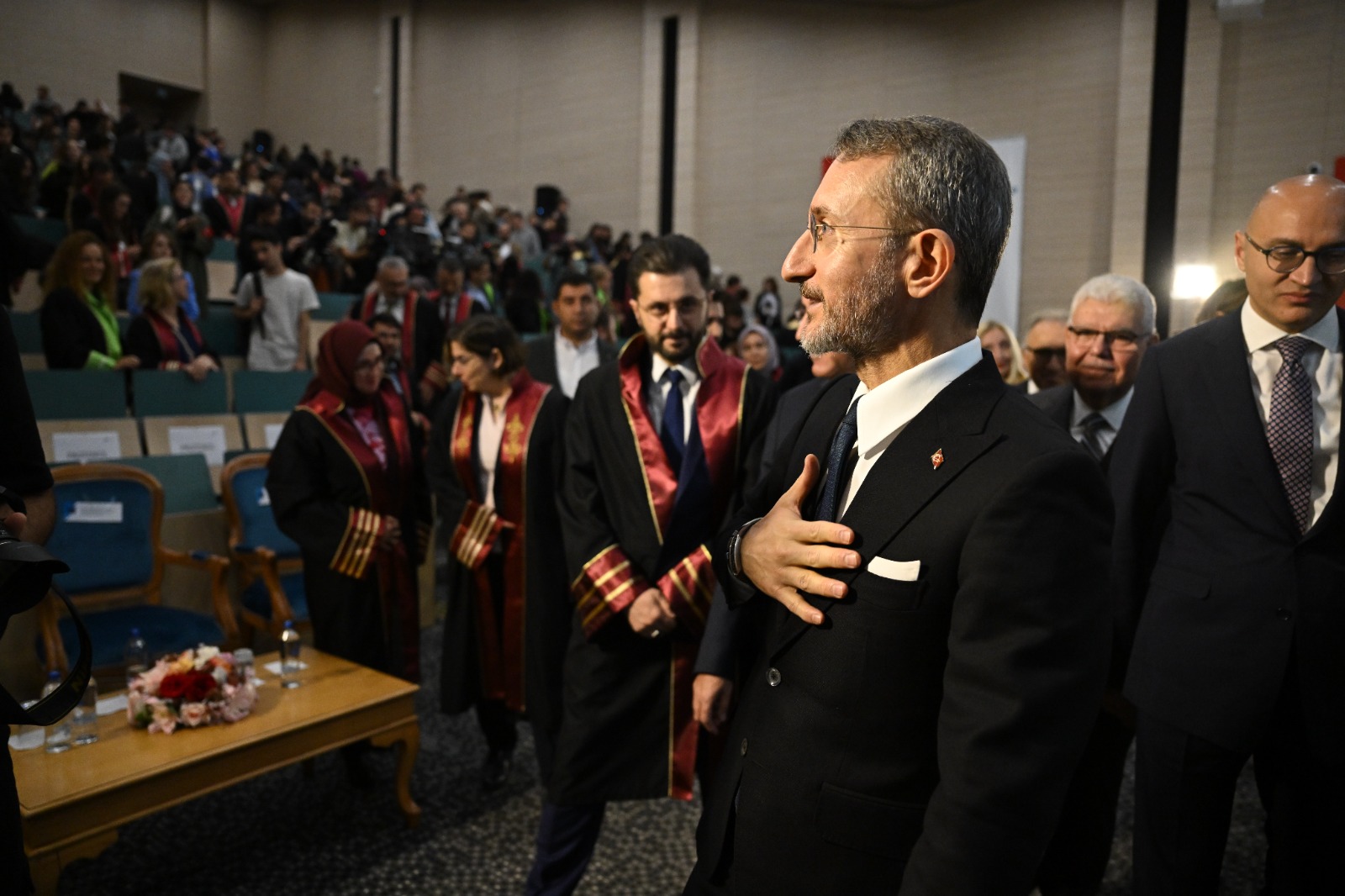
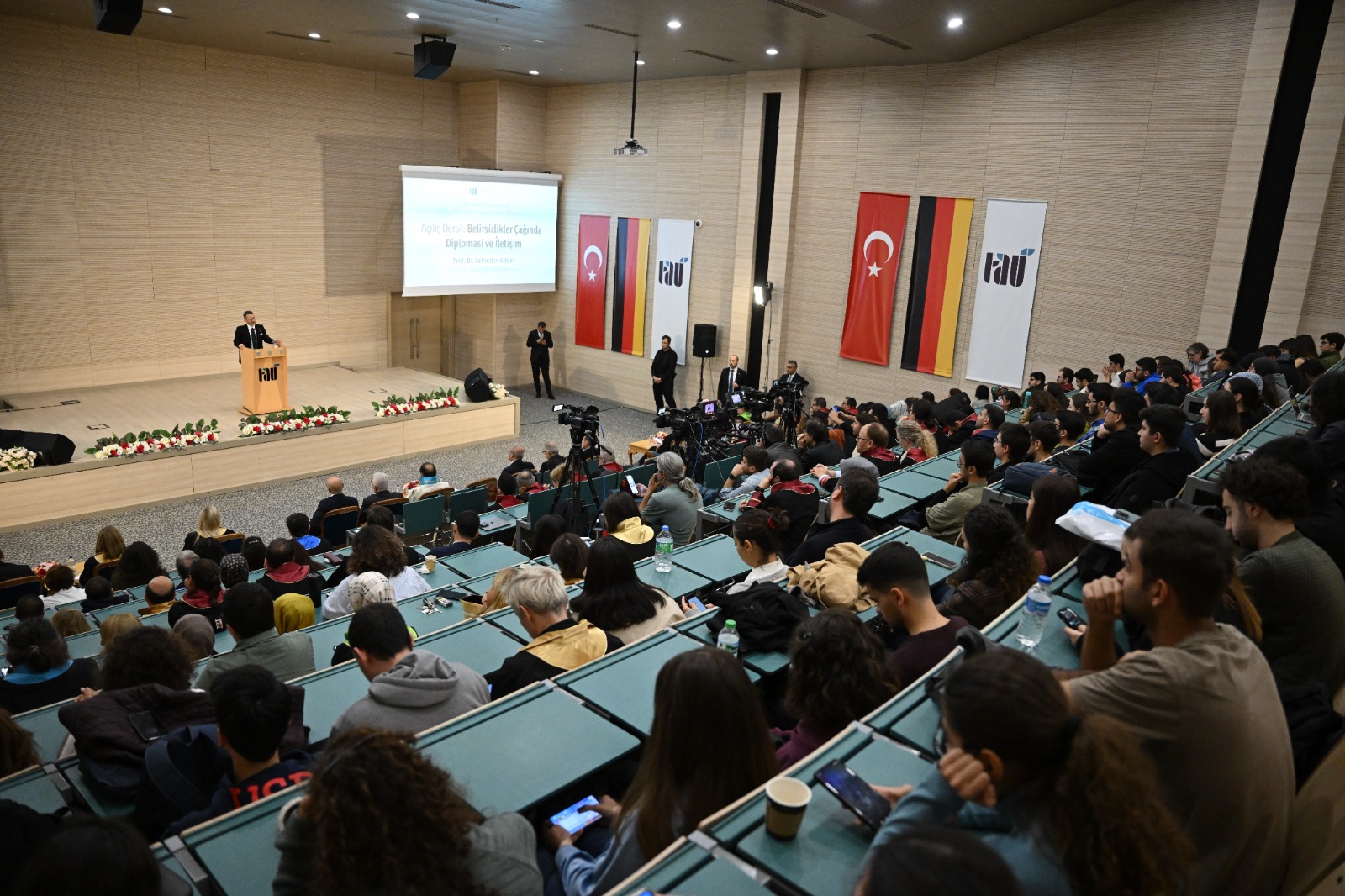
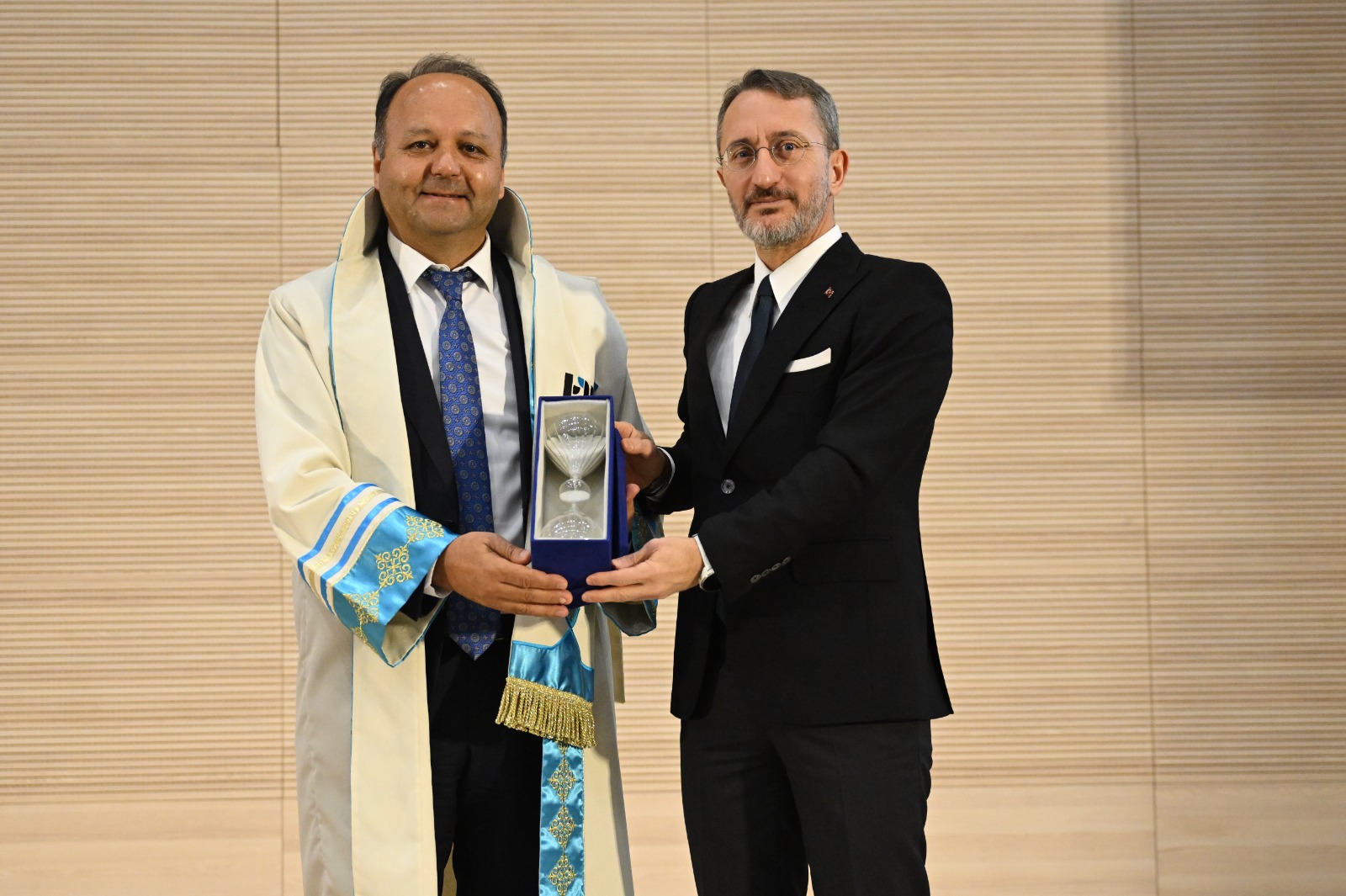
On the first day of the 2024-2025 academic year at the Turkish-German University, Fahrettin Altun delivered the inaugural lecture, "Diplomacy and Communication in the Age of Uncertainties," in which he condemned the terrorist attack on the Turkish Aerospace Industries (TAI) campus.
Noting that terrorism's objective is to instil dread, intimidate, and cause chaos, instability, and insecurity and that Türkiye was plagued by terrorism for many years, Head of Communications Altun stated, "Türkiye was regrettably manipulated by terrorism for years. Through the terrorist apparatus, terrorist organisations tried and succeeded in influencing Turkish policies. But that is no longer the case for Türkiye. Türkiye is no longer a country that may or could be manipulated by terrorism. Regardless, we have been and will be resolute in our fight against terrorism. We will persist in our efforts to fight against terrorism and terrorist organisations, irrespective of their origin, shape or form while adhering to the strategy of eradicating terrorism at its source."
Head of Communications Altun went on to say that while they are fighting ardently against terrorism and working towards a "terrorism-free Türkiye," one of the most significant auxiliary components of terrorism in this process is terrorist propaganda, adding:
"Unfortunately, there was yet another incident that upset us regarding the attack that took place two days ago. Sadly, certain images that could serve the terrorist organisations' propaganda were circulated. Naturally, we will take strong action against the person or people who, whether deliberately or unintentionally, disseminated these images serving this terrorist organisation's propaganda. Our Office of the Chief Public Prosecutor will conduct an investigation into the process. Of course, the most disheartening aspect of this process is that the media failed to act responsibly and publicised these images after they were leaked. We were likewise upset by that. This reiterates the necessity for the media, particularly when it comes to terrorism and terrorist acts, to adhere to responsible broadcasting principles and consider, 'Would publishing any of these images contribute to the cause of terrorism?' Never, under any circumstances, underestimate the importance of the responsibility to inform the public."
Noting that the media has the most significant role in this regard, Altun emphasised that informing the public is the foundation of democracy.
"However, providing terrorist propaganda is never acceptable. In the event of such incidents, it is imperative to consistently adhere to the principles of responsible broadcasting," said Head of Communications Altun. Presenting a few indicators from the United Nations (UN) Global Trends 2023 Report on income inequality, global climate crisis, migration, the digital divide in communication, and access to health services, Altun claimed that these indicators clearly reveal the inequalities, injustices, and imbalances that persist in the world by 2024.
Emphasising that inequalities are deepening at the global level and that the world is still grappling with conflicts, occupations, and various forms of crises, Heads of Communications explained how these processes are accompanied by numerous negative trends, including racism, xenophobia, and Islamophobia, in a cultural context.
Head of Communications Altun pointed out that this image breeds instability and disorder on a worldwide scale, instils a sense of unpredictability about the future, and indicates that we are living in a time of chaotic uncertainty.
Upon observing that uncertainty has become the accepted norm in the international arena, they also recognise that it has become a problem, in its own right, in international relations, conflicts, and power dynamics. Noting that the current era of uncertainty has been further exacerbated by the pandemic, the Russia-Ukraine war, Israel's atrocities in Gaza, and its policy of extending this conflict to the region.
Head of Communications Altun noted that the issue of institutionalising global injustice arises when these factors combine with the dysfunctionality of the global system's institutions, a consequence of historical colonial relations that have operated in the international arena for an extended period.
Emphasising that the "crisis of truth" is an additional crisis that exacerbates the global justice crisis, Head of Communications Altun stated, "Today, the crisis of global justice and the crisis of truth are in a dialectical relationship, feeding and growing each other, thereby exacerbating atrocities and suffering worldwide."
Arguing that the devaluation, trivialisation, downplay and blurring of the boundaries between truth and lie constitute the crisis of truth, Head of Communications Altun noted that the analogue media order and, perhaps more significantly, the digital media order have both contributed to the construction of the era today, which some theorists refer to as the "post-truth era."
Altun also pointed out that the crisis of truth forces individuals to confront extremely severe tests and challenges and that there is a democracy crisis worldwide.
"Disinformation poses a threat to inter-state relations"
Head of Communications Altun remarked, "It is this crisis of truth that brings new crises to the international scene and to the agenda of state-to-state interactions. These days, disinformation poses a threat to inter-state relations as much as it does to individuals and societies on their own. Disinformative content in bilateral interactions can often substantially harm discussion and international diplomacy processes.
Head of Communications Altun stated that German Prime Minister Olaf Scholz's visit to Türkiye last week resulted in a disinformation campaign just after he met with President Recep Tayyip Erdoğan, and added:
"A news report was published. According to the story, the two leaders inked a secret pact. According to the so-called secret agreement, 'Türkiye has agreed on letting migrants into the country;' this is the allegation, a lie, and disinformation. You may say, if there is an allegation that you know is false, refute it. We rejected it five times already. Four times this claim was on the agenda, and four times, we denied it with evidence via the Centre for Combating Disinformation of the Directorate of Communications. What's more, there are two interlocutors. And neither of them has admitted it. They are not saying, 'Yes, we have achieved such an accord.' Furthermore, an official institution states, "This is false; this is disinformation." Nevertheless, it is intriguing and disheartening that certain individuals from both Türkiye and Germany, including those in politics, the media, and the public, have continued to perpetuate this lie. I have once again personally declared this allegation to be false by documenting these four previous denials. Afterwards, we observed that it was not repeated. But 'we do not know how many of those people who were exposed to that lie, that disinformative content, were there when we told the truth.' The issue lies in the dissemination of this deceptive content with the sudden influx of information. We must fight this. We observe significant consequences of this in the context of interstate relations."
Head of Communication Altun remarked that they have noticed that this disinformative content has been regularly used in Türkiye-Greece relations to poison the relations, adding, "But no matter what, the truth cannot be hidden. Of course, the truth is the most valuable capital, and it must be emphasised continually. On the other side, attempts to falsify the truth are detrimental to interstate relations."
Head of Communications Altun cited President Erdoğan's attendance at the BRICS Summit, stating, "After our President returned from the meeting yesterday, a disinformative content was served to the international media, 'India opposed Türkiye's BRICS membership.' We also said that was a lie. We hope that no actor will repeat this lie at home."
Head of Communications Altun emphasised the importance of media actors creating responsible material and operating responsibly in this field and stated:
"In this process, it is critical that persons who consume communication content interact with the media in a responsible and fully aware manner. When confronting these new communication technologies on a national and international scale, it is imperative that we exhibit communication awareness, be cognisant of the opportunities, and manage and consider the risks that accompany these new opportunities. We must be both circumspect and courageous, acknowledging the opportunities while also being cognisant of the threats. This is our approach to emerging communication technologies. Whatever occurs, we must regulate these communication technologies for the public good. We must protect our citizens' rights from the firms who own these communication technologies. Furthermore, we must use these communication technologies courageously and invest in better ones."
"The President's leader-to-leader diplomacy is one of Türkiye's most significant assets in its foreign policy"
Head of Communications Altun emphasised the significance of public diplomacy and citizen diplomacy, stating, "As Türkiye, we recognise that leader-to-leader diplomacy is of the utmost importance. In this sense, our President's leader-to-leader diplomacy is one of Türkiye's most significant assets in its foreign policy. Undoubtedly, the leader's field of action is extended by their experience, strong social capital, self-confidence, ability to balance realism, idealism, and pragmatism, friendships with other leaders, and comparable opportunities. This enhances the nation's diplomacy and the protection of its interests in the international community."
Head of Communications Altun said that staying stable in this age of uncertainty is important, but added that being a stabilising force, power, and actor in this age of uncertainty is even more essential.
Head of Communications Altun noted that Türkiye's recent foreign policy struggles have been substantially concentrated on this area, stating, "Because the world, geography, and era in which we are living do not allow us to exist as an island of stability on our own. We must undoubtedly serve our environment and region as a stabilising actor. Türkiye's efforts to intervene in the Russian-Ukraine conflict and establish a platform for peace are related to this. Türkiye's position in the Balkans, Africa, and the Middle East is linked to this."
Head of Communications Altun emphasised that Türkiye has historical resonance, cultural memory, and opportunities resulting from this cultural memory in all of these geographies and that Türkiye's strategic investments in these regions as a stabilising actor are intended to contribute to global peace and stability.
Head of Communications Altun stressed the relevance of universities in a moment of uncertainty and global chaos, saying that students' desire to form the "Türkiye of the future" is valuable.
Head of Communications Altun wished the Turkish-German University an auspicious new academic year.