Foreign Minister Fidan said, “We expect the United States to further use its influence to urge Israel to end its policies that undermine both regional and global peace and stability.”
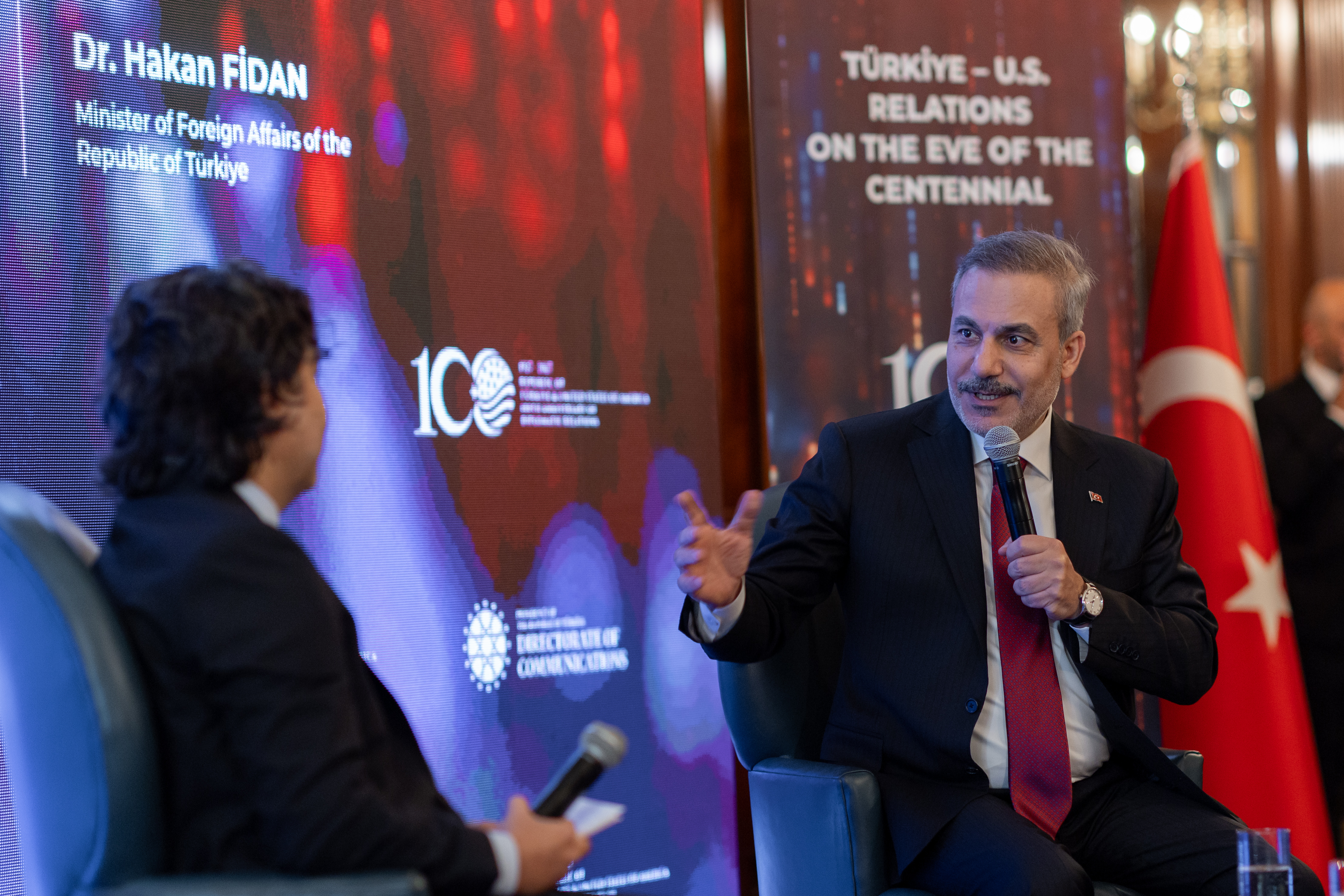
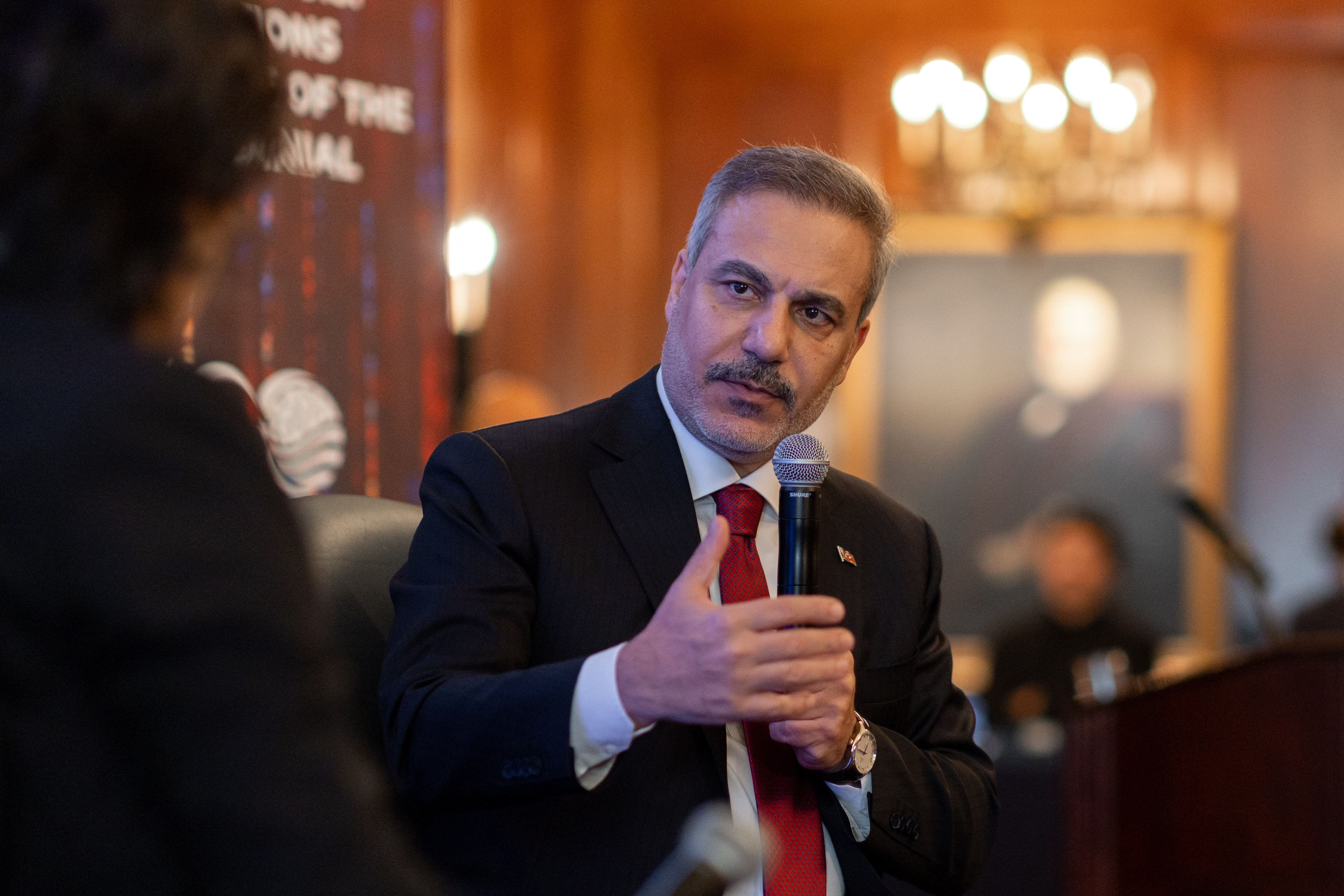
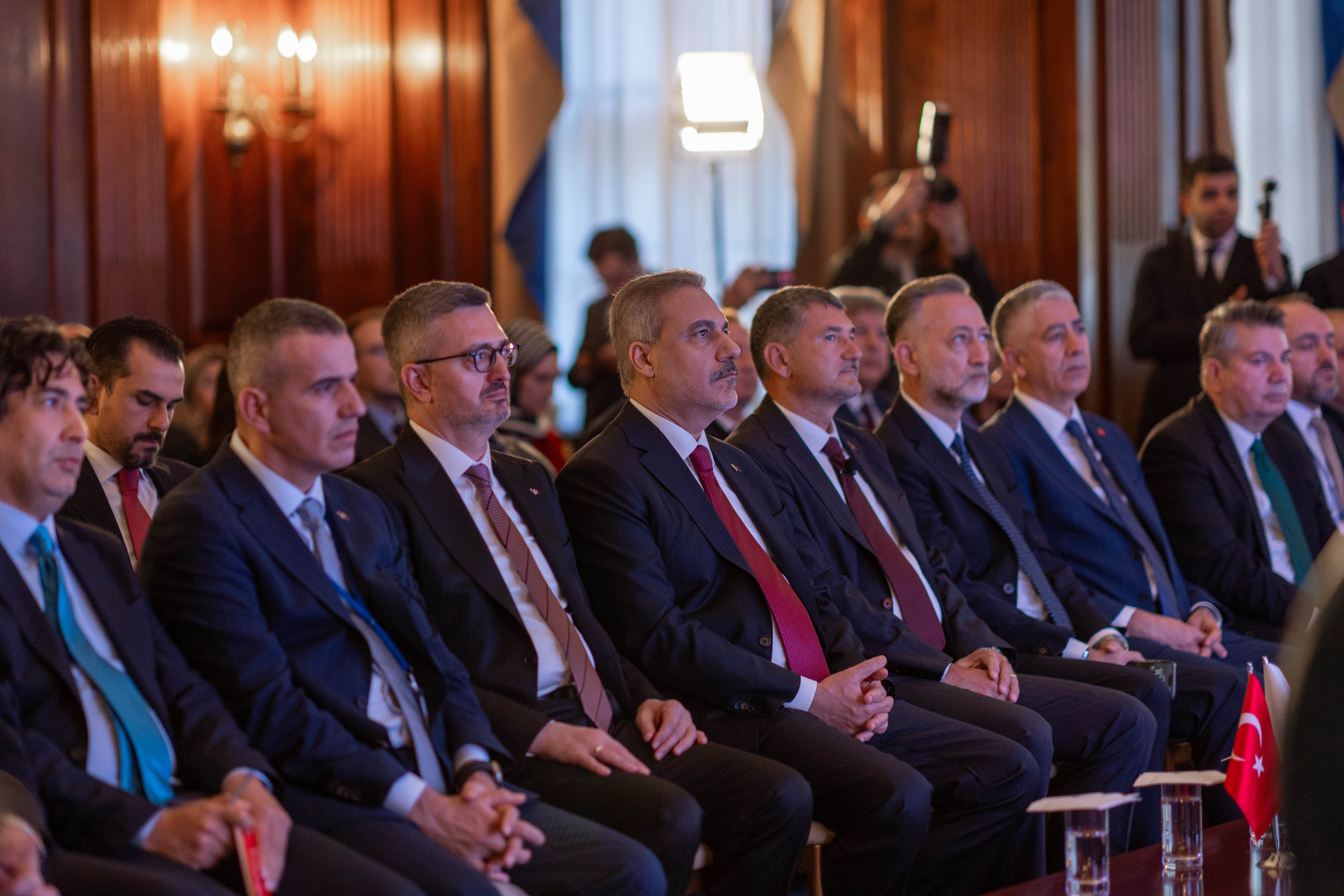
Minister of Foreign Affairs Hakan Fidan addressed the “Türkiye-U.S. Relations on the Eve of the Centennial” panel organised by our Directorate in New York.
Noting that, as Türkiye-U.S. diplomatic relations approach their centennial, there is an opportunity to assess what the partnership between the two countries has achieved to date and what it can achieve in the future, Fidan said, “Our relationship has stood the test of time and demonstrated its enduring value. Two countries geographically distant from one another have become partners and allies with an influence that extends far beyond our borders. Our relationship has remained resilient despite disagreements, crises, and dramatic changes in the international system." Fidan pointed out that both countries have been able to overcome challenges because they recognise the critical value of their partnership.
Underlining that Türkiye-US relations have gained strong, renewed momentum, Fidan said: “The exceptional relationship between President Recep Tayyip Erdoğan and US President Donald Trump is playing a central role in the current momentum.” Foreign Minister Fidan said it was also necessary to translate this momentum into tangible gains not only for the two countries but also to safeguard regional peace and stability, and to institutionalise cooperation.
“As we enter the second century of our diplomatic relations, we are determined to realise the full potential of our cooperation and resolve the issues that stand in its way. To this end, we need to assess where we stand and set clear goals for what we can achieve together,” Fidan said.
“We need to remove barriers and restrictions”
Pointing out that the international system is undergoing one of its most profound transformations, Fidan noted that the global balance of power is shifting, economic competition is intensifying, and technology is reshaping the world as we know it. Drawing attention to the difficulties global security and governance institutions face in responding to these developments, Fidan continued:
“Unresolved conflicts affect other regions through energy prices, migration, trade, terrorism and food security. Addressing these challenges requires effective partnership and shared responsibility. Türkiye and the US have the experience, capacity, diplomatic reach and, most importantly, the political will to respond to all these crises together.”
Emphasising that President Erdoğan’s visit to Washington in 2025 and President Trump’s visit to Ankara in July this year demonstrated their shared determination to advance bilateral relations across all areas, Fidan said: “This is helping us make progress on long-standing issues.”
Noting that there is significant scope to expand the economic partnership between the two countries, Fidan said: “Our economic relationship is steadily expanding in terms of both trade and investment, with bilateral trade volume reaching approximately $40 billion. In 2025, the US was Türkiye’s third-largest export market and fourth-largest source of imports. Our balanced trade provides a solid foundation for further expansion.” Recalling that President Erdoğan had set a target of $100 billion, Fidan said: “Our goal is a broader economic partnership that advances high value-added production and economic security. To achieve this goal, we need to remove barriers, particularly additional tariffs.”
Stating that defence cooperation has long been another strong pillar of Türkiye-US relations, Fidan said: “We must resolve ongoing issues and remove restrictions that limit our cooperation. Such restrictions have no place between two allies. Our Presidents have demonstrated strong political will to translate their shared understanding into concrete results.” Fidan pointed out that lifting these restrictions would help companies further develop their partnerships in different parts of the world, adding that energy is another area in which close cooperation can deliver tangible and significant gains.
Foreign Minister Fidan noted that the US has now become one of Türkiye’s leading energy suppliers, adding that long-term agreements have further strengthened this relationship.
“A Syria free from terrorism and with its territorial integrity preserved would mark significant progress”
“This solid bilateral foundation and shared strategic vision also provide us with a stronger basis for advancing regional peace and security. We are already cooperating on regional and global issues, from the Middle East to the Caucasus and the Balkans. In the Middle East, our shared interest lies in having sovereign and stable states with the capacity to ensure security and prosperity in our region,” Fidan said. Pointing out that this starts with Syria and Iraq, he continued:
“We aim to strengthen national institutions so that they can govern effectively and leave no room for terrorist organisations to operate. A Syria free from terrorism and with its territorial integrity preserved would mark significant progress for regional security and prosperity.”
“We need to embrace regional ownership”
Fidan noted that, as the two countries advance their shared goals for greater regional security, it should be borne in mind that locally driven solutions have a greater chance of succeeding. He said:
“We therefore believe that the countries of the region should assume greater responsibility for the security and stability of their own geography. For this reason, we need to embrace and advance regional ownership. With this understanding, together with Pakistan and Saudi Arabia, we established the Mecca Joint Defence Agreement. This alliance provides an institutional foundation for supporting regional peace and security through regional ownership and security cooperation. We welcome President Trump’s support for this initiative.”
“We expect the US to make greater use of its influence over Israel”
Fidan said that stronger regional security in the Middle East also reinforces the military security dimension and Europe’s security architecture, while warning that interconnected threats could undermine joint efforts.
Citing the Iran War, the conflict in Yemen, and Israel’s destabilising policies and actions across the region, Fidan said: “These threats reinforce one another and obstruct diplomacy. Addressing them requires effective regional responsibility and close cooperation with the US. In particular, we expect the US to make greater use of its influence over Israel to bring an end to policies that undermine both regional and global peace and stability.”
Foreign Minister Fidan said Gaza remains a central test of the shared capacity to establish security, cooperation and prosperity in the region and beyond. Stating that the genocide in Gaza and the ongoing atrocities against civilians in Palestine have deeply wounded the global conscience and irreparably undermined confidence in the international system, Fidan underlined that finding a lasting solution to the Palestinian issue remains crucial to the stability of the Middle East and beyond.
Fidan noted that Türkiye supports President Trump’s efforts to bring the Gaza crisis to an end and that the commitments set out in the peace plan must now be fully implemented.
“In the second century, our goal is to harness our partnership for the global good”
Pointing out that Türkiye-US cooperation can also help advance peace and stability in neighbouring regions, Fidan said they support the peace process between Azerbaijan and Armenia in the Caucasus, while in the Black Sea they aim to reduce the risk of escalation, ensure the safety of navigation, and turn the Black Sea into a source of cooperation rather than a source of problems.
Fidan said they also support dialogue and diplomacy to achieve lasting peace in Ukraine, noting that lines of communication with both Kyiv and Moscow remain open for this purpose. Turning to the Balkans, Fidan stressed the need to address tensions in Bosnia and Herzegovina and between Serbia and Kosovo before they deepen. “Close coordination and preventive diplomacy can help preserve and strengthen the fragile stability in these regions. We are guided by the same principle: strengthening legitimate institutions, supporting regional ownership, and establishing a strong link between security and economic opportunity,” he said.
Reiterating that the transformation taking place in the international order requires greater regional ownership, Fidan said it also necessitates effective partnerships between global powers and regional actors with the necessary capacity.
“As we approach the centennial, our history demonstrates what we can achieve together. I firmly believe that this strong momentum, reinforced by the rapport between President Erdoğan and President Trump, will help us institutionalise and deepen our cooperation across different regions and on different issues,” Foreign Minister Fidan said.
Noting that Türkiye-US cooperation has made a tangible difference in protracted conflicts in some challenging areas, including Libya, Sudan and crises across Africa, Fidan said: “In the second century of our diplomatic relations with the US, our goal is to harness the Turkish-American partnership for the greater good of global peace and stability.”
Following his remarks, Fidan answered questions from Prof. Kılıç Buğra Kanat, a member of the Presidential Security and Foreign Policies Council, as well as questions from the audience.
Addressing Türkiye’s policy of “regional ownership”, pursued through the Türkiye-led Mecca Alliance, Fidan said: “The US is transforming itself towards a new era. This is not something we are doing based on our assessment of what US global policy will be. This is a process we have believed in for a long time.” Fidan noted that outside actors had intervened in the region “for good, bad and other reasons”, but that, over time, the countries of the region had matured. He continued:
“The countries of the region have learned the principle that we, as Türkiye, have articulated: ‘There is no domination, no submission; rather, there is cooperation.’ This is a fundamental element of our regional policy. Through the Mecca Agreement, we are proposing a starting point for the principle of ‘regional ownership’. This is because we have long observed a lack of trust among the countries of our region.”
Pointing out that wars in the region, the involvement of external powers, “and even some countries fighting one another to serve others’ agendas” stem from this lack of trust, Fidan said: “What we need now is not merely to come together for security, but to demonstrate a commitment to the security, territorial integrity and sovereignty of each and every one of us. This is something that has long been lacking in our region.”
“Türkiye has been a state in this region for a long time, but some countries in our region are still relatively young. It took some time to realise that nation-states cooperate better in the modern era. We have seen similar examples in Europe and elsewhere, so why not apply the lessons learned there to our region?” Fidan said.
Pointing out that sovereign UN member states with clearly defined borders and no border disputes with other countries have no option other than “cooperation” and “institutionalising that cooperation”, Fidan stressed that there had been a belief in the region that economic cooperation would come first and be followed by security cooperation, but that a lack of trust made this more difficult.
“First and foremost, we must demonstrate a commitment to one another’s security, sovereignty and territorial integrity. Compatibility on such matters is also important, as is the kind of bureaucracy you have. We need to make this work so that it serves as a good example for our region. Otherwise, every problem we face affects us, and that impact has global consequences,” Fidan said.
Asked what had been instrumental in establishing the Mecca Alliance, Fidan said that under the leadership of President Recep Tayyip Erdoğan, lessons had been drawn from the recent past and the steps to be taken had been identified. He continued:
“[The Mecca Alliance] is something we have been considering for the past five or six years, but it took time to convince countries. I think these countries have also learned lessons during this process. They now understand the importance of regional cooperation and solidarity. We resolve one problem in the region, and then another emerges. The region faces many problems. We therefore need to conduct an in-depth analysis of this structural problem. We have a roadmap with our partners, Saudi Arabia and Pakistan. There are countries that want to be part of this regional structure. Our idea is that once we institutionalise it, the invitation for other countries to join will remain open.”
“NATO’s Article 5 has been invoked only once”
Asked whether the attacks by the Iran-backed Houthis in Yemen against Saudi Arabia constituted the first test of the Mecca Agreement and how the Agreement had fared in that test, Fidan pointed to former US Ambassador to Türkiye James Jeffrey, who was in the audience, and asked him when he had joined the military. After Jeffrey replied that it had been about 50 years ago, Fidan asked how many times he had witnessed NATO’s Article 5 being invoked. “Only once,” came the response from the audience. “That is not fair at all. No one criticises NATO for being a ‘paper tiger’, but when it comes to a newly established defence alliance, they point to a 10-year crisis—the Yemen crisis—and say, ‘Look, it doesn’t work.’ We have only just begun,” Fidan said. Foreign Minister Fidan’s response drew applause from the audience.
“Wars such as the Russia-Ukraine war are challenging for mediators”
Asked by a member of the audience about relations with US counterparts in crises where Türkiye has played a mediating role, Fidan said they were in contact and working with US President Donald Trump’s Special Envoy Steve Witkoff and adviser Jared Kushner. Fidan described “the Russia-Ukraine war, the Gaza peace plan, Libya, the Horn of Africa and developments in the South Caucasus” as areas in which Türkiye and the US work together and consult continuously to coordinate their efforts and actions, adding that issues such as the Russia-Ukraine war and the return of the Cold War are difficult for mediators.
Fidan underlined that US initiatives to end conflicts in the Gulf and the wars in Gaza and between Russia and Ukraine are also in Türkiye’s interests.
Asked about the status of Türkiye’s return to the F-35 programme, Fidan said:
“During President Erdoğan’s visit to the White House in 2025, the position of the two leaders was very clear: at the political level, they want this issue—the CAATSA issue—to be resolved as soon as possible. Both sides also agreed to do whatever is necessary to remove this obstacle to our defence cooperation platform. We have been working on the issue since then, and certain steps need to be taken; this is also known to the public. So our work is ongoing. What is encouraging is that there is political will and everyone is making an intensive effort. The process is simply taking a little longer than we expected.”
“The war in Ukraine must end”
Responding to a question about the Russia-Ukraine war, Fidan said: “From the very beginning, our position has been that this war should be brought to an end as soon as possible. First and foremost, it has been a very long war and, from the outset, highly prone to escalation, both geopolitically and rhetorically. Over the past few years, we have seen the conflict escalate, and there is scope for it to escalate even further. We welcome President Trump’s position in favour of bringing this war to an end.”
Stating that they understood Ukraine’s need to resist when it was invaded, but that the conflict had now grown into something far larger than a war between two countries, Fidan stressed that the “war of attrition” between the parties had now turned into a “war of destruction”, with no limits remaining on the targets of reciprocal attacks. He noted that “infrastructure, energy facilities, communication lines, transport routes and civilian structures” were being targeted and that, as a result, shipping in the Black Sea had declined.
Fidan noted that Türkiye supports Ukraine’s territorial integrity, adding that, despite being NATO members, they held different views on efforts to achieve peace.