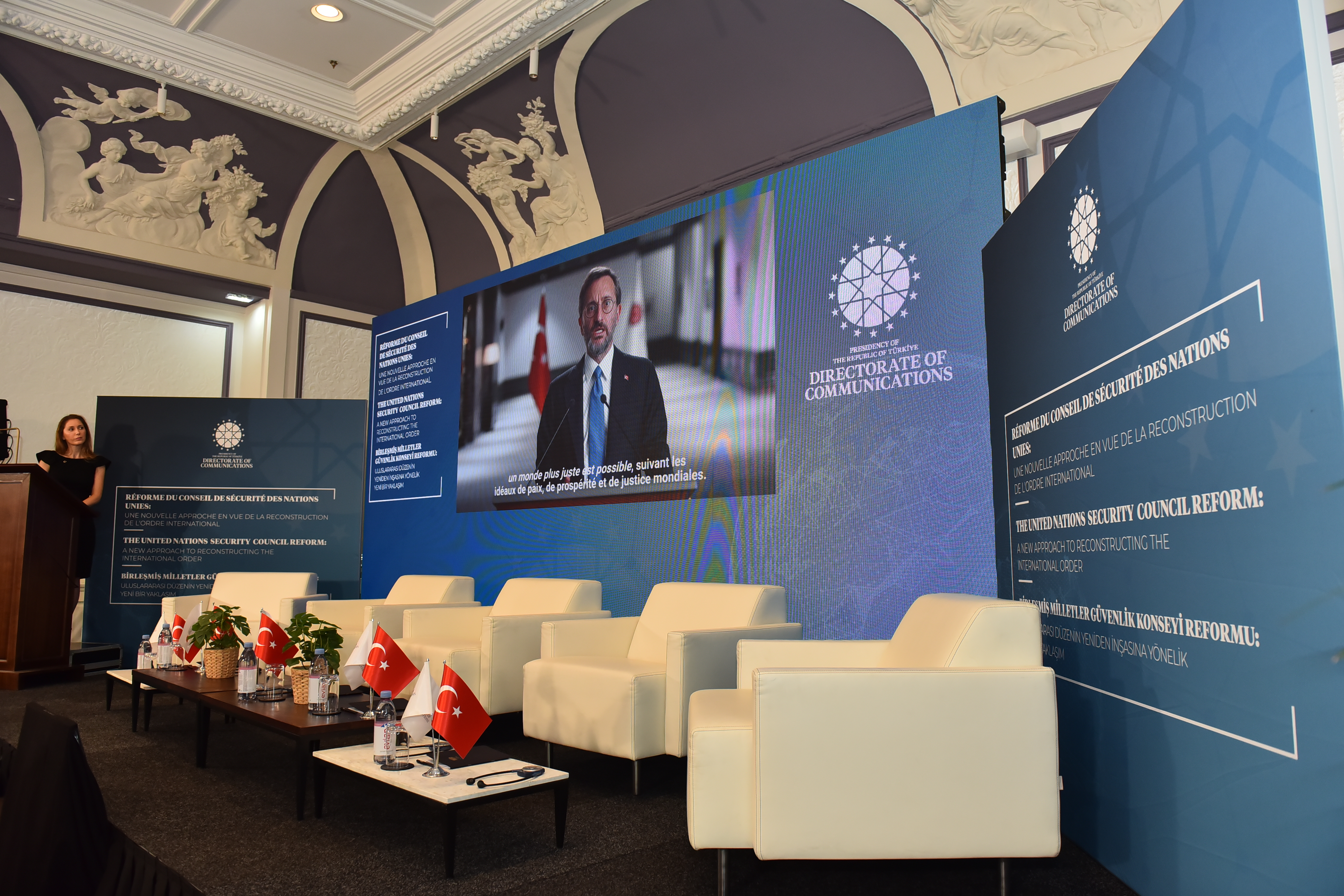
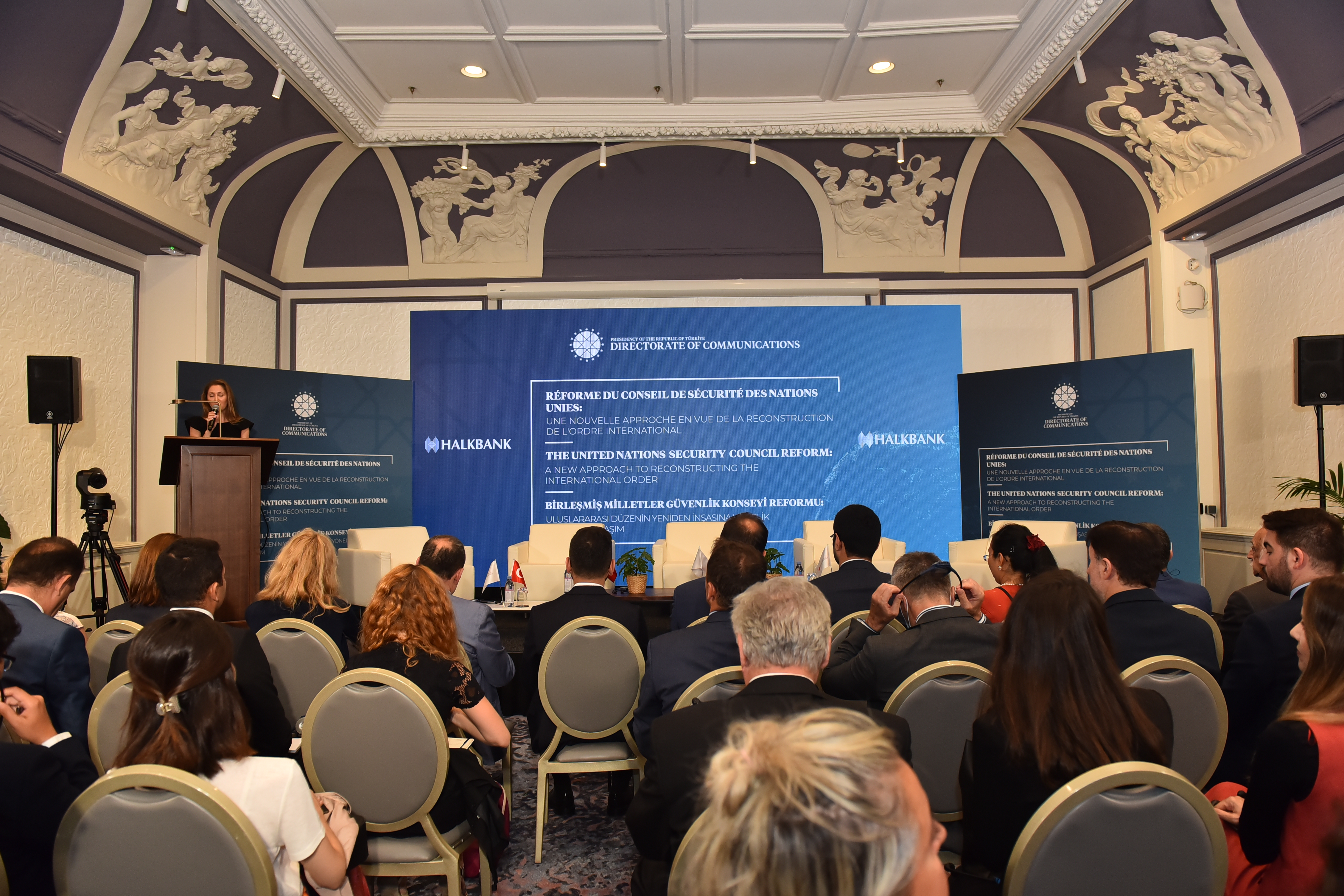
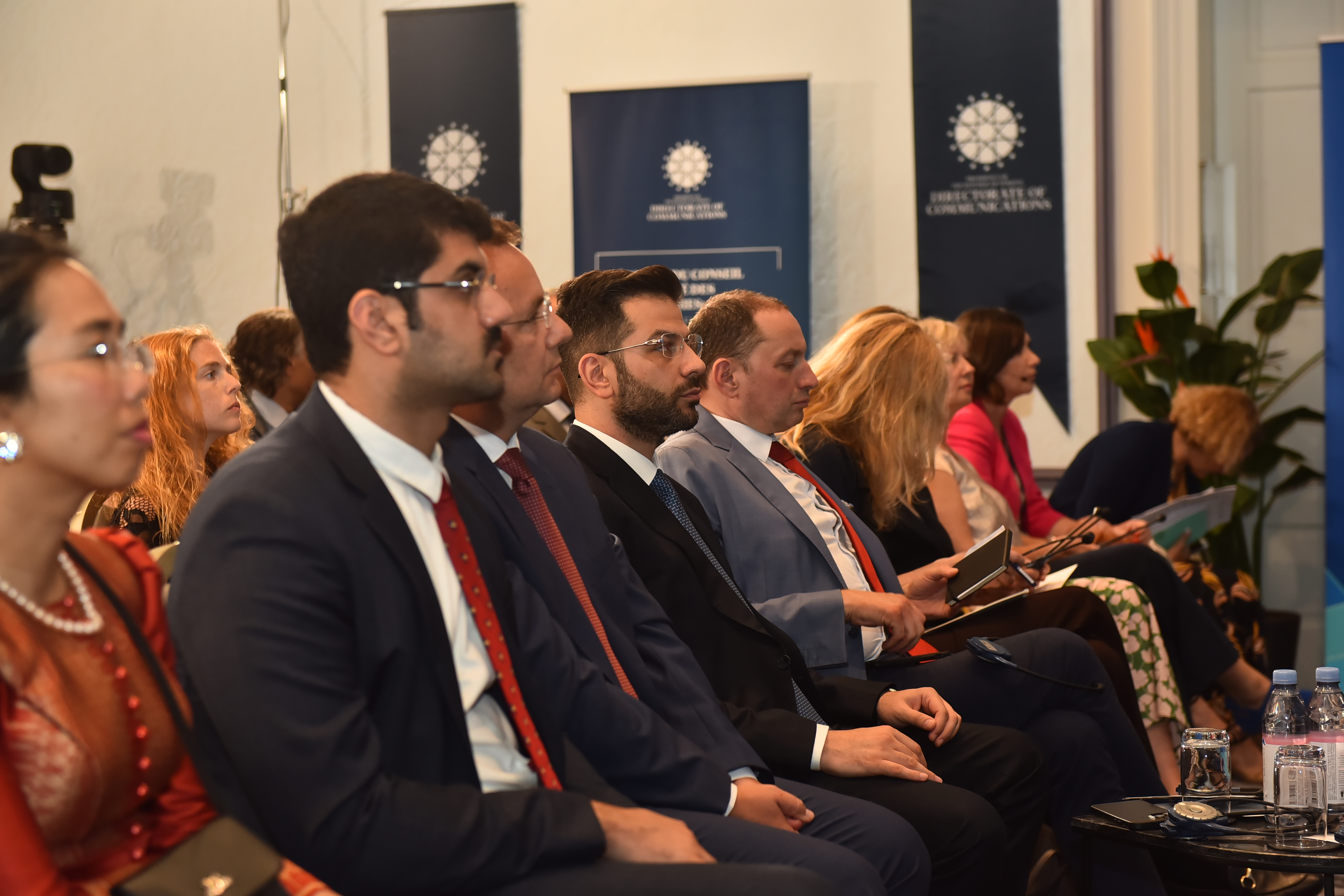
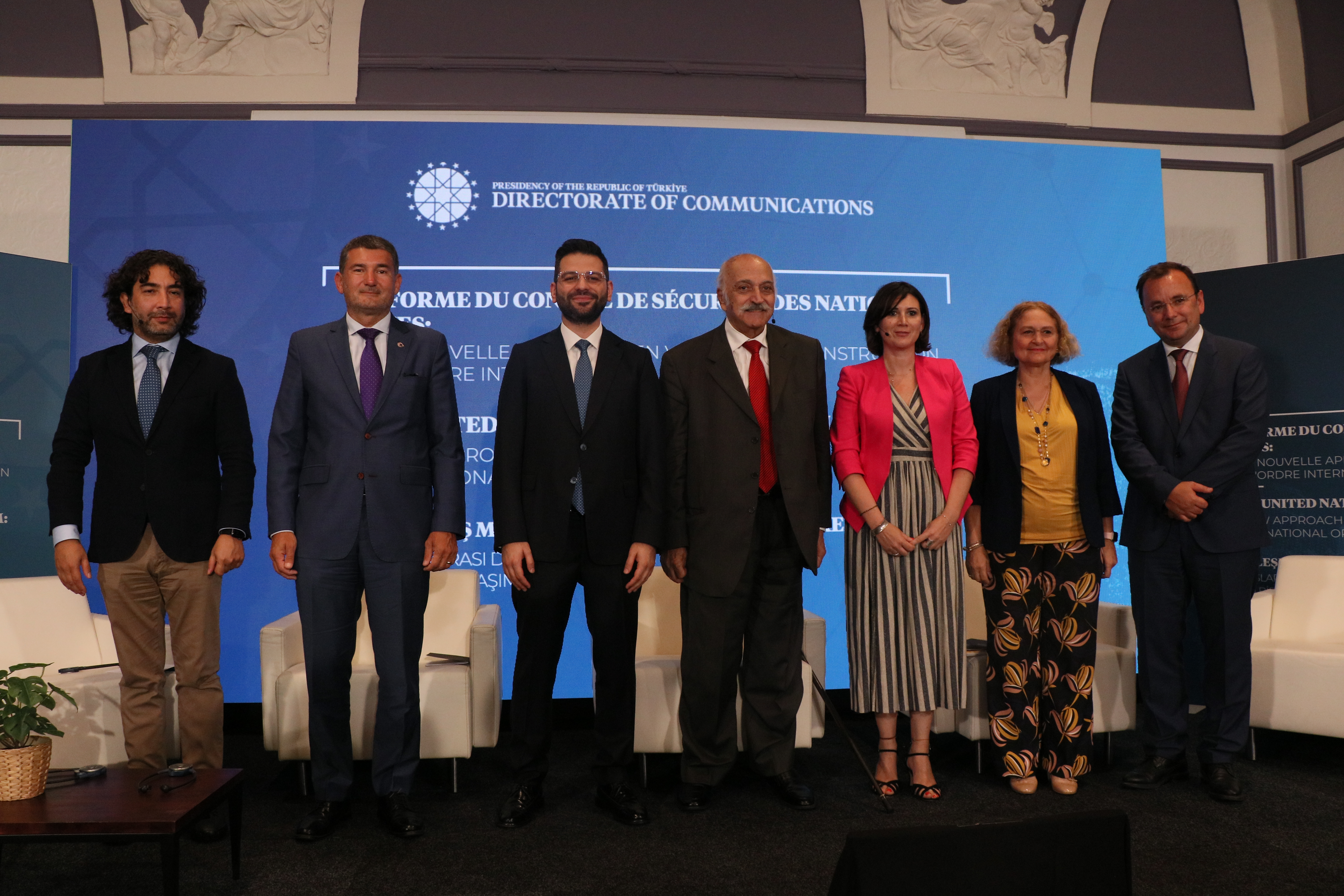
Presidency's Directorate of Communications held a panel with the theme "United Nations (UN) Security Council Reform: A New Approach to Reconstructing the International Order" in Paris, the capital of France.
Presidency's Deputy Director of Communications Çağatay Özdemir and First Counsellor of the Turkish Embassy in Paris Özgür Arslan, as well as many guests, attended the panel. Altınbaş University Rector and Member of the Presidential Security and Foreign Policy Council Prof. Çağrı Erhan, Faculty Member of İstanbul Nişantaşı University and Member of the Presidential Security and Foreign Policies Council Prof. Nurşin Güney, President of the Association of Foreign Journalists (APE) Elias Masboungi, and Scientific Director of Observatory on Türkiye at the Centre for Politics and International Studies (CeSPI) Valeria Giannotta discussed the past and current reform proposals for the UN Security Council (UNSC) during the panel moderated by Assoc. Prof. Kılıç Buğra Kanat, SETA Foundation Washington Research Director.
Assoc. Prof. Kanat stated that they plan to organise the aforementioned panel series in ten countries over the next two weeks.
Kanat emphasised that raising awareness about the need for UN reform, especially after the pandemic, the international food crisis, and the Ukraine-Russia war, was their primary objective when they began this project and that they consider "UNSC reform to be a necessity, not an option."
"UN system was established for a world that was four times smaller than the one we live in today"
Prof. Erhan pointed out that the UN was founded during the Second World War, an extraordinary and difficult period, and indicated reform had been a topic of discussion since the organisation's establishment and that the UN has gone through several reforms and changes in the past.
Erhan said that African and Asian nations exerted the most pressure for the UN reform in the 1960s and that the United Nations Development Program (UNDP) was established in 1965.
Erhan stated that following the end of the Cold War, in the early 2000s, former UN Secretary-General Kofi Annan and current UN Secretary-General Antonio Guterres started a series of reforms within the UN.
Erhan noted that the number of member states has increased from 51 to 193 since the establishment of the UN, while the world population has increased from 2.5 billion to 8 billion, saying, "We clearly need a change because the UN system was designed for a world that was four times smaller than the one we live in today. However, this is not easy. Because the current system's founders and beneficiaries do not want to lose their privileges."
Erhan, on the other hand, stated that the term "reform" has been problematic for UN member states due to the "lack of clarity and unanimity over its implementation."
Erhan underscored that, as proposed by Secretary-General Guterres, the UN has a reform agenda focusing on three key areas — development, UN administration, peace and security —, and he stated that Guterres wants to change the entire UN development system and achieve the 2030 Sustainable Development Goals for the development reform.
Pointing out that there are difficulties when it comes to peace and security, Erhan said, "When we attempt to address security issues, one of the five permanent members begins to impede these initiatives because they have some privileges. The current structure of the UN Security Council reflects the global power structure of 1945. It does not reflect the power structure of 2022."
"The veto power should be abolished"
Prof. Erhan stated that today's world deserves a more effective security mechanism that maintains equality between states in terms of population, economic status or military power.
Stating that the permanent members of the UNSC protect themselves from any sanctions by using their veto rights, Erhan said, "Therefore, the veto power should be abolished."
Stating that the number of UN Security Council members should be increased to 25 and the number of permanent members should not be less than 10, Erhan stressed that there is no longer a balance between the UN General Assembly and the UN Security Council, and this needs to be re-established.
The veto power in the UNSC 'must be balanced'
Prof. Güney also stated that all world citizens and the international order were experiencing difficult times and that it was impossible to predict the future of the international order.
Noting that the UNSC did not operate as expected during the Cold War, Güney asserted that the world underwent significant changes.
Noting that the veto power vested in the five permanent members of the UN could be used against humanity's well-being due to divergent national interests, Güney said there were attempts to reform the UN in the past.
Mentioning the significance of the UNSC enlargement, Güney stated that many countries desired permanent membership, including the G4 nations of Brazil, Germany, India, and Japan.
Güney stated that what the world was experiencing with the Russia-Ukraine war was not new and that many similar tragedies had occurred in the past, and that the UN could not function due to the veto power of the permanent members of the UN Security Council.
Referring to Turkish President Recep Tayyip Erdoğan's statement, "The world is bigger than five," Güney pointed out that the veto power in the UN Security Council must be balanced.
Güney recalled that during its non-permanent membership in the UN Security Council in 2009-2010, Türkiye provided support to maintain peace and trust, and he added that with its experience and trust-building diplomacy, Türkiye managed to secure a grain agreement between the parties today.
Congratulations on President Erdoğan's UN reform efforts
APE President Masboungi congratulated President Erdoğan on his initiative to reform and restructure the UN.
Masboungi stated that the UN General Assembly was the only forum where every country had a voice, citing the veto power as the reason why the UN Security Council was unable to implement its own decisions.
Masboungi said that the G4 countries wanted to be permanent members of the UNSC, recalling that Türkiye supported this initiative.
Referring to President Erdoğan's statement that "The world is bigger than five", Masboungi stated that the current state of the UNSC is "unfair" and that it is "abnormal for five countries to impose their dictates on the future of the world".
Elias Masboungi noted that the overwhelming majority of countries supported Türkiye's initiative.
Masboungi suggested that Türkiye propose the formation of a new global forum and stated that this forum would require a constituent assembly and a charter. Masboungi said that the powers and charter of the forum should be determined at the first meeting.
For this project, Masboungi called for a constituent assembly to be convened in Istanbul within two months.
"We must reconsider the role of a rising power like Türkiye"
"It has been demonstrated that the UN Security Council is ineffective at providing security and stability to the international system and dealing with crises," said Giannotta, Coordinator of the CeSPI Türkiye Observatory.
Giannotta reminded that since 1947, Russia had used its veto 120 times, the US 52 times, the UK 29 times, China and France 16 times in the UNSC, and underlined that no solutions to frozen conflicts and emerging problems had been found.
"The war between Russia and Ukraine has once again demonstrated our international community's inability to deal with the crisis," Giannotta said.
Giannotta stated that a single mechanism within the UN could be created by taking into account the current distribution of power and all international organisations and said, "Today, the current distribution of power does not reflect the distribution of power and the balance of power in 1947".
Noting that the main difference is that everyone is now aware that the world is changing, Giannotta referred to President Erdoğan's statement, "The world is bigger than five".
Giannotta said, "We must reconsider the role of a rising power like Türkiye. Thanks to the country's diplomatic efforts and geographical location, Türkiye is an actor who can speak to everyone".