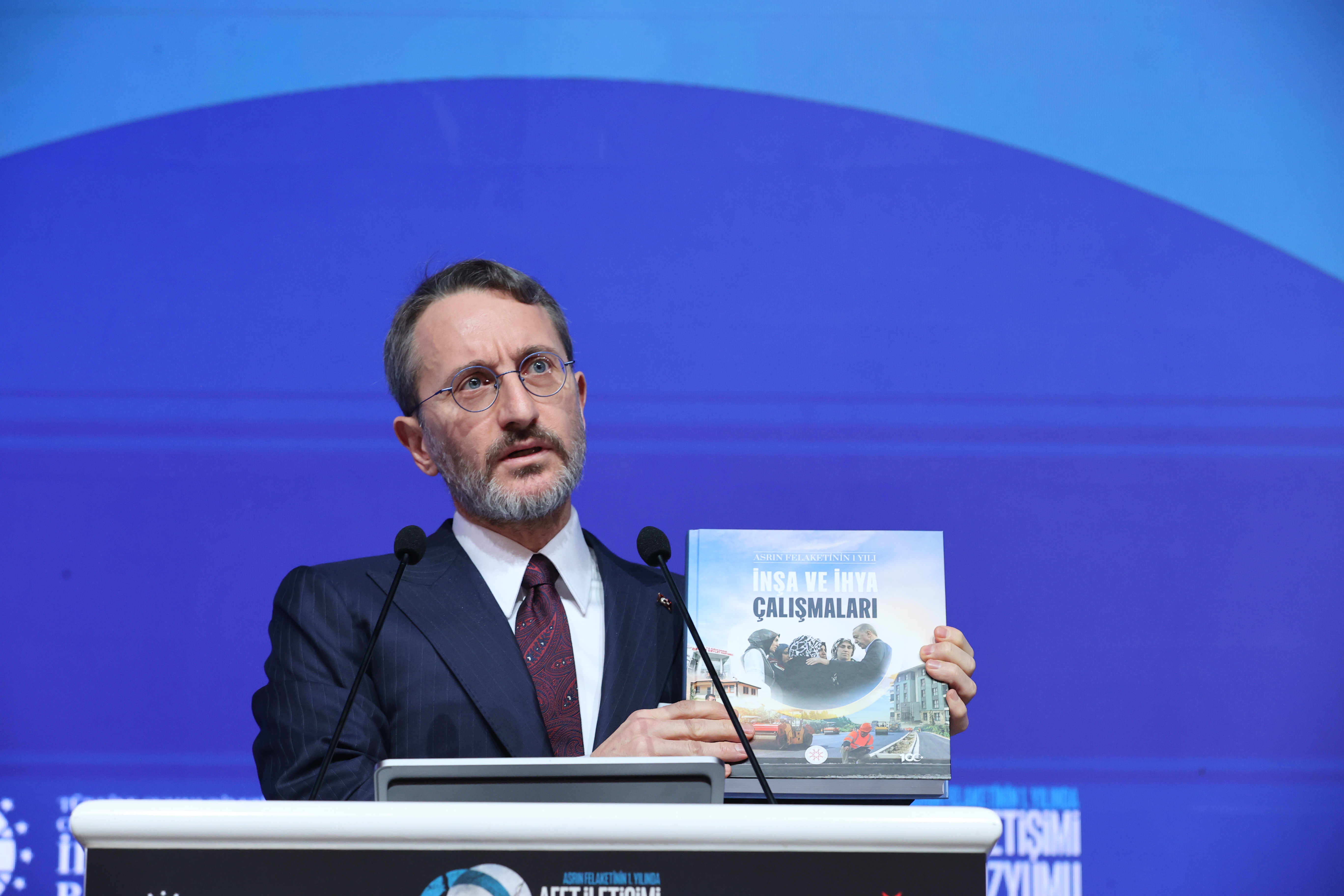
Presidency's Director of Communications, Fahrettin Altun, said in his speech at the Disaster Communication Symposium on the 1st Anniversary of the Disaster of the Century, "Türkiye's Communication Model, led by our President Recep Tayyip Erdoğan, features disaster communication as a major pillar as well."
Presidency's Director of Communications Fahrettin Altun attended the "Disaster Communication Symposium on the First Anniversary of the Disaster of the Century".
During his address at the symposium, Altun underscored the necessity of emergency response and process management for all disasters, irrespective of their magnitude. Moreover, Altun emphasised that disaster communication, a critical component of the integrated disaster management approach, is an integral part of our state's strategic communication policy.
Altun emphasised that disaster communication cannot be limited to communication activities only during disasters and that, as the Directorate of Communication, they contribute to informing the public before disasters as well as disaster prevention and risk reduction activities within their areas of responsibility. He also said:
"In fact, prior to the February 6 earthquakes and during the past year, we have organised several events similar to this symposium on disaster communication. Some of these events include the Disaster Communication Workshop, Panel on International Cooperation and Solidarity in Natural Disasters, Panel on Journalism in Times of Disaster and Crisis, the Stratcom Disaster Communication Forum and trainings and exercises in this context, 'Solidarity to Overcome Disaster' Panel at the European Parliament in Brussels, 'Disaster Diplomacy: Recoding International Solidarity for a Resilient World' panel in Washington, 'Crisis Information Management and Public Relations in Natural Disasters' panel in Tokyo. Furthermore, over the past year, we have made significant contributions to Türkiye's body of knowledge on disaster and crisis management. This includes our books 'Disaster of the Century' and 'Solidarity of the Century', which were prepared in three languages. We have also provided valuable insights through our books titled 'Türkiye National Risk Shield Model Opinions and Proposals' and 'Disaster Communication Forum: Preparedness, Response, Recovery'.
"We consider the disaster of the century to be a milestone in the context of disaster communication"
Director of Communications Altun noted that the final of these publications "Disaster of the Century's First Anniversary: Reconstruction and Recovery Efforts" has been made available for public use, adding, "With this book, we aimed to establish a place for the February 6 earthquakes with respect to other major disasters, delving into the nation's collective solidarity and our coordinated endeavours to recover and restore nearly all facets of life in the quake-hit region following the disaster, including transportation and communications to culture and art, education, health, agriculture, religious and social services.
Emphasising that following the bitter experience, they had never once considered "let's just alleviate our pain and get on with our lives," Director of Communications Altun went on to say: "On this matter, our President showed utmost sensitivity, 'The lives that have been lost are irretrievable. However, such disasters and adversities teach strong states valuable lessons; this is what distinguishes them from others,' he said. He has made every effort to ensure that we, as a state and a nation, have gained invaluable lessons from this disastrous tragedy. In our respective field, Türkiye regards the disaster of the century to be a milestone in the context of disaster communication, as well." With this in mind, we have set the following goal. To move Türkiye to the next level of disaster communication through significant efforts while also contributing to the academic and intellectual body of knowledge in the field."
Highlighting how Türkiye's Communication Model, led by President Recep Tayyip Erdoğan, features disaster communication as a major pillar, Director of Communications Altun went on to note:
"Today, no country can afford to deem disaster communication a choice. Disaster communication is a matter of public governance that requires absolute attention and investment. It is our responsibility as Türkiye to effectively manage disasters and associated risks in all their dimensions. Let us bear in mind that managing these risks consistently delivers more precise results and lower costs in comparison to managing crises. Risk management is of utmost importance. With this in mind, we will attempt to provide comprehensive answers to crucial questions such as "Where do we stand in terms of disaster communication?" "What are the impending threats and areas of cooperation?" and "Who are the key actors in disaster communication and how should they behave?" during this two-day symposium on disaster communication."
"We have endeavoured to ensure that the public gets the facts"
Director of Communications Altun emphasised that fourteen million people were affected in eleven cities by the Kahramanmaraş-centred earthquakes and that the government promptly initiated a reconstruction and recovery mobilisation following the conclusion of search and rescue operations.
Stating that 114,450 workers continue to labour day and night on 930 construction sites in eleven locations within the quake-hit region, Director of Communications Altun said:
"In this context, a significant portion of the tender has been undertaken for 307,000 detached units, 207,000 reserve areas, 50,000 city centres, and 50,000 light steel sections. The construction of the houses, for which the tender has been finalised, continues at a rapid pace. Our goal is to provide support for media representatives and facilitate their presence in the region so that these activities can be closely monitored by the public. Open and transparent communication with the public is the most vital component of this process. This matter has been the focus of our considerable attention since the initial moments of the earthquake. We ensured that the public was informed in the most precise and transparent manner possible by exerting every effort. In the midst of this endeavour, the Turkish media demonstrated unwavering allegiance and laboured assiduously to deliver the nation the truth. Despite the disinformation and hostile campaigns, influential figures in Türkiye's media made significant efforts wielding their pens, and they continue to do so.
"Proper management of the communication process is of great importance"
Pointing out that AFAD has determined ownership for a total of 441,500 detached units, including 390,000 houses, 40,000 workplaces and 11,500 barns, Director of Communications Altun said, "Until mid-March, the draws for 30,000 more houses will be held. In the following two months, the drawing of lots for 75 thousand houses will be completed."
Director of Communications Altun stated that Türkiye has a high level of resilience and organisational skills in the face of disasters and crises and said:
"Disaster communication is at the heart of our state's organisational capabilities. "One of the most strategic instruments at our disposal for disaster planning, emergency response, rehabilitation, and recovery operations has been our disaster communication strategy. From search and rescue operations to the efficient management of emergency response logistics, from the delivery of humanitarian aid to health services, effective management of the communication process is crucial." Additionally crucial is ensuring that our earthquake-affected citizens have prompt and efficient access to accurate information. Of course, this requires a well-developed and operating communications infrastructure. Because we know that every time communication is disrupted, the material and psychological harm caused by the disaster, as well as the human losses, grow dramatically.
To accomplish all of these, it is critical to have well-planned and thoroughly analysed current and foreseeable scenarios that feed communication strategies. At this point, we should underline the importance of our communication methods in the process. Thus, above all, a comprehensive crisis communication plan is essential for ensuring the safety of citizens."
"We have answered 300 thousand applications"
Altun emphasised the importance of coordination in disasters, stating that the successful implementation of emergency response and rescue operations depends on the efficient management of institutions' and the public's emergency mindset. Director of Communications Altun noted that the Directorate of Communications has made and continues to make every effort to establish a robust communication ecosystem by leveraging both conventional and modern media platforms and continued:
"In this respect, we quickly activated the CIMER-Earthquake Emergency application following the earthquake and worked around the clock at our headquarters and on the ground. We have made sure that our Earthquake Emergency application facilitates effective communication between the relevant institutions of our state and the citizens affected by earthquakes. This includes coordinating search and rescue efforts, assessing damage to buildings, efficiently distributing aid to victims, providing shelter, ensuring security and public order, and delivering education and health services. Overall, we received and answered approximately 300 thousand applications. We have taken great care to ensure that the rights of both national and international public opinion to information and freedom of expression are respected. In order to facilitate the work of press members operating in earthquake-stricken areas, we have established temporary press centres for both national and international media professionals.
"We uncovered over 200 lies"
Altun emphasised that malicious actors that attempt to manipulate the emergency psychology created by catastrophic disasters and, therefore, worsen the tragedy must be combated, and went on to say,
"It's unfortunate that they exist, but they do. They carry out their activities in a systematic way. We witnessed this during the earthquakes that struck on February 6. We have seen that malicious actors have primarily used disinformation attacks to manipulate public psychology and impede the progress of search and rescue, rehabilitation, and recovery operations. Through our Centre for Combating Disinformation, we released disinformation bulletins. Between February 6 and 20, 2023, we successfully identified and exposed over 200 disinformative so-called news stories, which were actually lies and could have major negative implications. We uncovered not just the lies but also those who are responsible for them. We demanded that the process be investigated for the public's interest. Following the earthquake, we released a newspaper named 'Hakikat Mücadelesi' (Struggle for Truth) and made sure that our fellow citizens affected by the earthquake received accurate information about the situation in the disaster area."
"We thwarted the efforts of those with malicious intentions"
Referring to the objectives of disinformation attacks during the disaster, Director of Communications Altun said, "The aim of those who carry out these disinformation campaigns is to create a sense of public distrust towards the competent authorities and to disrupt search and rescue and relief activities by circulating false information, to mislead individuals directly and indirectly affected by disasters, to weaken social resilience and resistance by generating chaos and anxiety, to prevent individuals from accessing accurate information, and to undermine decision-making processes. Due in large part to the collective endeavours of the nation and state in the aftermath of the earthquakes, we successfully thwarted the objectives of those vile entities. However, this does not imply an end to such attacks. We are aware that such malicious attempts will undoubtedly manifest themselves in potential crisis and disaster situations. In light of this, the struggle against disinformation must be designated as our highest priority concern with regard to disaster communication."
Underscoring the significance of adhering to official institutions and organisations and relying on their statements during times of crisis and disaster, Director of Communications Altun said:
"While getting news and information, we should diversify our sources and never rely on a single source. Particularly on new media, in the aftermath of the catastrophe, we should prioritise the quality and accuracy of posts over their frequency and popularity. In times of disaster, we encounter a process we call 'disaster journalism.' It is imperative that we maintain a resilient stance in the face of this and refrain from endorsing journalism that amplifies and mirrors ostensibly occurring events for the sake of ratings. Rather than being the first to break the news, we should aim to be the ones who report it accurately. It is imperative to consider the possibility that any act of sharing could inadvertently result in misdirection. Information that could exacerbate the magnitude of the catastrophe, impede an effective response, or incite social unrest ought not to be disseminated. Above all else, we must address the issue in a responsible manner that prioritises the property and life safety of individuals."
"We have carried out numerous research projects on journalism and media ethics"
Director of Communications Altun underlined that another important issue in the face of major disasters is the problem of how to identify and provide qualified and accurate information, and pointed out that the issue of public broadcasting has become extremely important at this point.
Director of Communications Altun noted that in public broadcasting, factors including the source of the news, the way and style of presentation, and the potential impact the news will have on public opinion, should be filtered through an institutionalised media ethics filter and continued as follows: "These codes of ethics tell us that broadcasting in cases of disasters and crises should prioritise the safety of people's lives and property above all else. However, as we examine the new media landscape, it becomes evident that this kind of media ethics has not yet surfaced, let alone established itself. Because of this shortcoming, the Directorate of Communications has carried out numerous research projects on journalism and media ethics, and we will keep doing so uninterruptedly. Our book 'Accurate Reporting and Media Ethics', which we published in 2023, and the 'Panel on Accuracy in Journalism during Extraordinary Times in the Context of Media Ethics', which we organised, are just a few examples of them in this respect."
"Local media has significant roles and obligations."
Director of Communications Altun stated that diversifying communication methods and identifying various alternatives while taking into account various hazards is another aspect of disaster communication and concluded his address as follows:
"In this context, especially local media has significant roles and obligations. Gaining insight into the sociocultural dynamics of a certain area and utilising the knowledge of local media sources and journalists stationed there are crucial. As a result, local media plays a significant role in defining the form, content, and style of messages, announcements, and informational activities. Through our regional directorates and other channels, we, the Directorate of Communications, are in close contact with the local media to support and ensure their active participation in these activities. The Directorate often hosts workshops and discussions for the local media for this purpose. We will keep moving forward in the near future by improving the effectiveness and efficiency of this communication environment. In this sense, I think that our two-day Disaster Communication Symposium will make valuable contributions to this process."