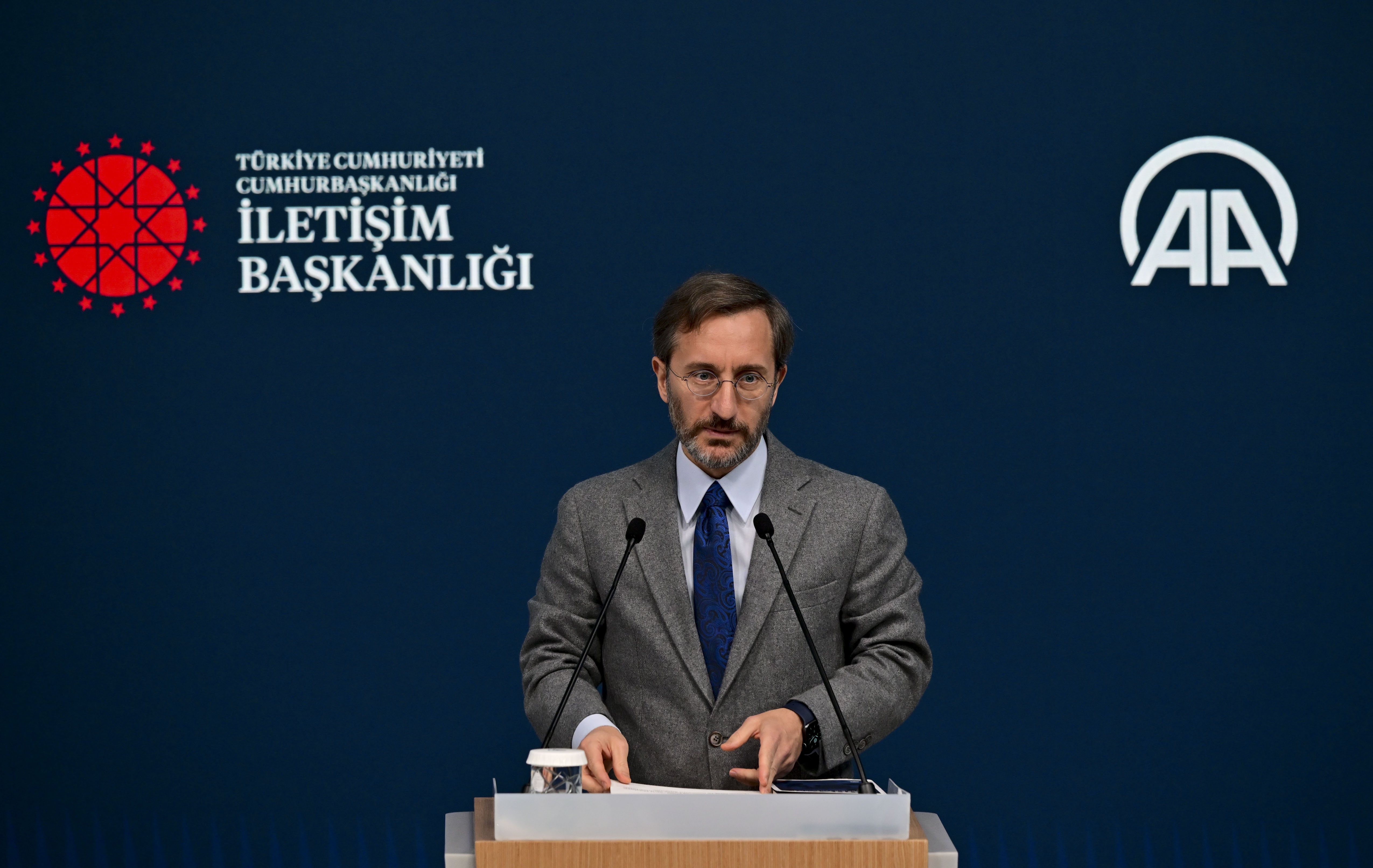
Director of Communications Fahrettin Altun: "As Türkiye, we prioritise countering war and the spread of terrorist propaganda in the same way that we prioritise reinforcing our national security and preventing humanitarian tragedies in different geographies."
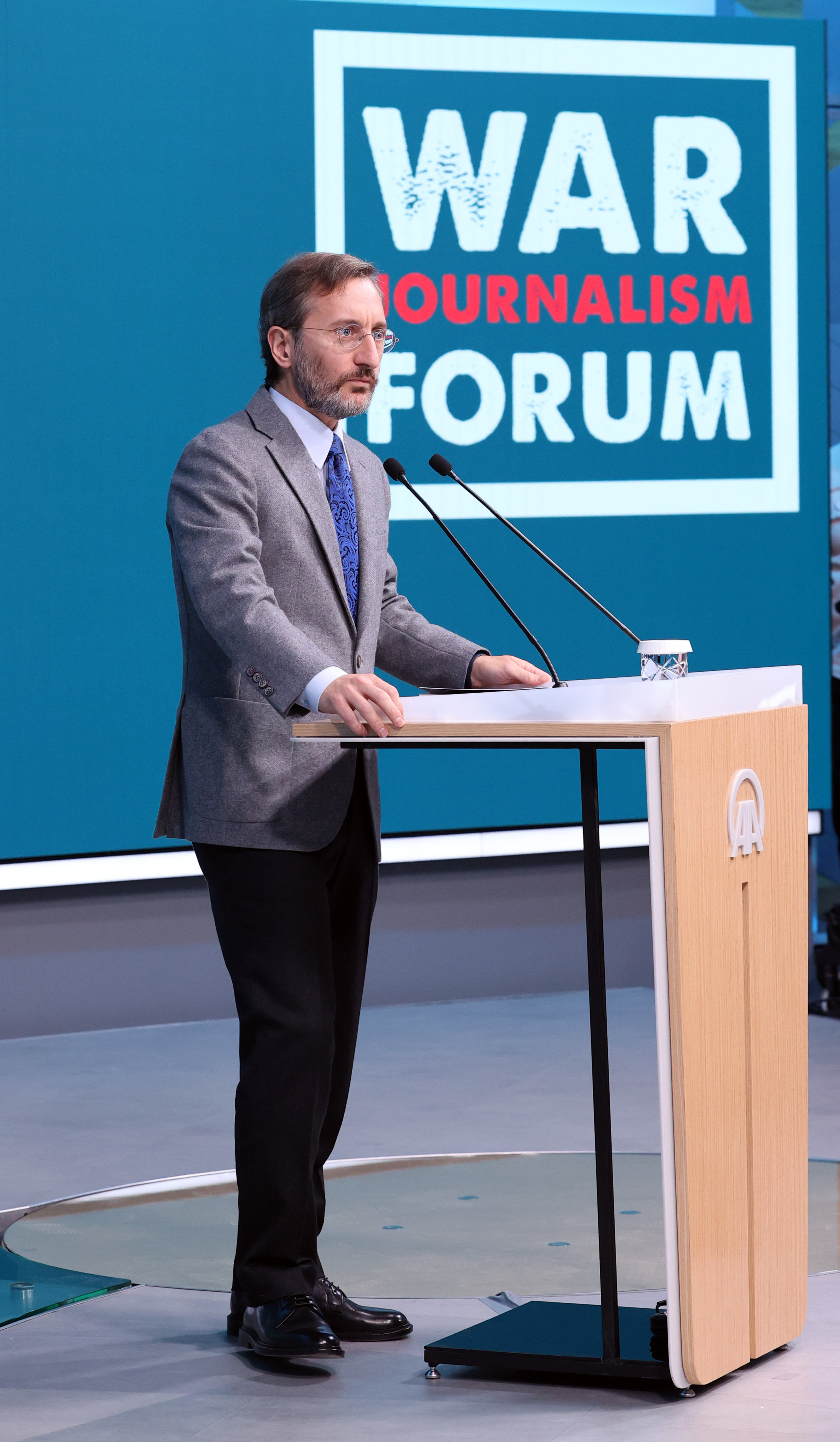
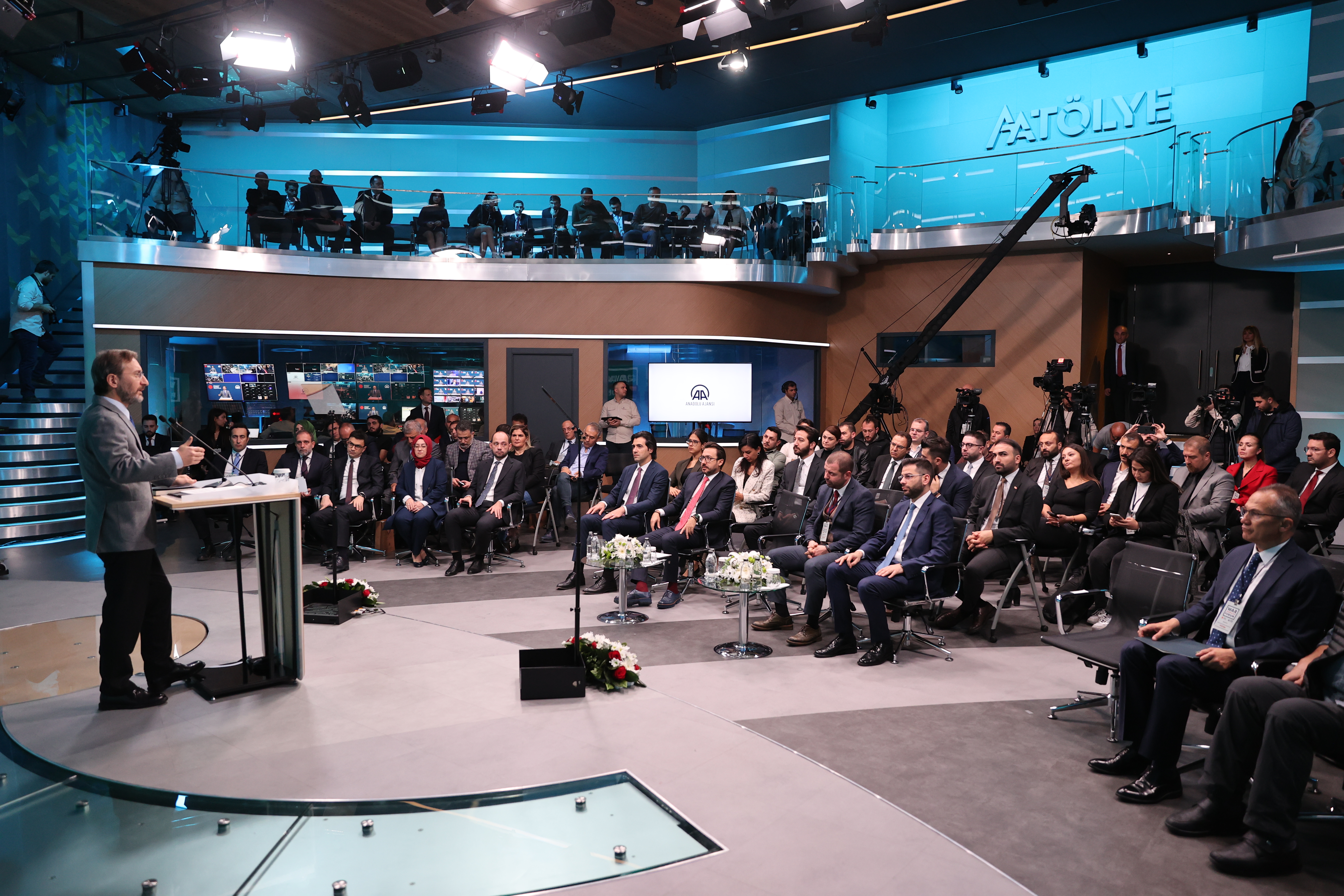
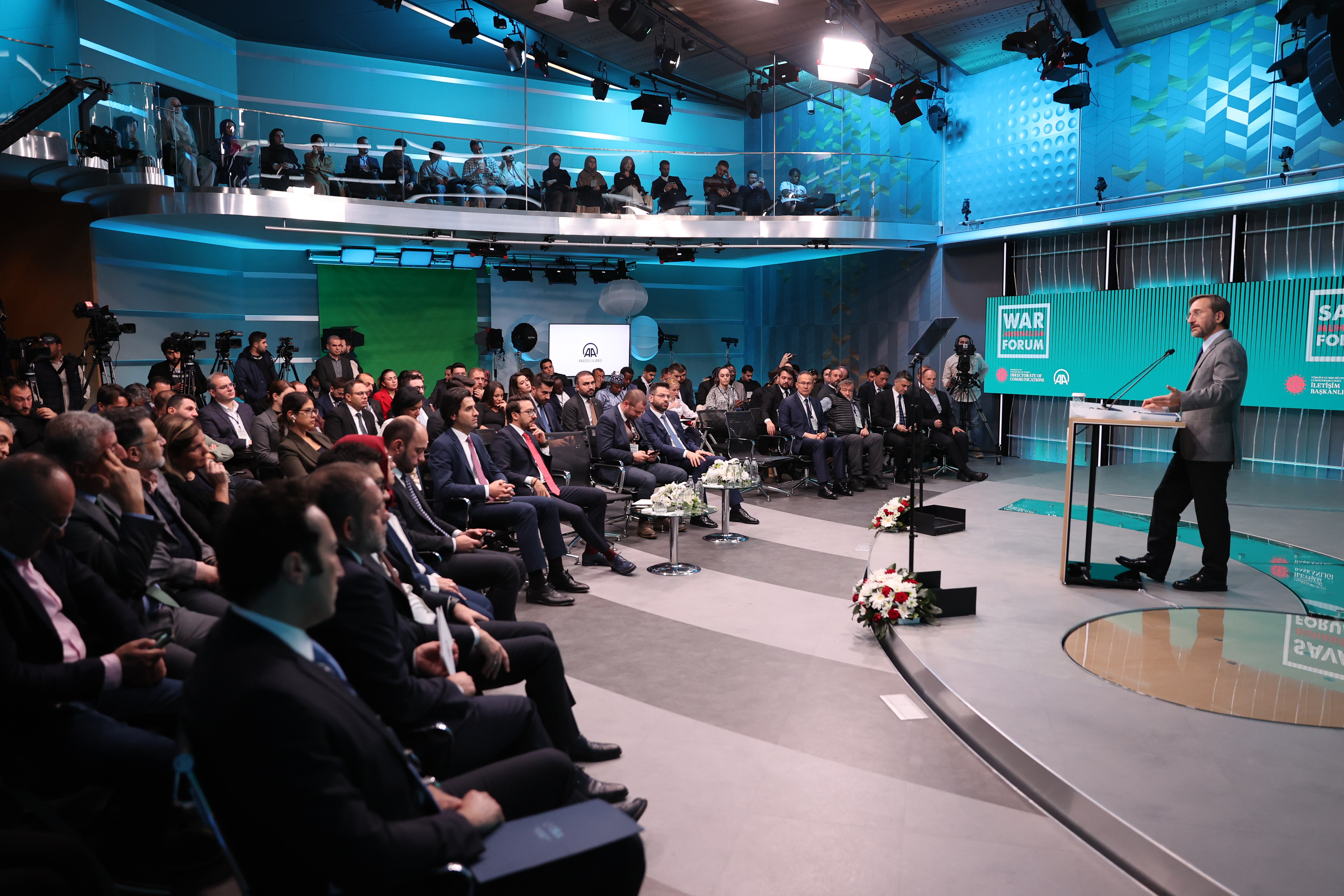
Presidency's Director of Communications Fahrettin Altun spoke at the "War Journalism and Reporting in Crisis Zones Forum" held at the Anadolu Agency (AA) General Directorate.
Expressing his pleasure at being present at the forum organised by AA, Director of Communications Altun said that as the Directorate of Communications, they take action with the responsibility of adopting measures to facilitate the activities of members of the press.
Emphasising that they attach great importance to the works and training conducted by Anadolu Agency, which is the pride of Turkish journalism, in thematic fields such as diplomacy, environment, and war correspondence with its more than a century of experience, Director of Communications Altun noted that they are trying to provide the best support possible to these works.
Underlining that it is a source of national pride for Türkiye that AA provides journalists from all over the world with training that is supplied by private companies abroad for very high fees, Director of Communications Altun thanked all those who contributed, especially AA Director General Serdar Karagöz, whose efforts made this pride a reality.
"A war journalist should act as a fair witness"
Pointing out that the training organised for journalists who will work in war and conflict zones and crisis regions meets an important need, Director of Communications Altun expressed that wars, conflicts, tensions and crises are the harsh realities of today's world.
Director of Communications Altun said, "I wish there were no wars, no conflicts, and no crisis zones, and that there was no need for a journalist specialising in this field. However, conflicts, crises, and wars are the harsh realities of our world and age." and underlined that in an era of modern warfare, it is more difficult to document suffering and to work as a reporter.
Noting that we live in a global era full of crises, uncertainties, and harsh conflicts, Director of Communications Altun remarked that covering wars, crises, tensions and conflicts between global and regional actors in the most accurate way in this age is one of the most challenging journalistic tasks.
Expressing that this journalistic activity requires special training and expertise, Director of Communications Altun continued his words as follows:
"Because the mentioned journalistic activity is performed under extraordinary circumstances, in settings with the highest levels of security concerns, the least amount of access to professional tools and equipment, and the most intense psychological pressure. It is important to display sensitivity in a range of areas, from employing the technical instruments that will communicate what you have witnessed in crisis, conflict, and war zones to not placing yourself in danger and protecting your life. On the other hand, times of conflict and crisis are when manipulation, perception operations, and disinformation are most likely to occur. Of course, a journalist should adhere to the fundamental principle of not using their position to further persecutory policies or as an instrument of war propaganda. In our history, we have seen and witnessed the devastation brought on by 'embedded' journalism in places like Syria and Iraq. A war journalist should, nonetheless, act as a fair witness. "
"It can sometimes change the course of a war"
Emphasising that "fair witnessing" should be the top consideration of those who cover war and crisis regions for news, Director of Communications Altun reported that they were able to see how each word that is written and each picture that is photographed can have an impact thanks to this "fair witness."
Pointing out that a photograph or image can sometimes change the course of a war by revealing the suffering and devastation brought on by it, Director of Communications Altun provided the following opinions:
"Actually, I agree with Johan Galtung that defining 'peace journalists' as opposed to 'war journalists' would be more suitable. Because conscientious journalists can help put an end to wars, conflicts, and crises, which in turn helps to bring about peace. Again, as stated by Thomas Hanitzsch, 'while war journalism only reports on violence at the front, peace journalism tries to share with the public the background, context, and course of the conflicts as well as the developments on the front' so that it can help to bring about peace rather than further war. We must carry on with our professional endeavours without using rhetoric that encourages conflicts, wars, or violence, but rather with language that always shows the true nature of conflict and promotes peace. We must not disregard the fact that this profession can also promote global awareness of humanitarian drama in different regions."
Stating that he considers bringing the tragedy experienced by immigrants exposed to the inhuman treatment of Greece in the Aegean to the attention of the world public within the scope of "peace journalism", Director of Communications Altun congratulated the media representatives operating in this context in the Aegean.
"We are working very hard to combat dark propaganda"
Recognising that President Recep Tayyip Erdoğan's peace diplomacy, which he practices in a variety of situations, including the Cyprus issue, the refugee crisis, and humanitarian crises, provides an important perspective to "peace journalism," Director of Communications Altun continued:
"As Türkiye, we prioritise countering war and the spread of terrorist propaganda in the same way that we prioritise reinforcing our national security and preventing humanitarian tragedies in different geographies. It is also a testament to our efforts to communicate credible news in the most reliable and timely possible manner through credible channels. Combating systematic disinformation and terrorism of lies is merely one aspect of our country's ardent war on terrorism, which is being led by our President. Because the terrorist organisations against which Türkiye is waging effective operations cling to falsehoods, defamation, and disinformation, and sadly, so do their propaganda agents. In addition to providing a thorough explanation of the efforts we have taken to eradicate terrorism at its source and their results, we are exerting a concerted effort to combat black propaganda on a national and international scale."
Referring to the fact that partisanship occasionally substitutes journalism, particularly in Western media, Director of Communications Altun noted how groups that are useful to the relevant states are almost marketed, while those that are not useful are ignored or defamed.
Reminding how they clearly observed this trend, especially in the counter-terrorism operations carried out by Türkiye in northern Syria, Director of Communications Altun said, "Some members of the press working with terrorist organisations profited from this situation by publishing provocative and untruthful articles. Some of them made new contracts in exchange for larger sums. We are well aware of their identities. In our resolve to render the terrorist organisation completely ineffective, we have not and will never allow systematic lies and disinformation."
"AA has built a significant capacity"
Director of Communications Altun stated that the media countered black propaganda with accurate information and images on the ground during the struggle that liberated Karabakh, the Azerbaijani territory, from Armenian occupation, adding, "We all recall the footage evidencing how journalists on the ground risked their lives to cover the Russia-Ukraine conflict. Through the 'peace reporters' in the region, the entire world witnessed and read about the war's violence, destruction, and humanitarian disasters."
Director of Communications Altun recalled that the Turkish media, particularly Anadolu Agency and TRT, produced exceptional news and visuals during Türkiye's fight against terrorism, as well as the Karabakh and Russia-Ukraine wars, and congratulated all reporters, camera operators, and photojournalists on the ground for their tremendous efforts and sacrifices.
Director of Communications Altun emphasised how these outputs and experiences demonstrate the importance of institutionalising "peace reporting" and that AA has built a significant capacity for national and international media through the training programmes it has been organising since 2012.
Presenting AA's book, the "Reporter", Director of Communications Altun said, "Here, you can find very clear information on the formation, approaches, and methods by which reporters, who are fundamentally at the core of the news in the field, including peace journalism, will communicate the truth to the public. I wanted to underline the significance of this work, to which I contributed as a communications scholar."
Director of Communications Altun emphasised that the training AA has provided to nearly 500 reporters from 50 countries has been met with great enthusiasm and that not only public institutions but all institutions in the media sector should demonstrate all of their knowledge and capabilities in order to meet the need in this field.
Director of Communications Altun thanked AA and all relevant institutions for their efforts to expand their expertise and awareness in war correspondence and congratulated members of the press who successfully completed the challenging training process that was no different than the real conditions.
"Rehabilitation for journalists in conflict zones"
Director of Communications Altun wished success and ease to journalists who worked under extreme conditions in conflict, crisis, and natural disaster zones, as well as God's mercy to members of the press who lost their lives in the line of duty.
Director of Communications Altun thanked the journalists, academics, and all forum participants who will be sharing their theoretical and practical experiences and hoped the forum to be beneficial and fruitful for the media in Türkiye and around the world.
Director of Communications Altun stated that the issues regarding reporting activities in conflict and crisis zones should not be confined to the physical protection of journalists:
"As is well known, our reporters and camera operators who work in crisis zones on a regular and long-term basis may suffer from 'post-traumatic stress disorder' and depression. In this regard, we intend to take the required steps in collaboration with the relevant institutions and organisations, particularly our Ministry of Health, and I would like to convey our commitment to contributing to the rehabilitation of our colleagues working in conflict zones. I would like to state with complete candour that we will always support the press workers who make it possible for the public to obtain information. I wish for a world free of wars and conflicts, where peace, stability, and trust prevail."
Following his speech, AA Chairman of the Board and General Manager Serdar Karagöz presented Director of Communications Altun with a camera model built of recyclable materials as a gift.
Director of Communications Altun also visited AA's photography exhibition.