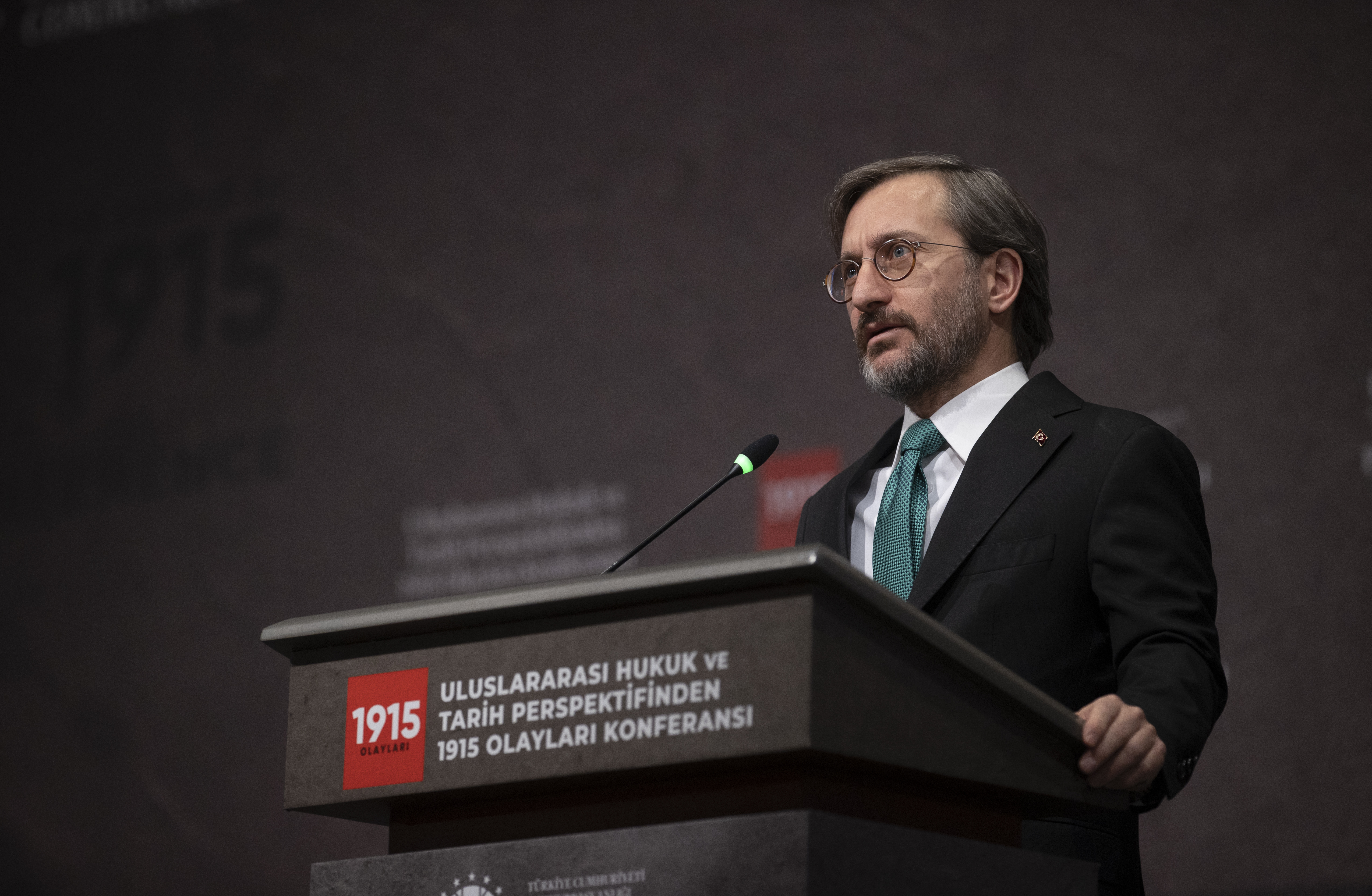
Director of Communications Altun: "The Republic of Türkiye is not worried about its history, nor is it afraid of its shared future with its neighbours. Contrary to the third parties who diverted the events of 1915 for the sake of their political agenda, we remain committed to resolving problems with our neighbours and ensuring peace and stability in the region, as we did in the past."
Director of Communications Fahrettin Altun, in his speech at the Conference on the Events of 1915 from International Law and History Perspective, held at the Presidency's Directorate of Communications, said, "Post-truth narratives based on distorting and exploiting history serve no purpose for us or the truth. Türkiye will always vigorously defend what is right and true."
Director of Communications Altun began his speech by greeting the participants, wishing that the conference would be auspicious, and he hoped that the evaluations they would make today contribute to the reconciliation of history and truth.
Director Communications Altun pointed out that the accurate reading of history, undoubtedly, could only be possible with a sincere search for the truth and conveyed his hopes that the conference would serve as a guide for this meaningful search. Director of Communications Altun underlined that the last century saw profound changes in the world's structure on political, economic, and technical levels and saw major transformations, including important breaking points, and while this transformation changed global borders and forms of government, it also brought great pains to humanity.
"A genocide never occurred"
Stating that one of the greatest tragedies of the 20th century, which witnessed many tragic events, was the First World War, Director of Communications Altun reminded that tens of millions of soldiers and civilians lost their lives in many battles in Europe, the Middle East, Africa and the Pacific.
Noting that this war had deeply affected the Ottoman Empire and the nation, Director of Communications Altun said:
"All Ottoman citizens, including Turks, Kurds, Arabs and Armenians, experienced the pain and suffering of the war. While the Ottoman Empire was fighting on fronts such as Çanakkale, Caucasus, Palestine, and Hejaz and losing hundreds of thousands of its sons and daughters, domestic massacres which were carried out by separatist gangs provoked by the occupying powers further aggravated the conditions of the state and the Muslim population. It is documented history that Armenian gangs, who took advantage of the war conditions in Anatolia, massacred hundreds of thousands of civilians. Thousands of Ottoman citizens had to leave their homeland in order to escape the massacres of the Armenian gangs. In 1915, the Law of Relocation and Resettlement was enacted by the Ottoman Empire in order to prevent the brutality that had reached unbearable dimensions. The Armenian population in the regions where these gangs escalated their attacks was temporarily relocated to the southern regions inside Ottoman borders by ensuring the safety of life and property, but never deported. A genocide never occurred."
Director of Communications Altun emphasised that this step was a security measure that the Ottoman Empire, which was shot in the back while waging an all-out struggle for its territorial integrity and security, had to resort to.
"The Events of 1915 are attempted to be exploited for dirty political purposes"
Noting that the Relocation and Resettlement, which was carried out for the protection of civilians and the defence of the homeland under war conditions, was the result of the mass armed rebellion of some Armenian gangs, which started before the war and continued on a bigger scale throughout the war, Director of Communications Altun said, "Throughout this compulsory relocation under the conditions of war, which continued with an intensity never seen on this land before, difficulties such as hunger and epidemics that affected the whole geography were also battled."
Pointing out that these sad events were the unfortunate luck of Turkish, Kurdish, Arab, Armenian, and all Ottoman citizens and the shared suffering of this geography, Director of Communications Altun added:
"However, we know that the common past, in which our nation had lived together in peace and calm for centuries, is stronger than anything. As our President Recep Tayyip Erdoğan has stated, 'Turks and Armenians have a centuries-old culture of coexistence that sets an example for humanity.' However, this historical truth is deliberately obscured; and the events of 1915 alone are manipulated by the abuses and baseless claims of malicious groups, and they are attempted to be exploited for dirty political purposes. We represent one of the most exceptional examples of the history of coexistence. In this regard, we cannot allow the common past of our nation to be forgotten. We must stand together against those who try to sow the seeds of hostility among us. We, the children of this land, have shared joy and pain for centuries, and we continue to do so. We will, however, never allow our common history to be maliciously politicised."
Pointing out that discussions concerning the period in question are intended to be used as a tool for certain parliaments' domestic politics with a prejudiced attitude that is far from science and has no link to historical facts, Director of Communications Altun said that, in particular, the fact that many western states brought these events to the agenda as a means of exerting political pressure and their intention to use them as an effective instrument in foreign policy revealed an imposing and tyrannical mindset toward Türkiye and that it has no validity.
"Historical facts should not be used for the narrow interests of the political conjuncture"
Expressing that while the events of 1915 should have been the focus of history and science, they have remained a source of political debate despite the fact that more than 100 years have passed, Director of Communications Altun said, "Let alone being a matter of a historical or scientific debate; this issue has failed to become anything more than a material for lobbies and election campaigns, and a future and a source of livelihood for politicians."
Director of Communications Altun recalled that the 20th century passed in the shadow of great wars for all humanity in general and stated that many peoples were negatively affected by the bitter experiences of these wars.
Underlining that falsifying the bitter records of the war is a great injustice to history and humanity, Director of Communications Altun said:
"This view also causes the historical memory to be disconnected from reality. The events of 1915 is a proof of how a historical event can be disconnected from reality and used to incite hatred against Turkish society and state, with various distortions. Historical facts should not be used for the narrow interests of the political conjuncture. When our President called for the formation of a joint history commission to investigate the events of 1915, he wished to rescue a historical subject from the clutches of politics and malicious circles. This call remains valid. This call has yet to receive a genuine response in the international arena. As the leader of a nation without fear, our President has made a call. This call must be answered. We expect this call to be answered so that the truth be revealed. Decisions regarding the events of 1915 taken by the parliaments of many countries against Türkiye are null and void in the light of scientific data and international law and from our point of view. Our President has repeatedly stated this. A fabricated perception of history is an insult to both history and humanity as a whole."
"As Türkiye, we will always defend what is true"
Director of Communications Altun said: "This menace may seem to threaten only the Republic of Türkiye today. What is desired to be sacrificed in political arenas, however, is a shared past, a shared memory, and, indeed, a shared future," and emphasised that they would never allow this.
Underlining that they would not bow down to any state, lobby or diaspora that destroys their shared history and pose the greatest obstacle to their shared future, Director of Communications Altun said:
"The Republic of Türkiye is not worried about its history, nor is it afraid of its shared future with its neighbours. Contrary to the third parties who diverted the events of 1915 for the sake of their political agenda, we remain committed to resolving problems with our neighbours and ensuring peace and stability in the region, as we did in the past. We make every effort for this. We also stand against the circles that distort our shared history in order to justify their own shady past. Attempts to falsify history are the most heinous form of disrespect to the pain suffered by all Ottoman citizens at the time and the memories. Post-truth narratives based on distorting and exploiting history serve no purpose for us or the truth. The critical point is to instil justice and truth in minds and hearts and to shine the light of truth on the shared future of the Turkish and Armenian peoples. As Türkiye, we will always vigorously defend what is right and true."
Fahrettin Altun stated that he believes this conference would contribute to the peace and stability of the Turkish and Armenian peoples and that their efforts are directed toward establishing a just memory in opposition to slanders and those who distort historical realities.
Director of Communications Altun expressed his gratitude to all the institutions that contributed to the conference, which was organised for this purpose, as well as the speakers and all guests who attended.