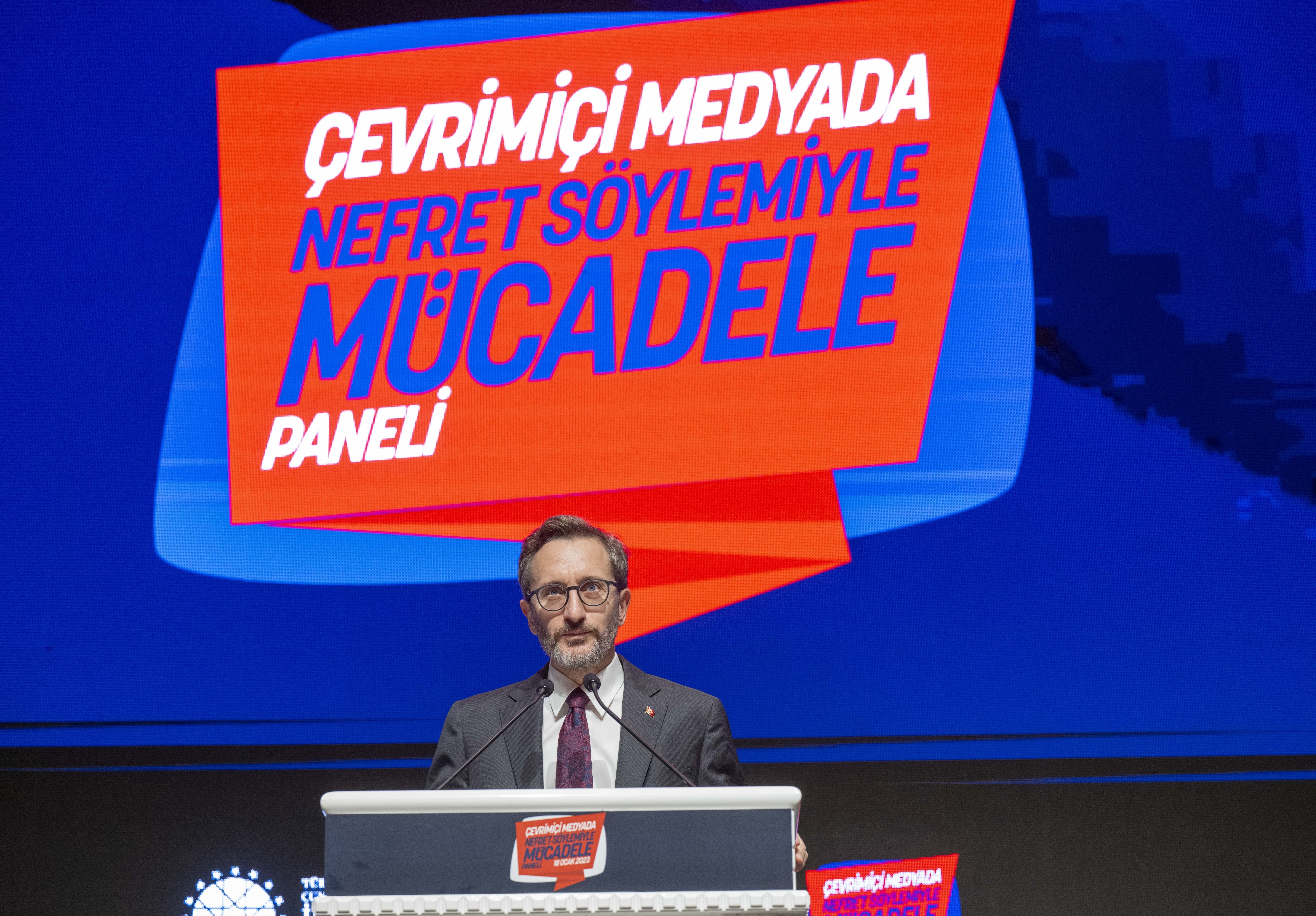
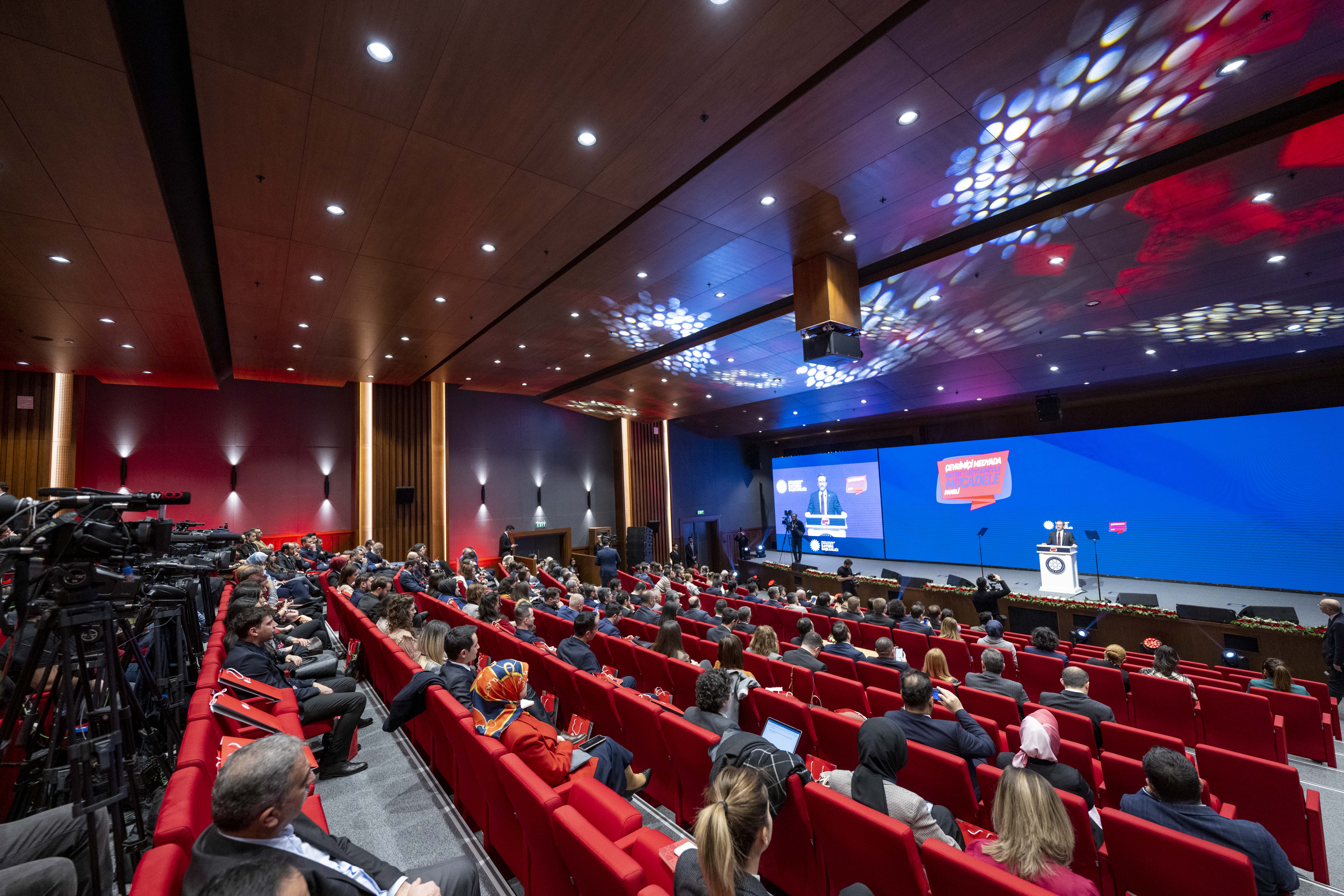
In his speech on the "Panel on Combating Hate Speech in Digital Media" held at the Presidency's Directorate of Communications, Presidency's Director of Communications Fahrettin Altun said, "Digitalisation serves the rapid spread of the content with hate speech. Therefore, the unity, integrity and solidarity of societies are under threat more than ever before in history."
Presidency's Director of Communications Altun stated, "Hate speech is one of the most challenging problems of the media in our country as it is all over the world. We are witnessing that the increasing hate speech in the digital media has undermined social peace, political culture, family values, cultural dynamics and the sense of mutual respect in Türkiye", saying that the social functions of the media include basic functions such as informing, meeting the needs of entertainment-consumption and education.
Stating that this situation also gives an idea about what the media does or is responsible for, Director of Communications Altun said that the way media functions is as important as what this function is.
Emphasising that the media should take into account the sensitivities, basic expectations, and needs of society and act responsibly, Director of Communications Altun stated that there are legal regulations that bind the media as a framework in this regard.
"We often come across content with hate speech in digital media"
Director of Communications Altun emphasised the importance of the media subjecting its internal functioning to self-regulation based on ethical and professional principles.
Pointing out that the ability to adopt an attitude and stand by the truth in an environment where hate speech and disinformation are prevalent is not a choice but a necessity for the journalism profession, Director of Communications Altun continued:
"However, nowadays, we frequently encounter content with hate speech, especially in new media and digital media. Hate speech and content with hatred, which we frequently see in digital media, are among the major issues we face in this post-truth era. As Castells points out, those who live in the network society, namely, "we are faced with hateful news and attacks from the point of view of freedom of expression, our lifestyles and our faith-based indicators. Undoubtedly, we are people of an anti-cultural age where the truth is distorted, and lies prevail over the truth. Of course, we are aware of this, and at this point, we continue our steadfast struggle."
Director of Communications Altun stated that they have recently witnessed not only the distortion of the truth but also the attempts to suppress the truth through content focusing on marginalisation, insults and humiliation.
Pointing out that they are faced with all kinds of manipulation in all aspects of life, from the political sphere to the digital media, Director of Communications Altun said, "Unfortunately, those who view marginalisation and exclusion as a means of subsistence also undermine the future of societies and the culture of co-existence. Media professionals, in particular, must be very sensitive in this regard."
"Hatred is blind and deaf, lacking conscience and mercy"
Director of Communications Altun underlined that in today's world, where digitalisation has become widespread; they witness the manipulation of truth by lies, with hate news and hate speech becoming one of the most significant components of this process.
Expressing that hate speech, which is disseminated over a large area and has a negative map of meaning, unfortunately, can also have a wide manoeuvre area, Director of Communications Altun commented as follows:
"As you know, hate speech feeds on and promotes hatred. Prejudice is the primary cause of this wicked feeling and its evil effects. Hatred is blind and deaf, lacking conscience and mercy. Therefore, it does not hesitate to abuse, humiliate, insult, and provoke hostility. Unfortunately, violence is also included in this unpleasant discourse, along with elements such as insults, discrimination, demonization and provocation against certain individuals and groups, as well as their identities. This discourse, which exists in almost every country in the world, leads to a climate of hatred by encouraging violence, hostility, humiliation and discrimination. Hate speech has the potential to destroy freedom of expression, which is one of the basic human rights and ideals, the egalitarian and decent arrangements of pluralist democratic societies, as well as the rights of individuals and groups."
Director of Communications Altun stressed that it is difficult to construct and simple to demolish and that a lie can travel around the world and back again while the truth is lacing up its boots.
Noting that they see these two facts unequivocally in the field of new media today, Director of Communications Altun said, "The rapid transformation and digitalisation of communication technologies facilitate the rapid dissemination and wide distribution of content with hate speech. This triggers polarisation among individuals and groups, increases tension between various political and social structures, and raises an insecure, exclusive and accusatory attitude towards the dominant culture. However, evil destroys. Therefore, the unity, integrity, and solidarity of societies are under greater peril than ever before in world history."
"Hate speech must be combated both in media and at institutional levels"
Director of Communications Altun said, "As in the rest of the world, hate speech is one of the most significant concerns facing the media in our country. We observe that the proliferation of hate speech in Türkiye's digital media threatens social peace, political culture, family values, cultural dynamics, and the sense of mutual respect "and added:
"Producing new content or reproducing existing content and disseminating it through mass media or digital media fosters the spread of hate speech. In this context, it is crucial to clear the digital media as much as possible of information containing hate speech and to raise public awareness on this issue. Exactly for this reason do we have this meeting. Hate speech must be combated both in media and at institutional levels. Today, we see that the emphasis on 'hate speech in the media' has been prominent in discussions and studies that have focused on the mass media in recent years. Here, discrimination takes place. Unfortunately, only marginal groups are included in hate speech literature in the international arena, while groups more frequently exposed to hate speech are often disregarded. Our research revealed the groups most exposed to hate speech in the media and the internet media are widespread within society. In Türkiye's media, particularly religious segments of society are exposed to hate speech. We must emphasise this truth. At this time, we believe the academic literature should no longer ignore this reality."
Director of Communications Altun stated that the oppression, marginalisation, or discrimination of individuals based on their religious beliefs, lifestyles, ethnic connections, political choices, and identities should be the focal point of hate speech research.
Director of Communications Altun emphasised the proliferation of hate speech content through the media, the formation of such an agenda, the marginalisation, and even the lynching of people exposed to this narrative in an attempt to influence the public through such content, and added, "The professional mechanism of the media reproduces feelings of hatred, which harms social peace and the culture of negotiation. The reach of hatred is, unfortunately, increasing and spreading."
"Distortion-lie is the most significant source of hate speech"
Director of Communications Altun highlighted that Türkiye stands out as one of the countries most exposed to disinformation worldwide and continued:
"In Türkiye, we observe a decline in the rate of trust in digital media news. Compared to 2021, confidence in digital media decreased by 5 per cent to 36 per cent in 2022. Sixty-four per cent of the population distrusts digital media. Distortion and fake content are the primary cause of this situation. Therefore, content in the distortion-lie category is the most significant source of hate speech in digital media in our country. At a rate of 47%, distortion-lie is the factor most responsible for the generation of hate speech. It is followed by content that falls into the insult-humiliation category with 29 per cent and exaggeration-generalisation with 17 per cent. It is thus necessary to make digital media safer, with its reach extending from individual rights to social order and national security. This unquestionably makes up a part of the communication mobilisation that our President has called for. As our President personally emphasised, it is our primary obligation to combat the terrorism of lies perpetrated both internally and externally, and this is one of the key tenets of our "Türkiye's Communication Model."
Director of Communications Altun stated that the media should make greater efforts to avoid provocative publications that incite violence, as well as re-evaluate the language it employs and the narrative framework it builds in terms of social unity and benefit.
Director of Communications Altun said that the media should create content in a way to contribute to the culture of social peace, democratic existence, and negotiation, adding, "This is not a luxury. The media should place this principle at the centre of their professional ethics. We must make it loud and clear that it is imperative for us to combat hate speech in digital media with a strategy that incorporates multiple individual, social, and political dimensions. Civil society, universities, public institutions and organisations should all be involved in a shared struggle. As the Presidency's Directorate of Communications, we exert considerable effort to do our part."