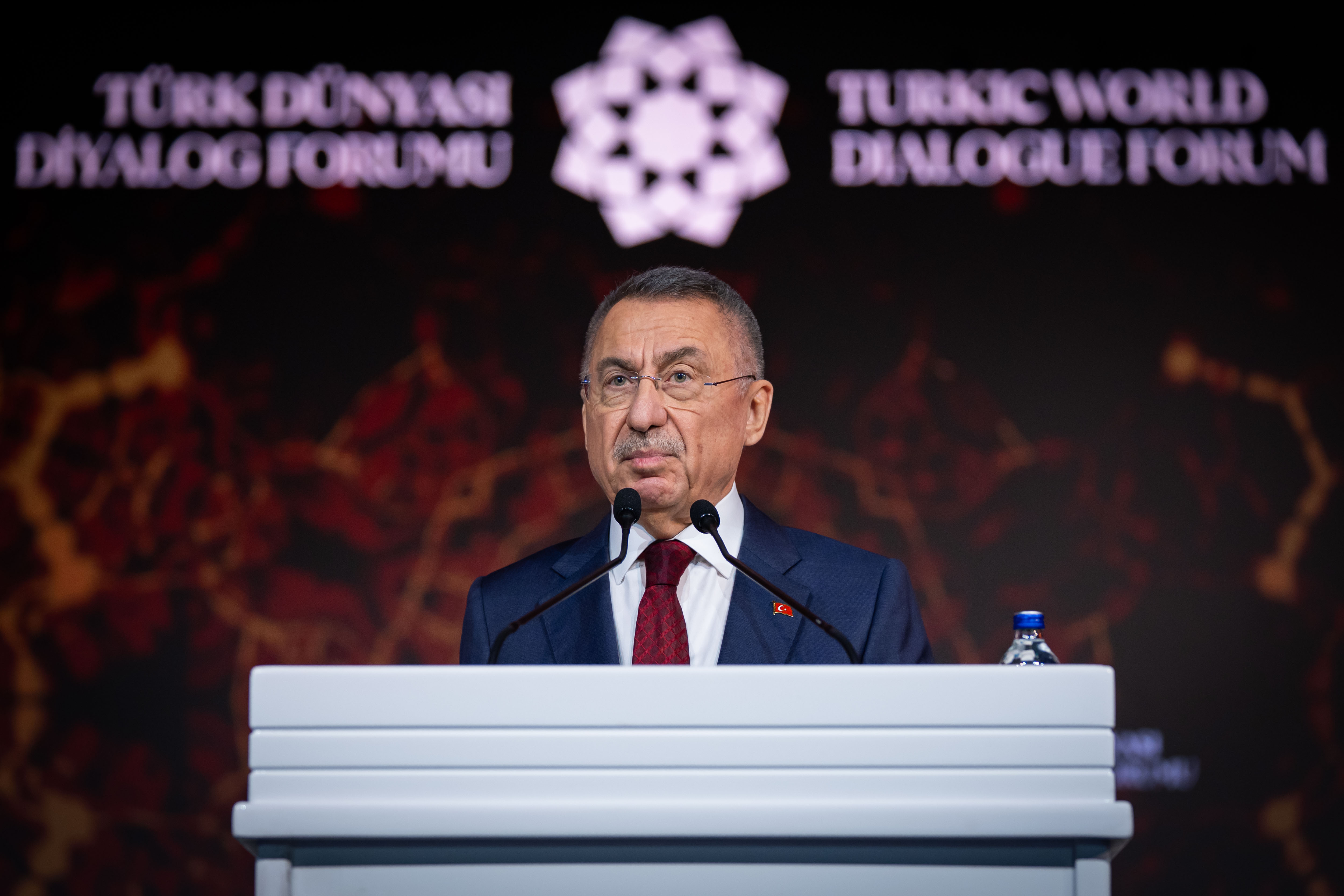
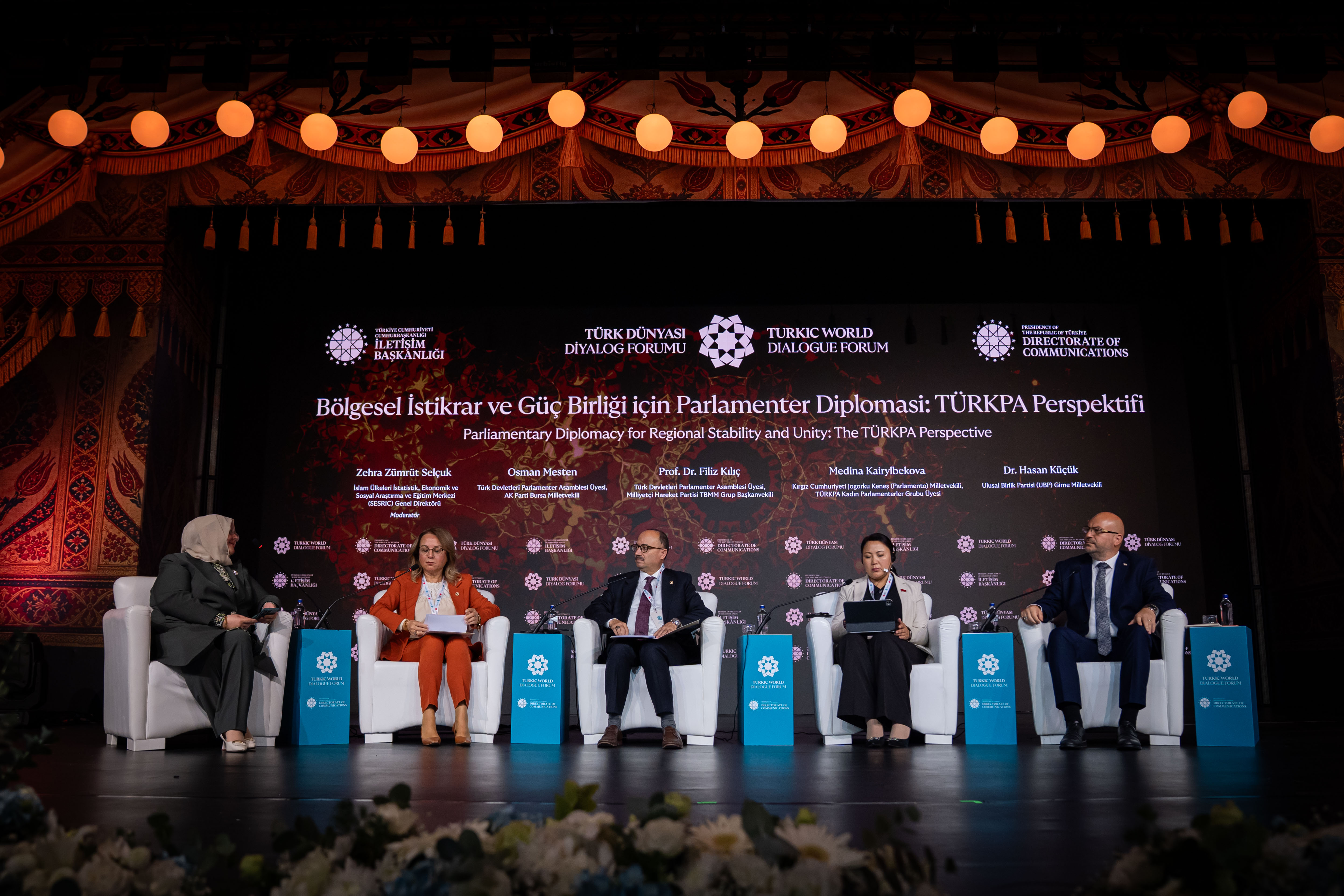
Fuat Oktay, Chair of the Foreign Affairs Committee of the Grand National Assembly of Türkiye (GNAT) and AK Party Member of Parliament for Ankara, spoke at the panel entitled “Parliamentary Diplomacy for Regional Stability and Unity: The TÜRKPA Perspective”, held as part of the Turkic World Dialogue Forum organised by the Directorate of Communications.
During the panel's opening address, Oktay, Chair of the Foreign Affairs Committee of the Grand National Assembly of Türkiye, remarked that the Turkic world must determine its own future and liberate itself from the influence of others as much as possible. Describing the Turkic world as “the beating heart of Eurasia”, Oktay said:
"The stronger this heart beats, the more solid the foundations of peace and prosperity in our region will be. In essence, the entire region and even the entire planet will gain from our unity and solidarity. As a result, our message is clear: deeper solidarity for Turkic unity, as well as more resolute initiatives and tangible actions for our shared future.
"Red Apple lies on the horizon of the Turkic ideal"
Oktay stated that they were building the Turkic Century by standing shoulder to shoulder, adding, "The Red Apple lies on the horizon of the Turkic ideal. Today's Red Apple, in my opinion, is a Turkic world with strong independence and sovereignty, great prosperity, scientific and technological innovation, global influence, cooperation, and steady progress toward integration." Oktay expressed his view of TURKPA as a collective family council, saying, "In contemporary legislative work, we are developing and will continue to develop mechanisms to capitalise on each other's legislative expertise."
Fuat Oktay highlighted that every step toward developing the Middle Corridor would bring the countries closer together, contributing not only to shared wealth but also to regional and global prosperity. He emphasised that uninterrupted direct interparliamentary communication is critical for quickly dispelling misperceptions and repelling malevolent activities in the face of externally driven manipulations and false tensions aimed at undermining regional stability.
"We will transform Turkic unity into a tangible benefit for the life of future generations"
Oktay highlighted the increasing persistence of global conflicts and instability since the “Second Meeting of the Foreign Affairs Committees of the Parliaments of Turkic States” in İstanbul last year, stating, “The unified position we exhibit as Turkic states and the resolute policies we implement, both at the governmental level and in parliamentary diplomacy, are crucial for fostering stability and averting conflicts in these regions.”
Oktay, underlining the vast geopolitical areas of the Turkic world from Hungary to the Balkans and from the Eastern Mediterranean to the Gulfs of Hormuz and Aden, emphasised that these areas are the inseparable components of the historical, cultural, economic and logistical connectivity of the Turkic world. Noting that every crisis in these regions directly and deeply affects the whole Turkic geography, Oktay said, “It is critically important for the protection of the strategic interests of the Turkic world to produce and implement common policies for peace, stability and prosperity in this vast basin within the framework of the principle of ‘regional ownership’.”
"The Eastern Mediterranean is the Turkic people's and the Turkic world's corridor of access to the high seas through the Mediterranean"
Oktay stated that solidarity must be maintained in order to strengthen the Turkish Republic of Northern Cyprus's ties with the Turkic world, develop parliamentary contacts, and overcome the unjust isolation to which its people are subjected, adding, "We must not forget that the Eastern Mediterranean is the Turkic people's and the Turkic world's corridor of access to the high seas through the Mediterranean."
Oktay continued:
“We all have the will to turn the upcoming era into the Turkic century. We will keep the ideal of the Red Apple alive by working, producing and standing by one another.” Under the auspices of the Organisation of Turkic States and TURKPA, we will strengthen our shared will and, as a result, turn the Turkic century into a tangible benefit for future generations. We will keep working until the very end to make sure that the Century of Türkiye is also the century of the Turkic world."
İbrahim Kalın, Director of the National Intelligence Organisation (MİT), spoke at a special session entitled “The Turkic World and the Vision of the Future from a Civilisational Perspective”, organised by the Directorate of Communications as part of the Turkic World Dialogue Forum.
Speaking at the special session moderated by Prof. Kılıç Buğra Kanat, Member of the Presidential Security and Foreign Policy Council, Kalın stated that the three main pillars of thought that had united the ancient Turkic lands of Central Asia and carried their legacy into the present were statecraft, unity in language and thought, and unity of hearts.
Emphasising that intensive efforts were still being made to foster and strengthen a spirit of unity, Kalın said that the three main objectives of the vision of the Organisation of Turkic States were unity around national values, unity in language and thought, and a broad-minded approach to understanding differences. Kalın noted that the cultural diversity and tradition of coexistence across the vast Turkic geography continued to thrive at the highest level, adding that the independence of the Turkic republics in 1991 had opened a new chapter in the history of the Central Asian Turkic peoples.
Pointing out that the Turkic world had taken significant steps in many areas over the years, Kalın said, "The highest-level institutional embodiment of these efforts is the Summit of the Organisation of Turkic States, the 13th edition of which is being held in Ankara today.”
“The Organisation of Turkic States poses no threat to any third party”
İbrahim Kalın said: “The Turkic world, covering approximately 4.8 million square kilometres, with a population of nearly 200 million and an economic strength of $2.17 trillion, makes significant contributions to global peace across this vast geography stretching from Central Asia to the Caucasus, from the Turkish Republic of Northern Cyprus to the Eastern Mediterranean and Hungary."
Noting that all these developments had made the Turkic region of Central Asia an area of growing international interest, Kalın said: “From time to time, we see perceptions emerging that this region represents an alternative, a threat or a rival to other countries or actors.” I would like to emphasise that, as a fundamental principle, the Organisation of Turkic States poses no threat to any third party and is committed to relations with every actor and every region on an equal footing, based on mutual interests.”
Referring to the transformation undergone by the countries that gained independence following the collapse of the Soviet Union, Kalın said, “When we look at the level of economic development that Azerbaijan, Kazakhstan and Uzbekistan have achieved today, their key role in energy security and their progress in other areas, we can see that the nearly four decades that have passed have not been wasted. The leaders worked tirelessly and achieved significant progress in their countries’ development while maintaining security, peace and stability.”
Kalın emphasised the importance of the Turkic world acting together in terms of geographical unity, shared memory, culture and thought, drawing attention to the complementary nature of the economies of the Central Asian Turkic republics. Kalın emphasised that Central Asia occupied a key position in terms of both energy and food security, noting that this also served as a common objective that brought the Turkic republics closer together.
Kalın emphasised that economic and political globalisation could not erase fundamental elements such as history, collective memory and culture, saying: “No matter how far we move towards becoming digital beings known as ‘homo digitus’, human beings will remain human. At the very least, they will continue to uphold this claim and strive to remain human.” Kalın stated that concepts such as belonging, history, collective memory and cultural unity would continue to play a decisive role, adding that Central Asia would make significant contributions to shaping the future direction of the world.
“We are in a position to identify and monitor threats jointly with our partners”
Noting that significant progress had been made in the field of technology across the Turkic world, Kalın said that intelligence agencies were working in close cooperation to counter terrorism, human trafficking, radicalisation and threats emanating from conflict zones. Kalın stated that the alert system they had established enabled them to monitor emerging threats in real time, and continued:
“Significant steps are also being taken in the field of technology. Our cooperation in this area is also at a very advanced level through the extensive activities we carry out among the intelligence agencies of the Turkic world. We maintain very close cooperation with the intelligence agencies of the Turkic world in combating terrorism, addressing issues related to conflict zones, combating human trafficking and radicalisation, and in other areas. In fact, the alert system we have established puts us in a position to identify and monitor threats emerging in any location simultaneously with all our partners.”
“None of us is safe until all of us are safe”
Emphasising that Türkiye’s approach to security is based on a holistic perspective, Kalın stated that countries should take into account the security of their neighbours and partners while ensuring their own security.
İbrahim Kalın stated the following:
“Because our approach to security is holistic and integrated. We have always acted on the following principle: ‘None of us is safe until all of us are safe.’ To guarantee my own security, I must also take into account the security of my stakeholders, neighbours and partners. You cannot be selfish when it comes to security. Secondly, you cannot delegate your security to others. You must ensure your own security. However, when you adopt a holistic approach to security, you must also prioritise the security of your neighbours and partners in order to ensure your own security.”
Kalın stated that the security and intelligence cooperation developed within the Turkic world also contributed to resolving regional issues, noting that certain border disputes and social unrest in previous years had been resolved before escalating into crises. Kalın said, "I can say that there is truly excellent cooperation within the Turkic world in these areas. Thanks to this integration in security and intelligence, we have experienced occasional minor border disputes or incidents of social unrest over the past 20 to 25 years, but none of them has escalated into a crisis. They were resolved swiftly, and an atmosphere of trust was restored.”
Kalın stated that regular meetings and summits were held among the intelligence agencies of the Turkic states, during which common security issues were discussed and intelligence was shared.
Emphasising the importance of communication based on mutual trust in this cooperation, Kalın said:
“Our intelligence agency also holds regular meetings and summits on a rotational basis. We discuss these matters in great detail at these meetings. I would like to share one of the observations that I have found encouraging: Developing a transparent model of communication based on mutual trust in these matters is extremely important.”
Combating cyber threats and disinformation
Kalın stated that extensive efforts were also being undertaken among the intelligence agencies of the Turkic states to combat cyber threats and disinformation, noting that social media was one of the areas vulnerable to manipulation. Kalın said, "Because social media is both a reality of our age and one of the areas most vulnerable to manipulation. That is why we must remain constantly vigilant on social media.”
Kalın emphasised that relations among the Turkic states should not be confined to the level of leaders, highlighting the importance of increasing contacts between institutions. Kalın said: “In international relations, we generally see the following pattern: Relations at the leadership level may be very good, with a positive atmosphere and favourable momentum, but it takes time for this to translate into progress at other levels. This positive momentum needs to have a stronger and more tangible impact at those levels.”
Kalın stated that closer ties should also be established among universities, academics and think tanks, noting that greater mutual engagement with the academic and intellectual communities of the Turkic states would contribute to their shared future.