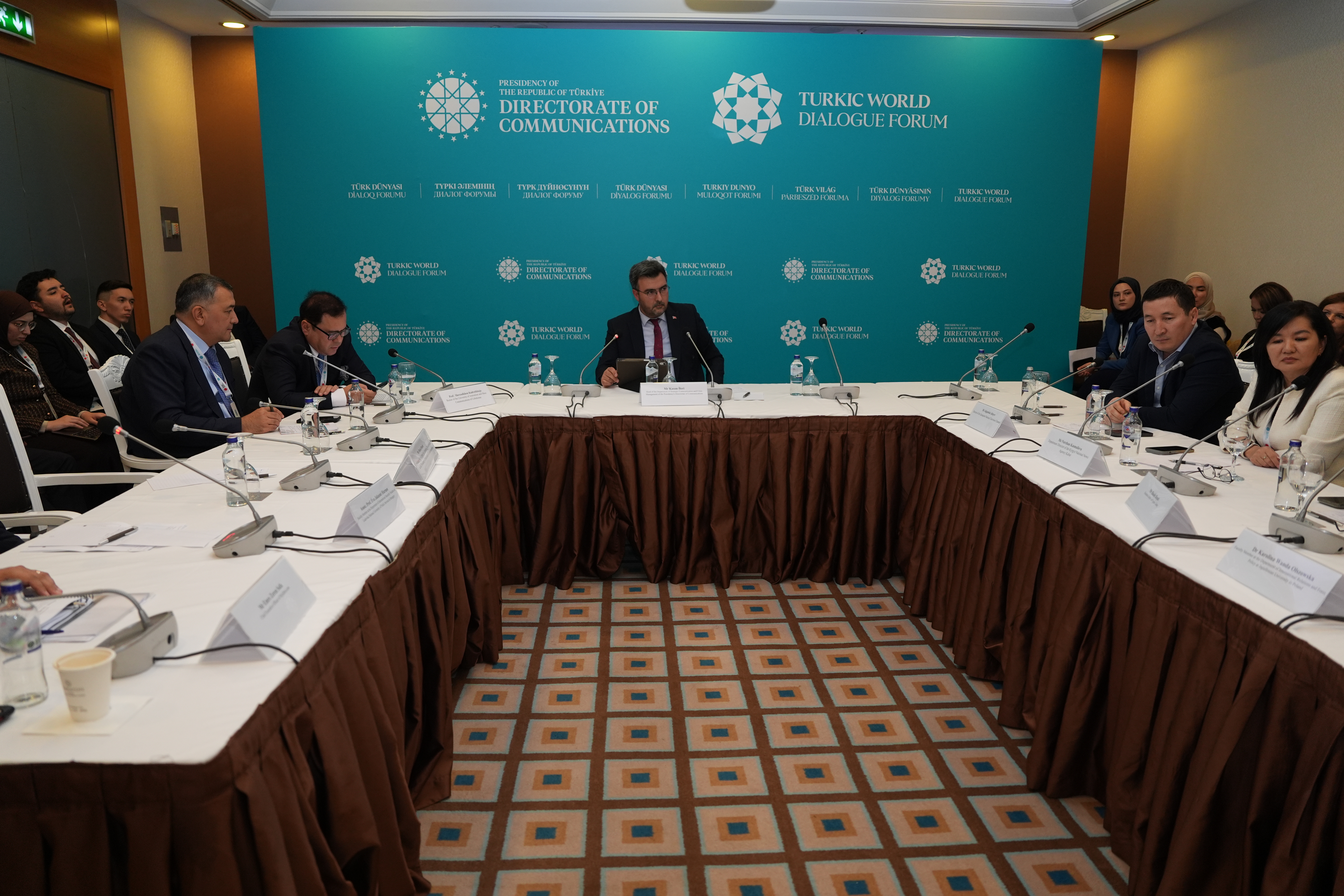
Directorate of Communications held a roundtable meeting on "Strategic Communication and Combating Disinformation in the Turkic World" as part of the "Turkic World Dialogue Forum".
The roundtable meeting was held at a hotel in Ankara and moderated by Kasım İleri, Head of the Department of Strategic Communication and Crisis Management at the Presidency's Directorate of Communications. The speakers included Deniz Demir, Coordinator of the Centre for Combating Disinformation (DMM) at the Presidency's Directorate of Communications; Jalgasbek Altayev, Director General of Kazakhstan's National Television Channel; Nurzhan Kasmalieva, Head of the International Relations Department at Kabar News Agency; Prof. Sherzodkhon Kudratkhuja, Rector of the University of Journalism and Mass Communications of Uzbekistan; Assoc. Prof. Eva Jakusne Harnos, faculty member at the Department of International Security Studies at Ludovika University of Public Service in Hungary; Rasıh Reşat, Editor-in-Chief of Cyprus Today; Emre Zeren Safa, Chief Executive Officer of Mykibris.com portal; and Dr Karolina Wanda Olszowska, faculty member at the Department of International Relations and Foreign Policy at Jagiellonian University.
DMM Coordinator Demir stated that the information manipulation ecosystem directly targets public perception, decision-making processes and social cohesion, recalling that Türkiye established the Centre for Combating Disinformation under the Presidency's Directorate of Communications in 2022 to address these threats.
Noting that the DMM represents an institutional, multidisciplinary approach to combating disinformation, Demir said its objective was to ensure accurate information reaches the public at the right time through clear, appropriate communication.
Demir stated that the DMM's remit was not limited to Türkiye and that it also considered the Turkic states part of its responsibility; in line with this approach, the DMM used AI-powered tools to monitor disinformation campaigns targeting the Turkic World.
Demir reported that, based on these monitoring activities, the DMM had prepared 16 official statements addressing disinformation campaigns targeting the Turkic World, and that these statements had been translated into the respective countries' languages and published.
"The more closely we work together, the stronger our resilience against disinformation will become"
Drawing attention to the fact that the DMM regards the security and integrity of the Turkic World's information environment as an integral part of Türkiye's own security, Demir stated, "Developing a common understanding with our brotherly states regarding shared threats, ensuring the timely dissemination of accurate information through clear and appropriate communication, and acting in institutional coordination constitute the main pillars of our work. The more closely we work together, the stronger our resilience against disinformation will become, and the more robust and lasting our shared vision for the future will be."
Altayev, Director General of Kazakhstan's National Television Channel, said they were going through challenging times, recounting an incident in which a job applicant for an announcer position submitted an AI-generated video. He said that he had initially struggled to recognise that the video was artificial.
Altayev explained that he initially believed the video was genuine and that the experience made him realise how challenging artificial intelligence has become for everyone. He stressed that protecting and maintaining the integrity of reliable information was a shared responsibility.
Journalists should be trained to distinguish between real and fake news
Explaining that Kazakhstan had a law requiring AI-generated content to be labelled, Altayev noted that the requirement applied only to television broadcasters and official websites, while no such obligation existed on social media platforms.
Altayev said that people were often unaware that fake videos were being used and stressed the need for a dedicated platform to combat this problem nationwide.
Emphasising the need to train journalists to distinguish real from fake news, Altayev added that they should also be supported in identifying reliable sources.
Kasmalieva, Head of the International Relations Department at Kabar News Agency, noted that they endeavoured to use only reliable sources and therefore preferred to obtain information from government institutions. She added that platforms could be established to develop certain mechanisms in this area.
Pointing out that such platforms could help establish rules for the use of artificial intelligence, Kasmalieva said that, based on their experience, young journalists should receive training in AI.
Kasmalieva stressed that incoming information should be verified, even if the process takes time, before it becomes news. She also noted that they cooperate with numerous news agencies worldwide and that they could expand this cooperation as well.
False information spreads on social media
Prof. Kudratkhuja noted that fake news spread rapidly and stated that such content was often disseminated not by journalists but by bloggers on social media platforms.
Pointing out that news accuracy was not being verified, Kudratkhuja highlighted the problem of potentially false reports originating in Turkic states being picked up by European and US media.
Emphasising that the most effective tool for combating disinformation and fake news is establishing reliable news sources, Kudratkhuja noted that the next generation differs from the current one, focusing more on social media platforms and tending to believe what they see there.
Kudratkhuja stressed that Turkic states often cited their shared historical roots, traditions, and culture, but they also needed to look beyond these commonalities and focus on future challenges and changes.
Noting that their efforts should focus not only on media organisations but also on bringing together influential public figures among young people, including social media influencers, Kudratkhuja said that a platform could be established to bring all these actors together.
Kudratkhuja emphasised the necessity of verifying the accuracy of information across all languages, suggesting that summer camps could be arranged for youth in many nations.
Emphasis on the need to manage online behaviour
Assoc. Prof. Harnos said that the European Union (EU) has shifted from its prior definition of disinformation, which focused on "verifiable fake news," to the concept of "information manipulation and foreign interference."
Harnos stated that this new approach addresses not only verifiable fake news but also the spread of misleading information through channels or sources that appear legitimate.
Harnos emphasised the necessity of taking immediate action against fake news, saying, "Our ability to dispel misinformation must be as rapid as the rate at which lies propagate around the world. Unfortunately, we are failing to accomplish this."
Harnos emphasised that seeing everything that happens online as potentially beneficial to a hostile actor in the physical world is critical to safeguarding social security, adding that all types of activities in these online spaces are carried out for a variety of reasons, including commercial profit, political advantage, and imposing pressure.
Harnos emphasised that the online behaviour "lays the groundwork for the collection of massive amounts of data, profiling, psychological profiling, or the manipulation of societies," adding, "This means that our behaviour in online environments needs to be kept under control."
“A pandemic of information poisoning"
Reşat, Editor-in-Chief of Cyprus Today, emphasised that the struggle has become more "intense and damaging" in an atmosphere where communication and disinformation spread more quickly, stating, "Frankly, this is a poisoning process. When it comes to the more general issue we are currently discussing, I prefer to refer to this situation as 'information poisoning'."
Reşat emphasised the importance of educating those who consume information, stating, "Think back to the COVID-19 pandemic. Public service announcements and videos were broadcast to explain how to deal with the pandemic. We learned how to wash our hands again. We realised how important it was to avoid kissing and hugging each other and to practise good hygiene. In other words, we have witnessed directly how people may be educated. We are dealing with a pandemic—a pandemic of information poisoning—and people must be educated about it."
According to Reşat, some people with social media profiles call themselves "citizen journalists" and feel they have the right to share any type of information without conducting factual checks or verification. He added, "They hear something, believe it to be genuine, and share it with the public. Social media allows this knowledge to spread very quickly, like a contagious disease."
Reşat emphasised the importance of journalism in this regard, noting that everything is built on reliability and transparency.
Reşat stated that states use “strategic communication” both as a defensive tool against information pollution and disinformation and as an offensive tool, adding, "We must also teach people how to consume information, what to trust and what not to trust. It all comes down to credible sources and trustworthy people. You trust a doctor to do surgery on your child, but when it comes to information that could affect your decisions, you may end up trusting anyone with a phone."
"As misinformation spreads, the situation develops into a vicious cycle through reciprocal contact"
Safa, Chief Executive Officer of Mykibris.com portal, stated that "strategic credibility" should be added to the concept of "strategic communication", adding, "While communication is about properly delivering a message, credibility is about whether the people who receive it have a reason to believe it. In other words, they are not the same."
Safa stated that a message could be coordinated, repeated, and spread to a large audience, but that all of these efforts would be ineffective if the target audience did not trust the source.
Safa stressed the significance of the speed of information reaching the target audience in a timely manner, saying, "In the Turkish Republic of Northern Cyprus, there is an overreliance on social media. To be honest, the fact that numerous media outlets, large and small, operate within the same constrained space leads to information being transmitted without verification, and even the inadvertent dissemination of disinformation."
Safa noted that this naturally leads to a loss of credibility, saying that over the past few years, they have observed a decline in both the standards by which readers and followers approach information and their level of comprehension.
Safa added, “As misinformation spreads, the situation develops into a vicious cycle through reciprocal contact. As a result, as publishers and media representatives, we have a critical responsibility to organise and govern this space in order to establish an environment in which we can all work in a reliable and constructive manner."
Importance of monitoring narratives in other countries
Olszowska from Jagiellonian University remarked that numerous disinformation campaigns are underway in various nations, intended to undermine shared interests and create discord in relationships, asserting, “Thus, it is crucial for us to monitor the narratives regarding us and our interests that are prevalent in other countries.”
Olszowska noted that they had encountered various forms of disinformation on numerous issues in international relations and said they had recommended that their government establish a mechanism for actively engaging with other countries in the event of similar incidents in the future.
Olszowska emphasised the importance of monitoring and recording information spread about one's country in other countries, saying, "We must know which issues are part of disinformation and how they work."