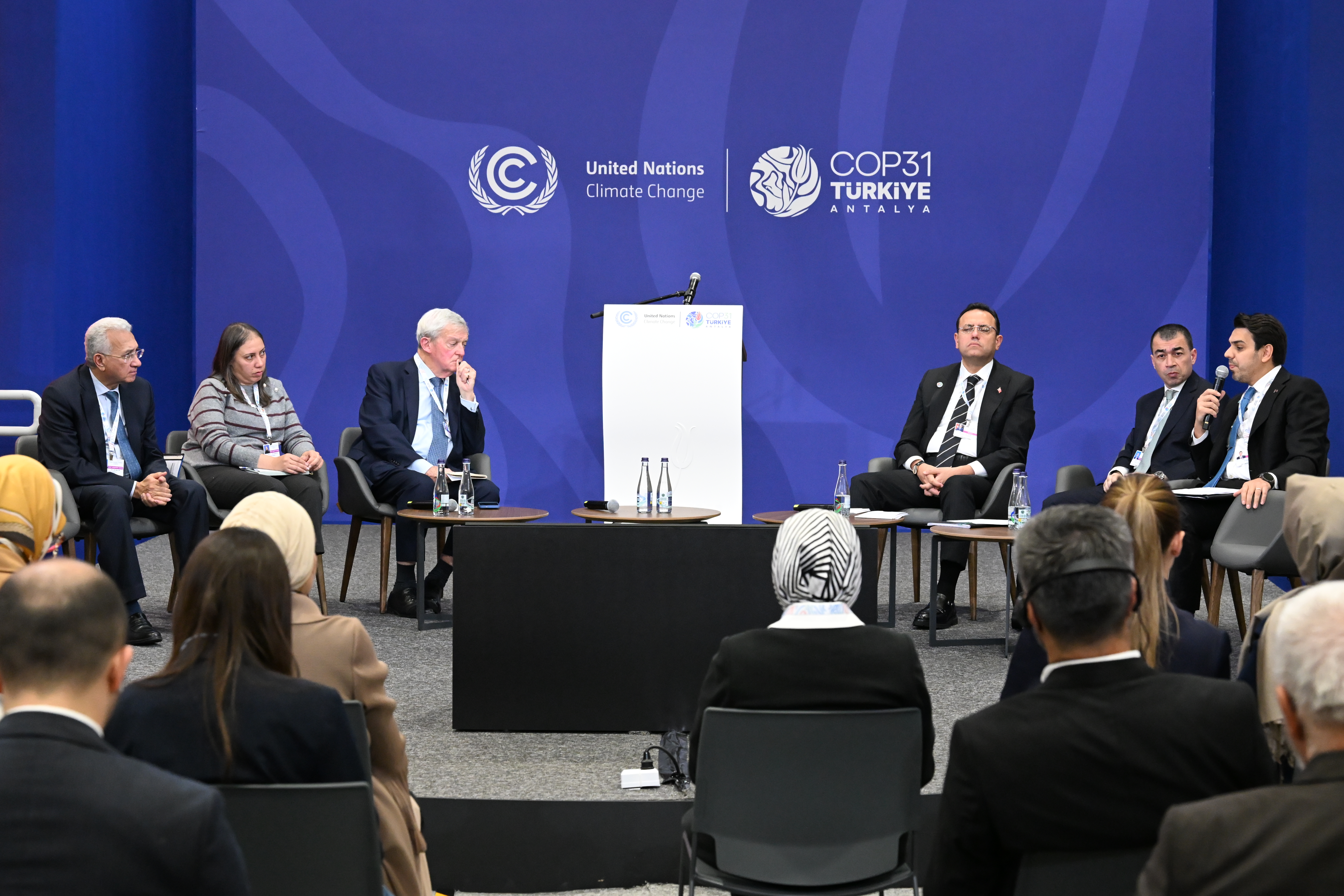
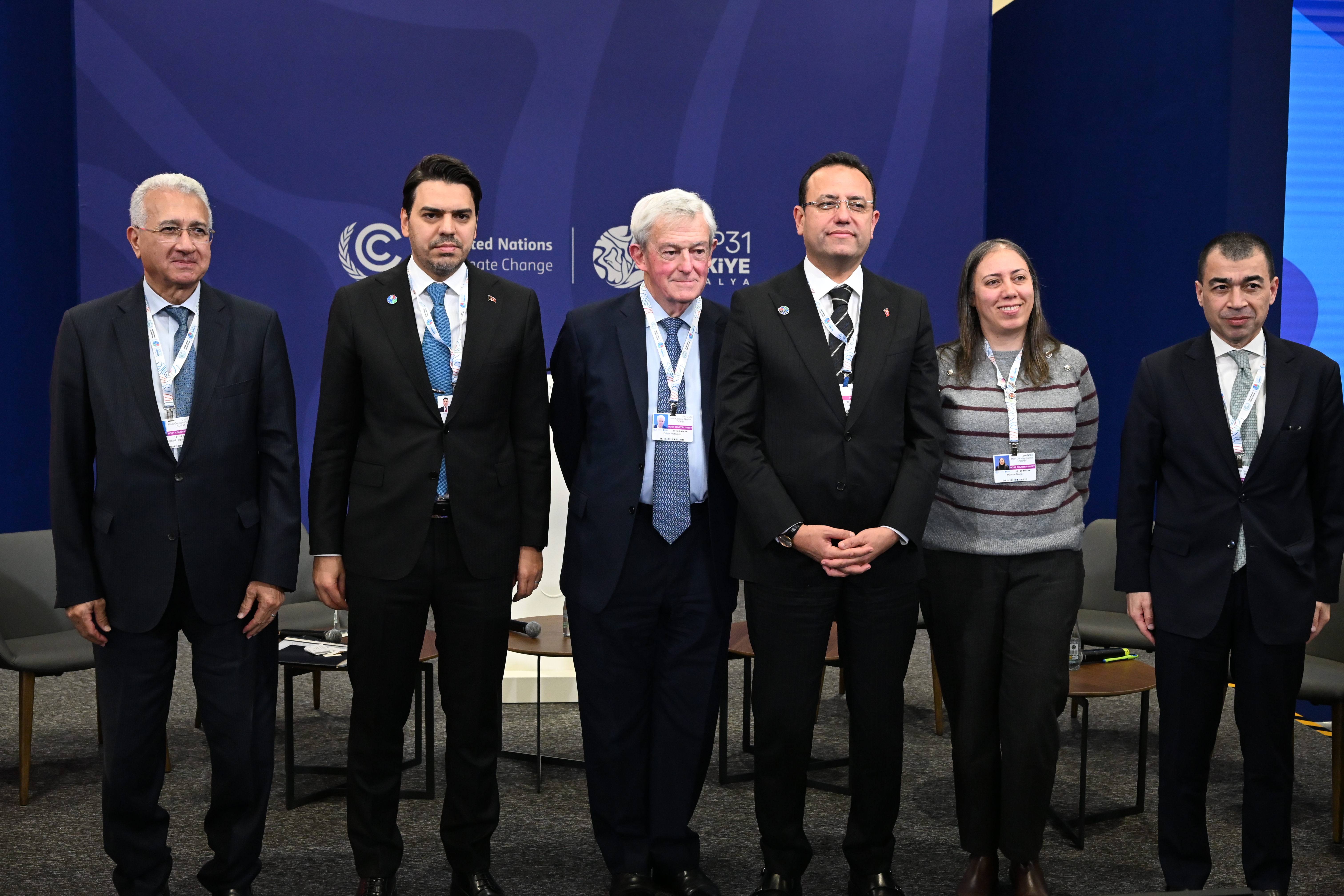
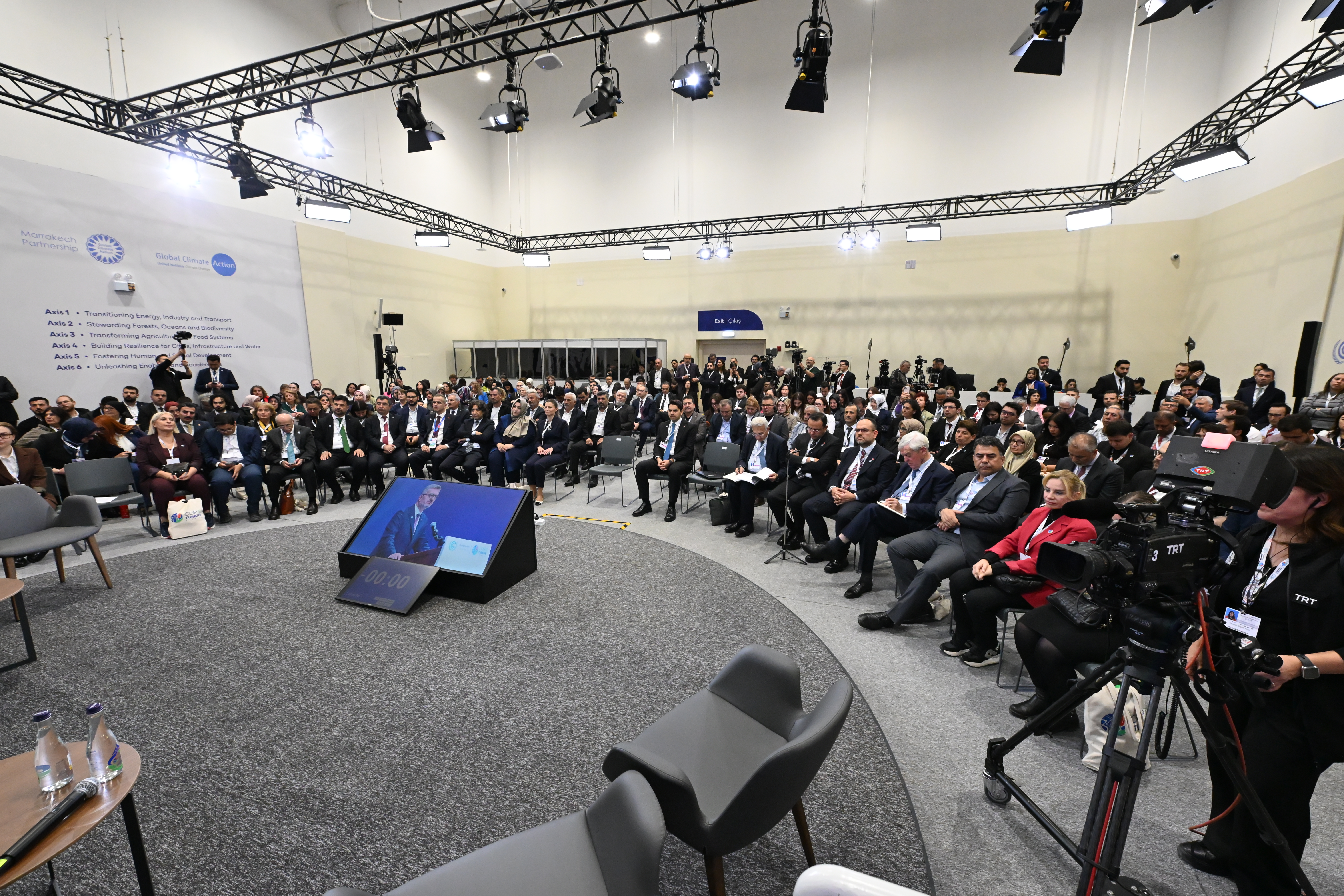
The panel, organised by the Directorate of Communications in collaboration with Forward Thinking as part of COP31, focused on the coordinated implementation of energy, agriculture, and climate policies, strengthening water and food security, and increasing resilience to climate change through international cooperation.
The panel titled "Connecting Energy, Agriculture, and Climate Action: Building Resilience Through International Partnerships," co-organised by the Directorate of Communications and Forward Thinking, took place in Antalya on 11 November 2026, as part of COP 31. The panel, which took place in Special Event Room 4 of the Blue Zone, discussed the importance of approaching energy, agriculture, and climate policies in tandem. The session, moderated by Forward Thinking Director Oliver McTernan, focused on opportunities for collaboration between Europe and the West Asia and North Africa (WANA) region, the water-energy-food security nexus, and policies and practices to improve climate resilience.
The Presidency's Head of Communications, Prof. Burhanettin Duran, gave the panel's opening speech and drew attention to the multifaceted effects of climate change on agricultural production, energy systems, and economic development, emphasising that the problem cannot be solved solely as an environmental issue. Duran noted that climate change poses serious risks to food security, livelihoods, and long-term social and economic stability, emphasising the importance of countries' ability to meet rising energy and food demand while adapting to changing climate conditions. He stated that, in this process, energy, agriculture, and environmental policies should be pursued concurrently and in accordance with common goals.
Duran emphasised the importance of developing climate-resilient agricultural practices and sustainable energy systems, citing the critical role of integrated policymaking, technological innovation, and strategic partnerships in increasing resilience to climate change. Duran highlighted opportunities for collaboration between Europe and the West Asia and North Africa region, stating that coordination among institutions responsible for energy, agriculture, environment, and foreign policy should be strengthened, resource-efficient practices should be expanded, and successful policy models shared. Duran emphasised the importance of mobilising investments and strengthening institutional capacity in order to translate climate commitments into feasible and scalable projects, citing governments, international organisations, and the private sector as all sharing responsibility. He expressed his hope that the panel would help develop concrete areas of collaboration to improve the resilience of agricultural and energy systems.
Forward Thinking Director Oliver McTernan, who moderated the panel, mentioned the collaboration with the Directorate of Communications and emphasised that COP31 should not be limited to rhetoric and consensus but should lay the groundwork for concrete action and implementation.
Deputy Minister of Agriculture and Forestry of the Republic of Türkiye Ebubekir Gizligider stated that climate change is not merely an environmental crisis; it is a holistic issue that directly affects food security, energy supply, economic development and social welfare. Highlighting the strong relationship between the water, energy and agriculture sectors, Gizligider said that, given the reality of water scarcity in Türkiye, the country has shaped its agricultural production planning on the basis of its existing water resources. In this regard, he stated that, within the framework of the 2026–2035 National Water Plan, water-efficient crops are being promoted through additional support in 52 districts across 11 provinces facing water scarcity, that modern pressurised irrigation systems are being rolled out, and that the Water Efficiency Campaign, led by First Lady Emine Erdoğan, aims to ensure the efficient use of water resources. Gizligider also noted that farmers are supported through the Agricultural Insurance Pool (TARSİM) against geopolitical risks and price fluctuations and stated that Türkiye shares its knowledge and experience, in collaboration with TİKA, the Food and Agriculture Organisation of the United Nations (FAO) and other international organisations, particularly with partner countries in Africa, Western Asia and the Caucasus. Emphasising that COP31 should mark a turning point in the transition from commitments to concrete action, Gizligider pointed out that water and food security are inseparable from sustainable development.
Majd Al Naber, Former Director General of the WANA Institute and a sustainability expert, assessed the increasingly severe drought, water scarcity and food security issues in the West Asia and North Africa region within the framework of the water-energy-food-environment nexus. Drawing on examples from Syria, Türkiye, Jordan, Lebanon and Iraq, Al Naber highlighted the effects of prolonged droughts on agricultural production, groundwater resources and rural livelihoods, noting that the drought experienced in Syria between 2006 –2009 had driven farmers away from rain-fed agriculture towards groundwater-based irrigation, and that this had led to a decline in groundwater levels and a deterioration in water quality. Al Naber, noting that drought can lead to an increased search for alternative sources of livelihood and internal migration, emphasised that food security is not merely a matter of production and food availability; it also encompasses accessibility, affordability, and nutritional quality. Noting that the rise in food prices in the region following the Russia-Ukraine War had highlighted the vulnerability caused by dependence on international supply chains, Al Naber listed resource efficiency, climate-resilient agriculture, drought-tolerant crops, renewable energy and the diversification of supply chains as areas for solutions. In addition, Al Naber, who warned that the reduction in irrigation costs brought about by renewable energy could encourage the over-use of groundwater, stated that water, energy, food and environmental policies must be implemented in a holistic manner, with due regard for environmental justice.
Cesar R. Abi Khalil, Member of the Lebanese Parliament and Former Lebanese Minister of Water and Energy, stated that the strong link between water, energy, agriculture and climate change makes it impossible to manage these sectors through policies that are independent of one another. Explaining through the example of Lebanon that water scarcity is not merely an environmental issue but also has direct impacts on food security, economic development, national sovereignty, and regional stability, Abi Khalil pointed out that an integrated approach based on natural river basins must be adopted for the effective management of water resources. Abi Khalil stressed the importance of coordination among public institutions, local communities, farmers, and industry and said that solar energy can reduce operating costs and increase system reliability in energy-intensive water infrastructure. Warning that lower energy costs must not lead to uncontrolled groundwater extraction, Abi Khalil added that renewable energy applications, modern irrigation, wastewater reuse and effective water management must be planned together to achieve sustainable water security.
Ambassador Mohamed Hegazy, former Assistant Minister of Foreign Affairs of Egypt and an international water expert, said that the Nile River has historically served as a source of life, an element of civilisation, and a line of communication among different societies and countries, emphasising that transboundary rivers should be viewed not as a source of conflict but as an instrument for cooperation and shared development. Pointing out that the Nile basin belongs to a shared ecosystem rather than a single country, Hegazy touched upon the importance of exploring transport and connectivity opportunities offered by rivers, in addition to the water, energy, and agricultural resources, through a holistic approach. Explaining that the proposal he developed as a result of six years of research on the Nile River combines water, energy, agriculture, and road and rail connections within a unified planning framework, Hegazy added that energy interconnections extending from Ethiopia to Sudan and Egypt, and thereafter to Jordan, Syria and Türkiye, could strengthen regional cooperation. Hegazy highlighted the potential of rivers to transform mutual interdependence among countries into strategic partnerships, noting that shared resources must be managed with a collective and integrated perspective within the scope of climate diplomacy.
Abdullah Eren, President of the Turkish Cooperation and Coordination Agency (TİKA), drew attention to the strong interplay between water, energy, and food security and climate change, arguing that these fields cannot be addressed independently of one another. Noting that climate change has an ever-increasing impact on agricultural production, Eren added that small-scale producers in particular face significant challenges in the face of drought, erratic rainfall, and rising production costs. Emphasising that solutions to these problems must be developed by taking local needs and conditions into account, Eren said that TİKA prioritises collaborating with local institutions, exchanging knowledge and experience, and implementing sustainable projects in its international development cooperation activities. Eren touched on the importance of supporting infrastructure investments with training, maintenance, technical know-how, and institutional capacity-building efforts, saying that supporting women in agriculture, promoting agricultural training, and strengthening production capacity contribute to the resilience of societies. He added that TİKA's primary objective is to strengthen the capacity of partner countries to lead their own development processes, while translating cooperation into concrete results on the ground.