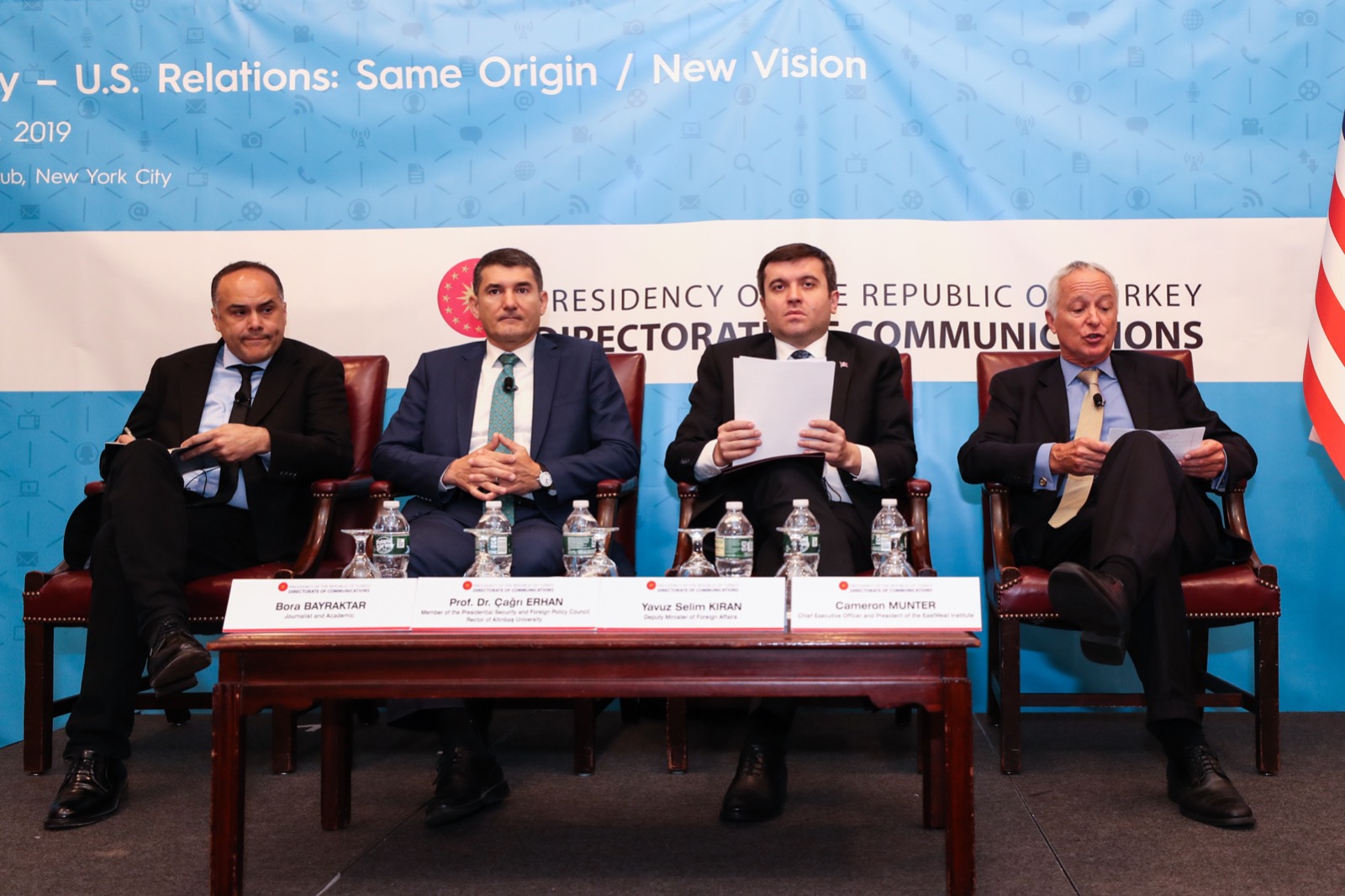
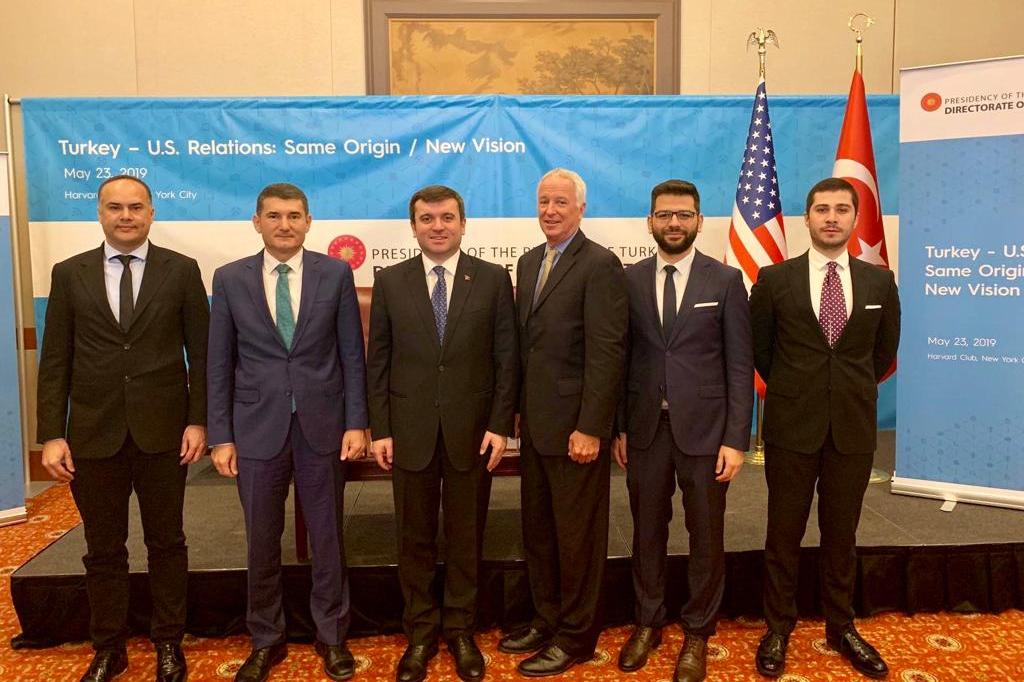
Presidency’s Directorate of Communications organized a panel titled “Turkish-American Relations: Same Origin, New Vision” at Harvard Club in New York.
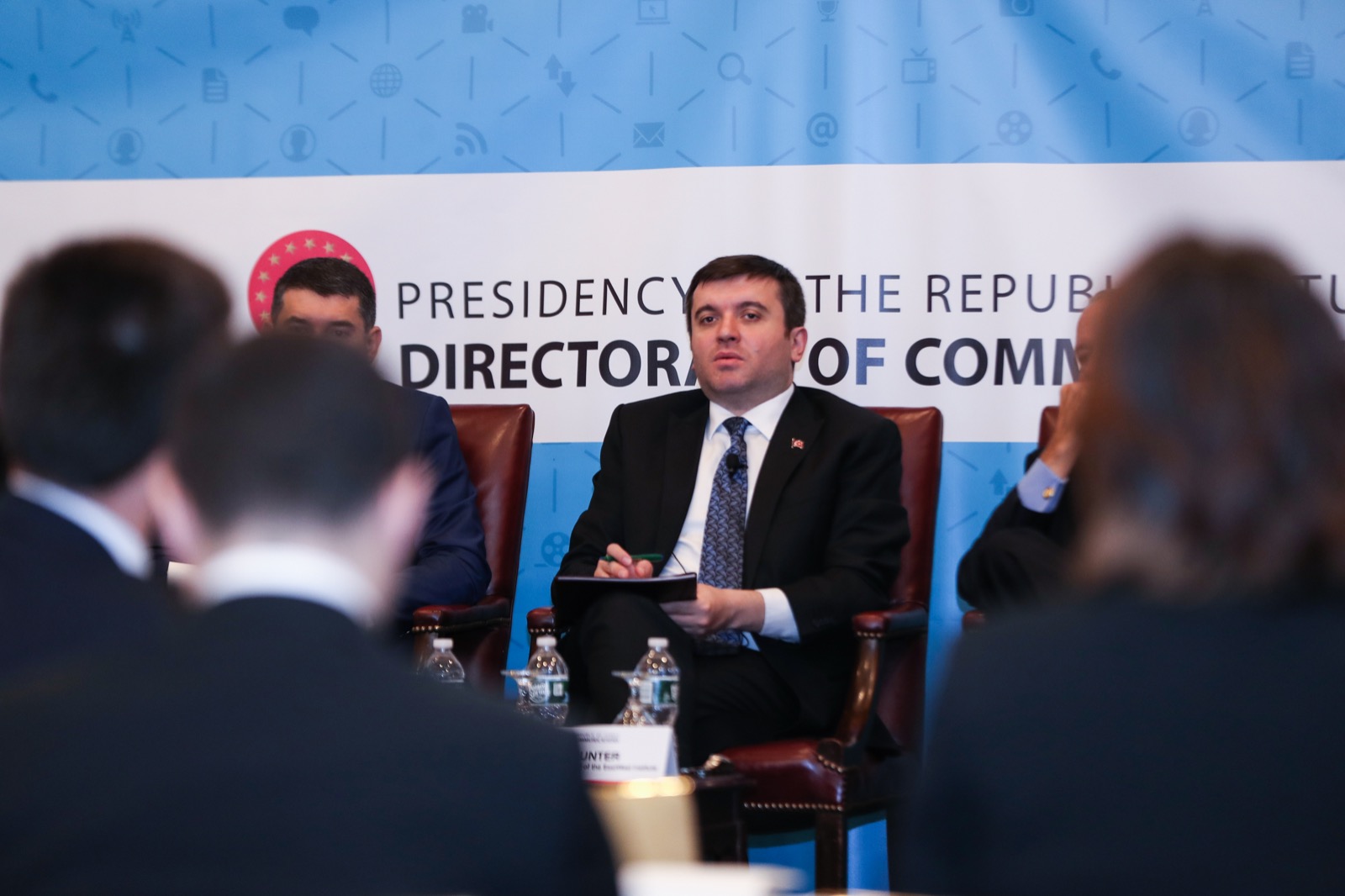
Deputy Foreign Minister Yavuz Selim Kıran, Altinbas University Rector and Member of the Presidential Security and Foreign Policy Committee Prof. Çağrı Erhan and CNN Turk General Manager Bora Bayraktar attended the panel as speakers.
The panel was moderated by Cameron Munter, the President of the EastWest Institute.
Kıran described Turkey-US relations as multilateral rather than bilateral.
Recalling the alliance between the two countries on Kosovo, Korea, and Afghanistan in the past, Kıran said: “History has demonstrated the vital importance of the relationship between Turkey and US.”
Emphasizing Turkey’s need for its own defence system as a country located in a region under considerable threat, Kıran said: “We held talks with the US for a defence system and waited for 17 months. We expected our colleagues to put in more effort yet they did not give us a satisfactory response and timetable. Russia, on the other hand, provided a reasonable timetable, and since it was an urgent need for us, we decided to purchase the system from Russia.
Kıran also reacted to discussions on the application of sanctions under CAATSA to Turkey over the purchase of S-400.
Also referring to the issue of fight against terrorism, Kıran said FETO terrorist organization posed a threat not just for Turkey but also for the other countries they are active in. “We are expecting support from all of our allies in this fight but we, unfortunately, see that many FETO members are living freely in the US,” Kıran stated.
"We expect out ally US to stop supporting this terrorist organization"
Highlighting the US support to YPG/PKK terrorist organization in Syria, Kıran noted the following: "PKK is listed as a terrorist organization in many countries including the US, yet our strategic ally (US) in the region is supporting the position of YPG/PKK in the fight against DAESH. It is obvious that we cannot defeat a terrorist organization by supporting another one. We expect our ally the US to stop supporting this terrorist organization.”
Indicating that he was hopeful about the future of Turkey-US relations despite the negative outlook, Kıran shared his opinion, saying: “We believe that the US needs Turkey and that Turkey needs the US.”
Kıran also commented on his visit to Washington before New York, saying: “The main agenda there was the issue of S-400. We saw here that many people thought we had come to the US primarily for these systems and that they did not know the background of the matter.”
"The US needs to win more allies"
Prof. Erhan also noted that Turkey-US relations dated back to 1800s and had many ups and downs, and said the two countries had always been successful in solving their problems.
"The relations between the US and Turkey, by its very nature, depend on mutual respect and efforts to understand each other,” said Erhan, explaining that the world had entered into a new era and this era was shaped by technology and the challenges faced by the US leadership.
Noting that experts anticipated that China would pose major challenges to the US in the 21st century, Erhan told: “Under such circumstances, the US needs to win more allies instead of making more enemies.”
"US’ alliances in the Middle East do not match the realities of the region"
CNN Turk General Manager Bayraktar also touched on the fact that global problems also affected the problems between the USA and Turkey, and namely, they were geographical competitions, energy security, and migration.
Criticizing the alliances the US forged in the Middle East, Bayraktar said: "US’ attempts to forge alliances with Saudi Arabia, Gulf countries, Israel and also with YPG, but I do not believe that such attempts match the realities of the region.”
Bayraktar stressed that it was not Turkey’s first choice to buy S-400 system from Russia and said: “Turkey took this path because it was hopeless.”
Bayraktar also pointed out that the US was putting pressure on Turkey on F-35 and S-400 systems, adding that such pressure did not work.