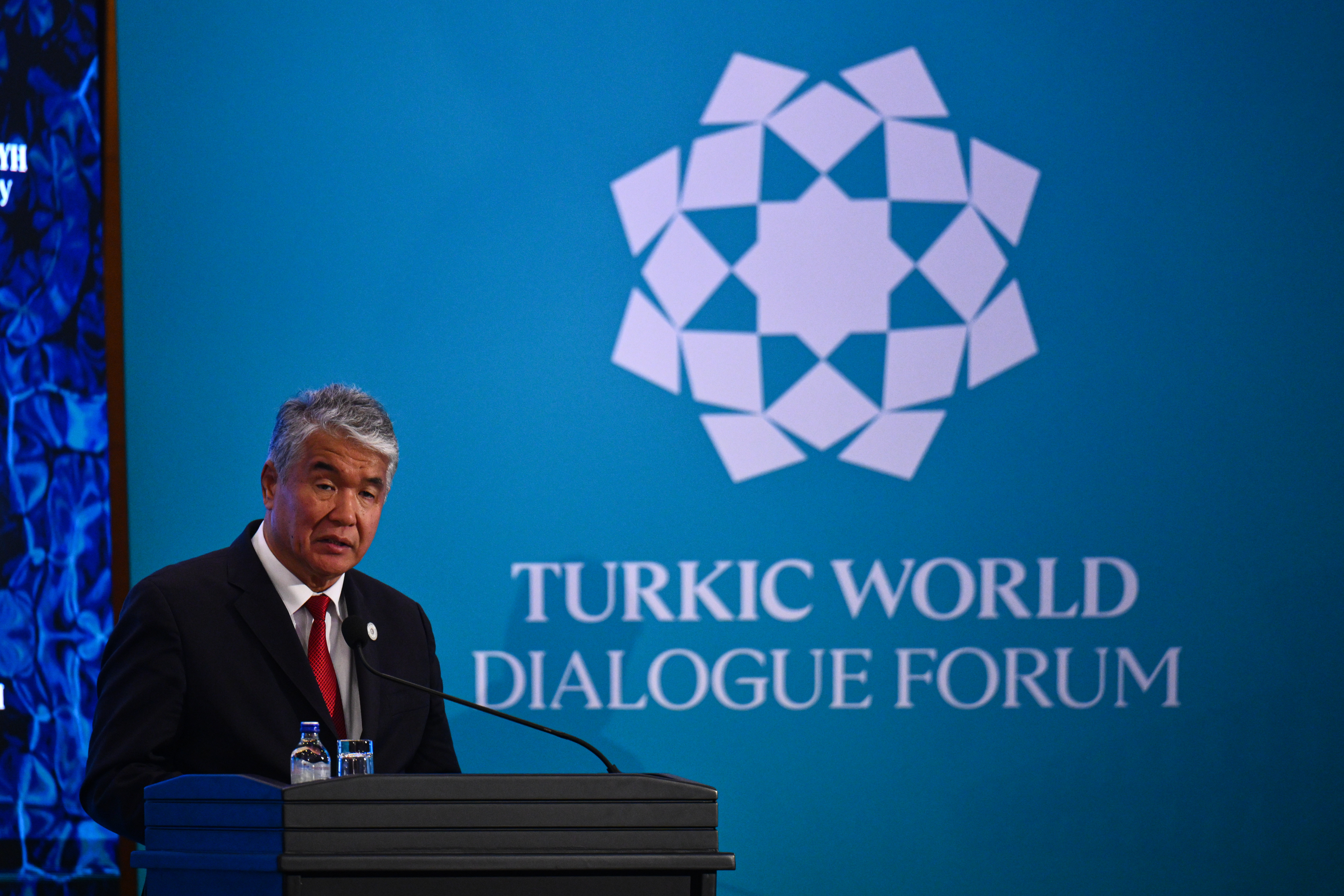
Sultan Raev, Secretary General of the International Organisation of Turkic Culture (TURKSOY), attended the panel titled “In the Footsteps of Gaspıralı: Language, Culture and Memory in the Turkic World”, held as part of the “Turkic World Dialogue Forum” organised by the Directorate of Communications in Ankara.
Delivering the opening address at the panel, Sultan Raev said that the Tercüman newspaper, first printed by Ismail Gaspıralı in Bahçesaray in 1883, served not only as a publication but also as a significant instrument for cultivating cultural connections among Turkic communities across various regions, noting that Gaspıralı was convinced that a shared language and culture would unite nations.
Raev emphasised that Gaspıralı's ideas were passed down to subsequent generations and that the principle of "Unity in language, thought, and action" expresses this intellectual world, saying that the Turkic world cannot be defined by current political borders and that Turkic communities, which have existed across vast geographies throughout history, are heirs to a shared civilisation.
Raev stated that memory is more than just remembering what happened in the past; it is also about knowing who one is and the values with which one can move forward. He added that simply telling young people about the past is insufficient; they must gain the courage to build their future by drawing strength from their heritage.
Raev emphasised the importance of initiatives in developing a common alphabet, language teaching, terminological unity, and publishing, stating that the main goal is not simply to use the same letters but also to ensure Turkic societies become acquainted with one another's ideas, literature, and scholarly output.
Raev noted that culture and art are powerful methods for building mutual understanding across nations, and that television series, films, and songs can sometimes reach larger audiences than official initiatives that take years.
Secretary General Raev said, "A piece of art can sometimes reach millions of people that years of government work cannot, and a young person in one country can learn words from a piece of art made in another Turkic country."
Raev emphasised that the issue is more than just technological progress, and that the place of the Turkic world and other civilisations in this new age is also important. He stated that civilisational memory, which includes language, literature, music, traditions, and thousands of years of intellectual accumulation, must be preserved.
Raev stated that preserving the legacy of Ismail Gaspıralı could not be achieved merely by repeating his words, noting that the courage, innovative thinking, and determination he demonstrated in his time needed to be carried forward in today's conditions.