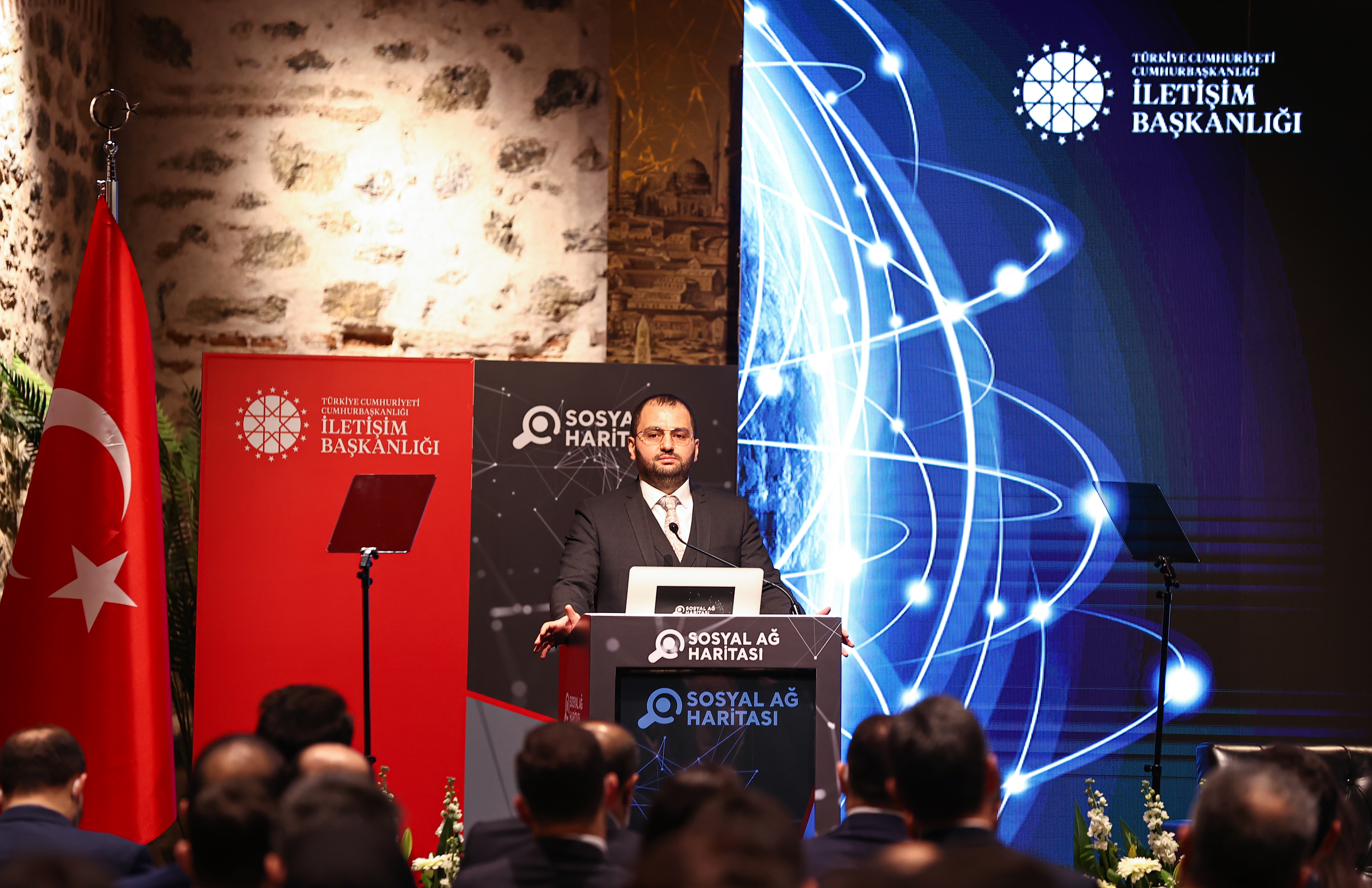
"According to the first-year data of our research, which we started in January 2021, Türkiye's internet access rate is 85.7 per cent, and social network usage rate is as high as 82.8 per cent. 51.8 per cent of citizens with internet access connect to the internet using both wireless networks and mobile devices. According to these statistics, a considerable portion of Turkish society is online at every stage of their daily life” said the Director of Communications Altun regarding Türkiye's internet access and social media usage rates.
During the launch of the Social Network Map Project held at the Presidential Working Office in Dolmabahçe, Presidency’s Director of Communications Fahrettin Altun expressed his hope that the domestic and national platform that would reveal the dynamism and dynamics of Türkiye’s social network would yield auspicious results.
Director of Communications Altun highlighted that international organisations, some for-profit, some non-profit, and some with differing interests, undertake internet and social network usage surveys in various countries, including Türkiye, and that they could see that the data had certain issues.
Director of Communications Altun indicated that data obtained through small sample size, infrequent time period, and very long intervals was open to question, adding, "It is also questionable that these research have extremely inconsistent figures and statistics when compared to other researches, and those figures and statistics cannot even be interpreted in the same research throughout different time periods.”
Director of Communications Altun emphasised that, in today's competitive world, the material value and size of the social media ecosystem is increasing by the day, and that it would be an overly optimistic approach to assume that any data was produced completely independent of commercial and ideological concerns.
Director of Communications Altun remarked that current circumstances necessitated the production of impartial, reliable and accurate data that would be made available to the public, academy, private sector and citizens, and added that this is one of the primary responsibilities of the Presidency's Directorate of Communications, in collaboration with academy and institutions in this sector.
In this regard, Director of Communications Altun stated that the Türkiye Social Network Map platform was introduced, which measures and analyses internet and social network usage in Türkiye in great detail in order to both produce public policy and make it available to all relevant parties.
Director of Communications Altun stressed that, under President Recep Tayyip Erdoğan's leadership, Türkiye made significant progress in all areas, from education to health, economy to technology, diplomacy to urban planning, social services to tourism in the last 19 years, and added, “Our country's progress, growth, and development over the last two decades have produced an example Türkiye model. As a result of accomplishments made during this period, we now have a growing economic activity and an expanding international activity. Our young, dynamic, educated and producing population is our biggest strength. Our communication infrastructure is growing stronger with innovative and pioneering investments. Thanks be to Allah that our brands and digital public services that we provide to the rest of the globe leave indelible impressions. In this regard, Türkiye continues to move forward as one of the leading countries in digital transformation, and our President's vision has been expressly revealed in the Presidency’s Digital Transformation Office, which was established within the Presidency.”
Expressing that public administration, private sector, and citizens use digital technologies efficiently, and that those technologies improve the connection and communication between the state and citizens, Director of Communications Altun emphasized that numerous public services may now be accessed through the internet, making the state considerably more accessible to citizens.
Remarking that they make full use of the internet's and digitalisation's advantages, guided by the Presidential System's dynamic vision of public administration, Director of Communications Altun said that all organs of the state, from the Presidency in particular, from ministries to governorships, from local administrations to provincial organisations of the public, make full use of communication and social media opportunities.
Stating the fact that citizens’ effective use of internet and social media is directly reflected in the data obtained in the Social Network Map Project, Director of Communications Altun said, "According to the first-year data of our research, which we started in January 2021, Türkiye's internet access rate is 85.7 per cent, and social media usage rate is as high as 82.8 per cent. 51.8 per cent of citizens with internet access connect to the internet using both wireless networks and mobile devices. According to these statistics, a considerable portion of Turkish society is online at every stage of their daily life. During the pandemic, our citizens' online time rose, as did their online activities. In the surveys performed periodically as part of the Social Network Map, it was observed that the rate of internet access increased to 91 per cent and the rate of online shopping increased to 54 per cent, especially during the full lockdown periods. Certainly, these statistics show that our society makes significant and frequent use of social networks."
Pointing out that occasionally request that individuals prefer more domestic and national social media platforms, Director of Communications Altun pointed out that the private sector's investment in this field will contribute to Türkiye's growing reputation as well as national security.
“We describe digital universe as 'cyber homeland' "
Stating that the social network usage statistics of various age groups reveal that practically everyone in society uses social networks on a daily basis, Director of Communications Altun said, "According to the Social Network Map's 2021 data, 98 per cent of young people aged 15 to 17 are members of society with internet access. 93 per cent of young people who have access to the internet also use at least one social network. Even though the rate of internet access declines relatively with age, the final numbers remain fairly high. Our government's investments in infrastructure and digitalisation reforms have unquestionably contributed to the country's high internet access rate. In this sense, Türkiye is at a very advanced level in terms of developing the infrastructure of both traditional media and social media as well as the extent of the investments in these fields. Türkiye's investments in this area clearly set it apart from the rest of the world in a favourable way."
Altun underlined that social media use is growing, as are the opportunities it brings, but they also confront a variety of threats and problems in this field, and added,
“As technological optimists say, I wish technology could simply better our social and individual life. We are making every effort to contribute to as many projects as possible, including legislative rules, to preserve our people’s rights on the internet and social media platforms. On this occasion, I would like to emphasise once again our determination not to allow the rights of our citizens to be violated and the public order to be disturbed, while retaining the liberal attitude consistent with the spirit of these platforms.”
Stating that as in all other communication platforms, the public interest, public order, rights and freedoms should be protected on the internet and social media platforms as well, Director of Communications Altun said:
“The primary considerations are individual and public benefit, rights and liberties, and, of course, legality. It is unimaginable for any field to be beyond the state’s sovereignty and legal authority. We refer to the digital universe as the ‘cyber homeland’ in this context. We believe that, in the same way that we struggle for sovereignty in real world, we should fight for sovereignty in the 'cyber world'. We address security concerns in the 'virtual world' in the same way that we do in the real world. We view cyber security and cybercrime as critical issues that must be addressed. And we do our best to protect our cyber homeland and cyber sovereignty. In this regard, it is extremely essential that our public institutions and organisations, private sector, non-governmental organisations, and universities act in cooperation and with strong coordination and make efforts to strengthen this cyber homeland based on our citizens’ rights. Recent events have demonstrated how security breaches in cyberspace can violate, distort, and manipulate daily life, international politics, internal politics, and the concept of privacy. Therefore, regardless of what happens, we are committed to taking every step we can to protect our citizens’ rights, public order, and public interest in the cyber homeland, just as we do in our homeland, blue homeland, and sky homeland. We will not refrain from doing this.”
Director of Communications Altun emphasized that they will not tolerate breaches of citizens’ rights in the digital world, including the internet and social media, and said, “We make every effort to avoid the unauthorised use of personal information or the violation of consumer rights while shopping. We see that these are very fundamental problems. We also oppose the propaganda and organising activities of terrorist organisations. Frankly, we cannot conceive international social media companies supporting terrorist organisations and acting as a propaganda centre for them. During our meetings with our interlocutors, we express that the support they provide to terrorist organisations fundamentally contributes to global terrorism.”
“We must build all necessary defenses against them”
Recalling President Erdoğan’s statements that terrorism is not only a problem of Türkiye, the Middle East, or the Islamic world, Director of Communications Altun emphasized that terrorism is a global problem and that unless it was addressed with determination on a global scale, it would remain and would continue to be the principal concern of all countries, regardless of East or West.
Stating that they were also concerned about copyright and intellectual property rights, Director of Communications Altun said they saw how readily copyright and intellectual property rights were infringed on social media platforms and took steps to prevent this. Expressing that they also endeavor to raise public awareness on this issue, Director of Communications Altun went on to say,
“We are working hard to prevent the reckless presentation of countless heinous and criminal activities, ranging from child abuse to sexual perversions. We cannot and must not allow the truth to be distorted. While we say ’long live the truth,’ we do not accept the socio-political environment that depicts an era in which the truth has become insignificant as a mandatory condition. We emphasise and try to emphasise the importance of fighting against this, the power of truth over fallacy, and the power of truth over erroneous thinking methods. We have seen many times and closely observed how political processes can be manipulated through social media platforms when they are not subject to the law and remain uncontrolled. Elections are the most fundamental democratic processes, and we have observed the devastation caused by manipulation campaigns conducted for elections through social media platforms and encountered in different countries. We must be resilient to them, and we must build all necessary defenses against them. We believe that all social media platforms should fundamentally modify and reform themselves by identifying these risks and making necessary agreements, and developing them. Above all, these are the responsibilities of social media companies.”
“There is no policy without an inventory.” said the Director of Communications Altun, and added that there was no room for growth in an area that couldn't be measured or provide data.
Director of Communications stated the following:
“As part of Türkiye's Social Network Map project, data will be generated under the headings ‘internet access’, ‘device ownership’, ‘gaming habits’, ‘social network usage’ and ‘most popular social networking platforms’. This data will continue to be generated. Each year, it is intended to produce over 40 reports, over 200 interactive graphics, and over 130 infographics within this framework. While internet access and social media use are addressed, this research will be shared with the public on a regular basis, with the goal of raising public awareness. In this context, Türkiye’s Social Network Map platform was made available at the URL ‘socialagharitasi.gov.tr’. Users will be able to access all reports, interactive graphics and infographics digitally through this website. In addition, individuals contacting via the platform will be able to seek access to the raw data used to create the reports, statistics, and infographics by declaring their non-commercial usage intentions. Taking into account the public interest, access to all data, images, graphics and statistics contained within the platform will be completely free of charge. I believe that the data generated as part of the Social Network Map will make a critical contribution not only to all users but also to the public. Along with our Directorate, all relevant public institutions and policymakers will benefit from the data provided by the Social Network Map making policy.”
While expressing his gratitude to those who contributed to the project, Director of Communications Altun hoped that the studies and data obtained as part of the Social Network Map would contribute to a safer, more democratic, transparent, accountable and responsible digital world.
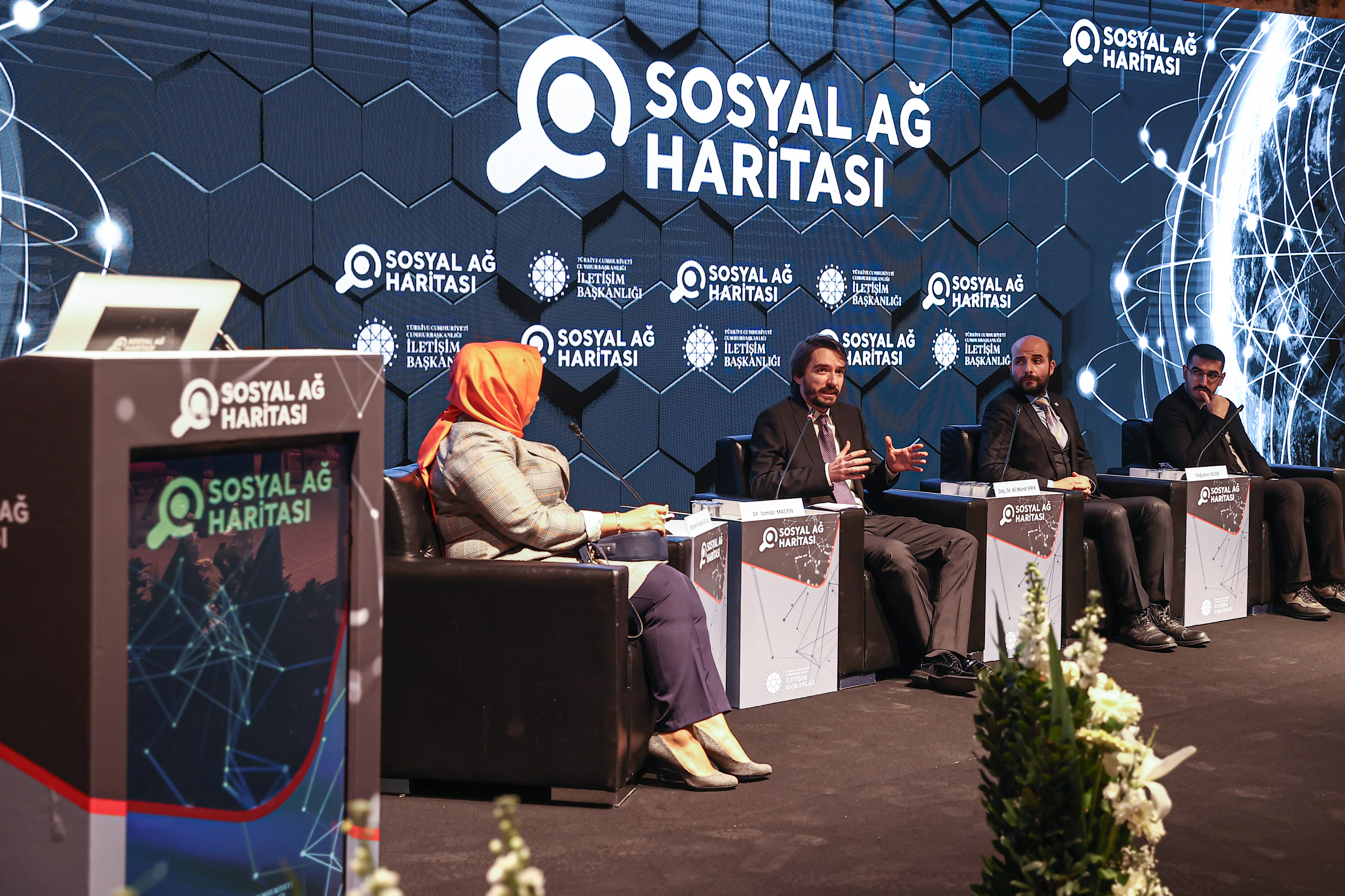
Associate Prof. İsmail Çağlar presented the project on which he worked as a consultant. Following the speeches, in a panel moderated by TRT Board Member Meryem İlayda Atlas, Marmara University Faculty Member Assoc. Prof. Ali Murat Kırık, editorial director of GZT Doğukan Gezer and Memoria Bilişim ve Medya A.Ş. representative Dr İsmail Maden shared their perspectives on digital media.