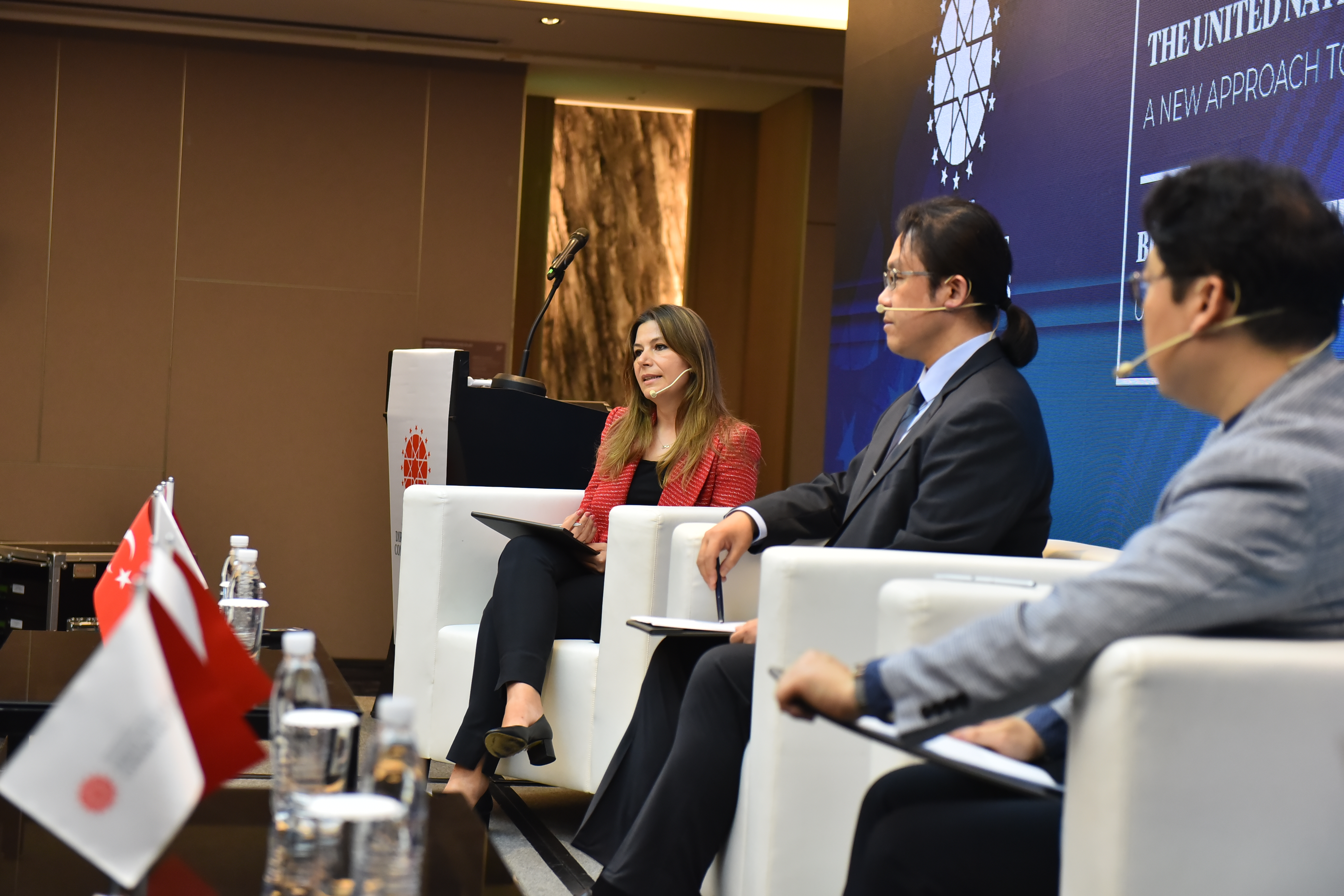
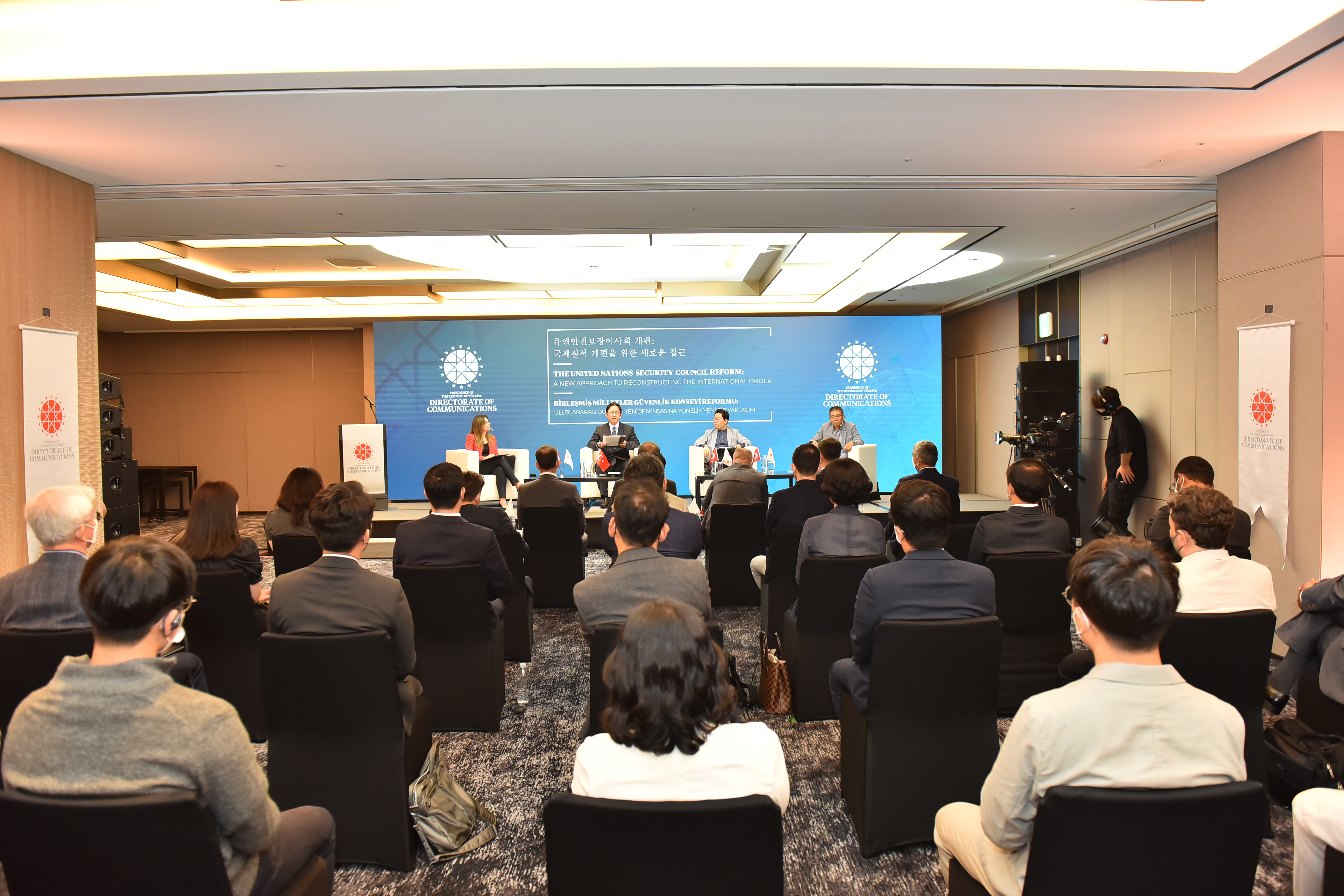
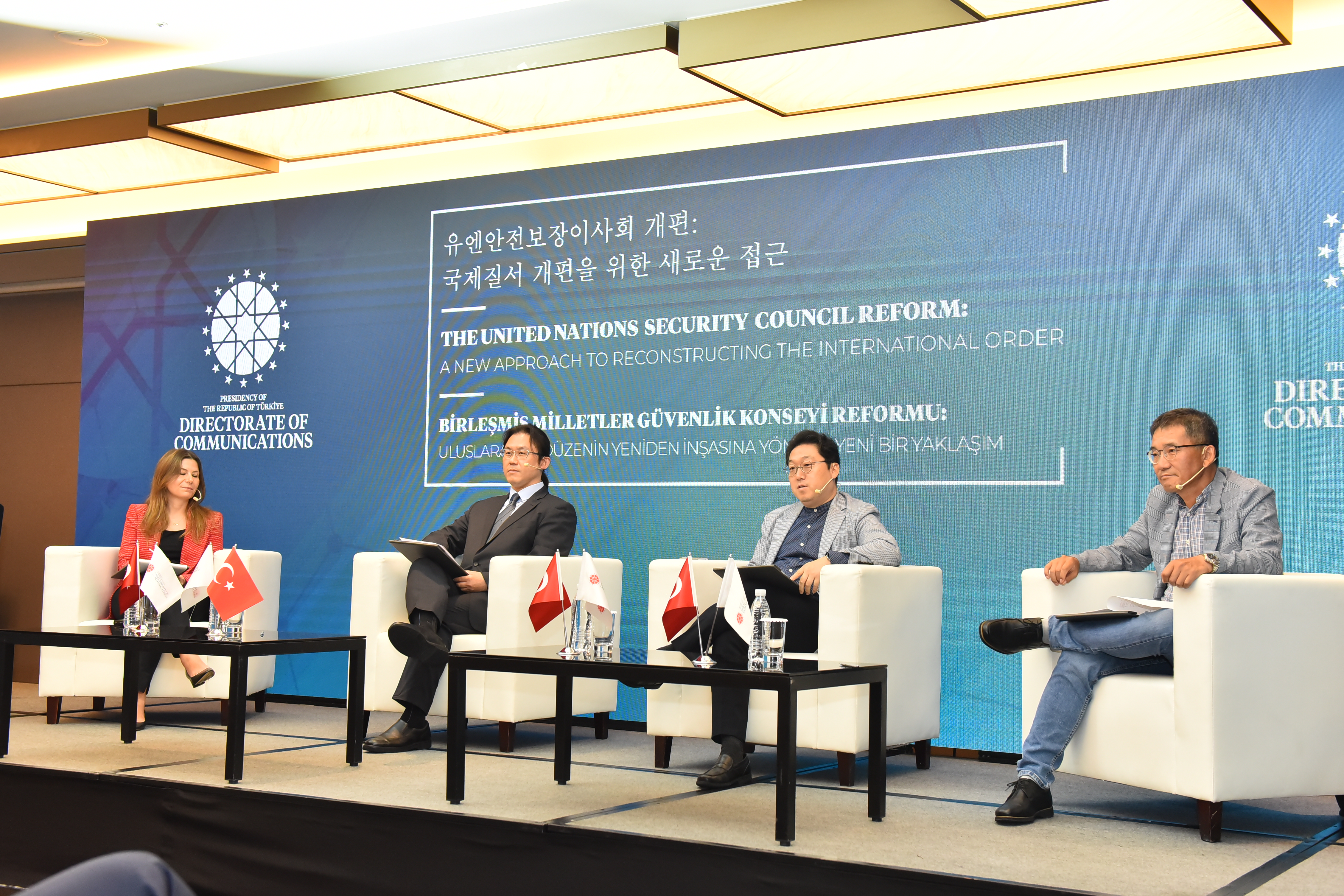
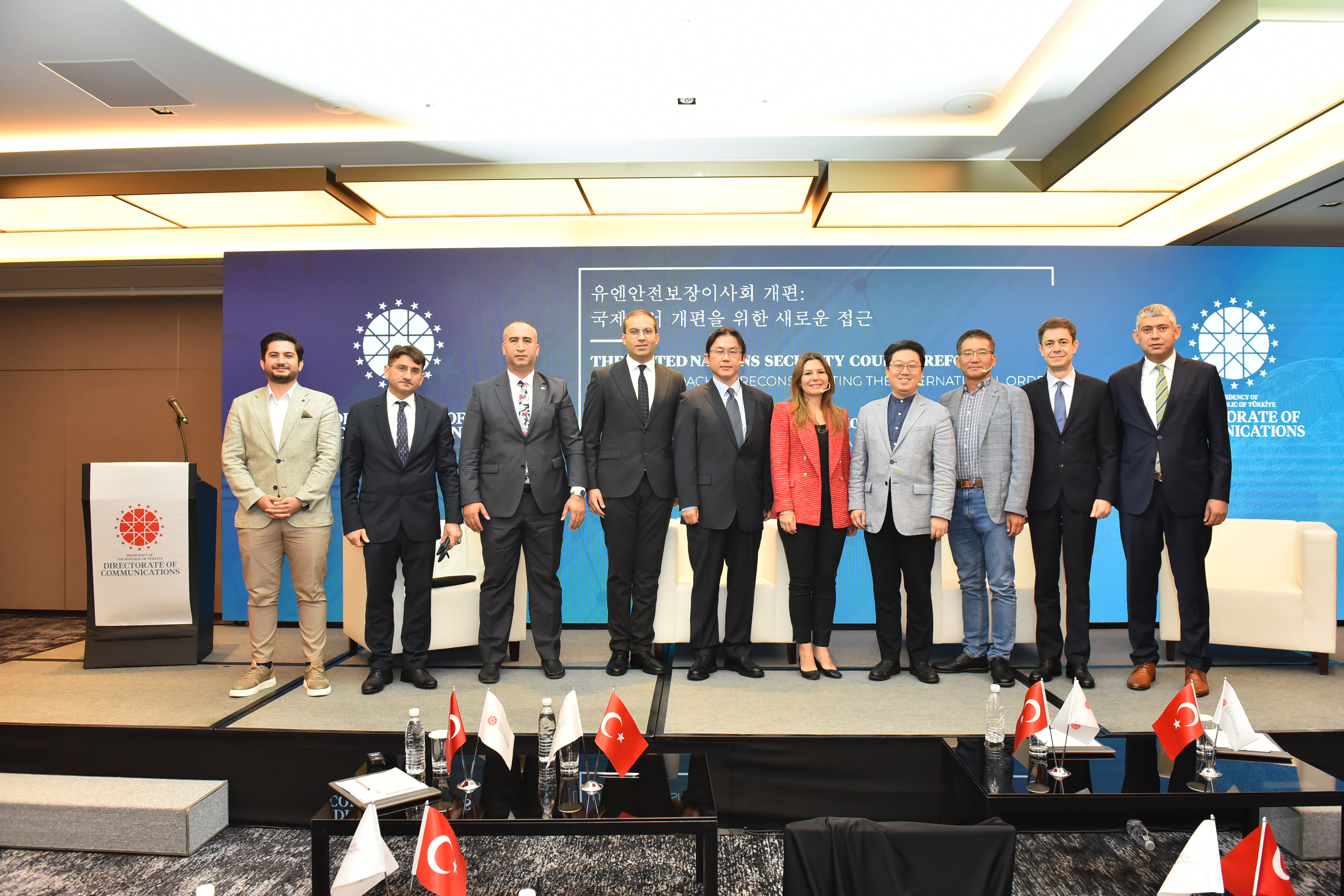
The Presidency's Directorate of Communications held a panel titled "United Nations (UN) Security Council Reform: A New Approach to Reconstructing the International Order" in Seoul, South Korea.
Prof. Giwoong Jung, Deputy Chair of Hankuk University’s Center for International Area Studies, Prof. Chong Jin Oh, Researcher at Hankuk University’s Türkiye-Azerbaijan Studies Department, and Dr. Seongwoo Yi, Researcher at Gyeonggi Research Institute attended the panel moderated by Assoc. Prof. Gonca Oğuz Gök from the International Relations Department of Marmara University’s Faculty of Political Sciences.
The goal of the UN Security Council Reform panel series, which recently took place in Italy, Argentina, England, Norway, France, Sweden, Germany and South Africa, is to inform the international community of Türkiye’s stance and policy on the United Nations reform embodied by President Recep Tayyip Erdoğan's remark that "The world is bigger than five”.
The panel started with the video message sent by the Presidency’s Director of Communications, Fahrettin Altun.
After the video message of Director of Communications Fahrettin Altun, moderator Assoc. Prof. Gonca Oğuz Gök opened the first session and underlined the need for a new consensus regarding the structure and function of the United Nations. Pointing to discussions about the inefficiency of the UN after the war in Ukraine, Assoc. Prof. Gök recalled that the "Unity for Peace" bills at the UN were occasionally brought to the agenda to overcome the bottlenecks in the UN Security Council.
The panel discussed the UNSC reform demands, including the permanent membership system, veto rights, and the representation issue, within the backdrop of recent international developments. It was stated that the international community and international organizations confronted great challenges in recent years and that the international system failed to address these challenges effectively.
In his remarks, Prof. Giwoong Jung stressed that in today's world, international cooperation is needed more than anything else. Referring to President Recep Tayyip Erdoğan's words, "The world is bigger than five", Prof. Jung added that the world is also bigger than two and underlined the necessity of overcoming the dualities such as “strong and weak”, “developed and undeveloped” among the countries of the world. Jung noted that although not among the world's most powerful countries, there are also middle power countries who, despite their lack of enormous might, can act independently of powerful nations. Korea and Türkiye, he added, fit this description. Jung stated that the expression “The world is bigger than two” also refers to the incompatibility of the USA and China as two developed countries who are engaged in a struggle for global hegemony while simultaneously attempting to attract other countries to their side. Emphasizing that the privilege granted to only five UNSC members is unacceptable, Jung stated that what these countries mean by multilateral cooperation is to align other countries’ interests with their own. As he closed his remarks, Prof. Jung expressed his view that UN reform should be shaped in accordance with universal values.
In his talk, Prof. Chong Jin Oh analyzed the role of middle power countries like Korea and Türkiye in restructuring the international order. He began by underlining the similarities between the two countries and their cooperation. Chong-jin stressed the tremendous potential of both Korea and Türkiye to play a constructive role in world politics, stating that the two nations are not seen as aggressive in their respective regions since they are not founded on an imperialist past. Prof. Chong-jin emphasized how middle power countries can use diplomacy to provide interested parties with alternative platforms even if they lack the capacity to address global issues. Chong-jin said it is time to discuss the reorganization of the UNSC and noted that today's world differs from the world in which the UNSC was shaped in many aspects, particularly the number of independent countries and the international economic-political environment. Prof. Chong-jin concluded his remarks by stating that today’s traditional and non-traditional security challenges call for more than only a military response.
In his presentation on the pursuit of reform in the United Nations Security Council, the last panellist Dr. Yi stated that the UN General Assembly provided the legitimacy of the UN in the current international system. Dr. Yi talked about the current security problems in the world and emphasized that the UNSC was insufficient to resolve them. Dr. Yi stated that the current structure of the UNSC was determined by the power balances and nuclear power after the Second World War. While restructuring the international order, Dr. Yi emphasized the necessity to reconsider the concept of security and the importance of emphasizing the concept of human security. In this context, Dr. Yi emphasized that the creation of a "Humanitarian Security Council" that places humanitarian issues on the agenda alongside the current Security Council is a possibility.