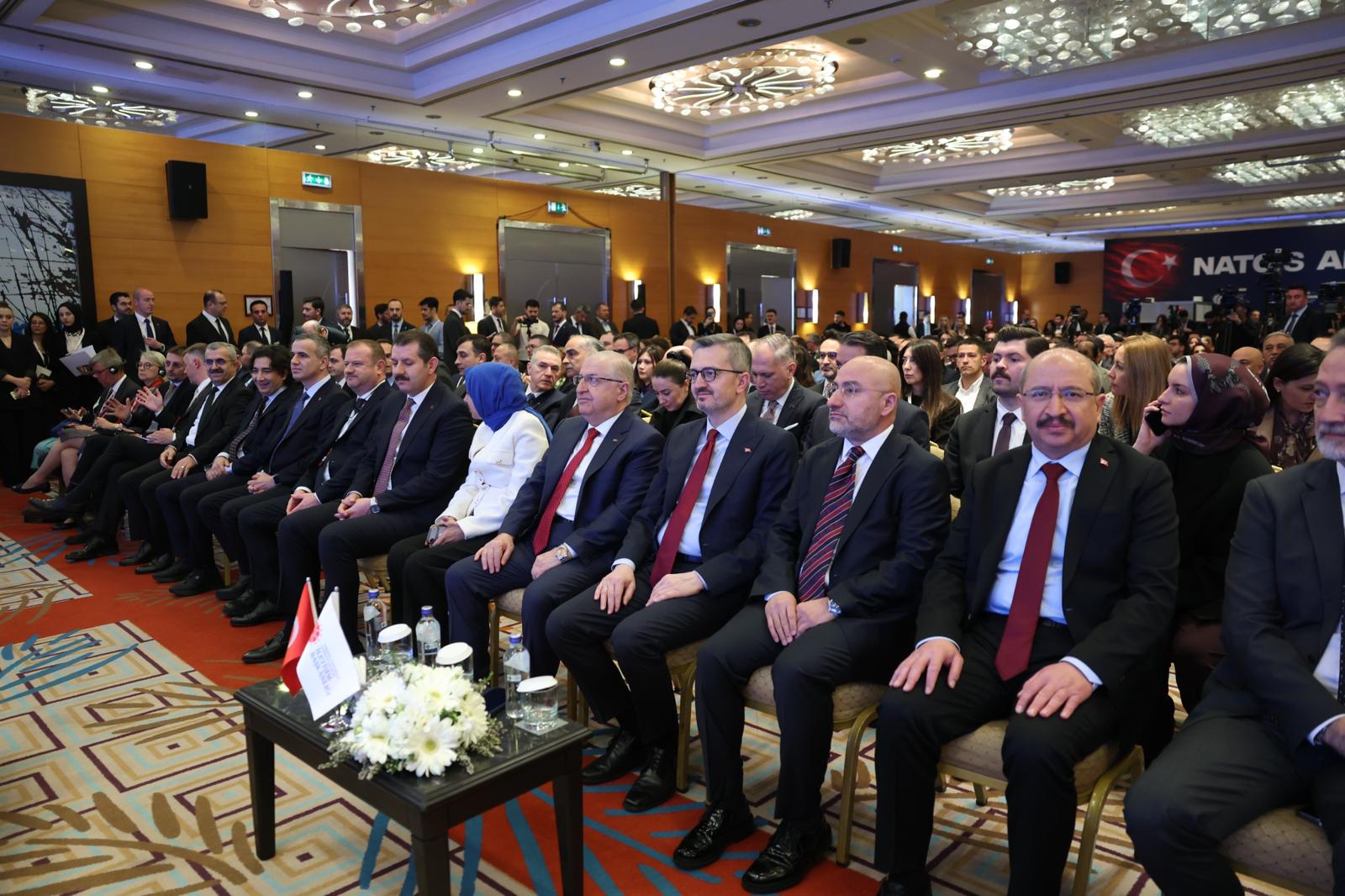
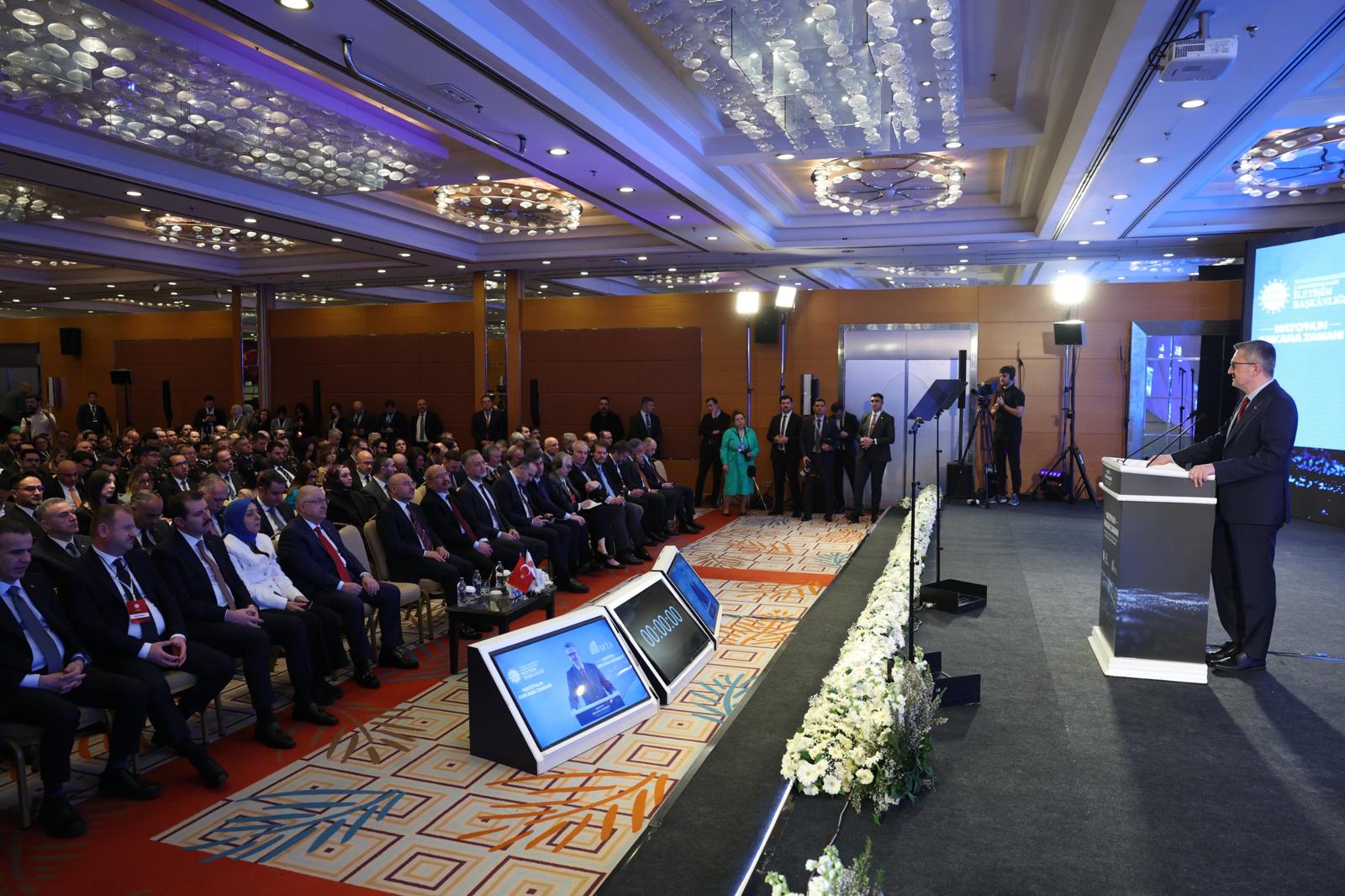
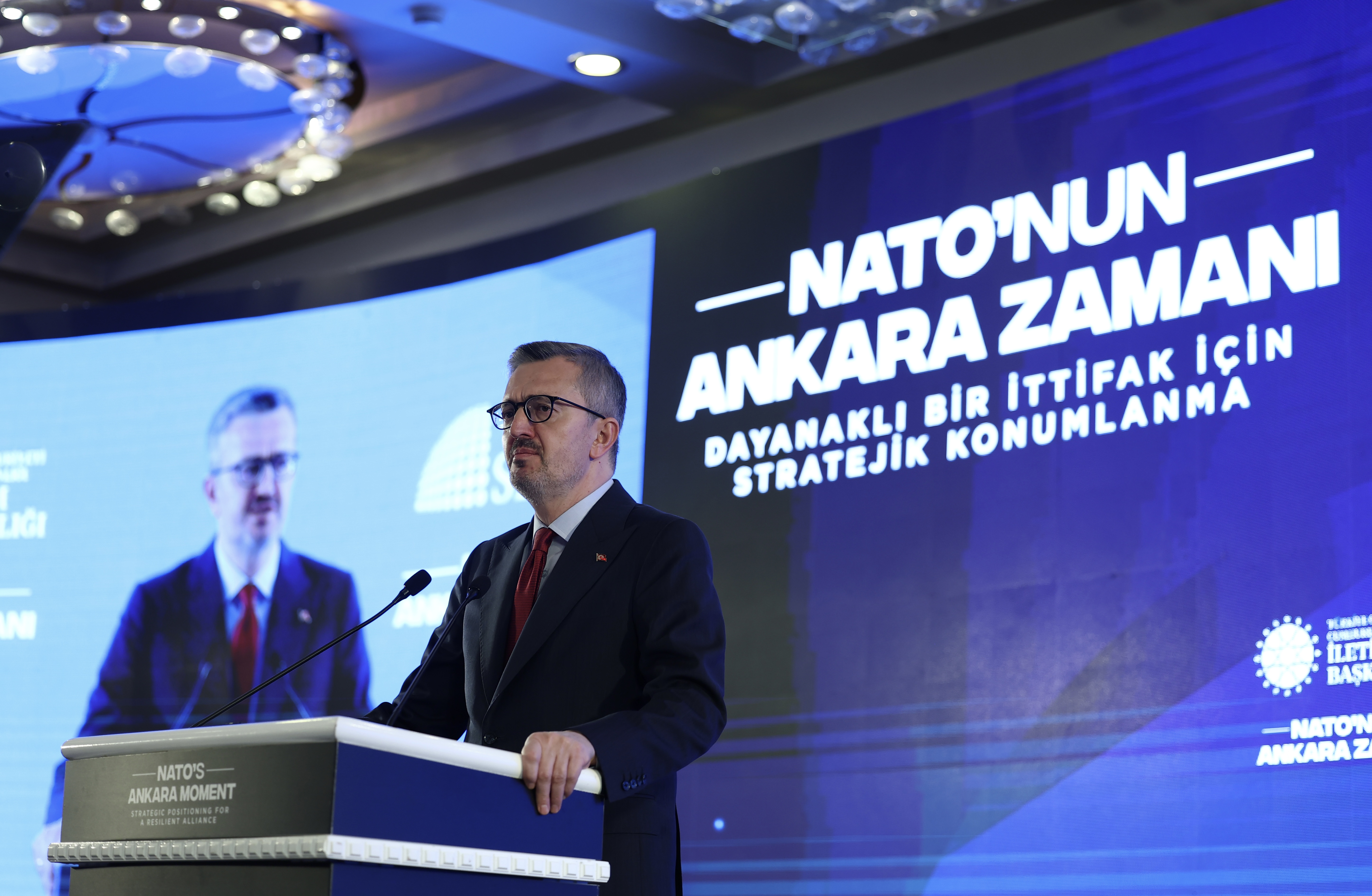
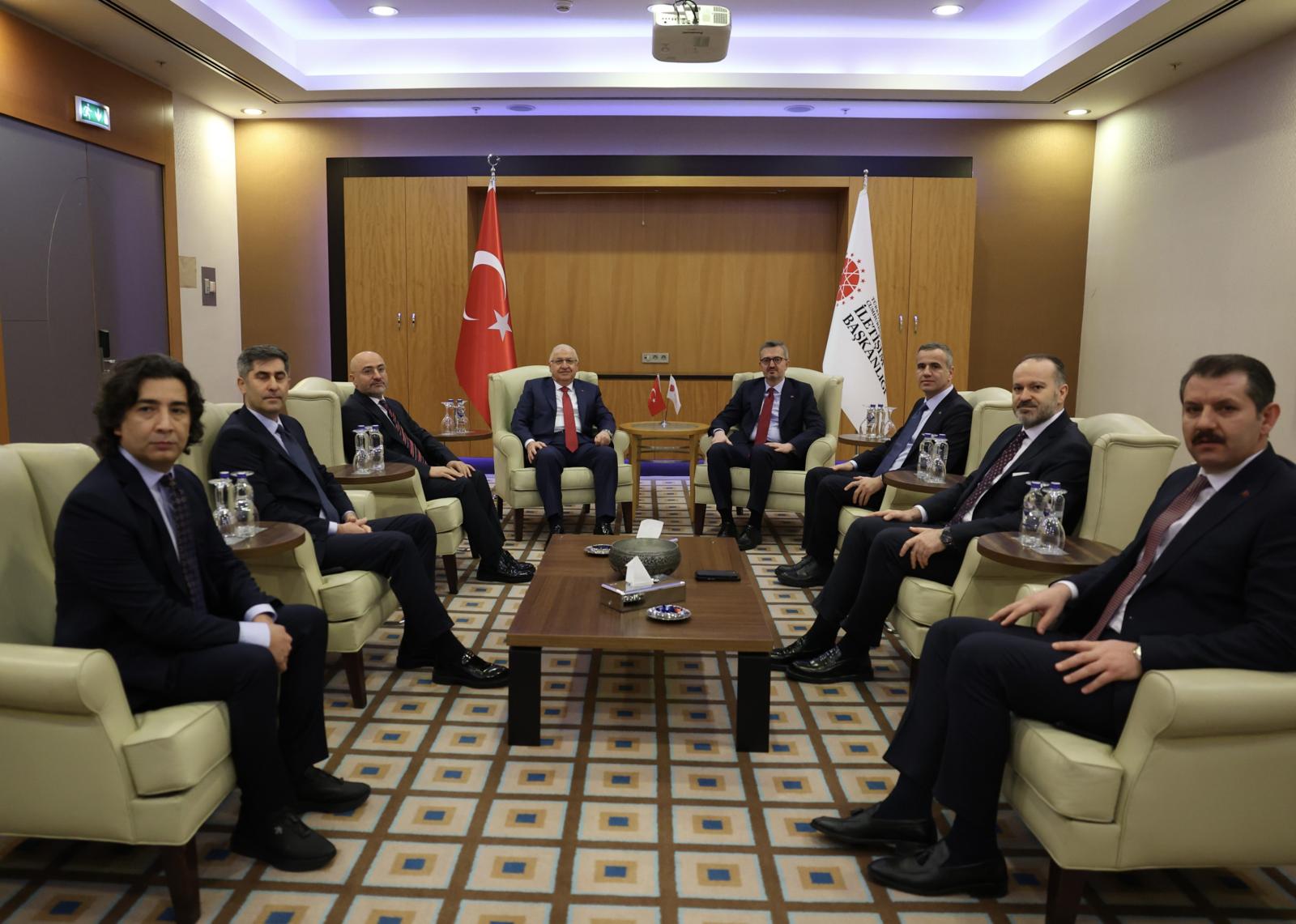
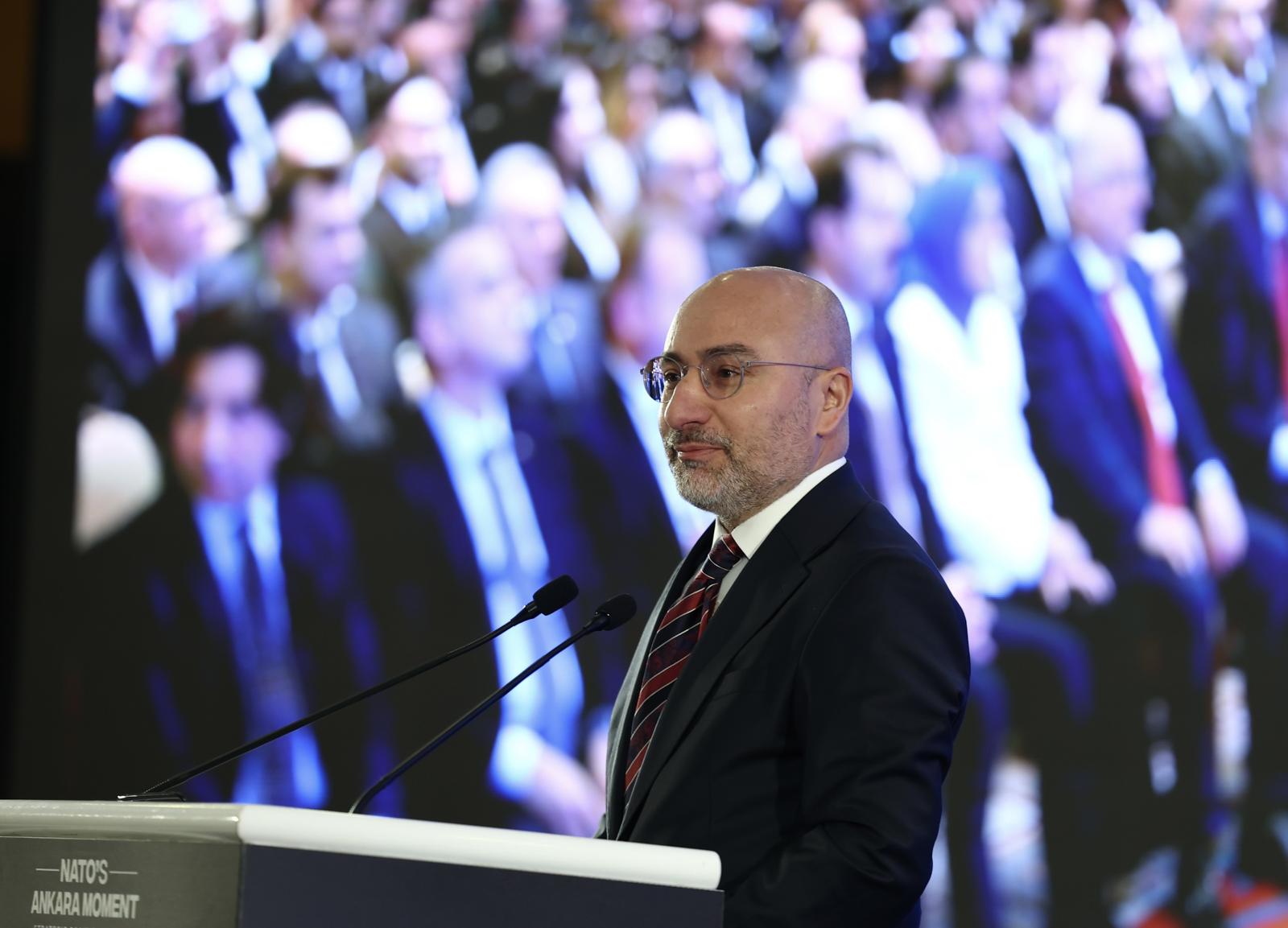
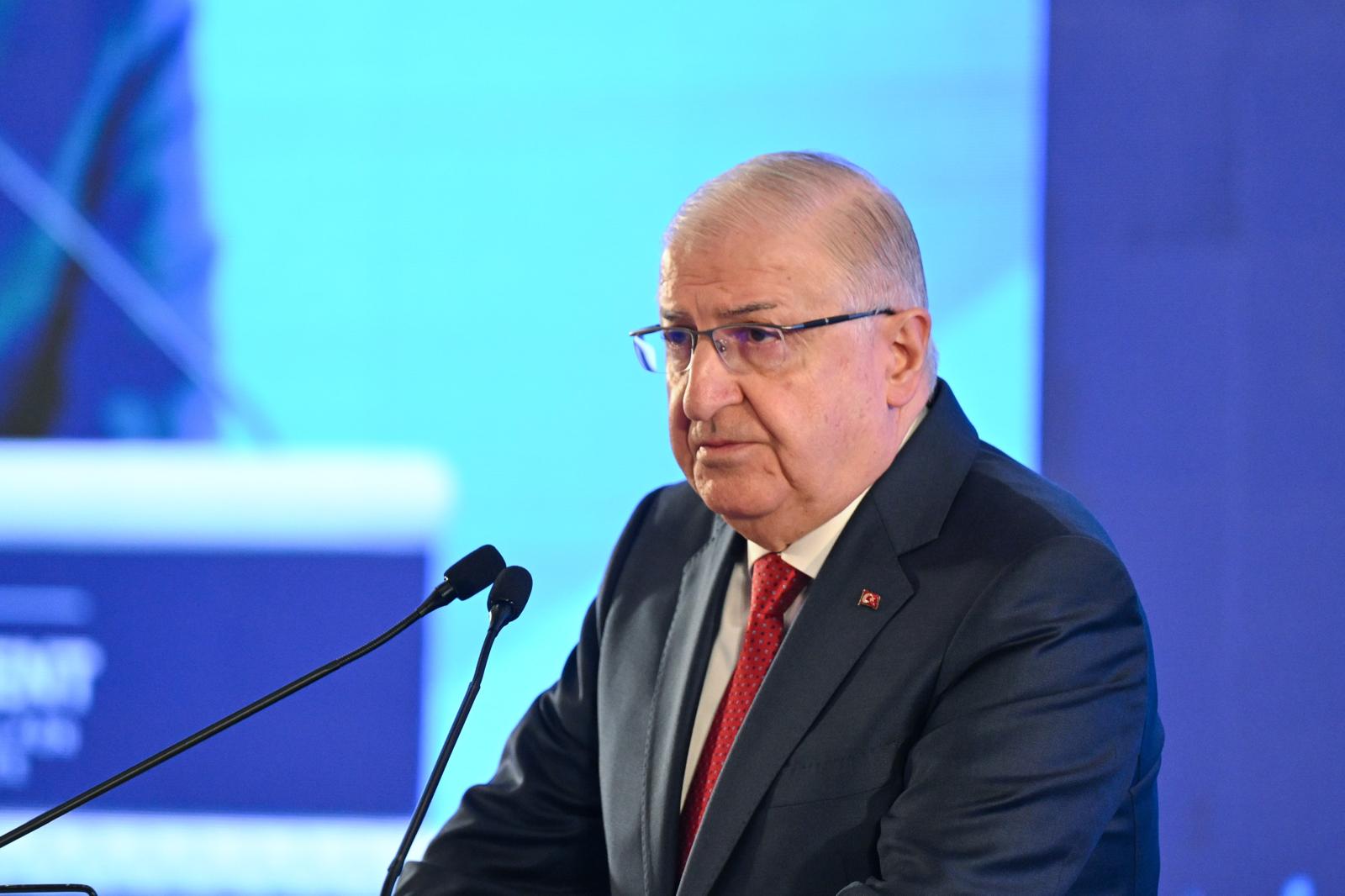
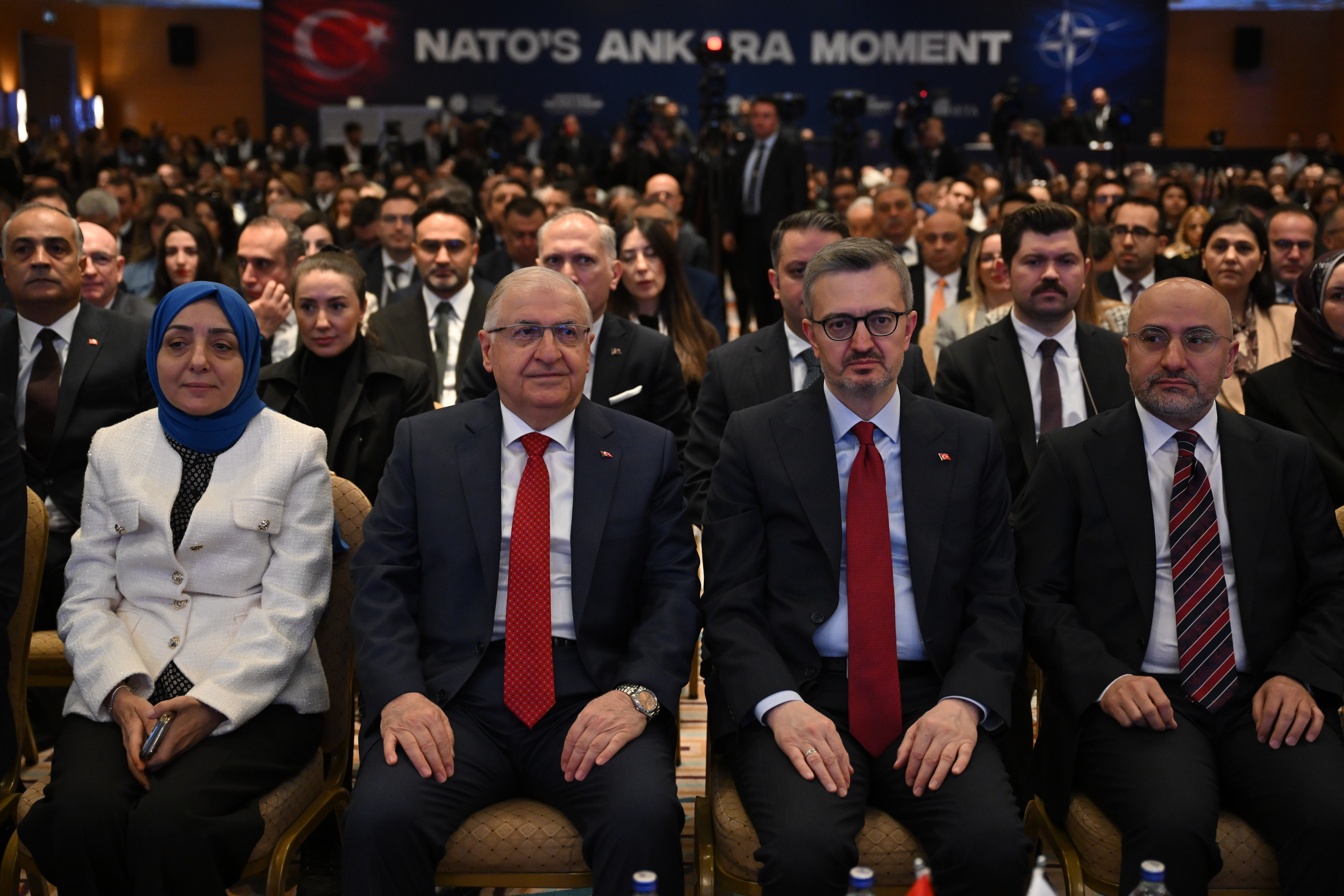
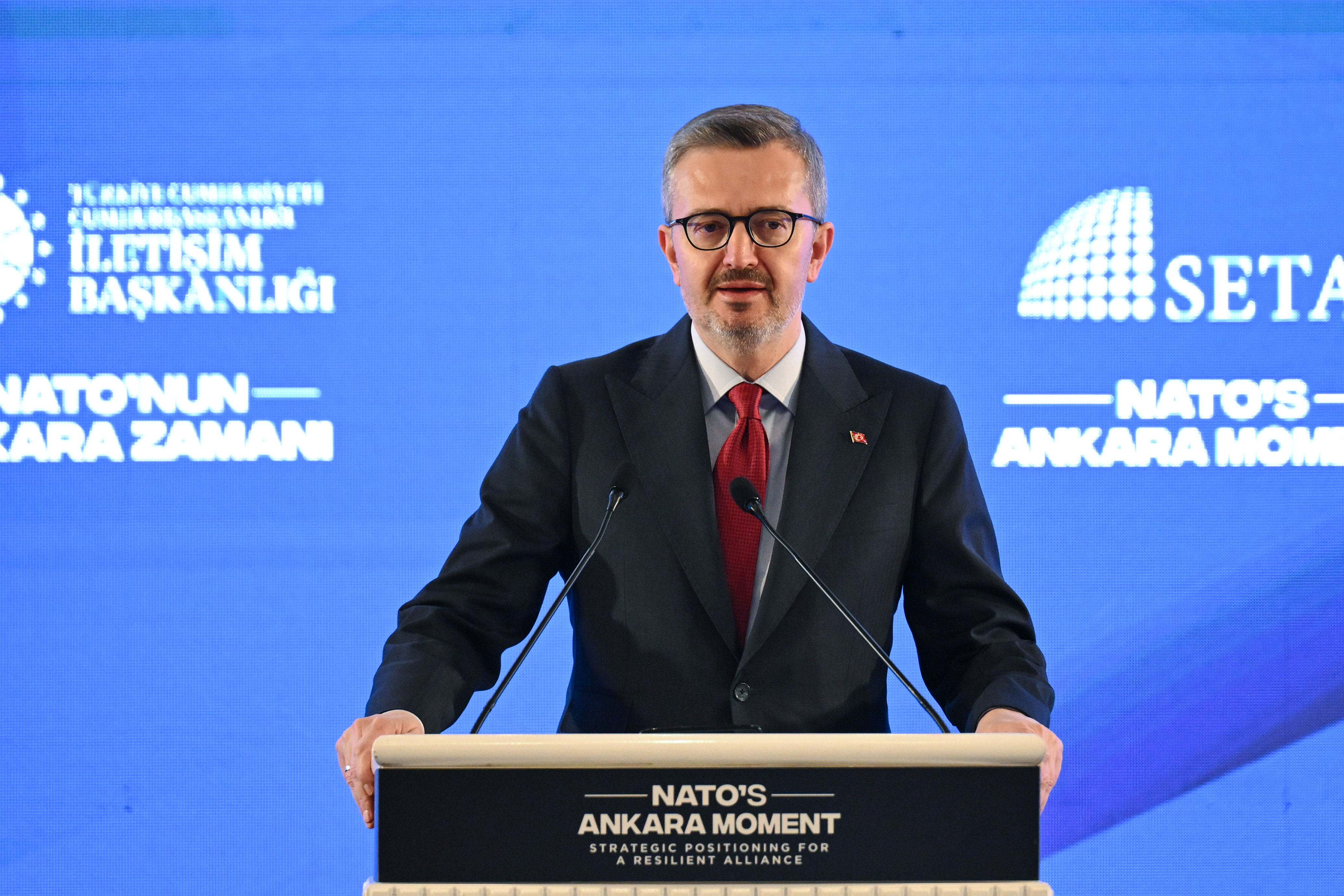
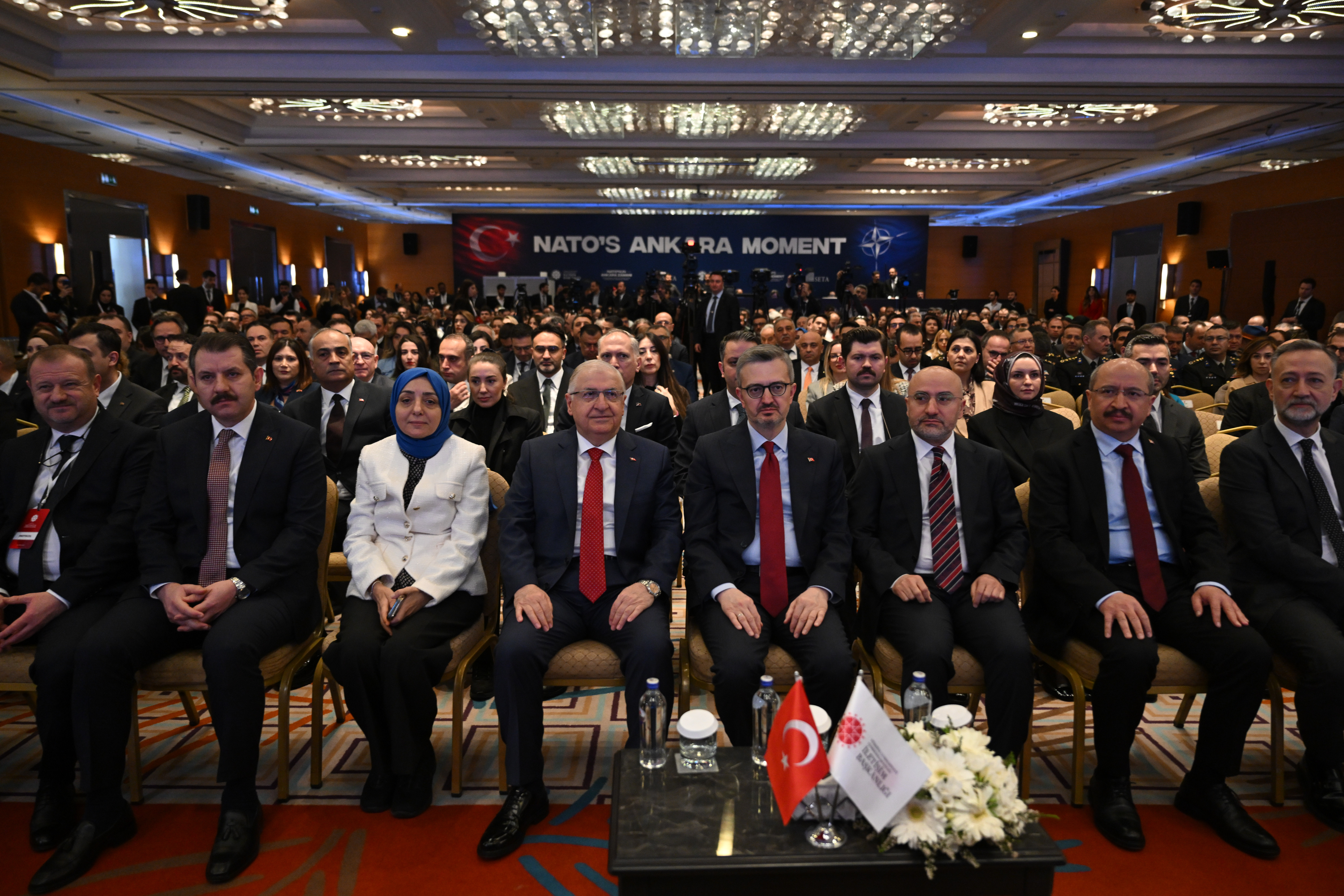
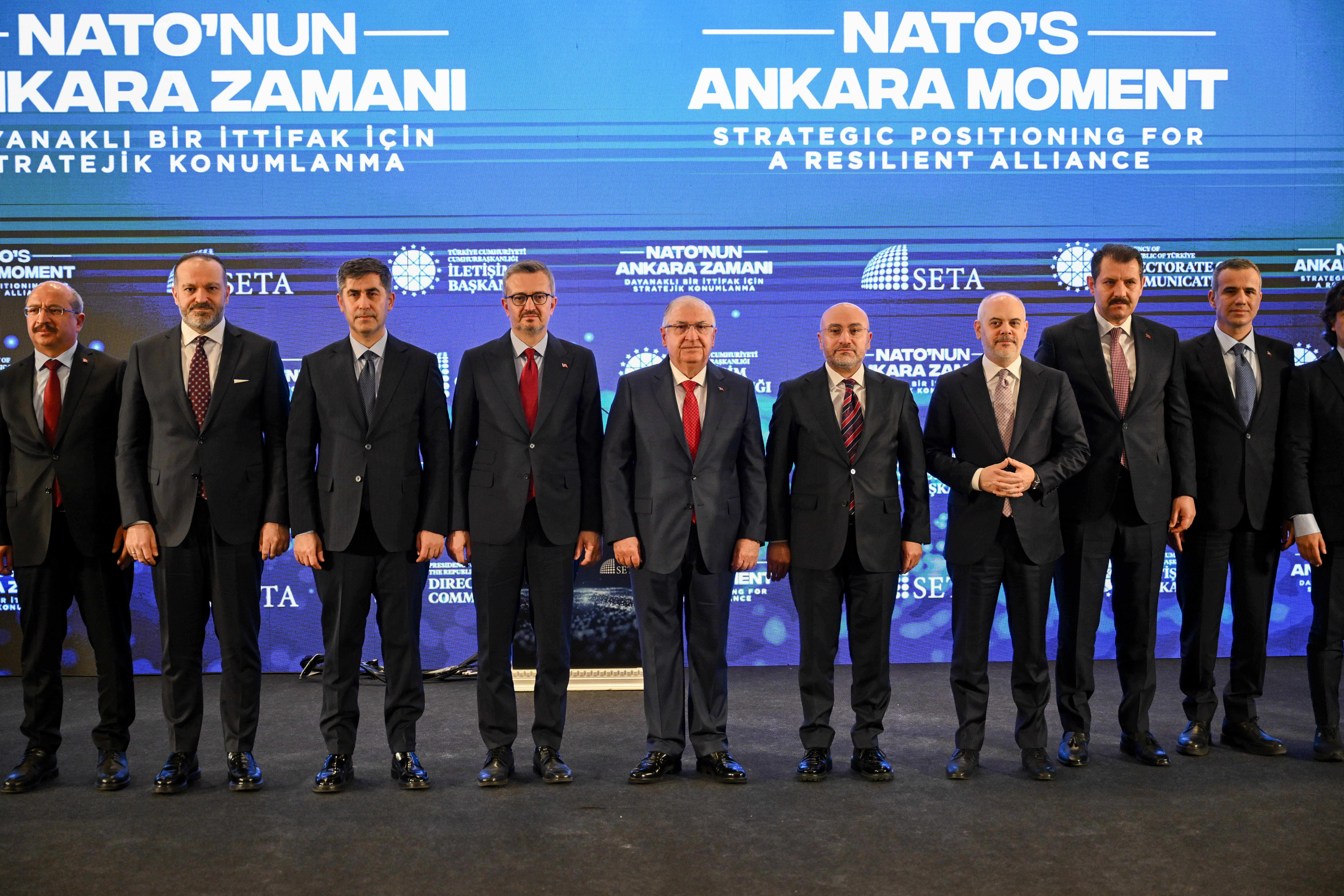
The "NATO's Ankara Moment: Strategic Positioning for a Resilient Alliance" panel was organised by the Directorate of Communications and SETA on the occasion of the 74th anniversary of Türkiye's membership in NATO, highlighting the role it has undertaken within the Alliance, its contributions, and its developing defence industry.
The panel addressed Türkiye's perspective and expectations towards NATO, an organisation in which it has played an active role since its founding. In addition, the civil and military contributions made by our country—one of the Alliance’s strongest members—were assessed, along with the critical importance Türkiye holds for NATO.
The event, which featured opening addresses by Minister of National Defence Yaşar Güler, the Presidency's Head of Communications Prof Burhanettin Duran, and SETA General Coordinator Prof Nebi Miş, included a video presentation highlighting Türkiye’s critical role within NATO. The first session, entitled ''NATO and the Evolving Security Environment", was moderated by Prof Murat Yeşiltaş, Director of Foreign Policy Research at SETA. The session featured the Chief Advisor to the President on Foreign Policy and Security, Akif Çağatay Kılıç; Lieutenant General Yavuz Türkgenci; IRIS Associate Research Fellow Patrice Moyeuvre; and Scientific Director of CeSPI (Centre for Studies on International Policies) Türkiye Observatory, Dr Valeria Giannotta as speakers.
The second panel, entitled ''Türkiye–NATO Partnership at 74", was moderated by Prof Kılıç Buğra Kanat, Director of the SETA Foundation at Washington DC. The session featured AK Party Antalya Deputy and Head of the Turkish Delegation to the NATO Parliamentary Assembly, Mevlüt Çavuşoğlu; a Senior Fellow at Hudson Institute, Dr Can Kasapoğlu; and National Intelligence Academy Faculty Member, Prof Nurşin Ateşoğlu Güney.
In his speech, Minister Güler outlined Türkiye’s geopolitical role within the alliance, the strides made in the defence industry, and the strategic vision for the NATO Summit to be held in Ankara in 2026.
Speaking at the event, the Minister of National Defence, Yaşar Güler, stated that Türkiye, having joined NATO in 1952, has become not merely a member but a decisive actor that influences decisions and delivers results on the ground. Güler noted that Türkiye, which began the membership process as a ''frontline state'', now positions itself as one of the ''central countries'', emphasising that, with its high military capacity and geostrategic position, it directly contributes to the security of its allies.
It was noted that Türkiye’s advances in its domestic and national defence industry make a direct contribution to NATO’s deterrence capability. Minister Güler stated that successes in fields such as unmanned systems, air defence solutions, electronic warfare, and munitions technologies have made Türkiye a strategic force multiplier, noting that the Turkish Armed Forces stand out among the world’s armies thanks to their level of modernisation and field experience.
Minister Güler pointed out that the Ankara NATO Summit will be a pivotal occasion where Türkiye's military and diplomatic power will stand at the forefront. He added that Türkiye's expectations for the summit are for allies to reaffirm their commitment to Article 5 and strengthen defence industry cooperations.
Addressing the rising global and regional uncertainties, Güler underscored that Türkiye adopts an approach that prioritises diplomacy and resolves conflicts instead of deepening them. Minister Güler said that Türkiye's rational and constructive stance, particularly in reducing tensions in the region, has garnered appreciation both nationally and internationally.
In his speech, Prof. Burhanettin Duran, the Presidency's Head of Communications, highlighted the significant pressure facing NATO to transform in the current conjuncture, noting that the international system is experiencing a multidimensional disruption.
Head of Communications Duran added that NATO, originally founded for collective defence during the Cold War, is currently undergoing a permanent and structural transformation. Underlining that the Russia-Ukraine war and the US's shifting stance towards NATO in particular have shaken security paradigms for Europe, Head of Communications Duran said, "In an era of structural warfare, NATO must transform by embracing a strong, integrated approach that puts resilience, deterrence, and crisis management at its core."
Highlighting Türkiye’s strategic importance within NATO, Head of Communications Duran noted that Türkiye is in an exemplary position in managing modern threats with a 360-degree security perspective.
Head of Communications Duran stressed that Türkiye has become an indispensable part of the equation in several regions from Syria to Gaza and a "safe harbour" under the leadership of President Recep Tayyip Erdoğan. Pointing out that the field of communication has become part of conflicts, Head of Communications Duran said that a holistic strategic communication approach against disinformation, perception management operations, and AI-generated fake content is essential. He added that NATO must prioritise enhancing this capacity and that a modern security architecture can only be built on a communication framework based on truth.
Speaking on the significance of this panel leading up to the historic Ankara NATO Summit in July, Head of Communications Duran said that the messages to be conveyed by leaders in Ankara will decide the future of the alliance. Head of Communications Duran reaffirmed Türkiye’s support for Lebanon’s territorial integrity while calling on the international community to take action against aggression in the region.
Prof. Nebi Miş, the General Coordinator of SETA, underscored in his speech that the international system is being subjected to a comprehensive "stress test" and that a multidimensional security transformation is underway. Noting that the Russia-Ukraine war and recent developments in the Middle East once again called into question NATO's deterrence capacity and cohesion within the alliance, Miş said that the Ankara Summit marks a critical juncture that will shape NATO’s future.
It was highlighted in the speech that Türkiye has been one of the countries contributing the most to NATO operations for over 70 years, emphasising that the country stands out not only for its military capacity but also for its diplomatic flexibility and crisis management capabilities. It was stated that the progress achieved in the domestic and national defence industry, along with its high operational capability, has made Türkiye an indispensable actor within NATO. Miş underlined that President Recep Tayyip Erdoğan’s approach, that “European security cannot be conceived without Türkiye,” has found even stronger resonance today.
It was also recalled that Türkiye is not only a country that shares the burden within NATO, but also one that defines threats and develops strategic vision; once again, expectations for equal and sincere solidarity from allies were expressed.
Moderating the first panel session titled “NATO and the Evolving Security Environment", Prof. Murat Yeşiltaş emphasised that we are experiencing a profound paradigm shift in which uncertainty lies at the centre of the international system and questioned how NATO will adapt to this new security environment. He also opened for discussion how differing security perceptions among allied countries and the growing pursuit of strategic autonomy in Europe will shape the future of the Alliance.
Ambassador Akif Çağatay Kılıç, the Chief Advisor to the President on Foreign Policy and Security, stressed that the duplication of NATO structures by the European Union while establishing its own defence mechanisms would cause significant harm to the Alliance and that the two institutions should not compete with each other. He noted that Türkiye is a very strong ally, ensuring security on Europe’s southeastern flank, and highlighted that, despite past restrictions imposed by its allies, Türkiye has successfully developed its domestic defence industry and military capacity.
Lieutenant General Yavuz Türkgenci stated that NATO has successfully adapted to diverse threats on its eastern and southern flanks (such as Russia, terrorism, and migration) through a 360-degree “threat-informed” approach. He emphasised the urgent need to transition from industrial-age military structures to the requirements of the digital age (including unmanned systems) and warned that NATO’s robust command structure should not be undermined by the EU and that non-EU allies (such as Türkiye, the United Kingdom, and Canada) should not be excluded from Europe’s security architecture.
Valeria Giannotta, the Scientific Director of the CeSPI Türkiye Observatory, noted that the international system is evolving into a multipolar structure and stated that, in the face of increasing conflicts, the need for collective security within NATO has once again come to the forefront. She drew attention to differences in threat perceptions within the Alliance, emphasising that for countries such as Italy and Türkiye, challenges on the southern flank are a priority, and highlighted the pressures placed on the countries by Europe’s pursuit of strategic autonomy and increased defence spending targets.
Patrice Moyeuvre, an Associate Research Fellow at IRIS, described NATO as the only unique alliance in the world capable of planning and conducting complex military operations in consensus with dozens of countries and as a vital bridge for dialogue among nations. He argued that the European Union’s defence initiatives and NATO should be complementary structures; however, he stated that the operational constraints of member states and the lack of a full understanding of the interoperability between these two institutions are important challenges that need to be overcome.
At the panel session titled "Türkiye–NATO Partnership at 74", AK Party Antalya Deputy and Head of the Turkish Delegation to the NATO Parliamentary Assembly, Mevlüt Çavuşoğlu, stated that Türkiye’s contributions to NATO operations, particularly its missions in Afghanistan, serve as an example of burden-sharing. Çavuşoğlu, emphasising the importance of incorporating Türkiye’s experience in counterterrorism into NATO’s security concept, stated that it is gratifying that allies are lifting restrictions on the defence industry. Çavuşoğlu recalled that during the Russia–Ukraine war, Türkiye was the only NATO ally able to maintain dialogue with both sides and that, in this way, it managed critical processes such as the Grain Corridor and prisoner exchanges. He also emphasised that Türkiye, by strictly implementing the Montreux Convention, prevented an escalation of tensions in the Black Sea.
Dr Can Kasapoğlu, a senior fellow at Hudson Institute, said that NATO is in a "back to basics" process and that military capacity is once again coming to the forefront. Kasapoğlu emphasised that Türkiye is the only ally, apart from the United States, capable of producing sophisticated UAV technology and actively employing conventional forces in the field. He stated that Türkiye’s defence industry has moved beyond the industrial age and has become one of the winners of the ''hyperwar'' era, which is based on robotics, artificial intelligence, and information superiority. He also noted that Türkiye is one of the few countries in Europe with an active ballistic missile programme.
National Intelligence Academy Faculty Member Prof. Nurşin Ateşoğlu Güney stated that the international system has taken on a "fractured" structure and that great power competition has returned. Nurşin Ateşoğlu Güney stated that, at a time when solidarity within NATO is being questioned, Türkiye plays a strategic bridging and facilitating role between Washington and Europe. She added that, with its achievements over the past twenty years, Türkiye has filled gaps as a "middle power" when multilateral formats have proved ineffective and has been a critical actor in maintaining the unity of the alliance.
At the panel, experts agreed that Türkiye’s importance within NATO stems not only from its geographical location but also from its tangible military capabilities and diplomatic flexibility.