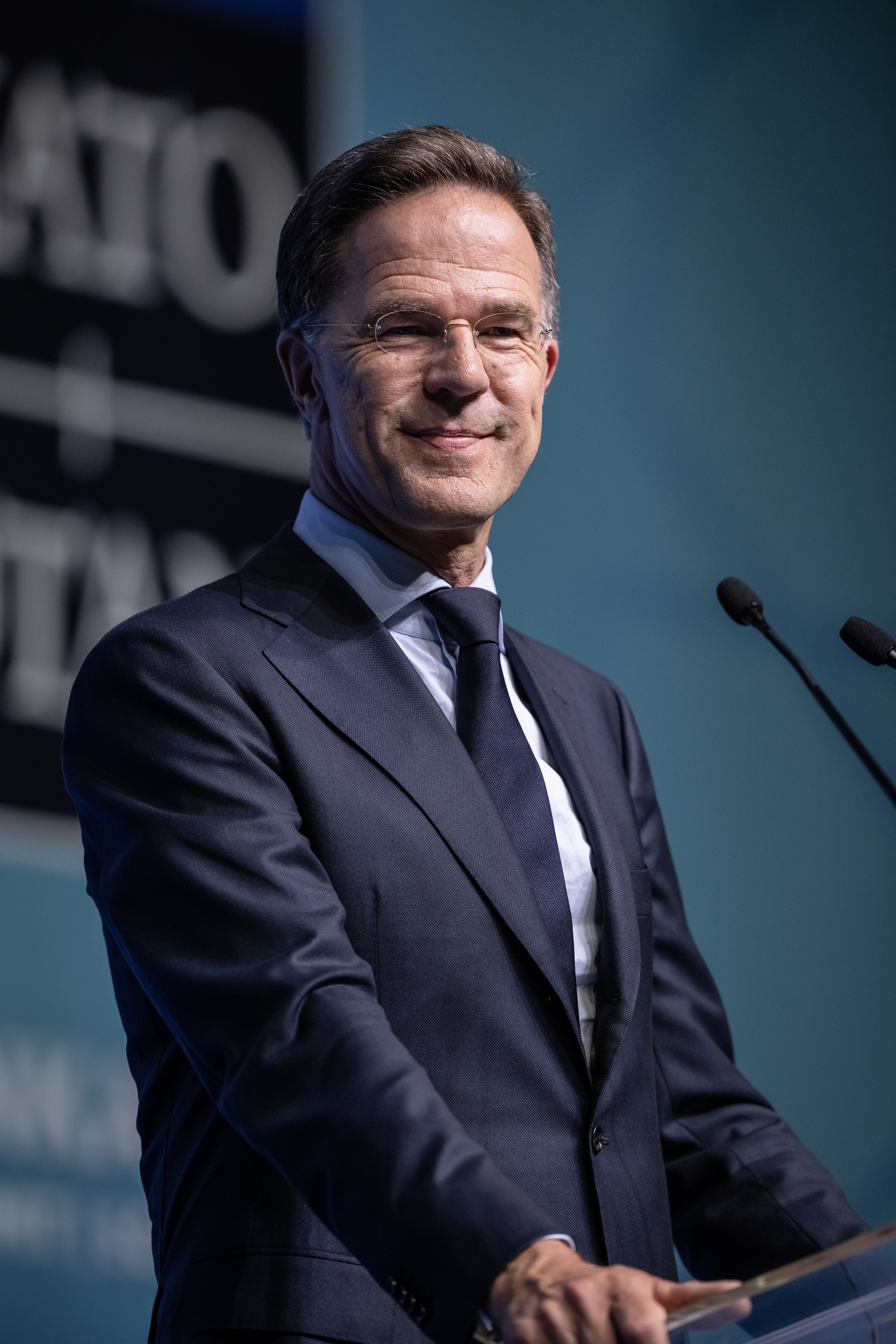
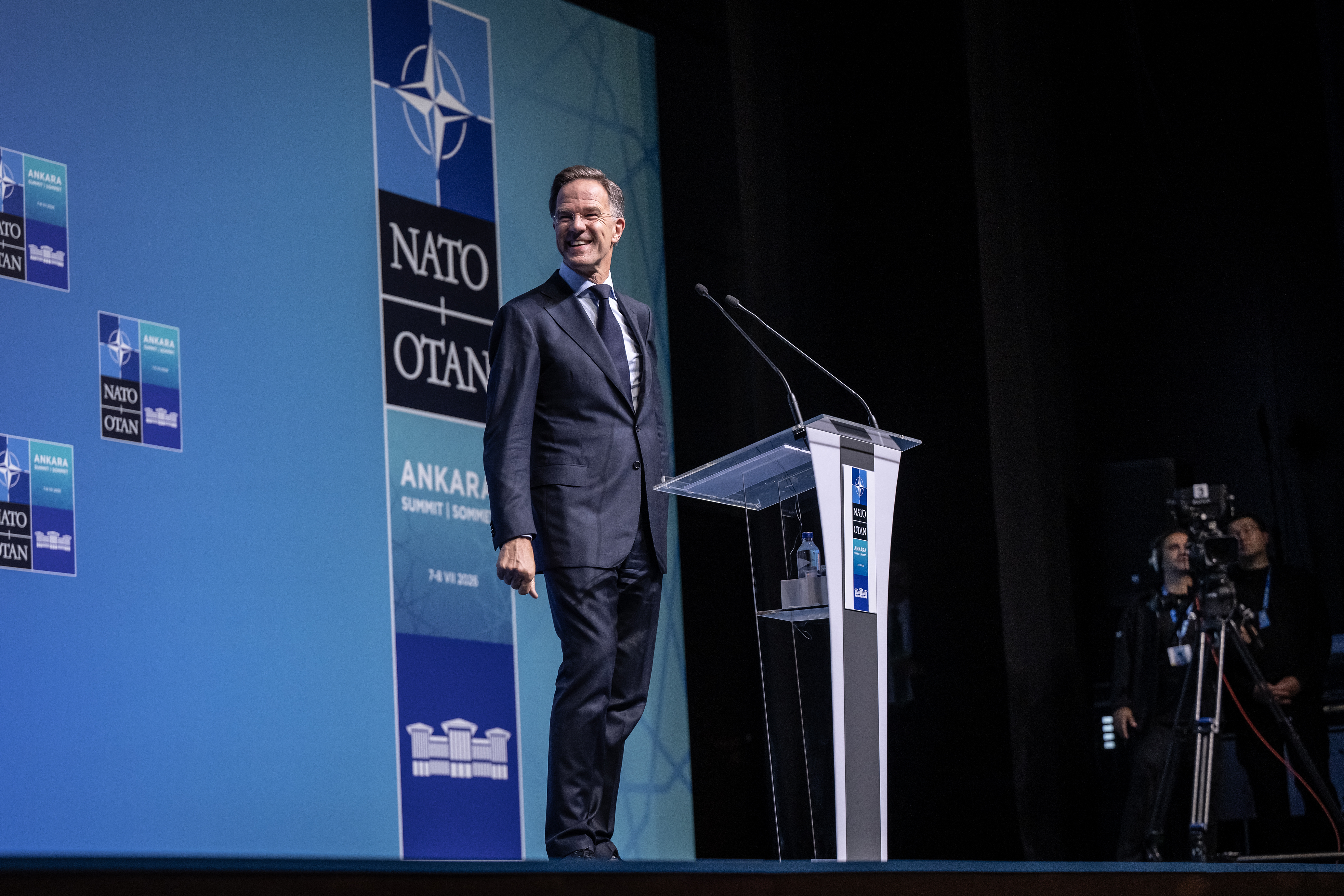
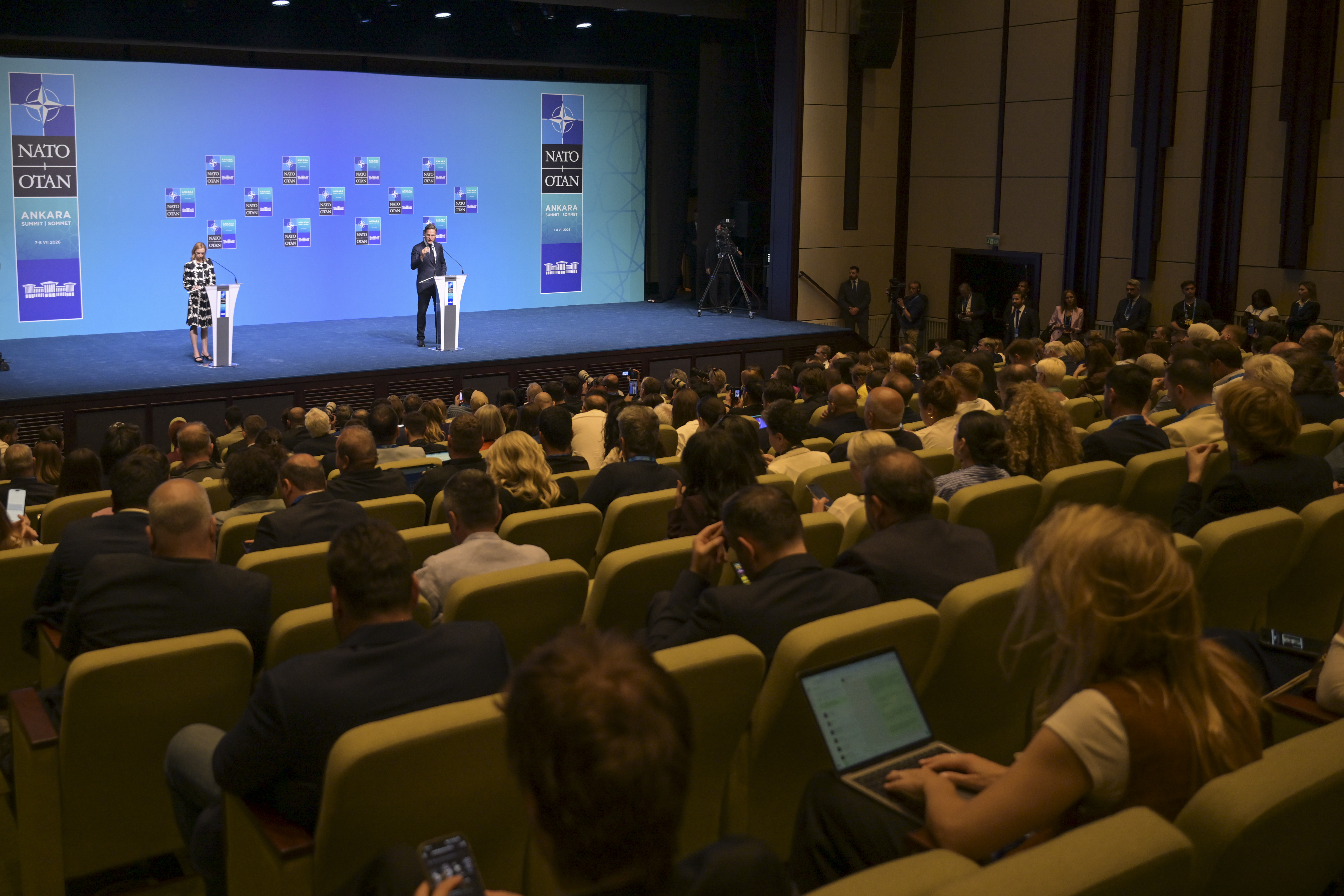
NATO Secretary General Mark Rutte spoke to the press at the Presidential Complex ahead of the 36th Summit of NATO Heads of State and Government, which will be hosted by the capital Ankara.
He emphasised that Canada and Europe have boosted their defence spending to 4 per cent in accordance with their commitments, which is critical both for their own security and the alliance's overall security.
Rutte noted, "Europe and Canada boosted their core defence spending by 20 per cent last year compared to the previous year. The rise for 2025 and 2026 totals an additional 258 billion American dollars, and it will continue. We will have more sources, more forces and more bases. After years of underinvestment, we are currently developing genuine capabilities. Our European allies and Canada equalised such spending with the United States. Europe and Canada are now preparing to take on more leadership. We are moving beyond conventional defence."
Rutte underscored that the Alliance will possess a deterrent defence framework and that NATO's eastern flank, encompassing the Baltic region, the Arctic, and Ukraine, is supported.
Secretary General Rutte stated that all of this was evidence of a real shift in mindset and that a stronger Europe equals a stronger NATO.
Rutte said that the economic investments were translated into military capabilities, and added:
"In other words, we are putting the cash to work. We are putting our cash into missiles, ammunition and also the ability to counter future strikes. Simultaneously, we are strengthening our national defence industry infrastructure. Tomorrow we will host a defence industry forum. This will serve as a platform, a stage on which we can all demonstrate our reliable defence and deterrence systems. We need all of this because we have to deter.
And when our industries in the region extending from Arkansas to Ankara combine their strengths, the result is improved economies and innovation. We will support tens of thousands of jobs on both sides of the Atlantic."
Rutte said that this was very important in terms of security and that societies had to be safeguarded today and tomorrow.
Underlining that the threats they faced are real – including from Russia, and added, "Right now, Ukraine is changing the dynamics on the battlefield This is now changing thanks to Ukraine's bravery, dedication, and ingenuity. Russia continues to attack Ukrainian cities, when it comes to air defence."
"Your leadership in NATO is important"
Rutte stated that since joining NATO in 1952, Türkiye has been one of the biggest armed forces in the Alliance, adding, "In the last 5 to 10 years, you have rapidly developed your defence industrial base. Türkiye has now about 3,000 companies operating in the defence industry."
Rutte noted that the Turkish defence sector provides Alliance members with the means to defend themselves, adding, "Your (Türkiye's) leadership in NATO is important. Your place on the map is important. The fact that you organised this (Summit), now, in Ankara is evidence of that."
Admiration for the Turkish defence industry
In response to an Anadolu Agency reporter's question about Türkiye's defence industry, Rutte said, "NATO is already very much profiting from what Türkiye is doing in terms of the defence industrial output."
Underlining that ASELSAN is one of the best examples, Rutte said that big ones and also medium-sized smaller companies in Türkiye operate in the defence industry.
"(ASELSAN), through Türkiye's defence industry, supports so many other countries within our Alliance," said Rutte, adding that Ankara is working across the Alliance.
Referring to visits by Belgian and Polish delegations to Türkiye, Rutte pointed out that Türkiye works closely with so many countries in NATO, within the EU, and also with the US.
Rutte stated that there are investments by Turkish industrial companies in the United States, which is really important.
Rutte indicated the necessity of a structure with the least number of barriers possible in terms of working together across the Alliance, calling for collaboration extending from Arkansas to Ankara, throughout the Alliance territory.
Rutte stated that Russia continues to attack Ukraine, and Ukraine will continue to defend its sovereignty.
Rutte said that they will continue to ensure Ukraine gets the support it needs, and added:
"Because Ukraine’s security is so closely linked with our own. Overviewing our agenda for here in Ankara, we will be delivering on the commitments made in The Hague to invest in our defence. We will ensure that we are rebalancing for the better sharing of responsibility and burden. We will turn cash into capabilities, joining forces with industry. And we will continue our robust support for Ukraine."
Rutte underlined that they represent nearly two-thirds of the global economy and that cooperation is key at this juncture.
"We are stronger together in NATO with partners to ensure freedom and security," Rutte said.
"I had a good meeting with Trump"
When asked how US President Donald Trump's recent remarks regarding Greenland, criticisms of allies, and Iran-US tensions would affect the summit's message of unity and solidarity, Rutte shared that he had a "good meeting" with Trump last week, where they discussed the "staggering increase" in defence spending by Europeans and Canadians.
Rutte indicated that the primary driver for this was Russia-Ukraine and added,
"But also, President Trump has been extremely forceful, encouraging us to do this. You could argue that he is the first president of the US since Eisenhower to succeed in reaching a situation where the Europeans and Canadians will spend the same as the Americans. This equalisation had been a wish for 50–60 years, and now it is happening in large part, thanks to his leadership."
Noting that they also addressed Trump's disappointment regarding the Strait of Hormuz or Iran in general during the meeting, Rutte said that on 3 July, France and the UK held talks with Oman aimed at preserving the principle of freedom of navigation in the Strait of Hormuz.
To a question about the impact of Russia's recent attacks on Ukraine on the NATO Summit and the message leaders would send in response, Rutte replied that Ukraine is doing well and succeeding on the battlefield.
When asked about the scrambling of British fighter jets after a Russian military aircraft approached a NATO aircraft carrier task group in the Norwegian Sea, Rutte responded that the UK Armed Forces acted appropriately.
Characterising Russia's stance as "reckless and unprofessional", Rutte stressed NATO's resolve to defend itself.
To a question regarding China's missile test in the South Pacific and its impact on NATO's cooperation with Indo-Pacific partners, Rutte replied that one "cannot be naive" about China and added that Indo-Pacific and Transatlantic security are becoming increasingly intertwined.
Rutte noted that China, North Korea, and Iran support Russia in the Russia-Ukraine War and that NATO is poised for these developments.
Europe and Canada take on more responsibility in NATO
Rutte said that European countries and Canada are now taking on more responsibility in the defence sphere within NATO and that this division of labour is effectively being put into practice within the Alliance.
Pointing to the example of Ukraine, Rutte shared that the US continues to provide military equipment vital to the Ukrainian defence industry, while the cost of interceptor missiles is covered by European countries and Canada.
Rutte pointed out that the additional 250 billion USD budget projected for defence in 2025 and 2026 will be enabled by a contribution of approximately 215 billion USD from European countries and Canada.
To a question regarding the hosting of the NATO Summit in Ankara and freedom of the press, the NATO Secretary General responded, "Democracy is also the free media; it means that you in this room can ask all the questions you want, write the pieces you want, and do any research you want."
"I would argue that the NATO from three, four, or five years ago was not sustainable"
Reflecting on the accelerated pace of the transformation process, calling for Europe to take on greater responsibility in defence, Rutte said,
"I would argue that the NATO from three, four, or five years ago was not sustainable. It is not sustainable that we ask a country with 350 million people, living an 8-hour flight away from here, to defend us against the Russians, with 600 million people living in this part of NATO territory—the richest part of the world—being so overly dependent on the US."
Arguing that the balance between Europe and the US must therefore be re-established, Rutte said that Europe assuming greater responsibility in conventional defence would bolster the security of both the US and NATO.
Rutte explained that the US maintains its essential role in NATO's nuclear deterrence and the critical military support it provides to the Alliance, citing the prevention of Russian nuclear submarines from reaching US shores as an example.
Underscoring the importance of Europe playing a stronger role and Canada assuming greater responsibility for defence, Rutte said: “ We are now creating an Alliance which is sustainable where the US knows it is a fair deal. We are spending the same as they are, taking more responsibility for the conventional defence of Europe. Stronger Europe, stronger NATO.”
“PURL deliveries, including interceptors, are being sent to Ukraine and being used by Ukraine”
Responding to a question about claims that “the United States is splitting NATO,” Rutte said, on the contrary, the United States was bringing NATO closer together.
“And the way it will be organised with the Supreme Allied Commander being centre stage in the review, the fact that the Americans have declared very clearly that they will do this in close coordination with all Allies, I think, is absolutely important,” said Rutte.
To a question about Lithuania and Finland lifting their prohibitions on hosting nuclear weapons on their territories, Rutte responded, “And you saw this in a Nuclear Planning Group meeting we had with the defence ministers, now 4 weeks ago, which was very successful and led to clear outcomes, so, individual decisions by Finland and Lithuania. Generally speaking, we are in a good place."
Saying that the United States is doing everything it can to deliver on Ukraine’s Prioritised Requirements List (PURL) commitment, Rutte said, “And they are doing so. PURL deliveries, including interceptors, are being sent to Ukraine and being used by Ukraine.”
Stating that there is a limit to the number of interceptors there in NATO territory, Rutte continued:
“That's why we need to make sure that we produce more. That's one of the reasons why Ukraine itself has been working. Of course, this is not something which will lead to results immediately, but to see what they can do with the help of NATO partners and Allies to produce more when it comes to interceptors. So, we are working from every angle, everybody is involved in this."
Rutte noted the importance of all 32 Allies to work together, as boundaryless as possible, without any barriers, and said:
“Of course, in an Alliance, like NATO, you will always have your political discussions, and sometimes disagreements. People are always getting overly excited when that happens. I think it is only incumbent upon democratic Alliances that you sometimes have those discussions. And then it is my role to discreetly, behind the scenes, see what I can do to solve it, to help solve it.
In the end, we have only one goal. To protect the whole of NATO territory against Russia, against terrorism, against any other threat we face. And that means that internally, we can have these discussions. Again, no problem, but then solve them and come together."
Explaining that President Volodymyr Zelenskyy of Ukraine is willing to sit down with President Vladimir Putin of Russia in whatever format to solve the Russia-Ukraine War, Rutte thanked the Americans “for breaking the deadlock with Putin.”
As to what needs to happen for Putin to come to the negotiating table, Rutte said, “I think nobody in this room can predict."
Stating that Ukraine is doing better on the battlefield, Rutte said, “Putin is willing to sacrifice up to 35,000 of his own men, which is crazy, on the battlefield.”
“(The S-400 issue) That is a bilateral decision between Allies”
Regarding Zelenskyy’s offer to co-produce PAC-3 missiles for Patriots, Rutte said these matters need to be discussed bilaterally.
Rutte went on to say:
"Nothing new to report here, but, more generally speaking, of course, it is always good if Allies and partners work together in a trustworthy way, to see what you can do to collectively ramp up the production. The United States has a problem with the defence industrial output. So has Europe. So, we need to produce more. We discussed these in quadruple sessions in the White House. But in the end, these are bilateral decisions."
In response to a question about the S-400s, Rutte said, “That is a bilateral decision between Allies.”
Stating that it is up to the United States to decide how it builds its relationship with the other 31, Rutte noted that he viewed the outcome of his meeting with US President Trump on 25 June in the Oval Office as “promising and encouraging.”