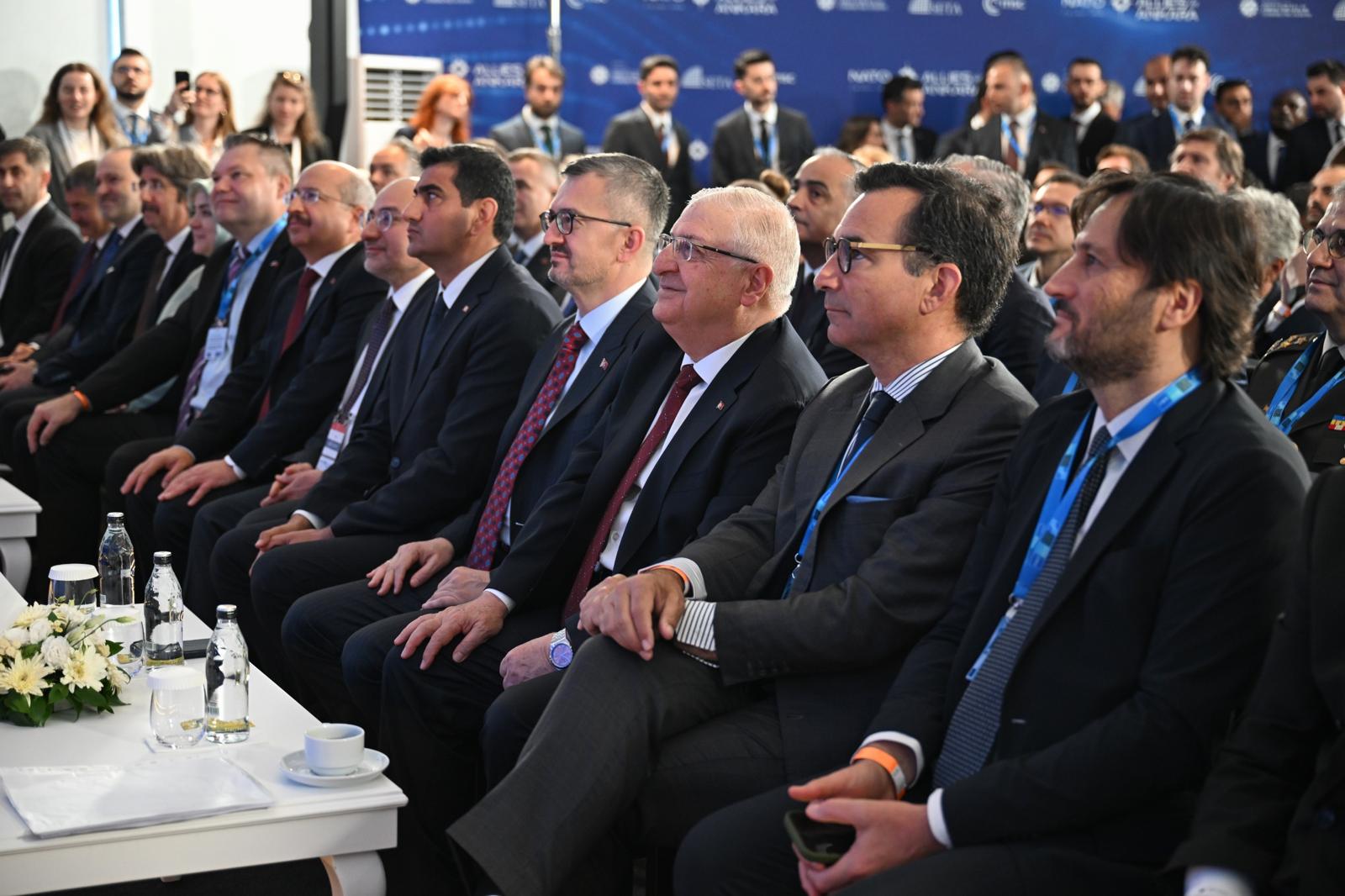
Minister Güler said, "We welcome Europe contributing more strongly to defence. However, this contribution should not compete with NATO; it should strengthen it."
Minister of National Defence Yaşar Güler participated in the "Allies in Ankara" programme organised by the Presidency's Directorate of Communications in cooperation with the Munich Security Conference (MSC) and the Foundation for Political, Economic and Social Research (SETA), as part of the NATO Heads of State and Government Summit.
Speaking at the programme, Minister Güler said that since its establishment, NATO has been more than a military alliance; it is the institutional manifestation of collective defence, political solidarity, and the transatlantic bond. Recalling that, throughout history, alliances have either been short-lived or have become ineffective because they were unable to adapt to changing circumstances, Minister Güler said that NATO has still endured because it has been able to renew itself without losing sight of its fundamental purpose.
Minister Güler, stating that NATO’s transformation could broadly be considered in three stages, went on to say:
"The first phase, referred to as 'NATO 1.0', was the period following the Second World War and spanning the Cold War, during which the Alliance continued to fulfil its mission on the basis of a realistic threat assessment. In this context, the rapid reaction forces have ensured joint security by building interoperability alongside combat service support capabilities and a reliable burden-sharing arrangement. The Alliance’s main priority during this period was to establish a strong and deterrent military structure within the framework of collective defence. However, following the profound changes in the global system after the Cold War, many European Allies reduced their defence spending, forces, stockpiles, and industrial capacity. The focus of this period, described as ‘NATO 2.0’, was on crisis management and out-of-area operations, driven by terrorism and the wars in the Balkans."
Minister Güler said that since 2014, conventional warfare has gradually reached NATO’s borders, and new great-power competition and simultaneous regional crises have brought the Alliance members to a new phase, namely the 'NATO 3.0' period.
"NATO must preserve its 360-degree perspective"
Explaining that the main challenge of this process is for NATO to re-establish reliable collective defence while preserving its ability to manage crises and respond to threats from every direction, Minister Güler continued as follows:
"This situation calls for a stronger, more realistic, and more balanced Alliance, in which Europe assumes greater responsibility for conventional defence, while the transatlantic bond and the indispensability of the US’s extended deterrence remain intact. This transformation is taking place in an extraordinarily complex security environment. While the war in Ukraine continues to shape Euro-Atlantic security, the recent conflict involving Iran, Israel, and the United States has shown how regional crises can have global consequences. Missile and drone attacks, disruptions in maritime transport, interruptions to energy supply, and pressure on supply chains reveal how deeply interconnected the threats are. For this reason, NATO must preserve a comprehensive 360-degree perspective covering the eastern and southern flanks as well as challenges beyond the Euro-Atlantic area. In such a critical period, European Allies must take on more responsibility. However, this cannot be achieved merely by announcing higher budget figures. Defence spending must be directed towards ready units, trained personnel, ammunition, resilient logistics systems, integrated command structures and combat-capable forces."
Minister Güler also pointed out that burden-sharing within the Alliance should take into account operational risk, geographical location, readiness level, mission contributions, industrial capacity, and the ability to carry out missions in times of crisis.
"Türkiye’s experience is extremely valuable"
Stating that the United States’ arrangements regarding its military presence in Europe have accentuated the need to rebalance responsibilities within the Alliance, Minister Güler said:
"In this respect, Türkiye’s experience is invaluable. While much of Europe downgraded its armed forces after the Cold War, Türkiye did not follow the same path. Türkiye has maintained a large, professional, and active force structure, increased its readiness level, invested in its defence industry, and preserved its ability to conduct operations in challenging environments. This broad range of capabilities and the continuity it provides have today become a strategic advantage for both Türkiye and the Alliance. While some Allies are trying to restructure their units, recruit personnel, and replenish their stocks, Türkiye is able to make an immediate contribution owing to its existing structures and operational know-how."
Minister Güler underlined that Türkiye has a strong position in the 'NATO 3.0' process thanks to its deployable forces, experienced commanders, well-established training culture, and solid military foundation.
Pointing out that this situation enables Türkiye to help address gaps in preparedness, strengthen deterrence across various fronts, and respond swiftly to crises, Minister Güler said, "Since joining NATO in 1952, Türkiye has not merely been a country situated on the Alliance’s geographical front line. On the contrary, Türkiye has demonstrated a stance that takes risks, assumes responsibility, is present on the ground in crises and, when necessary, carries the actual burden of deterrence."
"Türkiye makes significant contributions to NATO missions"
Minister Güler recalled that, with its high training standards, operational experience, and robust joint operational capabilities, Türkiye possesses NATO’s second-largest army and one of its most capable armed forces. "Our high-readiness commando units constitute significant strategic force multipliers, enabling the rapid deployment of forces across a wide geographical area and effective crisis response," Güler noted.
Minister Güler emphasised that Türkiye has made substantial contributions to NATO missions, operations, and exercises, from Kosovo to the Mediterranean and from the Baltic region to the Black Sea.
"In this context, we undertake responsibilities in the fields of air policing, maritime security, crisis management, and training. The large-scale NATO exercises conducted in recent years have once again demonstrated Türkiye’s capacity to contribute to security not only in its immediate neighbourhood but also across the entire Euro-Atlantic area. Türkiye’s operational experience in Africa, the Middle East, and Asia also represents a strategic asset at a time when vacuums are rapidly filled by competing actors," Güler said.
"Increasing defence spending is important"
Minister Güler noted that one of NATO’s fundamental questions today is, "To what extent, and how rapidly, can NATO translate its political commitments into concrete military capabilities?” adding, "Increasing defence spending is important. However, financial resources alone do not generate deterrence. Deterrence requires well-trained personnel, ready forces, adequate ammunition stockpiles, robust logistics, integrated air and missile defence, effective command and control, cyber resilience, industrial capacity, and political resolve."
Stating that one of the key messages of the Ankara Summit is the need to translate commitments into implementation, Minister Güler said, "NATO's future will be determined not merely by budgetary ratios but by how rapidly those budgets are converted into real capabilities. Türkiye possesses significant capabilities in this regard. Over the next three years, we will prioritise the procurement of air and ballistic missile defence systems, long-range fire capabilities, and unmanned systems to meet both NATO capability targets and our national defence requirements."
Minister Güler underlined that Türkiye has reached an advanced level in the fields of the defence industry, unmanned systems, air defence systems, electronic warfare, munitions, naval platforms, aviation, and command-and-control technologies. Recalling that 50 military vessels, including export projects, are currently under construction in Türkiye, Minister Güler said:
"Our unmanned and next-generation aerial platforms are also contributing to the transformation of modern warfare. These are not merely national capabilities. When properly integrated, they can help address NATO’s capability and production shortfalls. In the field of the defence industry, Türkiye advocates complementarity rather than competition, joint production rather than exclusion, and cooperation based on trust rather than restrictions. The spirit of alliance is strengthened not through limitations, but through solidarity and a shared vision."
"NATO–EU cooperation must be inclusive"
Minister Güler stated that another critical issue concerns the future structure of European security and said, "We welcome Europe’s stronger contribution to defence. However, this contribution should not compete with NATO; it should strengthen it."
Emphasising that a stronger European pillar should strengthen the transatlantic bond while preserving NATO’s role as the cornerstone of Europe’s collective defence, he continued:
"European security initiatives should remain open to all NATO Allies possessing the relevant capabilities, including those that are not members of the European Union. Excluding Türkiye—a leading actor in the international security architecture with its military capabilities, advanced defence industry, operational experience, and geostrategic position—will not make Europe more secure. Our expectation is clear: NATO–EU cooperation must be inclusive, complementary, and mutually reinforcing. A stronger, more realistic, and more balanced NATO requires equal participation of all Allies and fully utilising the capabilities of each Ally."
Pointing out that the Ankara Summit is far more than a diplomatic gathering, Minister Güler said it represents a critical milestone at which NATO’s unity and solidarity, defence investment targets, defence industrial production, support for Ukraine, and the sustainability of the Alliance’s deterrence will all be addressed.
"We will continue working closely with our allies"
Stressing that “The message from Ankara must be clear: our commitment to Article 5 is unwavering, and political commitments will be backed by reliable military power,” Minister Güler stated:
"In this context, Allies must translate defence investments into ready forces, resilient infrastructure, sustainable ammunition stockpiles, and modern capabilities. Areas of cooperation that increase production, foster innovation, and build an inclusive defence industrial ecosystem must also be broadened. The software-defined capabilities, artificial intelligence, and cognitive warfare technologies to be discussed today, together with issues such as critical infrastructure, maritime security, and the geopolitical dynamics of NATO’s southern flank, the Black Sea, the Caucasus, the Gulf, and the Indo-Pacific, all represent different dimensions of the same strategic reality. In today’s world, deterrence can no longer be built solely on tanks, aircraft, and warships."
Minister Güler noted that deterrence is also built upon secure data, effective strategic communication, resilient supply chains, protected critical infrastructure, resilient societies, and the ability to operate faster than potential adversaries. He emphasised that NATO’s future depends not only on the strength of its armed forces but also on the resilience of its societies, industries, technologies, and political cohesion.
Describing Türkiye as an Ally that shares NATO’s burden, assumes responsibility on the ground, takes defence investment seriously, and invests in future capabilities, Minister Güler concluded, "We will continue to contribute to NATO’s defence and deterrence, work in close cooperation with our Allies, and actively support the Alliance’s transformation. I hope that the discussions and assessments to be made during this event will contribute to our common understanding of the Alliance’s future and the challenges that may lie ahead."