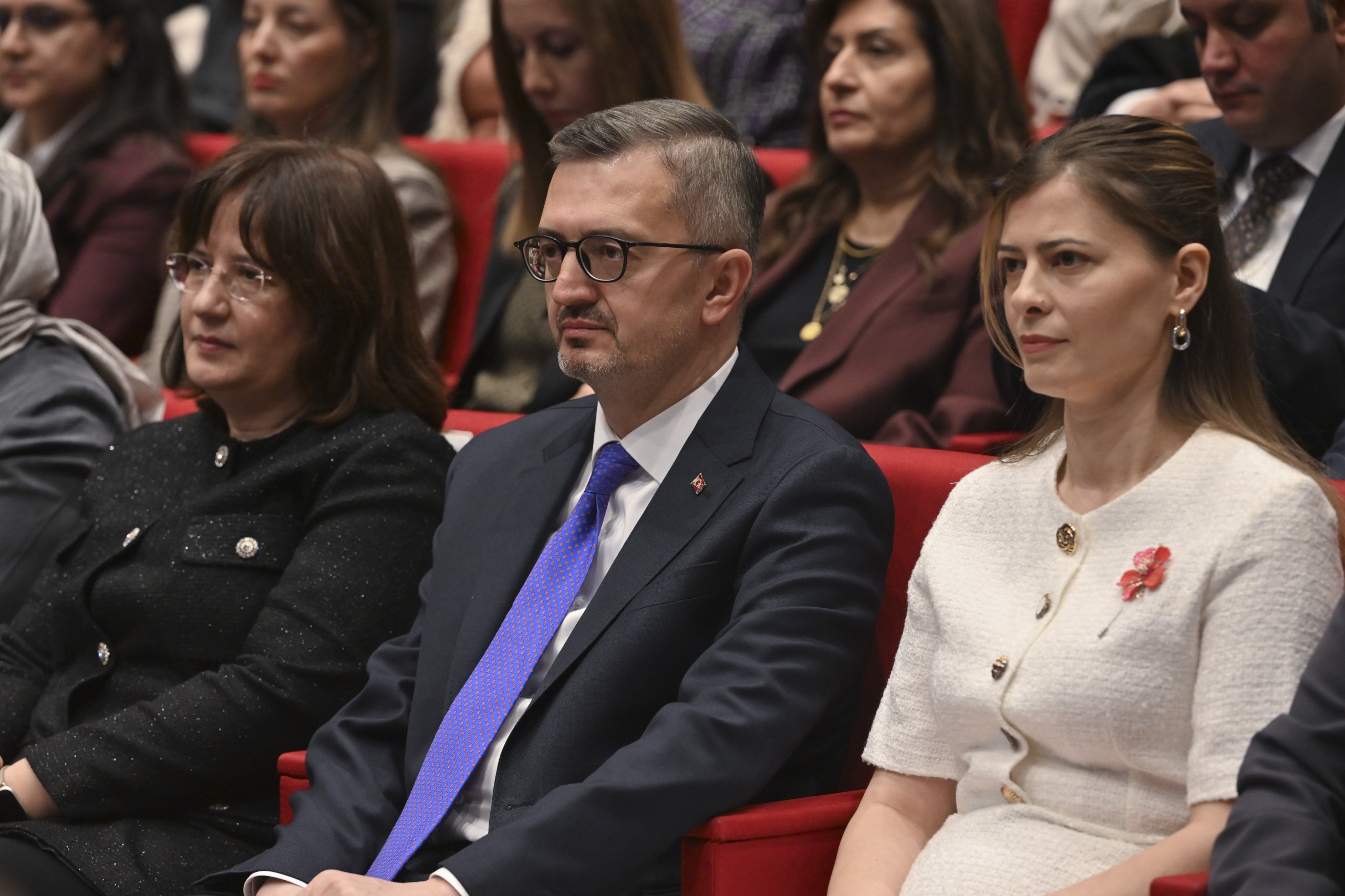
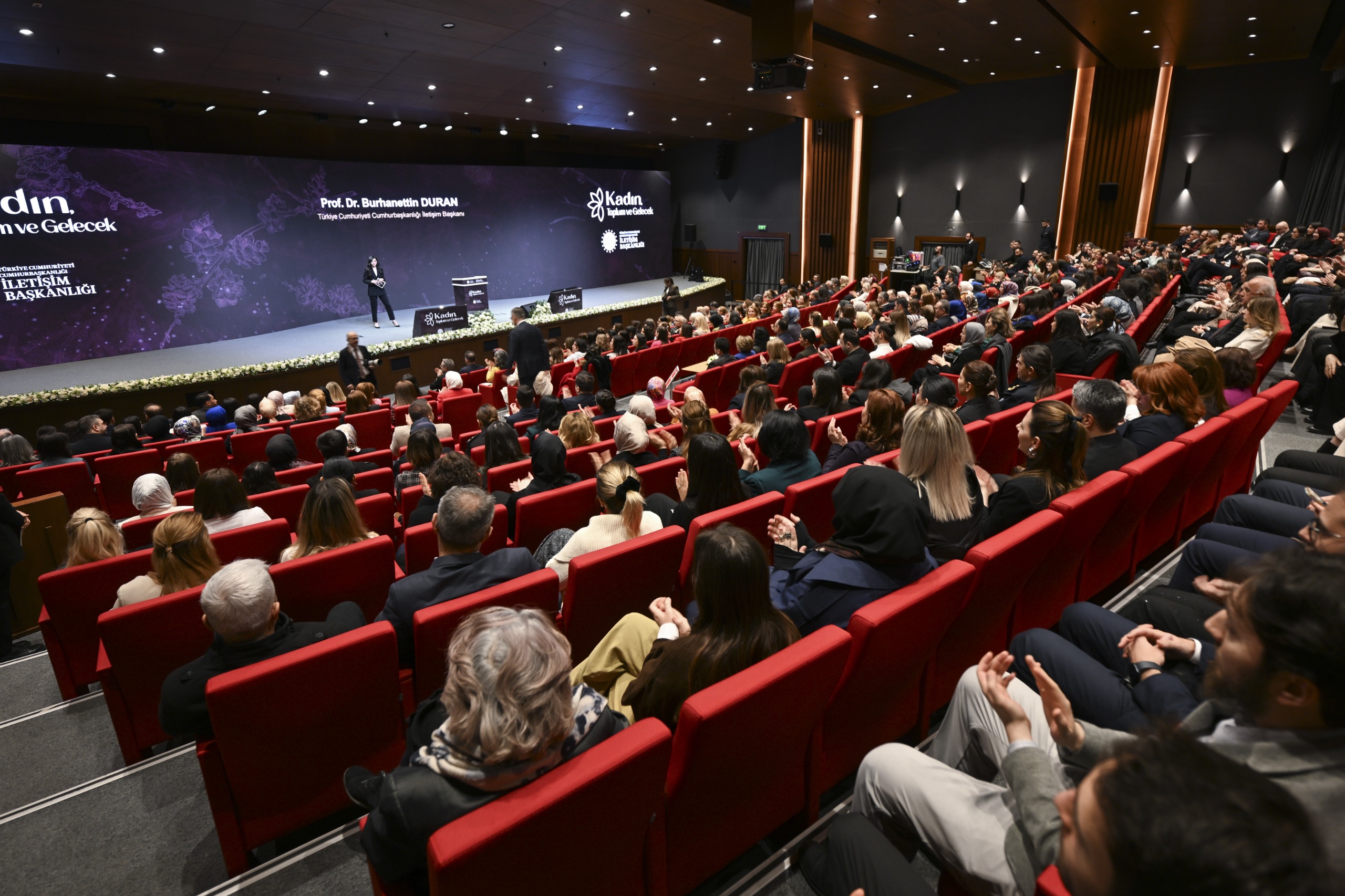
Presidency’s Head of Communications, Burhanettin Duran, delivered a speech at the “Women, Society and the Future” Panel organised by the Directorate on the occasion of 8 March International Women’s Day, where he extended his wishes for a swift recovery to citizens affected by the earthquake that occurred in the Buldan district of Denizli.
Head of Communications Duran congratulated all women on International Women’s Day, whose labour, determination, and contributions to social life enrich life and help shape society, and commemorated, with mercy and gratitude, all women heroes and martyrs who have secured a place in the nation’s material and spiritual memory.
Greeting mothers and women around the world who have been tested by various hardships, from Gaza to Syria, from Rakhine to Africa, Head of Communications Duran congratulated them on 8 March Women’s Day and said: “I also extend my condolences to the grieving Iranian mothers whose children recently lost their lives when their schools turned into graves for them. I pray for Allah’s mercy for those who passed away and patience for their families.”
Emphasising that the concept of women’s rights does not merely refer to the pursuit of legal rights or demands for equality, Head of Communications Duran stated:
“Women’s rights represent a comprehensive and vital issue that concerns every aspect of life and the entirety of society. For this reason, we deliberately chose the title of our panel as ‘Women, Society and the Future.’ Because we do not consider these three elements separately.”
Head of Communications Duran stressed that over the past two centuries, women have waged significant struggles to become visible within the economic order shaped by relations of production, to take a more active role in social life, and to attain equal standing within the relationship between the state and its citizens. He noted that this struggle has not only been about individual rights but has also represented a strong will to build a fair and inclusive social order.
Continuing his remarks, Head of Communications Duran stated:
“At this point, I would particularly like to emphasise the following. The issue of women’s rights is turned into a part of the advertising industry and consumer culture through slogan-driven expressions, and the image of the “strong woman” is brought to the fore through hollowed-out rhetoric, distancing us from the real issues and producing a social illusion. The problems faced by women are too deep and multidimensional to be explained by superficial slogans or popular discourse. Such an approach neither produces solutions to women’s real problems nor contributes to social justice. Therefore, we must approach this issue from a deeper perspective that takes into account our social realities.”
“A significant portion of the 92,000 messages of appreciation submitted to CİMER are directed to women public officials”
Head of Communications Duran noted that making women more visible and active in public life without discrimination is one of their fundamental responsibilities. He emphasised that they carefully listen to every voice from society regarding issues that directly affect women’s lives, including equal pay, maternity leave, childcare facilities, harassment and mobbing.
Within this framework, Duran stated that the Directorate of Communications attaches particular importance to carefully examining applications submitted by women to the Presidency’s Communication Centre (CİMER), one of the mechanisms through which citizens convey their requests and feedback. “A significant portion of the approximately 92,000 messages of appreciation submitted to CİMER throughout 2025 are directed to women public officials. From doctors and nurses to teachers, social service professionals, and security personnel, women working with dedication in almost every field have elevated the quality of public services through their devoted efforts. I would like to take this opportunity to express my gratitude to all of them,” Duran noted.
“We consider violence against women a crime with no mitigating justification”
Head of Communications Duran stated that President Recep Tayyip Erdoğan’s determined, uncompromising and principled stance on combating violence against women has opened the door to a significant transformation in mentality in our country over the past twenty years. Head of Communications Duran noted that, thanks to the legal steps taken and the institutional mechanisms developed, a strong societal awareness has emerged regarding the prevention of violence.
Duran underlined that the state today is far removed from any approach that remains indifferent to a woman seeking help against violence, stating: “The transition from the outdated mentality of the past to the understanding that ‘the state must and will protect its citizens from all forms of violence’ represents a major transformation in social consciousness in Türkiye.”
Noting that for years the state has provided violence awareness and intervention training to thousands of public officials, from law enforcement officers to personnel of the Presidency of Religious Affairs, and from social service professionals to staff in the health and education sectors, Head of Communications Duran said, “We consider violence against women a crime with no mitigating justification. In this regard, through Law No. 6284 as well as initiatives such as the ALO 183 hotline and the KADES application, we are striving to build a society that rejects violence and the language of violence.”
Duran further emphasised that President Erdoğan’s firm stance has also been instrumental in increasing the visibility of women in decision-making mechanisms and parliamentary representation. He noted, “Under governments led by President Erdoğan, Türkiye has had more women ministers than ever before in the history of the Republic. We are also particularly pleased to have our women deputy ministers with us today.”
Highlighting that the proportion of women members of parliament, which stood at around 4 percent in 2002, has steadily increased to approximately 20 percent in 2023, Duran continued:
“In working life, regulations such as maternity and breastfeeding leave, as well as flexible working hours for mothers with young children, have been developed in favour of women. A proposal to extend maternity leave from 16 weeks to 24 weeks is currently on the agenda of our Parliament. Over the past century, we have also recorded very important and positive developments, particularly in the schooling rates of girls.”
Noting that the ratio of female and male students in secondary and higher education today is very close, Duran added:
“In the 2010s, the rate of women aged 25–29 who had graduated from higher education was around 11 percent; in the 2020s this figure has risen to over 40 percent. This success represents a revolutionary leap in women’s education since the founding of our Republic. We did not carry the losses of rights, social injustices, and barriers to schooling and employment that women faced in the twentieth century into the twenty-first century.
Similarly, we have left behind discriminatory practices such as the headscarf ban of the 28 February coup period, which directly targeted women. Women who faced both political and social barriers due to wearing headscarves have now taken their rightful place in the public sphere. The right to stand for election granted to women in 1934 began to be fully realised with the lifting of the headscarf ban in 2014 under the leadership of President Erdoğan.”
Emphasising that “The vision of the Century of Türkiye represents a vision of a Türkiye in which women are protected and empowered in every sense”, Duran stated that efforts will continue with determination to address women’s demands for employment, justice and equal treatment.
He also underlined that the Century of Türkiye will be the century of consolidating women’s legal achievements with structural and sustainable equality of opportunity.
Head of Communications, Duran, went on to say,
“Through its long-standing foreign policy approach based on humanitarian justice and peace, Türkiye also supports women’s struggles for rights and freedoms across different regions of the world. This approach forms the basis of our principled and determined stance against the injustices faced by women in Syria, Yemen, Africa and many other places. In Palestine, where a brutal genocide is taking place today, Türkiye clearly voices its reaction on every platform to the tragedies, particularly faced by women. On the occasion of Women’s Day, I would like to salute the women of Gaza, who have become symbols of resistance, and to commend their dignified stance that has inspired the world. Our hope is that peace will soon be established in all regions affected by conflicts and wars, creating an environment in which women can live their lives with dignity, security and without fear.”
Stating that the Directorate of Communications carries out public communication with an inclusive approach that strengthens social values, Duran expressed his hope that the panel would provide a constructive platform for dialogue among media representatives, public institutions, academia and civil society organisations.
Emphasising that empowering women means empowering society, Duran concluded,
“Women’s role in building a fairer future is indispensable.”
Following his speech, Head of Communications Duran presented flowers and a gift to Yurdagül Girgin, the most senior female staff member of the institution.
At the “Women, Society and the Future Panel”, moderated by Prof. Emine Sare Aydın, speeches were also delivered by Deputy Minister of Interior Kübra Güran Yiğitbaşı, Deputy Minister of Environment, Urbanisation and Climate Change Fatma Varank, KADEM Board Member Sedide Yılmaz Akbulut, and journalist Fadime Özkan.