Head of Communications Duran said, “Türkiye stands firmly against any act that threatens the lives of civilians and violates international law. It is crucial that common sense and reason prevail, that an immediate ceasefire be secured, and that space for diplomacy be created."
The Presidency's Head of Communications, Burhanettin Duran, delivered remarks at the opening of the "Memory and Truth: February 28 and Disinformation Panel", organised by the Directorate of Communications.
At the beginning of his speech, Head of Communications Duran referred to the process directly affecting Türkiye and the region, which began with the U.S. and Israeli attack against Iran and continued with Iran’s retaliations, stating that the process poses serious risks for the region and that the expansion of the conflict in a manner encompassing several countries is concerning. As President Recep Tayyip Erdoğan has also emphasised, Head of Communications Duran underlined that they strongly condemn the attacks that violate Iran’s sovereignty and, likewise, find the attacks directed at brotherly countries in the Gulf to be unacceptable and continued:
“Türkiye stands firmly against any act that threatens the lives of civilians and violates international law. It is crucial that common sense and reason prevail, that an immediate ceasefire be secured, and that space for diplomacy be created. If the relevant countries, actors, and leaders fail to steer the process in this direction and allow the conflict to persist, it is evident that risks will arise, endangering both our region and the world. Our region must not be drawn into a ring of fire. For this, diplomacy and negotiation must be brought to the forefront. As Türkiye, we maintain our contact with all actors, especially the Islamic world, and encourage a return to the negotiation table as soon as possible. We voice our readiness to offer any constructive contribution, including mediation, at every opportunity. We believe that the future of the region and its contribution to global peace will only be through diplomacy. Türkiye will continue to act in line with this understanding.
"28 February has gone down in our history as an intervention that caused deep traumas."
Emphasising that there are certain breaking points in the history of nations, Head of Communications Duran noted that these moments are significant thresholds that leave deep marks in the memory of societies, going beyond political agendas.
Head of Communications Duran said that they gathered not to remember a dark day in recent history but to reevaluate the deep trauma Türkiye experienced from a sociopolitical perspective.
Head of Communications Burhanettin Duran stated that such moments must not be forgotten and should undergo a profound reckoning in society's collective memory, with politics shaped accordingly. Although 28 February may seem like a distant memory to younger generations, he emphasised the importance of preserving this historic day through panels like this one.
Head of Communications Burhanettin Duran emphasised that 28 February is often described as a "postmodern coup", but the term falls short of fully capturing the nature of what occurred. He underlined that the expression portrays 28 February as a case outside the classical forms of coups—as something controversial and ambiguous—and, in this respect, downplays the true character of the coup. Head of Communications Duran went on to say:
“This process on 28 February was a planned, systematic and comprehensive social engineering attempt directed against our nation’s fundamental values, its faith and its will to live together. This intervention, which had an effective political economy and sociology, reshaped the definition of the ‘acceptable citizen’ and deliberately narrowed the space for politics. The aim was to establish a social order dependent on tutelary centres of power. The objective was to turn Türkiye into, in the words of President Recep Tayyip Erdoğan, ‘a country where ballot boxes existed but the national will was disregarded.’ In this respect, 28 February has taken its place in our history as an intervention that produced deep traumas.”
Noting that the putschist mindset, which staged direct coups on 27 May, 12 March, and 12 September, carried out the 28 February intervention through a different method, Head of Communications Duran stated, "The media was wielded as a weapon to legitimise the attempt. Newspapers and televisions of the time were used to manipulate public opinion and deceive and provoke the public with false news." Head of Communications Duran recalled that by the end of the 1990s, almost every home had a television and that it was a time when sources of information were not as diverse as today, and shared the following:
"At that time, spreading disinformation through television was undoubtedly more effective than stationing a soldier at every doorstep. This was, of course, made possible by the voluntary collaboration of certain media outlets and journalists who once saw themselves as a tutelary authority above politics. This voluntary collaboration included bureaucratic elites, capital classes, self-styled intellectuals, certain civil society organisations, and universities. Through fake media operations, masses were manipulated, certain segments of the society were marginalised, and a significant portion of society was aggrieved by journalists and media organisations. We still vividly remember the headlines of that period. Headlines such as 'If necessary, we will even use weapons' and 'This time, let the unarmed forces settle the matter' were featured, targeting the legitimate government.
Yet, the fundamental duty of the media was to enlighten the public, advance the culture of discussion, and even facilitate the formation of public opinion against this tutelary mindset. There were people forced to resign from public service or drop out of education, compelled to pursue education abroad due to the headscarf ban, as well as people who were banned from politics, had their capital frozen, and were barred from conducting business. These struggles, endured by a large segment of society, were not covered by the media outlets. On the contrary, there were only the putschists' bulletins prepared for the purposes of psychological warfare. During that period, the said newspapers had a duty more important than covering the problems of society; their actual duty was to carry out the orders of the junta."
"Millions of our young people had their dreams and futures stolen"
Head of Communications Duran said that through the 28 February process, Türkiye was intended to be deprived of several opportunities that the 2000s would offer and of the right to a peaceful and prosperous future. Noting that the instability caused by the coalitions formed during that period, and further intensified by tutelary pressures, led to the most severe economic crisis in the history of the Republic, Head of Communications Duran stated, "Those who wagged their fingers at our nation and at the popularly elected, legitimate government, warning against a 'reactionary approach' because of their beliefs and values, pushed Türkiye back decades in economic and political terms through the instability they caused.''
Pointing out that the heaviest burden of 28 February was borne by the youth, particularly young women, Head of Communications Duran emphasised that, under the tutelary system, young people were deprived of their fundamental human rights, including the freedoms of education and work, and that their dignity was targeted in the so-called ''persuasion rooms'', the psychological torture centres designed to break their will.
Head of Communications Duran stated, ''The dreams and futures of millions of young people waiting at university gates were stolen due to the unfair coefficient system in university admissions. All these practices demonstrated that 28 February was, at its core, an attempt to erase devout and conservative segments of society from the public sphere, as a form of exclusion.''
''Türkiye was brought to a political and social climate consistent with its core values''
Head of Communications, Duran, emphasised that, throughout history, no movement that has waged war against its own people and succeeded has ever endured, stating:
"The process that was said to 'last a thousand years' in reference to 28 February could only last a few years. With its insight and determination, our esteemed nation was able to completely dismantle the tutelage system in a short period of time. In 2002, the political and social movement led by President Recep Tayyip Erdoğan gained widespread support from the public. Türkiye embarked on an uninterrupted journey to achieve one of the greatest 'silent revolutions' in our democratic history. In the years that followed, many prohibitive regulations, such as the headscarf ban and coefficient system applied in university admissions, were repealed; individual freedoms were expanded through successive democratisation packages, and Türkiye was brought to a political and social climate consistent with its core values."
"We hold these commemorative events out of the responsibility to prevent any repetition of such interventions"
Head of Communications Duran stated that today, as a nation, they have completely left behind the tutelary, prohibitive, elitist mindset that sees itself above the people and have stepped into the "Century of Türkiye" under the leadership of President Erdoğan. He conveyed that the Century of Türkiye is a century of a new social contract based on national will, where civilian, inclusive, fundamental rights and freedoms are guaranteed. Head of Communications Duran noted that one of the foremost tasks of the Century of Türkiye is to crown these achievements with a new constitution that is civilian, freedom‑oriented and inclusive, adding that, as President Erdoğan has stated, such a constitution is not a luxury for Türkiye but a long-delayed necessity.
Head of Communications Duran stated that the vision of the Century of Türkiye embodies a perspective of robust national unity and solidarity, where no one is excluded on account of their faith, origin, or way of life; every member of the nation is recognised as first-class; and diversity is embraced as a source of richness.
Head of Communications Duran said, “We must never forget the heavy costs and the arduous struggles through which we earned the climate of freedom we enjoy today as a country, as well as our position as a strong actor at the regional and global levels. As the Directorate of Communications, we will resolutely continue our efforts to ensure that the media and digital platforms never again return to the dark days of the past, when headlines toppled governments and false news and disinformation were used to manipulate public opinion through attempts at social engineering."
Head of Communications Duran stated that, under the leadership of President Erdoğan, the Directorate of Communications works tirelessly, day and night, with all its units to strengthen the front of truth and counter lies and disinformation with all its might.
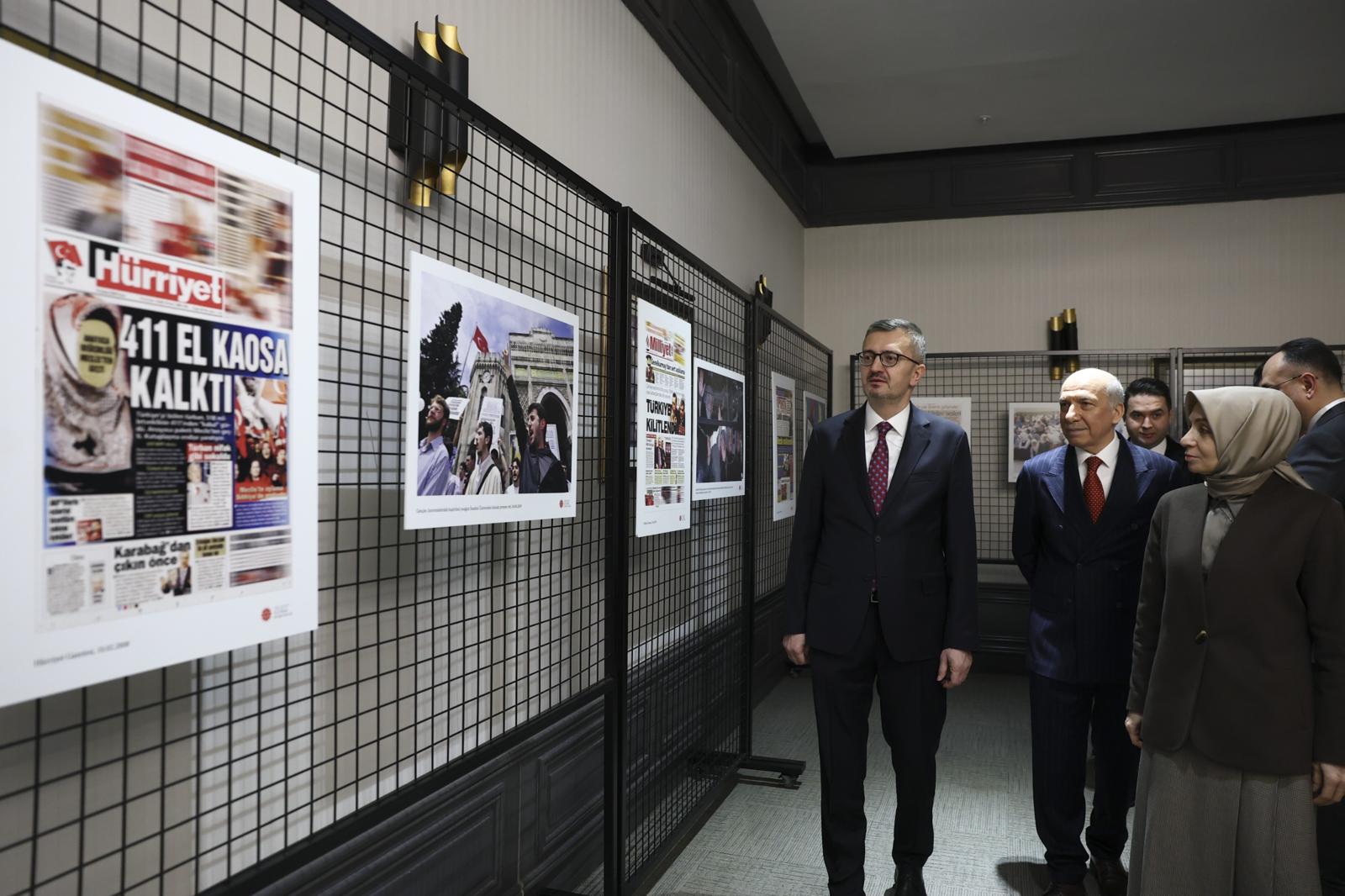
Head of Communications Duran underlined that particularly with regard to 28 February and 15 July, they organise numerous events – including publications, exhibitions, panels and forums – to ensure that the treacherous coup attempts are neither forgotten nor allowed to be forgotten, adding, “We hold these commemorative events not with a sense of revenge but out of the responsibility to prevent any repetition of such interventions.”
TRT Director General Zahid Sobacı and Anadolu Agency Deputy Director General and Editor-in-Chief Yusuf Özhan also attended the panel.