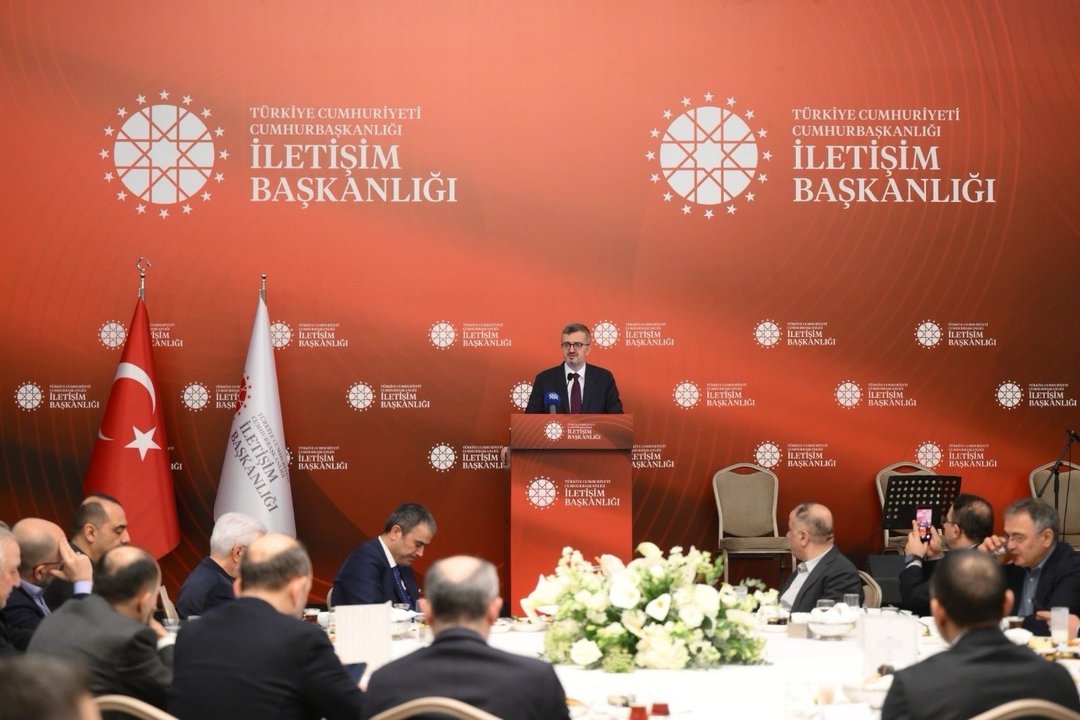
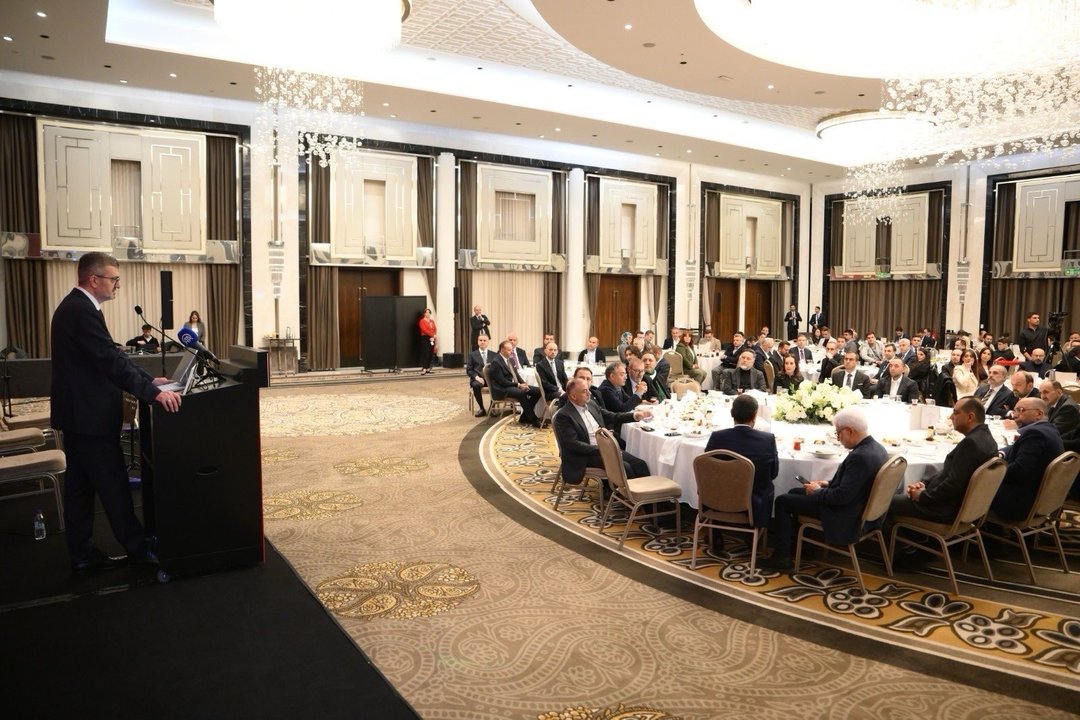
Speaking at an iftar dinner held in Istanbul for the İstanbul representatives of media outlets and presidential correspondents, organised by the Presidency’s Directorate of Communications, Head of Communications Burhanettin Duran stated that the holy month of Ramadan is a period for Muslims marked by self-reflection and a rise in acts of worship, and that it is also a time when solidarity and mutual assistance become more visible at the societal level.
Head of Communications Duran said, "Unfortunately, during this month, we are also witnessing troubling developments. We live in an age in which oppression has become normalised. The fact that conflict, bloodshed, tears and war have coincided with the month of Ramadan is, in itself, a source of sorrow for us. While people gather around iftar tables in some places, lives are tragically being shattered across many parts of the world. This is not merely about war. In fact, our fundamental problem as humanity is the loss of compassion. It is the loss of the will to live together and the will to resolve disputes through diplomacy. I believe this represents a very serious loss.”
Noting that a war marked by continuous air strikes has been unfolding for the past two weeks in Türkiye’s immediate neighbourhood, Head of Communications Duran said, "At this point, discussions are focused on when this war might come to an end. However, the point on which we agree is that the possibility of the war being prolonged, continuing in new modalities, and seriously destabilising the region, unfortunately, remains very real. What we are witnessing is that as the fire in the Middle East grows, global institutions are shrinking. The international order established after the Second World War is steadily losing its moral authority and diplomatic credibility. This order not only faces political and military problems. It also suffers from profound problems in terms of rules, morality and diplomacy.”
Emphasising that the critique of the international system launched by President Recep Tayyip Erdoğan with the phrase "The world is bigger than five" has become even more justified today, Head of Communications Duran noted that the world is currently witnessing a period in which diplomacy is being instrumentalised and a normative collapse is unfolding. He expressed deep concern about the institutionalisation of lawlessness, citing its impact on debates about the direction of the international system and the escalating uncertainty.
Head of Communications Duran noted that certain international organisations have been unable to fulfil their functions and that some powerful actors, such as the European Union, from whom action had been expected, have also failed to assume a mediating role and to demonstrate the capacity to produce solutions.
Stating that Israel’s aggressive posture, which disregards international law, has been escalating day by day, Head of Communications Duran continued his remarks as follows:
"From Türkiye’s standpoint, it is clear that the attacks carried out by the United States and Israel are unacceptable and that launching an attack against another country on the grounds of regime change is equally unacceptable. However, there has long been an issue that Türkiye has consistently emphasised. Countries in the region should resolve their own problems among themselves. We should establish the order of this region ourselves. This has a very clear meaning. An order established by external actors has not brought us opportunities; on the contrary, it has resulted in very serious problems. Therefore, the order needs to be established by the countries of the region. Unfortunately, we must say that some actors are not cooperative in this matter. Competition has not given way to solidarity. When we look at the situation today, the fact that Iran is being struck by the attacks of the United States and Israel and that Iran has directed its retaliations toward the Gulf countries is actually a 'lose–lose' for the region. In this sense, moving toward a situation in which Israel could take on a greater regional role in the future and, in some way, force many actors to conform to its own security understanding would not be a good direction at all."
"There are lessons learned from this war"
Head of Communications Duran stated that the shocks experienced have not only affected oil prices; security now begins not only at the border but also in the airspace, in the markets, in ports, and on screens. In such a situation, he said, no one can isolate themselves.
Emphasising that all these developments must be closely monitored, Head of Communications Duran said that the leader-to-leader diplomacy demonstrated by President Erdoğan from the very beginning has been aimed at extinguishing this fire.
Pointing out that the issue also has a dimension of sectarianism and ethnic discrimination, Head of Communications Duran said, "Especially as actors in the media world, this is one of the issues to which we must pay careful attention. Of course, our country and geography are home to a shared civilisation shaped by centuries of accumulation. In this sense, we should not feed or fuel the discord that comes from outside and does not belong to us."
Head of Communications Duran noted that some people in Türkiye have attempted to agitate the attacks against Iran within a Sunni–Shia context. He stressed that this issue should not be carried forward through sectarian or ethnic discrimination or through hostility, and the messages delivered by President Erdoğan in his speech the other day were crystal clear.
Head of Communications Duran said, "Despite the ongoing tensions, wars, and crises in our region, thanks to Allah, Türkiye continues to maintain its identity as 'dar es salaam', that is, a 'country of peace’."
Drawing attention to the policy being pursued in domestic politics to strengthen the internal front through the "Terror-Free Türkiye" process, Duran stated, "Those who cannot resolve their own internal problems cannot resolve problems abroad. This means that Türkiye must present and realise a state vision that is resilient both in terms of capacity and as a society."
Head of Communications Duran stated that, as the Directorate of Communications, they strive to convey the state's policies, activities, and vision, noting, "It is very valuable for the news to be accurate, swift, and reliable. In this sense, your contributions are quite important. I should say that I think our press members have performed very well during this recent war. I thank you both for the cooperation you have shown, for the sense of public responsibility you have demonstrated, and for the responsibility you have displayed in your broadcasts."
Head of Communications Duran stated that they remain in constant contact with press members as the Directorate of Communications and work to address the problems faced by journalists, and continued:
"On the other hand, the issues of the homeland. Since this is the ship we all live on together, we must work together if this vessel is to provide safety and stability to other places in a strong way. We must act with a profound sense of responsibility. I would like to express my appreciation for what you have done and the efforts you have shown, especially on this Ramadan evening and at this iftar gathering. Of course, you are all well aware of how certain manipulations and misinformation could complicate this situation if it weren't as it is.
"We need to find a way to control how quickly disinformation and manipulation spread"
Emphasising that "speed" is a crucial factor, Head of Communications Duran said, "We uncover the truth, but we need to do so more quickly. We need to find a way to control how quickly disinformation and manipulation spread. I must say, however, that the complex nature of social media can sometimes cause doubt, and in such cases, it is far more effective when our television stations, newspapers, colleagues working on online platforms, or responsible YouTubers stand on the side of the truth."
Head of Communications Duran added:
"Screens will no longer serve merely as platforms for conveying information; they are increasingly turning into a battlefield. We have seen how effectively this can be achieved through algorithms or the new tools of artificial intelligence. Because wars start first in the public consciousness, not on the ground, they begin on our screens, and once fear spreads, trust erodes, and solidarity and unity break down, they can become extremely effective. You are closely observing the domestic debate surrounding certain arguments about Türkiye, particularly those circulating on social media or originating abroad. In other words, simulation videos resembling missiles and tanks, specific types of artificial intelligence content, and coordinated propaganda networks are far from harmless. For this reason, we are closely monitoring these developments. I am well aware that you also approach this matter with great sensitivity. It would be fair to say that the struggle in the information sphere has effectively become one of the key components of national security, whether we like it or not.”
Head of Communications Burhanettin Duran noted that every effort is made to respond to the ill-treatment sometimes faced by journalists working on the ground and in conflict zones, emphasising that the state of the Republic of Türkiye stands behind every journalist who remains committed to pursuing the truth and serves as the voice of the oppressed and the rightful.
Citing certain issues faced by members of the press, Head of Communications Duran said, “Among our key concerns are the low wages of our press members and the migration of advertising to the virtual and digital realm. We are conducting efforts on these issues and are engaged in a rigorous investigation to explore possible solutions. In addition, as the Directorate of Communications, we are committed to supporting you in a variety of capacities, including the issuance of press and press traffic cards, accreditation procedures, coordination of media activities at national and international events, and providing on-the-ground guidance and information."
Head of Communications Burhanettin Duran said that the assistance initiative launched with the issuance of press cards to journalists working for news websites and in digital publishing has also brought measures such as granting press cards official identity card status, issuing permanent press cards to journalists with 18 years in the profession, and setting up press desks, press centres and press trucks during disasters and crises.
“Surely, these measures are not sufficient. I am fully aware that much more remains to be done. As Head of Communications, I must continue to put in significant effort. This is an inherent requirement of this dynamic world, which you understand far better,” Head of Communications Burhanettin Duran said.
Furthermore, Head of Communications Duran shared a post on his NSosyal account regarding the iftar dinner, noting:
“It was a great pleasure to meet with our esteemed members of the press at the iftar dinner we had held in İstanbul.
In our capacity as the Presidency’s Directorate of Communications, we strive to communicate our state’s efforts, policies, and vision to the public accurately and effectively. It is essential that news be delivered accurately, swiftly, and reliably throughout this process.
In this respect, the contributions of our press members are extremely valuable. I would like to highlight that our press members have performed exceptionally during the most recent war.
The Directorate of Communications attaches great importance to maintaining constant contact with press members and addressing the issues they encounter.
We are undertaking comprehensive efforts to ensure that the advertising sector, which plays a key role in strengthening the professional rights of journalists, improving working conditions, and supporting the sustainability of the media industry, operates smoothly.
We will continue our efforts with determination to ensure transparent, swift, and effective communication across all elements of our media."