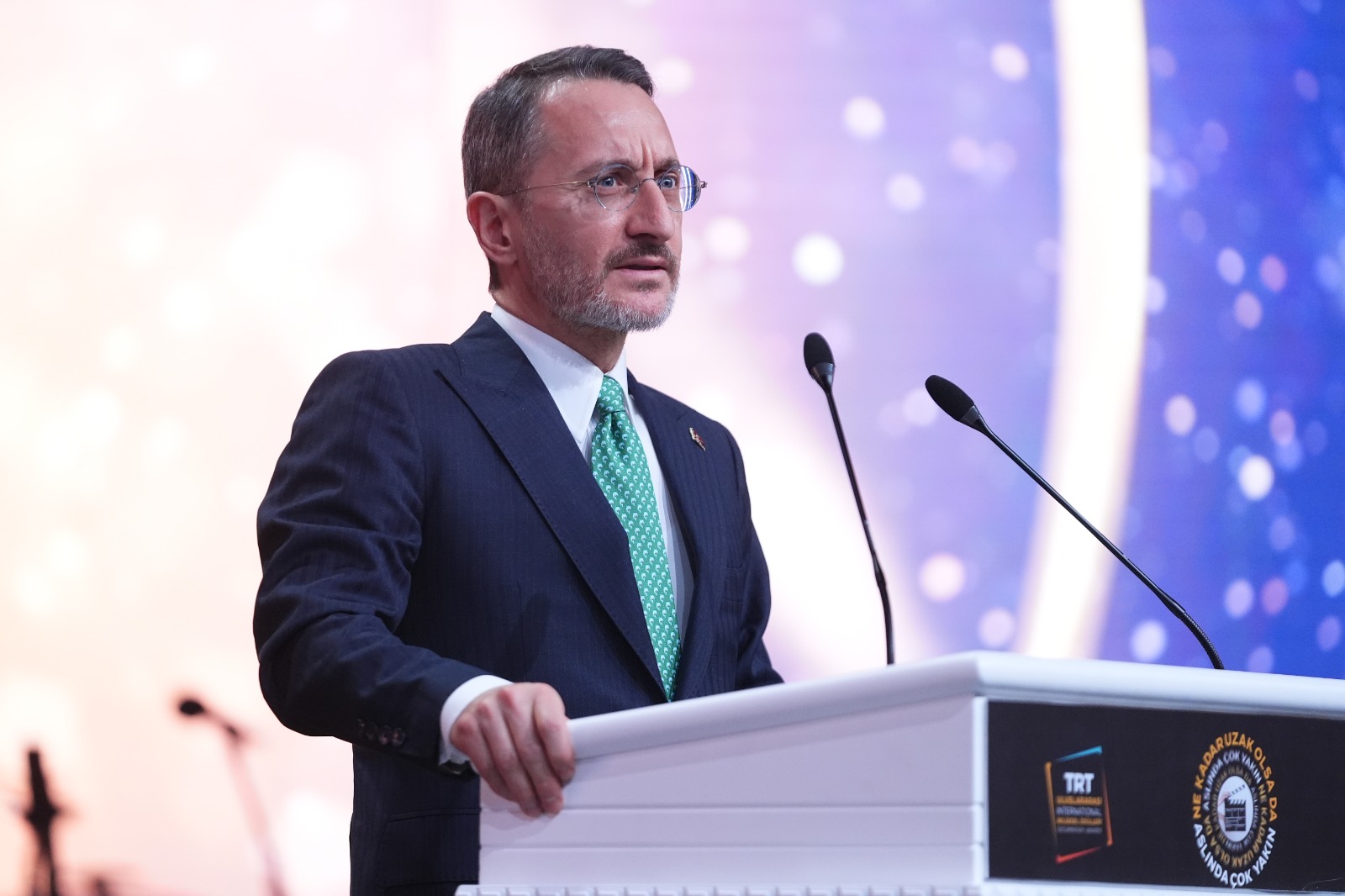
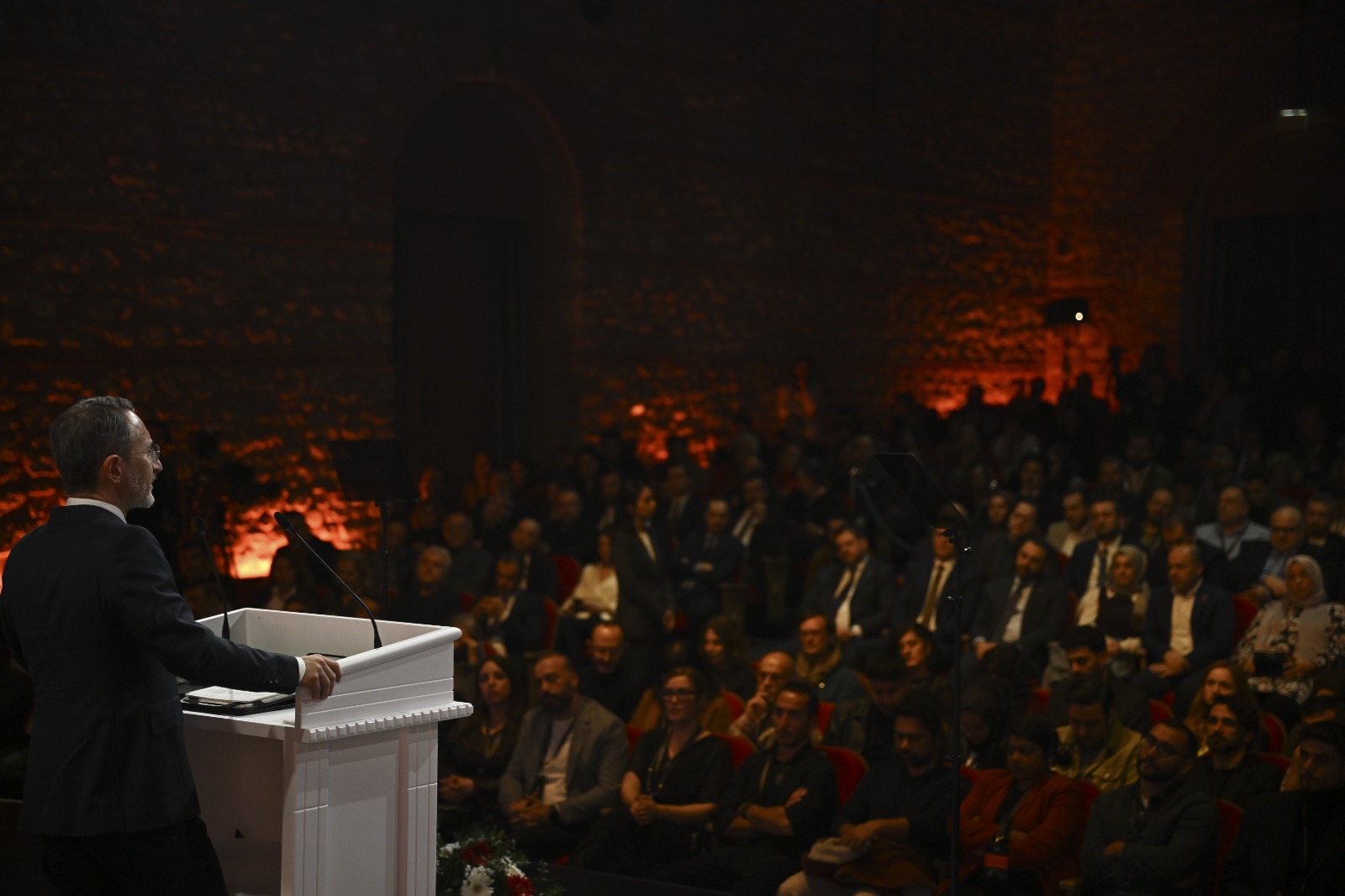
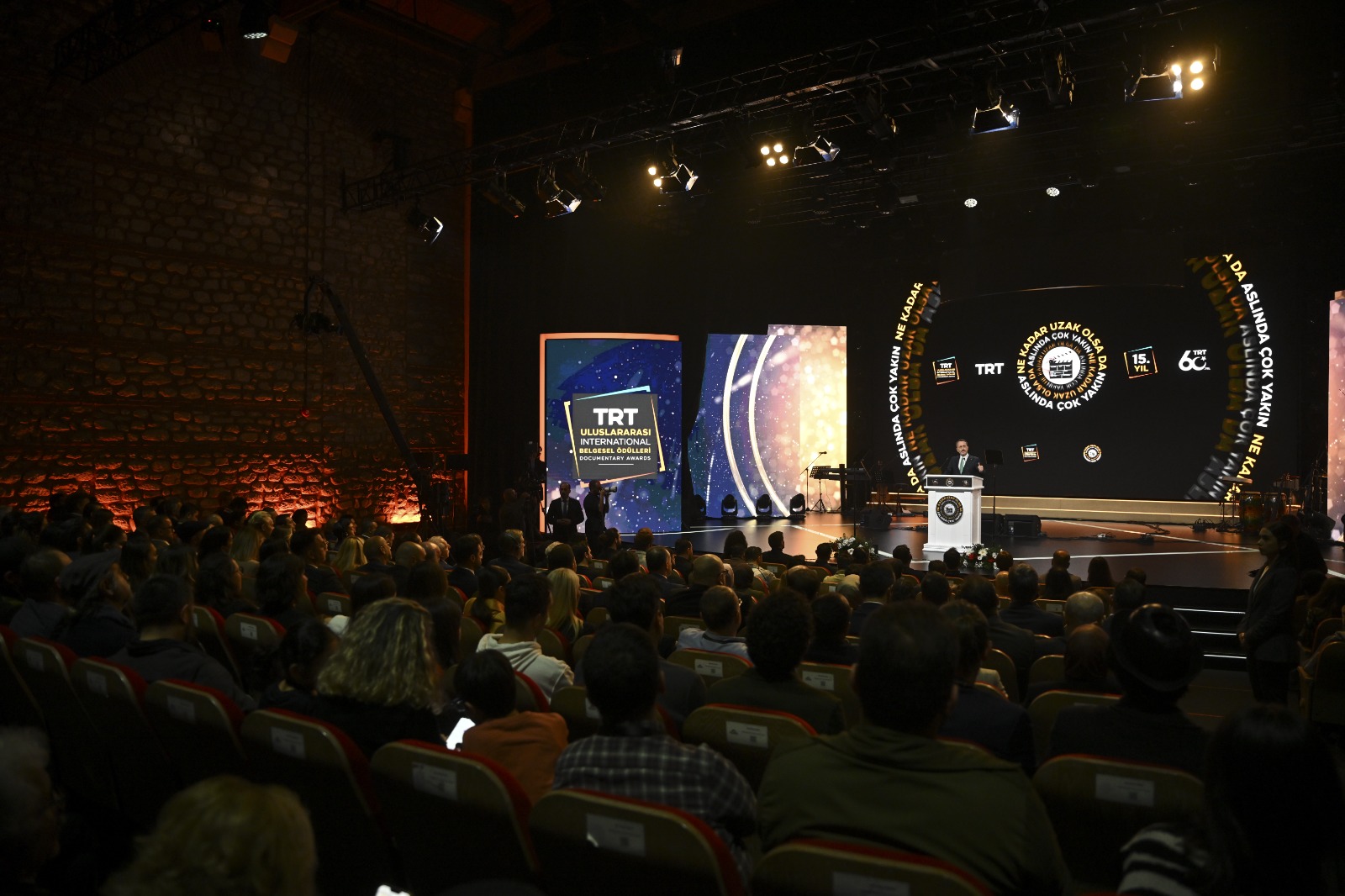
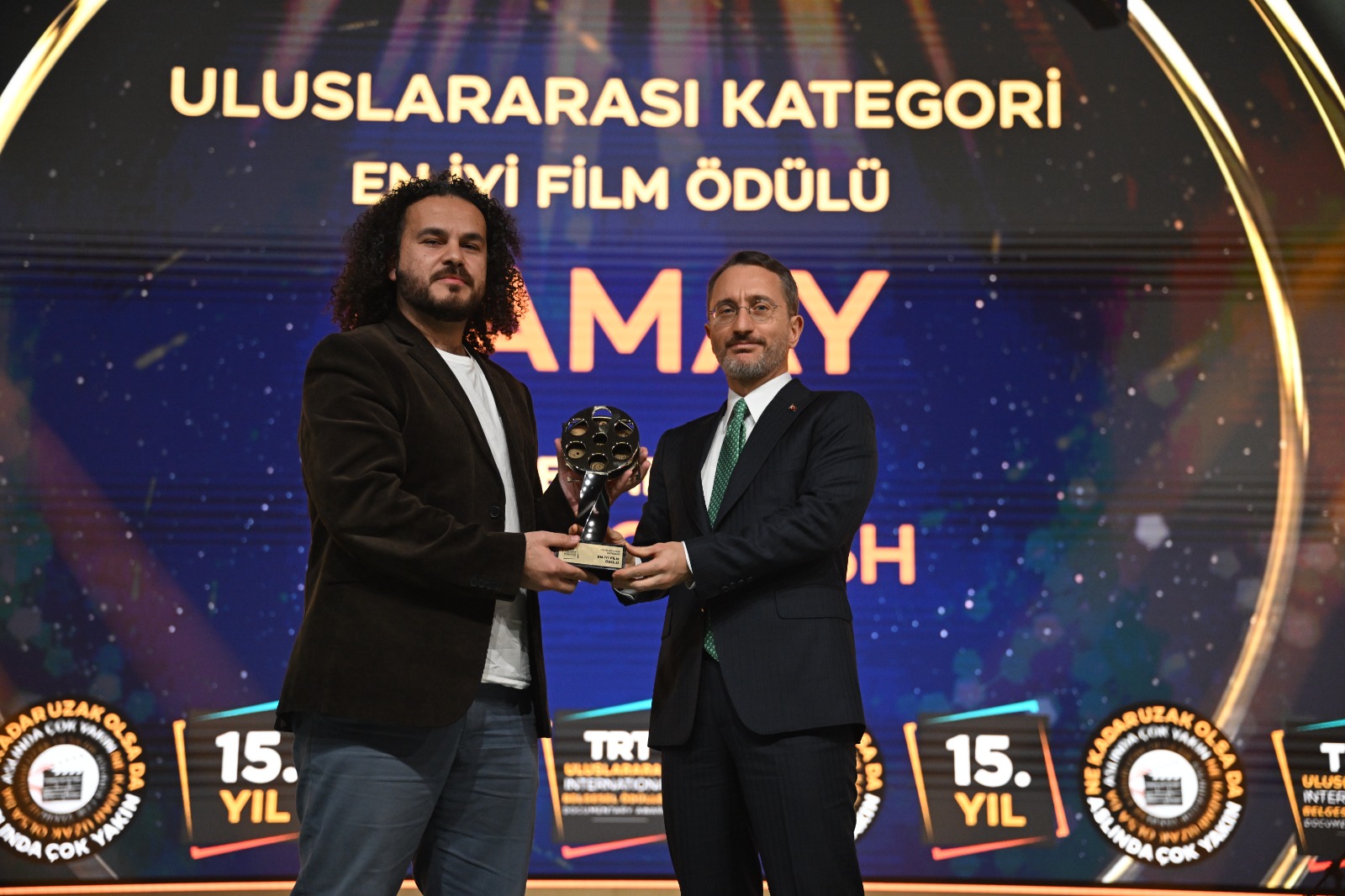
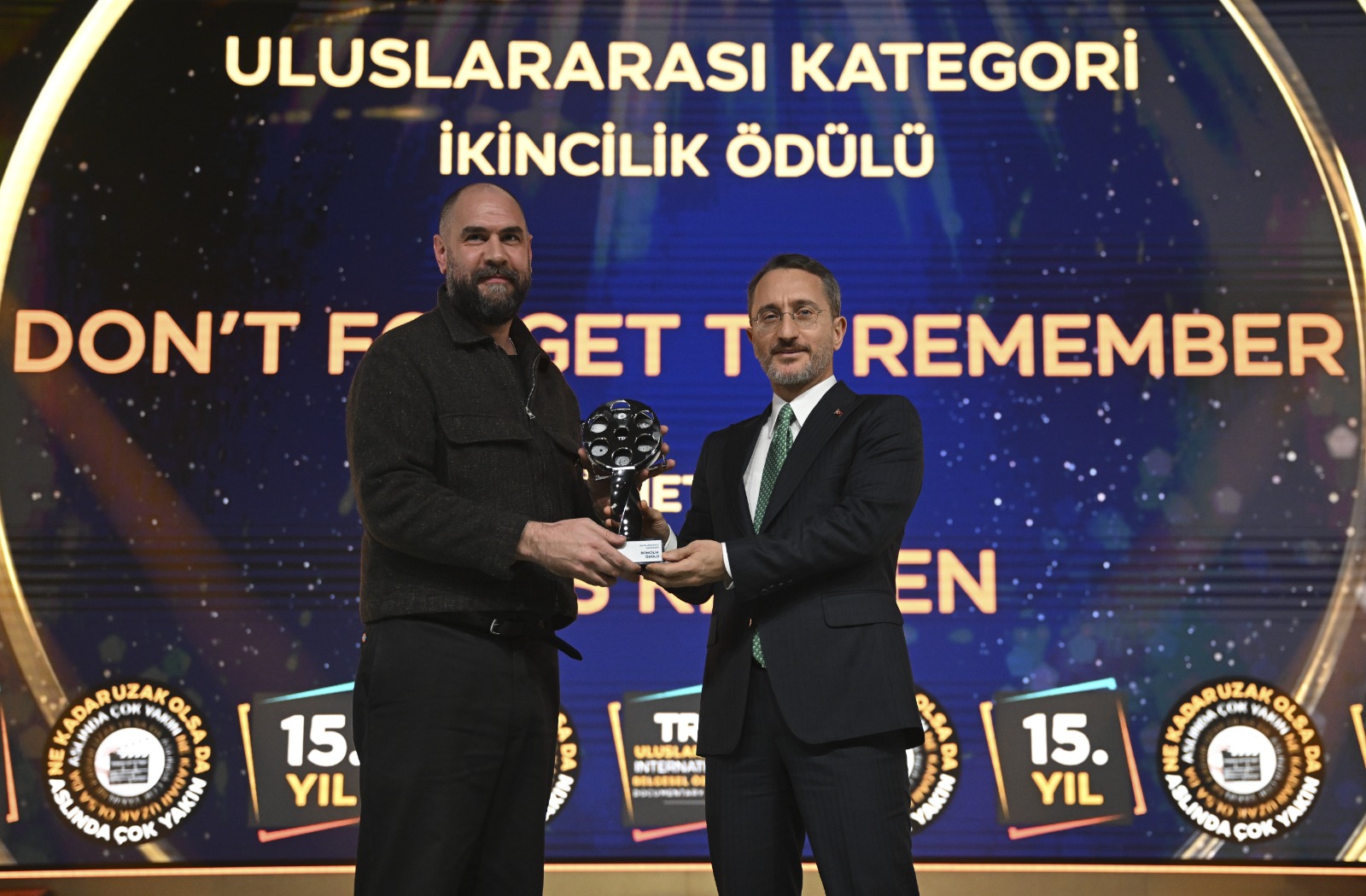
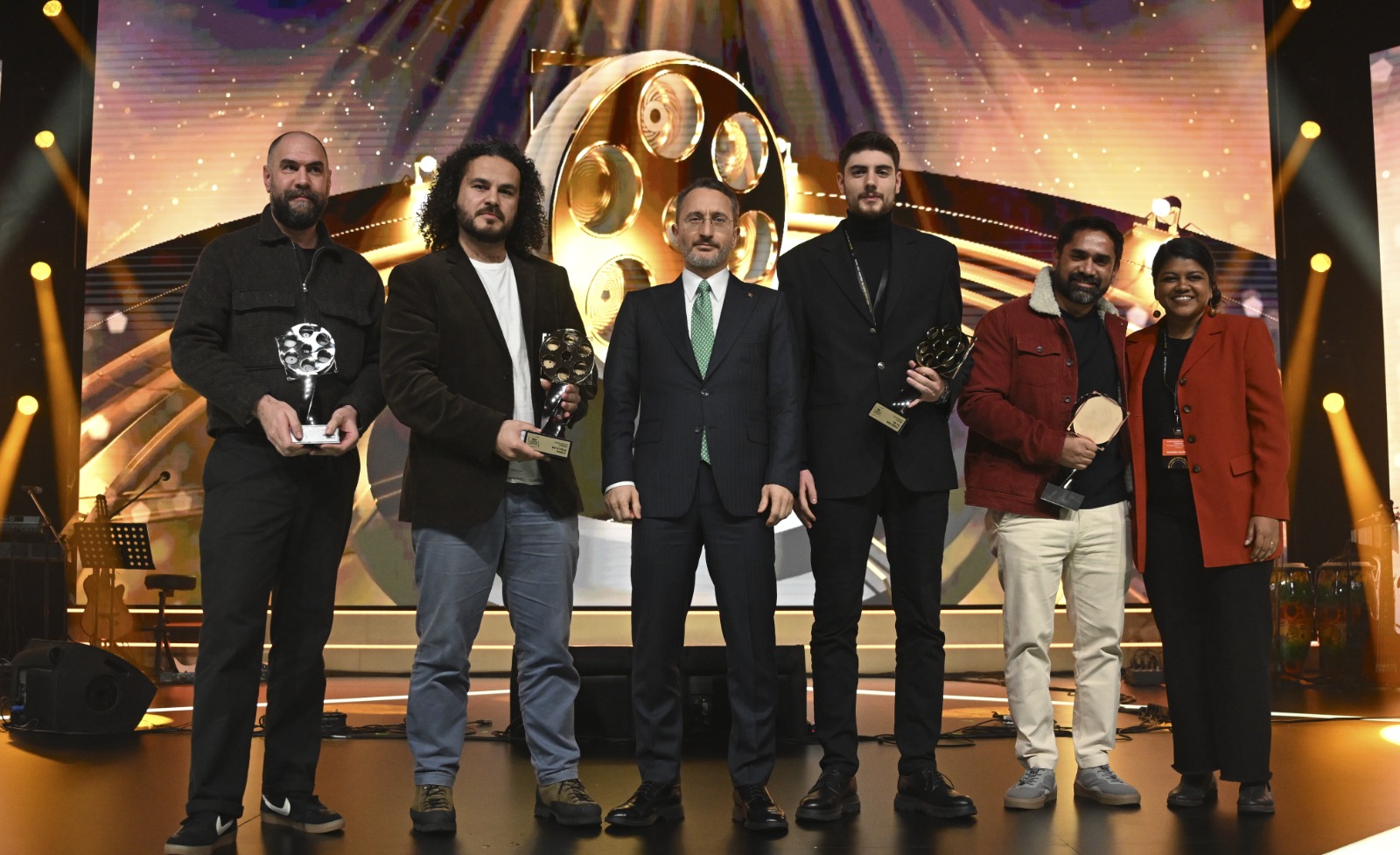
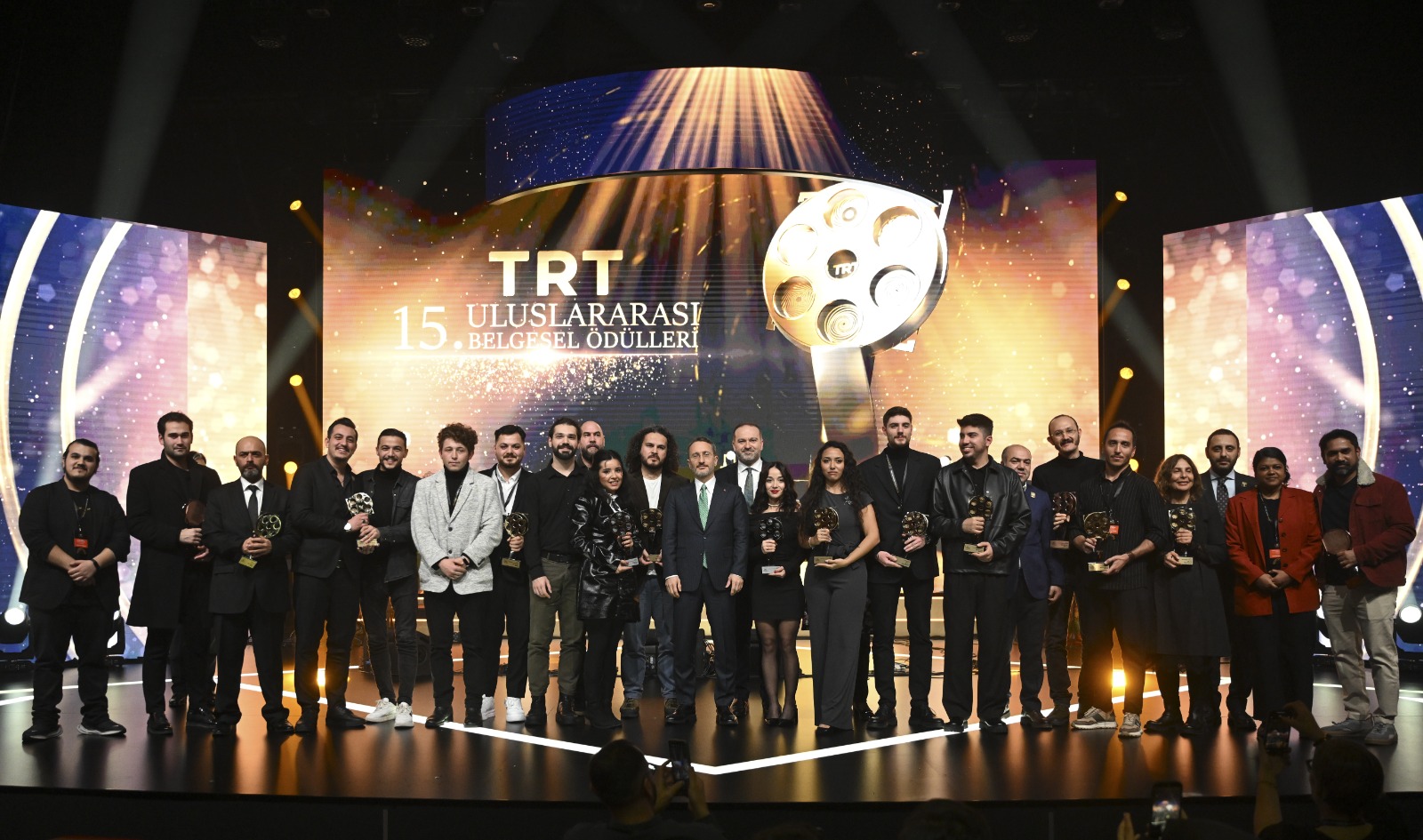
During his speech at the '15th TRT International Documentary Awards' gala event held at Fişekhane, Presidency's Head of Communications Fahrettin Altun expressed his pleasure at attending the ceremony, which TRT organised for the 15th time as part of its ‘global broadcasting mission’ to support documentary producers and professionals and to ensure international productions reach a wide audience.
Head of Communications Altun stated that this year's event, organised under the slogan ‘So far yet so close,’ was a significant occasion to give due recognition to documentary filmmaking, the value of which is better understood in an age of confrontation with threats such as war, conflict, climate crisis, hunger, and crimes against humanity.
Emphasising that documentaries, which provide audiences with 'documents,' that is, 'evidence,' are not merely productions for the silver screen or television but also a vital component of public diplomacy, an essential instrument of soft power, Head of Communications Altun said:
"Particularly in this era and especially in this region. There is no need to delve into the distant past; let us simply consider what has happened over the past year. Had the cameras not been recording, we would not have witnessed the tragedy, brutality, horror, and crimes against humanity in Gaza, nor would we have been able to feel that profound suffering as it is. Let us consider what has happened just in the past week. Had cameras not been rolling again, we would not have been able to document the unimaginable torture that went on for decades in Sednaya Prison in Damascus. Similarly, we would not have been able to see the joy and tears of happiness of those returning to their homeland after many years, nor would we have witnessed the endless smiles of those grateful for the end of oppression."
"Only Türkiye embraced those oppressed people when no one else did"
Head of Communications Altun continued:
"If one day Netanyahu and Assad are held accountable before the judiciary as criminals against humanity, which I firmly believe will happen, it will be journalists and documentary filmmakers who guide the judiciary, present the most important evidence, and document that atrocity. In particular, the documentary filmmakers of oppressed geographies. What leads me to express this so clearly is nothing other than the 'indifferent' attitude of the Western media towards Palestine, Lebanon, and Syria, all the murders, violations, torture, and cruelty. It all happens while we're alive. Before our eyes, as the poet says, 'It all happens while we're alive; the storms rage while we're alive.' Unfortunately, so many atrocities that will be recorded in history are occurring as we live, and we are witnessing them."
Reflecting on the many tragedies they have witnessed, Head of Communications Altun mentioned the haunting image of baby Aylan's tiny, lifeless body washed ashore, alongside the sorrowful words of a five-year-old girl who, having lost her mother, father, and siblings in the bombardment, said, "I will complain to Allah about all of you."
Head of Communications Altun continued:
"In the hell of Sednaya, we also saw the silence of innocents who were kept in pitch-black tunnels for 20, 30, or even 40 years, living on bread and water, even forgetting how to speak. We have witnessed them in this world. Moreover, we have also seen the dark mentality that tells people who are deprived of a homeland, who have nowhere to go, nowhere to take refuge, to ‘Be gone’. But we know that 'Time is the master.' Remember, when no one was standing by the oppressed and their suffering was deepening day by day, it was only Türkiye that stood by them. Remember the inflatable boats that were shot at and sunk in the Aegean and Mediterranean; remember the refugees who were beaten at the border gates; remember the crying babies and those who lack the compassion that make those infants cry. It was 13 years ago, on the very first day, that our President said, ‘We will open our doors to our brothers and sisters.' Then he said, "Men sabera zafera," that is, "Victory is for the patient." When the Assad regime was overthrown and the border gates were opened for the return to freedom this time, our President said this once again. Indeed, time, the master who mends all things, has granted victory to those who are patient. What remains is the cruelty of those who tell the oppressed, those who have lost their homeland and are desperately clinging to life in Türkiye, their last refuge, to 'Be gone.'"
"Türkiye will prioritise the protection of Syria's unity, unitary structure and territorial integrity"
Head of Communications Altun noted that in the last 13 years, under the leadership of President Recep Tayyip Erdoğan, the Republic of Türkiye has opened its doors wide to the oppressed, and if there were any political risks in the process, it has embraced those risks fully, and said, "In such a difficult period when populism has surged, racism has captivated the Western world, and xenophobia is on the rise, our nation has welcomed its Syrian brothers and sisters with a kindness that will be written in golden letters in history. Now, a brand new life begins in Syria, our neighbour with whom we share the longest land border of 911 kilometres. Türkiye will stand by Syria, heal its wounds, and contribute to its development with all its strength, as it has done throughout history and particularly in the last 13 years. As it did in the past, Türkiye will prioritise the protection of Syria's unity, its unitary structure, and its territorial integrity today and in the future."
Stating that President Erdoğan has made explicit statements on this issue, Head of Communications Altun noted that the President presented a very clear picture of Syria in his speech following the last cabinet meeting. Head of Communications Altun said, "He underlined the statement, 'In Syria, an environment must be created in which the unitary structure is preserved and a social framework is established where all ethnic, religious, and sectarian elements can live together in peace.' Within this framework, we will exert our best endeavours to ensure this. We will continue to mobilise all means at our disposal to ensure that terrorist organisations do not exploit the vacuum that has been created or that could potentially be created.
"There were attempts to portray Türkiye as an anti-refugee country"
Stating that the media has also given a significant test in the last 13 years and that it has successfully passed this test, Head of Communications Altun said:
"Instead of using provocative language during this process, our media has employed a calmer, more inclusive tone that respects the rights of our refugee brothers and sisters in Türkiye. But unfortunately, we regret to see that a section of our media was in an effort to use provocative language. Even if the perpetrators of that provocative language repent now, it is too late. It is too late because the harsh language of recent years has unfortunately had negative consequences. There were even attempts on the international stage to portray Türkiye as an anti-refugee country. There were attempts to organise provocations against our refugee brothers and sisters. However, none of the attempts were successful. These provocations were averted thanks to our nation's wisdom, our President's strong leadership, and our government's efforts. Unfortunately, our state and nation were the targets of black propaganda campaigns during a period in which our state was particularly sensitive to the plight of our refugee brothers and sisters, and our nation made significant sacrifices. But they did not succeed, either. We have once again observed that those who promote peace, stability, unity, and integrity have emerged victorious."
Head of Communications Altun stated that documentaries are tools that illuminate reality, focus on social, cultural, and political events, and tell powerful stories about various issues, while emphasising that although documentaries bear witness to reality, the method of doing so must be built on ethics.
Head of Communications Altun said that in a place where ethics are ignored, the documentary does not witness the truth but creates a new fictionalised reality and continued:
"As the world-famous screenwriter and director Jean-Luc Godard said, 'A camera pan is ultimately a moral issue for me,' and 'The real director does the editing in the camera,' he highlighted the importance of telling the truth and how it cannot be told without an ethical framework. Documentaries' realities are similar to examples of fictional cinema in that they present an aestheticised version of reality, despite the fact that they are not fictional. Materials such as music and images are subjected to montage, a type of editing similar to that used in fictional cinema, in order for the content to form a specific narrative. John Grierson, the first individual to coin the term 'documentary' and one of the pioneers of documentary cinema, once said, 'Everything is beautiful when it is arranged in the right order,' and 'Stories and materials taken from their true source are much more perfect.' He clearly distinguished between documentary and studio-produced motion pictures."
Emphasising that a genre such as documentary, which is seen as a historical record, should not break away from the truth and that the common values and interests of humanity should always be at its centre, Head of Communications Altun said, "A stable future of freedom, justice, and prosperity necessitates either the development of robust tools to identify lies or a shared understanding to guarantee that we never deviate from the truth."
Head of Communications Altun stated that TRT's productions significantly contributed to the country's cultural, political, diplomatic, and social image and reputation management as a public diplomacy actor by bringing Türkiye's history, cultural and natural riches, the potential of its human capital, and Türkiye's attitudes and policies against global challenges to the international community's agenda.
"Telling the truth in plain language has become a vital task"
Emphasising that in this post-truth era, the critical role played by documentaries is needed more than ever, Head of Communications Altun continued his words:
"At a time when the line between truth and falsehood is becoming increasingly blurred and the poisonous seeds of disinformation are being used to sow instability and insecurity, I believe that the efforts of responsible producers and directors are invaluable to the future of the struggle for truth. The voice of truth is no longer easily heard in regions where humanity faces significant challenges, such as Gaza and Syria, as I have just emphasised in detail. In an age when reality is distorted and there are multiple versions of it, telling the truth in plain language has become a vital task. Recording, documenting, and publicising issues, injustices, and distortions influences both the present and the future. Documentaries have the power to engage viewers with complex issues by presenting them in a visually compelling and convincing manner. From a journalistic standpoint, documentaries provide unique perspectives on issues that may not receive enough attention in the news format, allowing them to be addressed in depth and human stories to be shared."
Stating that it was of unique value for the witnesses of reality to be able to tell their own stories and make a note in history through documentaries, Altun said that there was a powerful force that transcended cultural and geographical boundaries and that documentaries, as storytelling tools, contributed to the enlightenment of complex problems and issues by mobilising the global conscience, showing what is not shown, and speaking for the silenced.
Head of Communications Altun stated that documentary films recorded reality, brought neglected issues to the forefront, and raised national and international awareness and also shed light on a variety of issues such as human rights violations, environmental problems, difficult life stories, and conflicts, allowing different voices to be heard globally.
"Documentaries also advocate for truth by inspiring viewers to take action"
Highlighting that through documentaries, people could see the sufferings of societies they do not know and become aware of injustices they have not heard about, Head of Communications Altun said:
"Another power of documentary films is that they help us understand that human values and truth are valuable to everyone, regardless of religion, language, or race. But documentaries do not just reflect reality. Documentaries also advocate for truth by inspiring viewers to take action. In this way, it sets the agenda and shapes public opinion on an international scale. Just as it is here today. Let us not forget that the International Documentary Awards is a platform that promotes documentaries and documentary filmmakers, gaining global attention. This is an important achievement. I congratulate all my friends who played a role in this success and all the employees of TRT."
The Director General of TRT, Zahid Sobacı, also delivered a speech at the premiere. The event was attended by Oğuz Karakaş, AA Publications and Productions Coordinator, and guests from the political, cinema, and artistic communities.