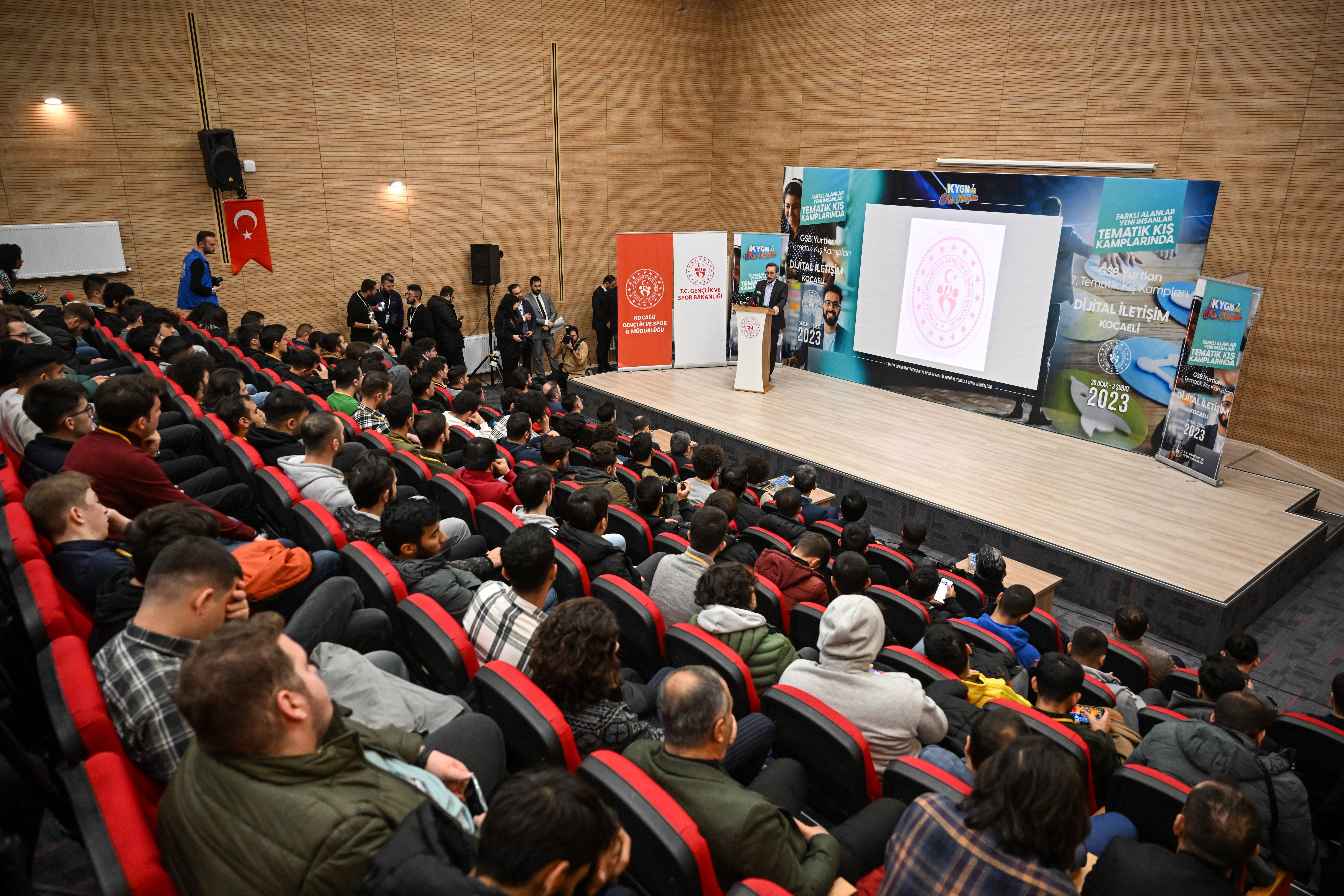
In his speech at the Digital Communication Winter Camp event held in Kocaeli as part of the Ministry of Youth and Sports Dormitories Thematic Winter Camps, Presidency's Director of Communications Fahretin Altun said, "The fact that the importance of the truth has diminished and the lie has become commonplace is a major threat equivalent to the global epidemic we are currently experiencing."
Director of Communications Altun stated that everyone is a part and a consumer of digital communication culture today, mentioning the historical development of communication culture and the impact of communication on the development of societies. Director of Communications Altun discussed developments in the field of communication, stating that, according to some perspectives, individuals are the creators of this culture.
Director of Communications Altun noted that communication technologies and transformations played a significant role in the rise of modern nationalisms and nation-states, adding, "Mass communication has assumed its place in contemporary history as a crucial factor influencing socio-political and international developments. In other words, from this aspect, the history of communication is essentially a part of the history of politics, a part of the history of societies, a part of inter-communal interaction. Consequently, mass communication and its processes have been at the centre of modern power struggles."
Director of Communications Altun remarked that as a result of the changes brought about by the industrial revolution, involving the masses in the consumption process has become a crucial element and stated:
"The primary function of mass media is to engage the masses in the consumption processes. In order to influence and direct political and consumption behaviour, the mass media institutionalises and becomes one of the fundamental institutions of modernity and the modern era. First and foremost, at this time, news emerges as one of the media industry's most valuable resources. The second is commercials. It evolves as a major institutionalised field in the realm of communication and media as a result of this process. The third sector incorporated in the process, entertainment, shines out as a major component of mass media once again. All these are fundamental elements that emerge to influence, direct, and manage the people.
Director of Communications Altun concluded that real-world events could be comprehended and assessed in light of past experiences, saying, "Instead of reflecting reality as it is, the mass media, industry, and media have acted as a mechanism that manipulates it for the sake of ideological, political, and economic interests, showing what they want and excluding what they do not want. Again, they have used news, information as a tool for advertising, sales, and marketing, so to speak, as bait. As a result, two basic crises arose, the repercussions of which we continue to endure as humanity: the crisis of democracy and the crisis of truth. These crises feed and exacerbate one another."
Director of Communications Altun made a comment about how regional and global crises have harmed societies, particularly with the Covid-19 pandemic, saying that the crises now far outweigh the institutionalisation processes and that modernity has made it difficult for institutions to keep their promises.
"We are facing a crisis of truth"
The Director of Communications Altun emphasised that crises are affecting not only non-Western countries but also Western countries in terms of finances, raw materials, and health, and added:
"But aside from these, there are two other fundamental crises that we need to focus on. As I have mentioned, the crisis of democracy and the crisis of truth. Individuals who are made to believe to be informed are at the core of the crisis of democracy. While modern mass media legitimise their own actions, they assert that they provide people and the masses with accurate information and assume that this will influence their political decision-making processes. If this is not a process of accurate information but rather distorted communication, we see the manipulation of those who are not well informed, as is the situation today.
And the existence of individuals who are influenced by the information processes managed by the elite group in democratic processes gives way to the crisis of democracy. This is much more significant in the age of digital communication. The other is the crisis of truth that ensues as a result of this. This relates to the presence of individuals and public opinion that have been manipulated. We are experiencing a crisis of truth in the digital communication era, as the truth's significance faded and lies have become the norm."
Director of Communications Altun stated that, as many commentators have noted, digital media does not represent a complete rupture from conventional media; rather, there is a significant continuity between both, highlighting the significance of comprehending this continuity to be able to exist as free individuals within the digital media culture.
Director of Communications Altun noted that significant attempts are thus being made to draw clear divisions between the conventional media culture and industry and digital media culture and industry, adding that he viewed this as problematic and that everyone should be aware of it.
Stating that many social phenomena and developments can be discussed from the perspective of the dichotomy between nature and composition, essence and content, which he frequently refers to, Director of Communications Altun said:
"Some processes or events that we claim are distinct may, in fact, differ merely in terms of their content. Nonetheless, we can observe that they have many similarities in terms of essence and nature and even the same social and historical trajectory. When comparing two historical events and drawing analogies, it is essential to consider if they differ in terms of nature, composition, essence, or content because most of the time, the picture presented to us asserts that the realities that are distinct in terms of content are also distinct in essence. However, the ability to understand the nature of continuity and evaluate the underlying power relations is a crucial component. Therefore, we can express clearly and unequivocally that the developments in mass communication processes, technologies and industries since the beginning of modernity, whether analogue or digital, differ in composition and content, but the essence is the same, they contain continuity."
Director of Communications Altun noted that Western-centred hegemony and institutionalisation have existed in the field of communication since the beginning of modernity and that these major media companies are evidence of this, as well as the fact that many of the companies that have been institutionalised since the end of the 19th century and have increased their influence in the 20th century are still in existence and their dominance persists.
Stating that those in the digital media are also large companies that are institutionalised there and are the carriers of Western capitalism, Director of Communications Altun said, "On the other hand, communication technologies were institutionalised in the West, emerging firstly as military technologies, and commercialised after their use achieved a certain point in this field. The Internet is the latest example of this. Again, we face the process in which the West is the producer, and non-Western societies are the consumers. It was like that yesterday, and so it is today. Therefore, large companies, communication technologies and a hierarchical mechanism in which the Western societies are producers and non-Western societies are consumers essentially indicate continuity."
"Western colonial order is at the foundation of global injustice"
Director of Communications Altun mentioned that they saw serious injustice when looking at the relations between societies in both the traditional media and the digital media era on the one hand, and said, "When we look at the global arena today, we see this injustice. In fact, our President came to the fore with the rhetoric 'The world is bigger than 5' and 'A fairer world is possible' to draw attention to this injustice. The main concern of our President here is to draw attention to global injustice and contribute to the solution of this problem."
Indicating that the Western colonial order was behind the injustice in the political, economic and cultural fields, Director of Communications Altun went on to say:
"The fundamental dynamic of global injustice and another essential element of this process is the Westernist dependency system. The Western colonial order could not and cannot exist without the Western dependency system. In other words, it is a system where there are the actors who established the Western colonial system, the actors who preserve it, as well as the elites in the non-Western world, who view Westernism as their primary political motivation and act on this axis, and therefore strongly advocate moving along the Western axis, the system of Westernist dependence. Currently, Türkiye's story in the present era has been to fight the Western colonial order, break away from the Western colonial order, and help raise awareness in non-Western societies; meanwhile, to liberate Türkiye from this Westernist dependence system."
Director of Communications Altun touched upon the developments that occurred following the widespread adoption of the Internet, stating that there was a sense of revolution in the field of communication during this period.
Director of Communications Altun emphasised that people day by day have shifted from an optimistic to a more critical perspective in an instant, adding:
"Why? Because we rapidly realised that this information inflation also brought with it another issue. The issue regarding the source and the reliability of the information. How do we address this issue? There is information and knowledge available everywhere. Therefore, what information is reliable or accurate? We see a lack of criteria. In fact, we saw that this information inflation brought about a series of developments that raised the likelihood of disinformation and opened the path for its dissemination."
"In the global setting, a communication system must be established in which the truth always prevails"
Director of Communications Altun stated that the new communication technologies are responsible for the current truth crisis, adding:
"I have just listed two concepts. The significance of the truth fading and lies becoming the norm. This is the greatest threat we face at present. I make this point very loud and clear. This is a huge threat, comparable to the global pandemic we are currently witnessing. A great threat that is akin to the global food crisis. It is a crisis and threat similar to the energy crisis, as its impacts will be felt considerably more in the future. You, my dear friends, who are pursuing degrees in communication faculties, must be aware of this and act accordingly; because neither science nor politics or commerce can be performed in a place where lies have become mundane and the truth has lost its value. In the global setting, a communication system must be established in which the truth always prevails. To accomplish this, we must fight together throughout a broad range, from the intellectual to the political field.
Currently, Türkiye is exerting its greatest efforts to combat global injustice in communication. At this point, our struggle in the realm of communication is primarily motivated by our President's vision of combating global injustices. In fact, for the past two decades, we have been making significant efforts to use all international platforms, especially on which Türkiye has been active to eliminate injustices in this area. We are striving to eliminate global injustices in the field of communication and media in Western organisations, such as the United Nations and the European Union, as well as in international platforms, such as the Organisation of Islamic Cooperation and the Organisation of Turkic States. We aspire for increased representation of non-Western societies and the greater resonance of their voices. In this sense, our highly significant institutions in both the public and private sectors function. Particularly, recent efforts by TRT and Anadolu Agency in the public sector emerge precisely as the voice of Türkiye and the non-Western world in an effort to raise attention to this global injustice, injustice in the field of communication and to globalise differing voices."
Director of Communications Altun highlighted that the threat of mechanisation, which was mentioned during the time when analogue media remained to exist, maintains its presence and vitality by gaining ground today and added:
"Resistance to the threat of mechanisation, the hegemony of digital communication culture and actors in the West, and awareness of this process are essential components. Regardless of what occurs, it is of the utmost importance that we remain vigilant against the Western colonial system and cherish the geography in which we reside. At this juncture, the presence of a strong public authority and a powerful state represents a significant opportunity."
"We must be aware of our capabilities and the threats we face"
Presidency's Director of Communications Fahrettin Altun addressed the students:
"Sadly, we observe that many actors influenced by Western powers in Türkiye are attempting to undermine the country by promoting the notion of a weak state. Never lend credence to this. In this era of global chaos, societies with powerful states will prevail. Nations with powerful states will shape the future. Therefore, the concept of a powerful state is crucial to us. Obviously, in this concept, regulating the digital communication field and developing our own communication tools are key components. Today's Türkiye is significantly stronger than it was twenty years ago, and we have the Century of Türkiye ahead of us. In this Century of Türkiye, as individuals aware of our capabilities and the threats we face, we must proceed in an active, hopeful, and assertive manner regardless of the circumstances. I am confident you will continue your work with this consciousness in mind."
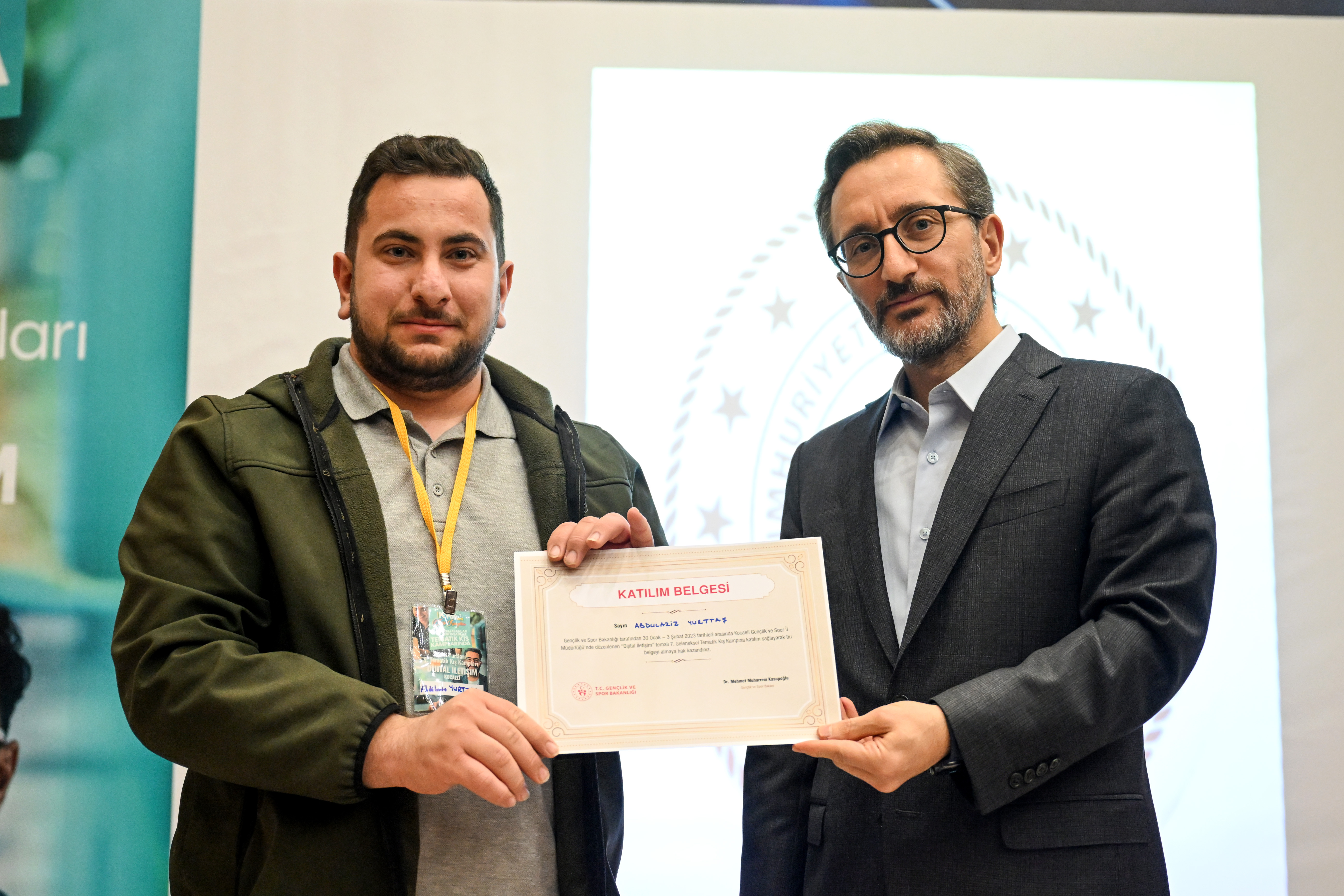
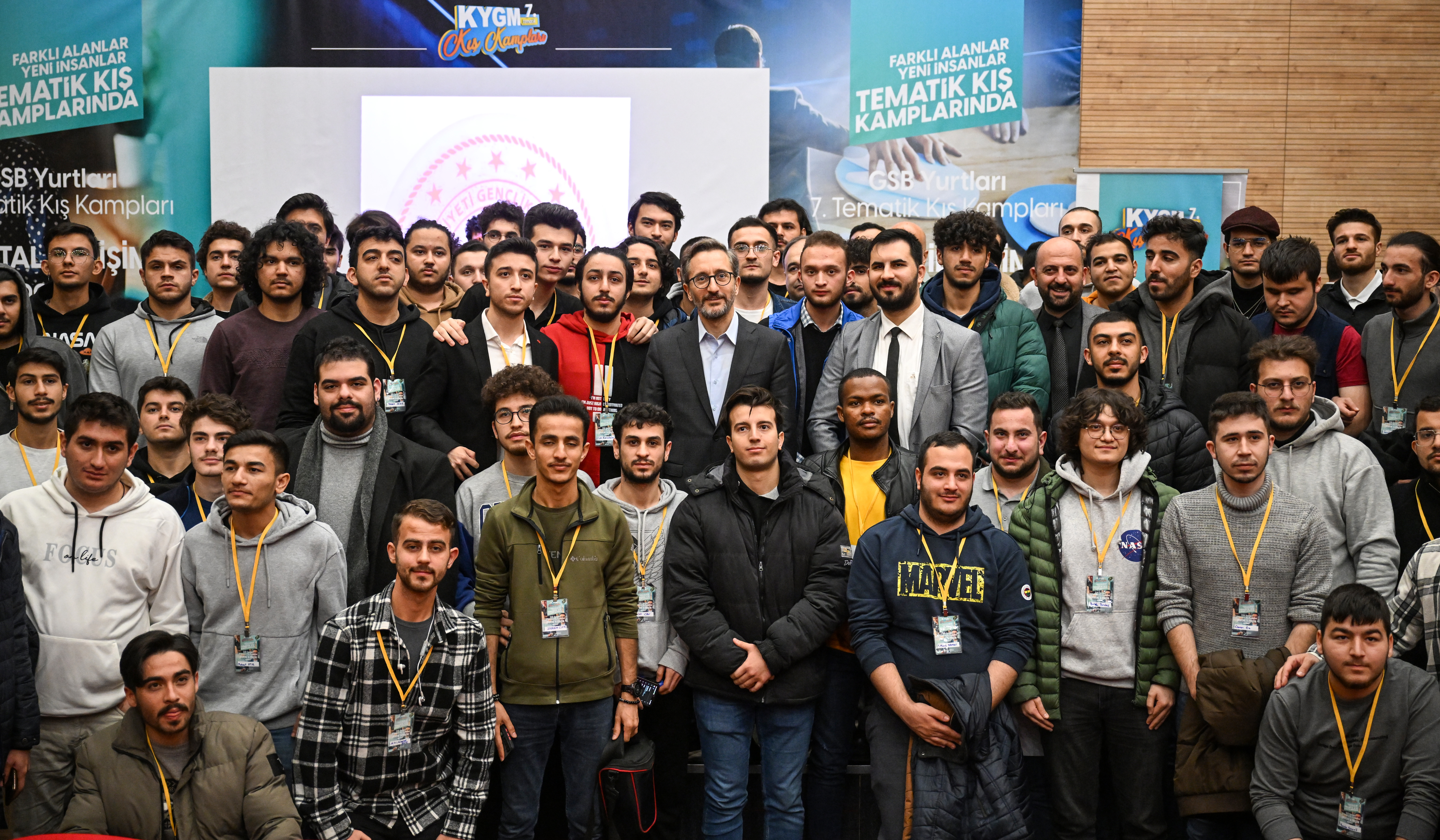
Following his address, Director of Communications Altun presented the students with certificates of attendance and had a souvenir photo taken. After that, the video message delivered by President Recep Tayyip Erdoğan was viewed.
At today's event, journalist Ersin Çelik also spoke to the students about developments in the field of communication.
The camp's closing ceremony was attended by Director of Communications Altun, Acting Governor Ali Ada, Mayor of Kartepe Mustafa Kocaman, representatives of relevant public institutions and organisations, and students.