Director of Communications Fahrettin Altun stated that the late Professor Teoman Duralı was the wealth of the Turkish intellectual and cultural world and said, "We want to know more about him, and we want Türkiye and the entire world to know about him."
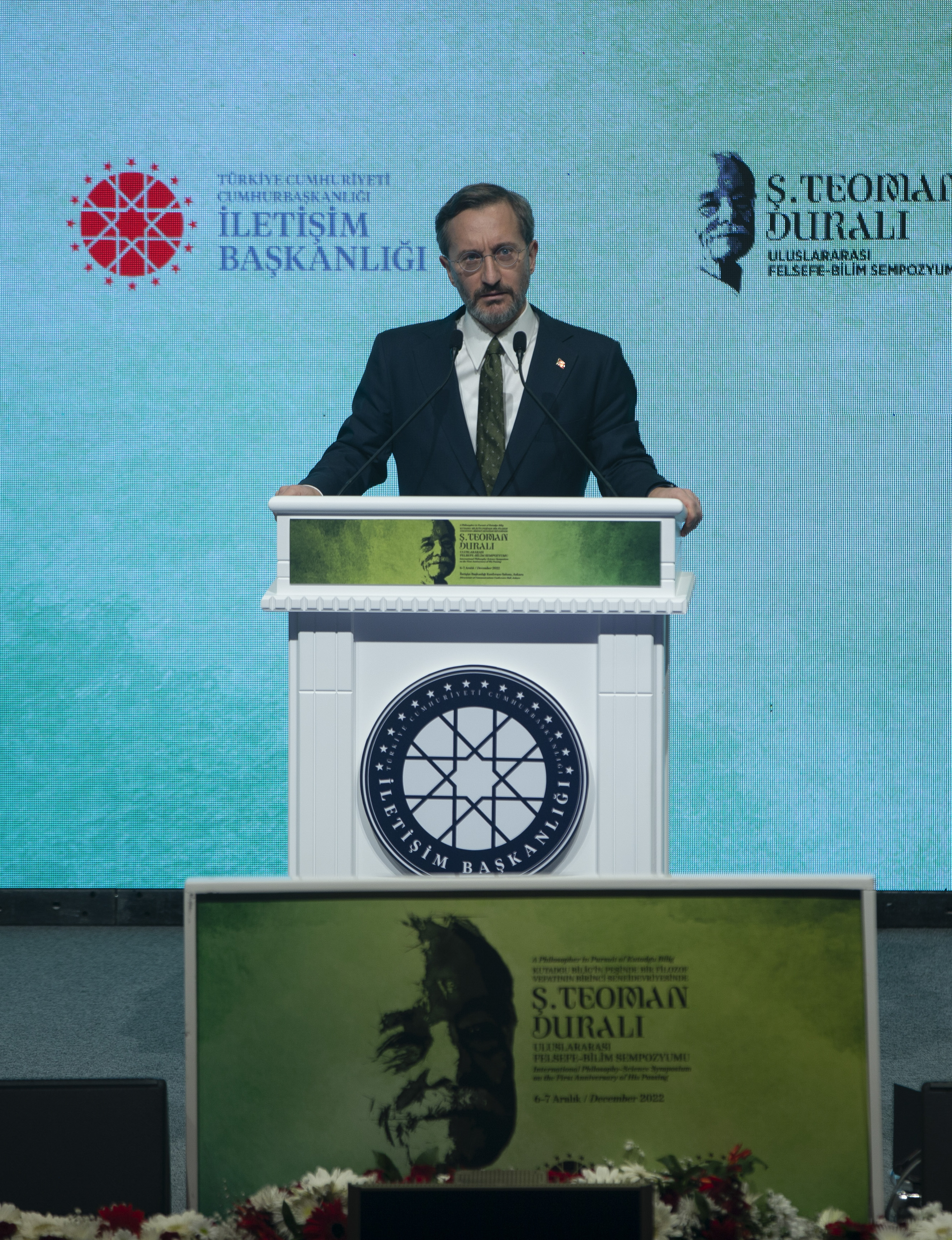
Presidency's Director of Communications Fahrettin Altun attended the "Teoman Duralı: A Philosopher in Pursuit of Kutadgu Bilig - International Philosophy-Science Symposium on the First Anniversary of His Passing " held at the Directorate of Communications Conference Hall.
Director of Communications Altun stated that the Presidency's Directorate of Communications was greatly honoured to organise this symposium in memory of the late philosopher, thinker, and academician Duralı.
Commemorating Duralı with mercy, who passed away last year today, Director of Communications Altun emphasised that, as President Recep Tayyip Erdoğan stated, Duralı, one of the most important values of Türkiye's intellectual world, rendered unforgettable services to the world of thought with his works at home and abroad.
Recalling that Teoman Duralı is also a member of the Presidential Science, Technology, and Innovation Policy Board, the Director of Communications Altun noted that Duralı, who was also deemed worthy of the 2021 Presidential Culture and Arts Grand Award, passed away two weeks before the award's presentation.
Director of Communications Altun emphasised that Duralı, who stood out for his systematic studies in philosophy and science, has made significant contributions to Türkiye's cultural life through his works, students, conferences, and interviews.
Stating that Duralı did not hesitate to share his vast knowledge with large segments of society, as seen in the "Philosophy Talks" programme on TRT 2 a few years ago, Director of Communications Altun said, "He questioned the age we live in from many angles, interpreted Türkiye's historical march from a local perspective, and influenced not only those who are passionate about philosophy but also those who are mildly curious about it."
"Every phase of his life is filled with lessons"
Stating that Duralı's expression of philosophy is based on strong rhetoric, mixing philosophy with culture, history, and science, and even reinforcing it with life from time to time, Director of Communications Altun said:
"During the years I studied at İstanbul University, I had the honour of attending Professor Duralı's lectures. Those who know will remember. During our Professor's lectures, the audience would exceed the capacity of the lecture hall. Students from other departments and other universities would attend classes. Professionals from outside the university would come. Every stage of Teoman Duralı's life, which started in Zonguldak, continued in Ankara and İstanbul, then spread to different geographies of the world and ended in İstanbul again, is full of lessons to be learnt. He wanted to study philosophy and natural science. Despite its difficulties, he was able to do that. In this sense, Aristotle was also a biologist; he studied and researched living things."
Director of Communications Altun pointed out that Professor Duralı was a thinker who was, first of all, aware that he was a part of a great civilisation, as can be seen in the biographical interview titled "Time Goes By", and said, "According to him, the most important fulcrum of human is time and space. The time of societies is history, and their civilisation is geography. He did not disregard Islam, the Seljuks and the Ottomans while explaining what Turkish culture is in the search for who we are. According to Duralı, Islam is so intertwined with Turkish culture that it is absolutely impossible to separate them from each other."
"He shared his inspiring results with everyone"
Director of Communications Altun reminded that Teoman Duralı lectured at many universities in Türkiye and said that Duralı travelled around Türkiye's cities from Adana to Elazığ, Diyarbakır to Kırklareli, Trabzon to Artvin, teaching in some of them and experiencing others by travelling from one city to another.
Director of Communications Altun noted the following:
"These were not just touristic trips; on the contrary, he was laying out the building blocks of the cultural meaning frame he was after, with what he learned from his travels. He was a traveller in this sense. Duralı, who knew that the most difficult thing in the world to understand is the problems of philosophy, was a unique genius, and he dealt with the most difficult philosophical issues with this genius. He turned to an area that no one in Türkiye was interested in and wrote texts focused on the philosophy of biology. Teoman Duralı believed that every philosopher should also gain competence in science. Because he believed that a system of philosophy not based on science is not possible. He stated that there could not be a purely philosophical system; philosophy must be stemmed from science. In addition to his academic studies and teaching life, he was also known for his travels around the globe. He studied the geography and history of the societies he visited and travelled to. He shared with everyone his conceptions of culture and civilisation based on scientific research, as well as his eye-opening insights of redefining fundamental concepts such as culture, civilisation, East, and West."
Director of Communications Altun stated that Teoman Duralı deeply rooted himself in the culture and civilisation in which he was raised by merging the traditions of philosophy and thought, understanding different cultures and civilisations, and recognising this diversity and that he enriched Türkiye's cultural life through his comprehensive readings from Aristotle to Al-Farabi, Al-Ghazâlî to Kant, Ibn Rushd to Descartes, Kierkegaard to Nietzsche, Ibn Arabi to Heidegger.
"He contemplated at length"
Director of Communications Altun noted that Teoman Duralı, a prominent figure in cultural historiography and linguistics, also wrote poetry and contemplated the relation between poetry and literature with philosophy and traditions at length, adding:
"Understanding that philosophy is based on reason alone and that emotions have no role, he closely studied global literature from Tolstoy to Ortega Gasset without neglecting their philosophical aspect. From Nermi Uygur, whom he referred to as "my guide," to Ahmet Yüksel Özemre, the head of the theoretical physics chair, whom he referred to as "my dearest professor, my guide," and İdris Küçükömer to Cemil Meriç, he shared his views on significant figures of our cultural world in his memories and within a holistic framework of meaning. He integrated his knowledge and life experiences to some extent in all of his research and endeavours. He also took part in public discussions. From his interest in maps to leftist ideology, non-religious European civilisations to the notion of intellectuals, language to the current world order, the personality of culture to Hagia Sophia, and the global pandemic to solidarity, he addressed a variety of topics. As a responsible intellectual, he consistently questioned the role of colonialism and its universal manifestation, imperialism, which had cultural and military aspects, in the destruction of culture and civilisation.
Director of Communications Altun said that the intellectual community is extremely familiar with Teoman Duralı's works "Contemporary Global Civilisation," which is about civilisation and can be considered a working metaphysics of history, and "What is the Problem?," which analyses the era and the current situation.
"Duralı: Philosophy and science were born together"
Director of Communications Altun said that in addition to these, Duralı's notable books are "What is Philosophy-Science?," "Anatomy of the Mind: The Critical Analysis of Pure Reason," "The Birth of Philosophy-Science," "Turkish Identity Without a Backbone," "Metaphysics with a Philosophy-Science Focus," "Anatomy of the Troubled Age," and "Kutadgubilig - The Turkish Philosophy Dictionary and Anatomy of Life," adding:
"His work, 'Sea and Being an Explorer,' comprised of his poetry and memoirs and on which he established his philosophy based on linguistics and cultural history sciences, is composed of the heartfelt musings of a traveller who had nearly been around the entire globe. Teoman Duralı has always reminded us that curiosity is the foundation of philosophy. As I already stated, philosophy and science were born together for him and shared the same purpose and method. His papers, books, and addresses all feature an overarching concept and a holistic approach. He offered his perspective of history in a holistic approach that encompasses the creation of the universe and the world, the origin of humans, the production of cultures, state formation, and processes of civilising. Teoman Duralı's writings on the origins of life, people, Eastern and Western civilisations, tribes, political, economic, and social life in civilisations, language-civilisation relations, the meeting of civilisations, wisdom, Turkish culture, and Islamic civilisation cannot be fully grasped apart from his historical point of view. Teoman Duralı, one of the most distinguished personalities in the Turkish intellectual community, views cultural personality as a crucial aspect of civilisation. His works can also be viewed as a cultural analysis due to the fact that he addresses each of the major cultural components individually."
Pointing to how according to Duralı, "human" stands for "culture", Director of Communications said, "So, what is the reasoning behind this, or why does the concept of culture dominate his intellectual universe? Because people cannot exist, live, stand, or survive in their natural state, i.e. as humans. Without culture, it is difficult for people to survive in their natural state."
"Duralı contributed to the reconstruction of our civilisation building"
Director of Communications Altun emphasised that Teoman Duralı, in pursuit of a theoretical expression in Turkish, drew upon the anxieties, elements, and solutions of his own cultural consciousness in order to discuss the deep depression in the world and by meticulously mapping the concepts down to the last detail, he contributed to the reconstruction of our civilisation building.
Director of Communications stressed how Duralı constantly emphasised the significance of history by asserting that "people who are unconscious of history will not be free, and that those who are not free will become automated and will be subject to exploitation," and noted:
"We know that previous to, and immediately after adopting Islam, Turkish scholars focused primarily on the state. One of the most striking aspects of Teoman Duralı is that he conducts philosophy-science research in line with the perspective of 'Kutadgu Bilig' based on the wisdom-filled work of Yusuf Has Hacib, whom he considers one of our most important thinkers. 'Kutadgu Bilig' is the supreme bliss of attaining consciousness; Kut is the supreme holiness. The person who experiences this consciousness based on culture, history and social philosophy is 'Kutadgu Bilig'. Referring to the art and tradition of the Turks to establish a state and statehood, Duralı believes that Yusuf Has Hacib has radically explained the Turkish state understanding along with Kutadgu Bilig. For him, this is similar to the discovery of "logos", which can be translated as" spiritualism" in Turkish, by Heraclitus of Ephesus, who prepared the threshold of philosophy and science. Logos is a man's wisdom and consciousness. Of course, while everyone has "potential," not everyone is capable of realizing it. Indicating that a similar situation is valid for" Kutadgu Bilig", Duralı thinks that the only indispensable factor that drives someone equipped with the consciousness of establishing and managing the state is the ideal of establishing justice in the society. Duralı believes that Kutadgu Bilig is not only the most important passion but also the manifestation of justice.
"His thoughts will be taken up from various aspects"
Noting that this framework, which I have tried to establish very briefly about Teoman Duralı, is, of course, much more detailed and complex than it seems, Director of Communications Altun said: "We all know that getting to know someone entails getting to know them and their characteristics. Knowledge is a more established form of acknowledgment."
According to Teoman Duralı's thought, a philosopher is a person who judges the world, primarily the physical order of the world, based on reason, and puts forward principles as a result of this judgment, and creates a system by establishing the connections between these principles, Director of Communications Altun added:
"We think that the sophisticated thoughts that Teoman Duralı wanted to put forward through his works, lectures, conferences, television interviews, poems and memories should be discussed in detail. From this point of view, as the Presidency's Directorate of Communications, we commemorate our visionary, local and competent philosopher Teoman Duralı, who interprets today's world, history and civilizations within a philosophical integrity, with a symposium we organized in the first year of his passing.
Prof. Teoman Duralı is the intellectual and cultural treasure of Türkiye. We would like to get to know him better and introduce him to Türkiye and the rest of the world. I hope that our symposium, which will last for two days, will lead to auspicious outcomes for our country and our intellectual world. Our rich program will include presentations on Teoman Duralı's life, thought, philosophy-science understanding, and publications, which helped shape the Turkish intellectual public's perspective through his articles. The sophisticated thoughts of a philosopher who lives by the motto "do philosophy with love" in its broadest sense will be discussed here today in a variety of contexts."
"The conversations of Duralı have been collected into a book"
Stating that he believes the symposium will contribute to the understanding of Duralı's thought and the development of his thought by new thinkers, Director of Communications Altun read Duralı's lines: "I did not know any boundaries. I would rather sail to the vast waters. From non-existence to existence and from existence to non-existence. An unstoppable caravan.''
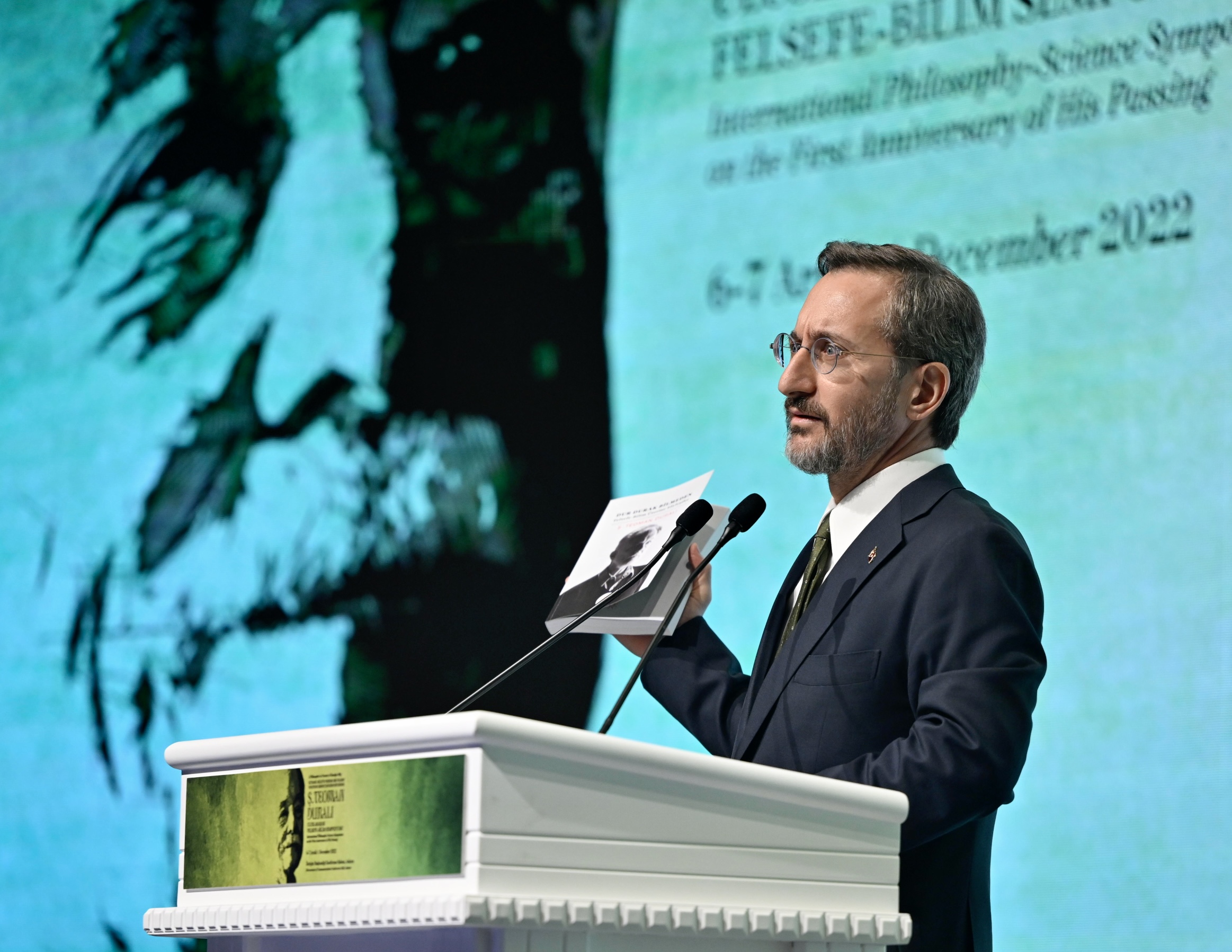
Inspired by these verses, Director of Communications Altun stated that, as the Presidency's Directorate of Communications, Teoman Duralı's interviews on philosophy and science were published as a book under the title "Knowing No Boundaries", and he believes this work will be a comprehensive guide on the architecture of thought of a philosopher who tries to systematize the knowledge gained by humanity, to make sense of the visible, and who makes seminal contributions to the intellectual debates in Türkiye.
Pointing out that the most valuable treasure of a nation is its highly qualified and well-trained people, Director of Communications Altun said, "If one of their two main characteristics is to lead by example, the other is to serve as a guide. I would like to express my gratitude to all academics, writers and thinkers who were among us to contribute to the symposium with their valuable presentations and to help us remember and understand him.''
Deniz Duralı talked about his father
Deniz Duralı, son of Teoman Duralı, who attended the symposium, said that his father was very sensitive about homework ethics and did not give up on his work and worked until the last moment.
Underlining that his father attached great importance to the "feeling of shame", Duralı said, "His life motto was the Prophet's saying 'Do whatever you do, as long as you are not ashamed.' He taught my sister and me to behave in a way that is not embarrassing, to do what we do if we are not ashamed of it in the end."
Stating that Teoman Duralı had a sense of curiosity that put people at the centre, Deniz Duralı noted that his father knew many languages and was an enthusiast of geography.