Director of Communications Altun said: "We are working hard to rebuild and improve all 11 provinces. Our state did not abandon its citizens in Van, Elazığ or İzmir in the past. We will also stand with our brothers and sisters that were hurt by the 'disaster of the century.'"
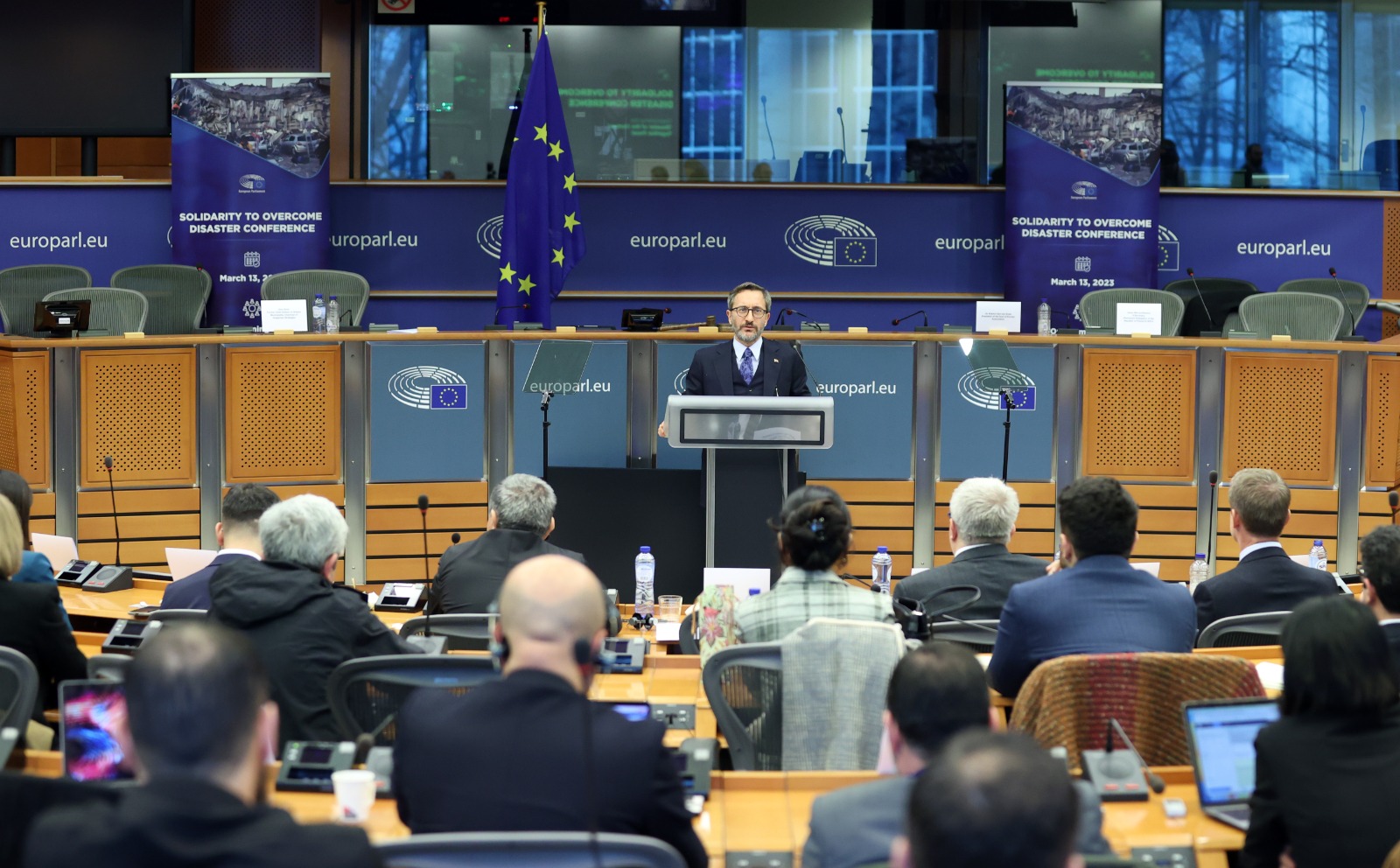
Director of Communications Altun attended the panel titled "Solidarity to Overcome Disaster" organised by the European Parliament in Brussels. Delivering the closing speech of the panel, which he attended as a guest of the European Parliament, Director of Communications Altun expressed his pleasure to attend this important meeting.
Indicating that Türkiye was going through a difficult period, Director of Communications Altun recalled that the country was shaken by a 7.7 magnitude earthquake on Monday morning, February 6, and a 7.6 magnitude earthquake was experienced approximately 9 hours after this earthquake.
Stating that more than 15 thousand aftershocks have been recorded since then and that almost 48 thousand people lost their lives in the earthquakes, Director of Communications Altun said that hundreds of thousands of people who survived the disaster suffered both physical and psychological injuries.
Stating that this disaster, which directly affected 11 provinces in Türkiye, deeply wounded even the citizens with no ties to the region, Director of Communications Altun said, "I must say that all of Türkiye was shaken. No citizen fully recovered from (what we call) the ‘disaster of the century’ anywhere in our country. Despite experiencing earthquakes often and having experienced major earthquakes in its recent past, Türkiye found it difficult to grasp what happened.”
Stating that despite the weight of this burden and the difficulty of this test, the Turkish state and people got back on their feet together, Director of Communications Altun noted that public institutions, non-governmental organisations, the private sector, sports clubs and the media passed this test with flying colours.
Director of Communications Altun emphasised that Türkiye's friends abroad - including many European governments - answered Türkiye’s call and made cash and in-kind donations as well as deployed their search-and-rescue teams to save many lives.
Recalling that the Turkish Disaster Response Plan (TAMP), which was developed by the government to prepare for the earthquake, was activated immediately after the earthquake, Director of Communications Altun said that while the search and rescue efforts were launched under the coordination of AFAD, the basic needs like food and shelter began to be addressed, and President Recep Tayyip Erdoğan, too, monitored and directed those efforts since the first moment.
Pointing out that, in truth, Türkiye took many steps to prepare for earthquakes and other disasters in the last 20 years, Director of Communications Altun said, "In truth, those steps highlight Türkiye’s transformation over the last 20 years and the strength of its institutions.”
Recalling that President Erdoğan recently said that 98 per cent of all collapsed buildings had been built before the 1999 earthquake, Director of Communications Altun said that, essentially, that information showed that Türkiye took the right steps after the Marmara earthquake, took most of the necessary precautions, and made progress toward disaster resilient cities.
Director of Communications Altun stated that it was clear that strong and stable political will was necessary to rebuild cities after the ‘disaster of the century’ and to resume ongoing urban renewal projects with an eco-friendly approach to urbanisation.
Pointing out that following the ‘disaster of the century’, the Turkish state supported its citizens through all of its institutions, Director of Communications Altun said, "Tens of thousands of public officials - including soldiers, policemen, medical workers and rescue workers - reached the disaster zone and began to work under AFAD’s coordination. As a matter of fact, we saw public officials stationed in the area help the general public without thinking about the safety of their families first."
"The entire state apparatus mobilised after the earthquake"
Underlining that the entire state apparatus mobilised after the earthquake, Director of Communications Altun said:
"In this regard, our indigenous drones scanned the area from the sky and identified collapsed or damaged buildings quickly. All the collected data was instantly delivered to the crisis desk in Ankara, and our resources were used most efficiently.
Of course, healing wounds is a long-term task. By now, more than 3.7 million people have been evacuated. We are taking steps to support them financially and emotionally – so that they can rebuild their lives and send their children to school.
After the earthquakes, we inspected 1.7 million buildings and 5.1 million independent units. Damage assessment in five provinces has been completed. We offer temporary housing to some 2 million citizens. For this purpose, we made available tents, container homes, student dorms, ships and guest houses."
"It became clear that disinformation is a threat"
Explaining that the Presidency's Directorate of Communications has been active on the ground and at the crisis desk in Ankara since the earthquakes, Director of Communications Altun stated that after the earthquake, they took steps to help the national and international press to work freely and to fight against disinformation and fake news at the same time.
Stating that in this regard, on top of Turkish journalists and some 400 foreign reporters living in Türkiye, they accredited 1400 international media representatives to ensure that they can operate safely and comfortably, Director of Communications Altun said that they established press centres and met some basic professional needs of journalists, such as backup batteries.
Pointing out that, likewise, the Presidency’s Communication Centre (CİMER) worked very hard to process some 1.5 million submissions from private citizens, Director of Communications Altun said that the Centre for Combating Disinformation, which is part of the Directorate, published bulletins to combat disinformation on social media platforms and responded directly to fake news.
Pointing out that many states came to see disinformation as a major threat in recent years, Director of Communications Altun said that Türkiye, like others, took some precautions.
Recalling that most recently, the Turkish Parliament passed a law to combat disinformation, Director of Communications Altun stated that they were trying to stop the systematic dissemination of fake news on social media. Director of Communications Altun made the following assessments:
"At the time, some people criticised Türkiye by hiding behind freedom of expression. Particularly, our European friends criticised Türkiye over a vital issue like the fight against disinformation but took very similar precautions themselves. Naturally, that raised some questions.
After the earthquakes, however, it became clear that disinformation threatens people’s lives and property – not just state security.
Specifically, some people and groups spread baseless rumours on social media. For example, thousands of people shared messages from social media users who said they were under the rubble. When rescue workers went there, they saw standing buildings. In this sense, we have seen how some people tried to prevent the efficient use of resources.
I must add that international social media companies, starting with Twitter, had some shortcomings in the beginning. We did not receive enough support from Twitter initially. But, after some meetings, the company began to pay attention to disinformation. We are now working closely with Twitter."
"We are grateful to all countries and peoples that stood with the Turkish people"
Referring to the contributions of non-governmental organisations within the context of the efforts made in Türkiye to heal the wounds of the earthquake, Director of Communications Altun emphasised that this sense of unity, fraternity, and solidarity, which resurfaced after the disaster, were the fundamental characteristics that make the Turkish nation special and invincible.
Stating that the ‘disaster of the century’ in Türkiye sent shockwaves through the world, Director of Communications Altun said that Türkiye declared a Level 4 alarm after making initial assessments in line with TAMP and that international assistance was requested within this framework.
Director of Communications Altun stated that many countries responded to Türkiye's call, from Australia to Azerbaijan, Japan to Greece, the United States to Ukraine, Israel to Germany, South Korea to Qatar, Russia to Spain, and noted:
"At the same time, we received significant support from the EU Civil Protection Mechanism and our NATO allies. Of course, we are grateful to all countries and peoples that stood with the Turkish people at this difficult time. Many countries sent rescue workers to Türkiye. They made cash and in-kind donations.
There is a beautiful Turkish proverb: ‘A true friend makes themselves known in difficult times.’ States may disagree from time to time. But we were happy to see how many friends we had – and that we could find common ground as human beings. In this sense, we strengthen the nation-state's reflexes to promote the welfare of our citizens. At the same time, we believe that the nation-state's reflexes must take a back seat in the face of shared suffering and risks. We must keep in mind that pandemics, wars and disasters have global impacts. We must develop a new model of international cooperation to stop them and heal the wounds."
"The Donors' Conference shall highlight the European states’ support"
Noting that they attach great importance to the upcoming Donors' Conference by the European Commission, Director of Communication Altun said: "This event shall highlight the European states' support to Türkiye and raise funds for long-term projects for earthquake survivors. It is possible to say that the whole world supported us partly because Türkiye has helped others for years in the face of humanitarian crises and natural disasters. As you know, our country has been a world leader in humanitarian aid based on gross national product. We have seen wealthier states offer their support in various ways. We appreciate and thank you for all those efforts. We pray that similar disasters do not occur anywhere in the world."
"We are determined to make Türkiye the best-prepared country against disasters"
Stating that President Erdoğan visited the region many times and met survivors, Director of Communications Altun continued:
"He heard their problems and instructed the authorities to address shortcomings if necessary. Unlike some people, who tried to take advantage of the 'disaster of the century,' he stressed that he was only interested in healing wounds – in line with the maxim: 'Let people live that the state may survive.'
In this regard, we are working hard to rebuild and improve all 11 provinces. Our state did not abandon its citizens in Van, Elazığ or İzmir in the past. We will also stand with our brothers and sisters that were hurt by the 'disaster of the century.' In this sense, we heal the wounds and reverse the damage to the region’s economic life, demographics, culture, historical heritage and environment. As Our President said, building safe and permanent housing units for survivors and delivering them within one year is among our priorities."
Director of Communications Altun also underlined that one of the main agenda items of Türkiye was to prepare for future disasters anywhere in our lands, especially in Istanbul.
Noting that President Erdoğan recently chaired the first meeting of the Turkish National Risk Shield Model, Director of Communications Altun said that he announced his decision to form the Disaster Management Policy Board at the Presidency, to which many valuable scientists attended.
Director of Communications Altun stated, "As Our President said, we are determined to make Türkiye the best prepared and most rapidly responding country in the world – with common reason, common conscience, common morals, and a common vision."
Ryszard Czarnecki, Chairman of the European Union (EU)-Türkiye Friendship Group and Member of the European Parliament, stated in his opening remarks that the EU was committed to continuing its support for the regions in Türkiye and Syria affected by the Kahramanmaraş-epicentred earthquakes that occurred on February 6.
Noting that the panel was important and held just in time ahead of the Donors' Conference in Brussels next week, Czarnecki stressed that they would try to find a solution to provide a brighter future for those living in the earthquake-affected regions and wished in Turkish, "Get well soon, Türkiye."
The emphasis that disasters can have a positive effect on EU-Türkiye relations
Koert Debeuf, an Oxford University associate researcher and European Director of the Tahrir Institute for Middle East Policy, stated that many Syrians lived in earthquake areas, that the earthquake also affected northern Syria, and that he wanted to draw attention to the situation in this region.
Debeuf emphasised that due to the civil war in Syria, the earthquake areas were divided between forces of the Bashar al-Assad regime and opposition forces and that aid would only reach those in need if it entered through Türkiye.
Koert Debeuf said, "If we really want to help the earthquake survivors in Syria, we have to work with Türkiye."
Debeuf stated that he advocated for Türkiye to join the EU for more than two decades, and he cited Greece's support for Türkiye during the 1999 Gölcük earthquake by "putting politics aside," adding that such crises present an opportunity to strengthen bilateral relations.
Call for continued safe habitation in the region
According to Dragoman Strategies President Onur Erim, the earthquake in Türkiye was among the most destructive in recorded history, and it affected a larger region than Bulgaria.
Erim stated that the Turkish authorities' response to the earthquake was prompt and well-organised.
Erim pointed out that Turkish citizens donated more than $6 billion to earthquake survivors in the past two weeks, but this figure remained at $160 million three months after the 1999 earthquake.
Erim said that, according to international estimates, the earthquake's damage in Türkiye and Syria exceeded $100 billion.
Recalling that 15 million people were directly impacted by the earthquake, Erim emphasised that there had been civilisation and life in the region for thousands of years and that it was imperative to ensure that people continued to live safely in their own regions.
A call for greater support from Europe
Patrick Van den Eede, President of the Soul of Europe initiative, stated that Europe's current support for the magnitude of the disaster was insufficient and that earthquake survivors should receive long-term assistance.
Reminding that Europe showed solidarity with Türkiye due to the earthquake, Van den Eede emphasised that there was still much that Europe could do.
Van den Eede pointed out the importance of increasing Europe's existing support, noting that the region should be supplied with tents, food, and water.
Van den Eede stated, "We must act for long-term support," urging all countries and major corporations to assist the survivors of the earthquake.
Van den Eede added that Soul of Europe would organise a wide range of events to support earthquake survivors.