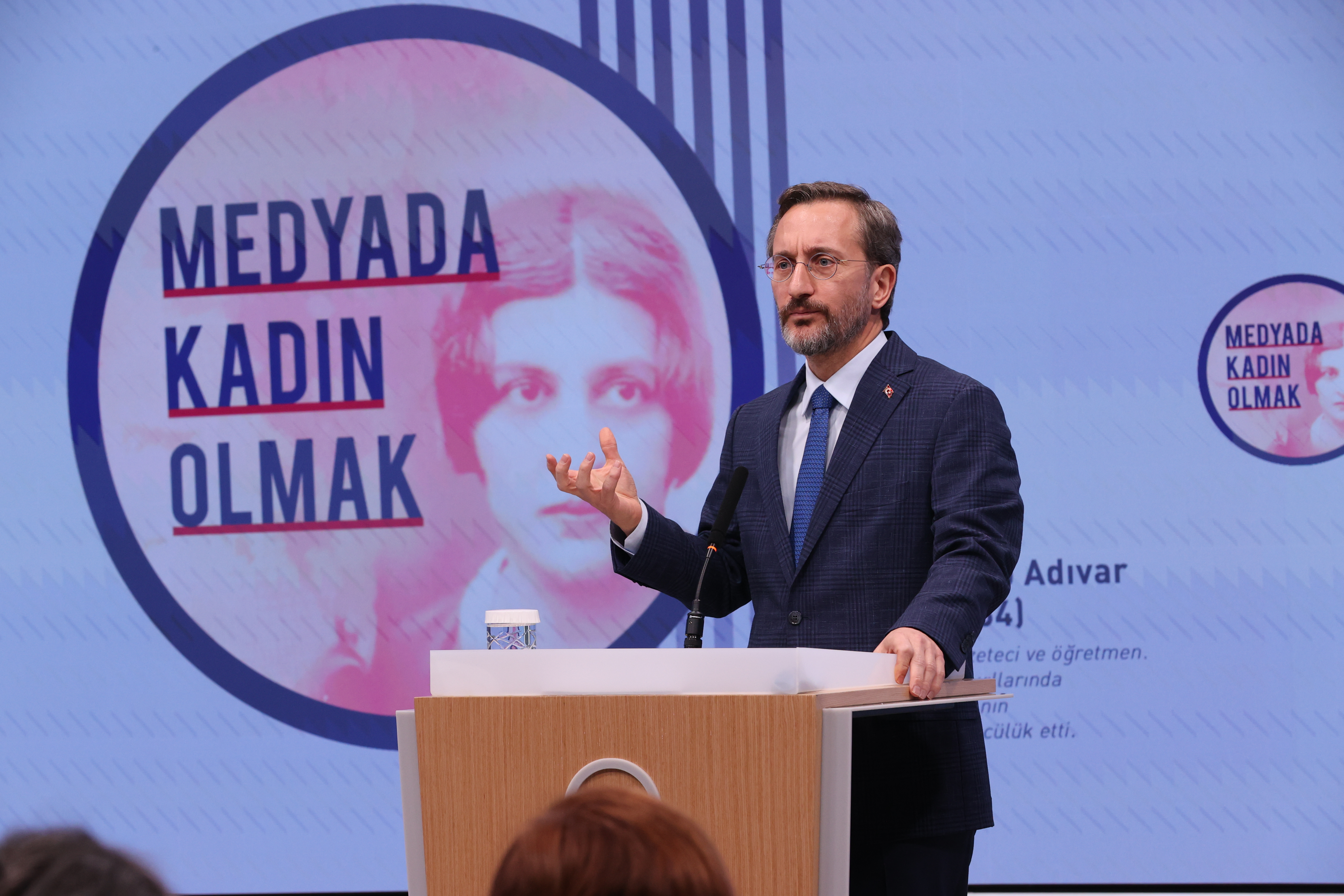
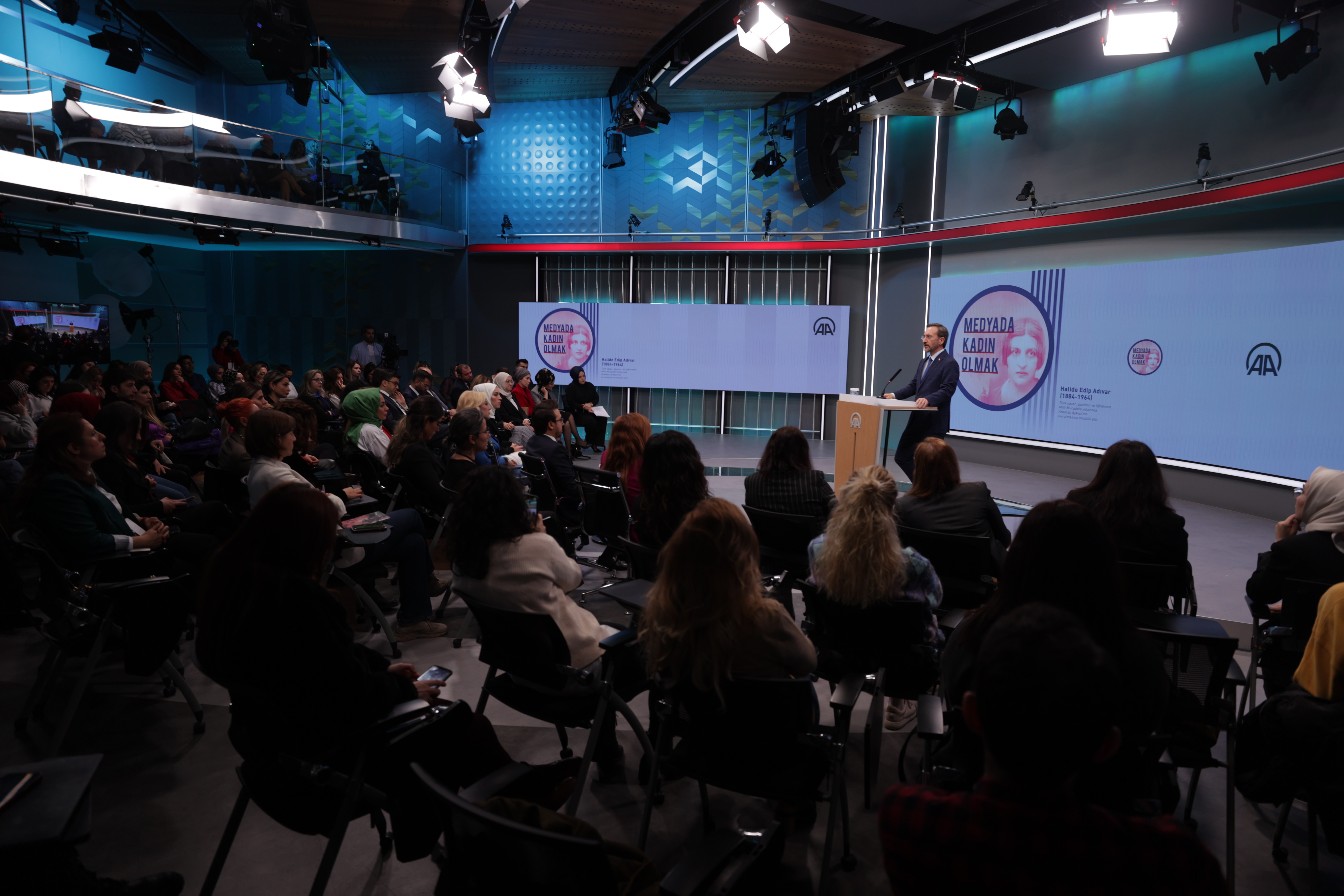
Presidency's Director of Communications noted that the more power women have in the media, and the more accurately women are represented in the content of publications, the more opportunity we have to achieve a fairer social order, and said, "We must work together for this. At this point, we are determined to do our part," in his address at the panel titled "Being a Woman in Media" held at AAtölye at the Anadolu Agency General Directorate,
Stating that the point is women's employment and the improvement of working conditions in the media sector and the representation of women in the content of publications, Director of Communications Altun noted that like Halide Edip Adıvar, who is featured on the promotional poster of the programme, we have encountered throughout history pioneering women actors who have achieved significant success in fields ranging from art to literature, media, and politics.
Director of Communications Altun stated that Adıvar was one of the key figures of the National Struggle, and she also provided the idea for the establishment of the Anadolu Agency.
Stressing that Adıvar held public demonstrations in Fatih on May 19, 1919, and in Kadıköy on May 22, she is particularly remembered for her speech at the demonstration in Sultanahmet Square on May 23, 1919, Director of Communications Altun stated that after Emin Yurdakul, she took the floor and said that Turkish women raised their strong voice in front of 200,000 people and made a clear call to the invaders.
Director of Communications Altun added:
"That self-confidence is so precious. When I read Halide Edip Adıvar's memoirs, one of the things that impressed me the most was self-confidence. We witness self-confidence in many women authors of the period. I believe we should talk about this self-confidence building in a discussion called 'Being a Woman in the Media'. What I believe must definitely continue to be at the centre of these discussions is how this sense of self-confidence is preserved, strengthened, and passed down from generation to generation."
"Female journalists have set very significant examples in reporting"
Director of Communications Altun stated that women's employment in the media sector has risen in recent years and that they have all witnessed this tangible progress, particularly in the previous two decades with the development of the media.
Director of Communications Altun emphasised the importance of discussing the improvement of women's working conditions in the media as a core issue at the panel and stated that the issue of working conditions, the reflection of experience in the sector, and the advancement of career processes must also be addressed.
Director of Communications Altun urged for a greater representation of women in management roles in the media and the institutionalisation of a culture of women managers, adding:
"We do need a media environment in which women are actively engaged in both technical and creative content areas and can easily climb the managerial ladder. For many years, we have been challenged by a misconception. 'Women in the media can undertake certain tasks, but not others. For instance, women cannot work in crisis reporting, disaster journalism, and war correspondent positions.' This misconception has recently been shattered by women journalists who have set very significant examples in reporting in our media history by producing extremely successful work."
Director of Communications Altun stated that these women journalists debunked this misconception via their successful work in war and disaster journalism.
"Women's representation is a fair representation of the society"
Director of Communications Altun pointed out that the issue of improving the position of women in the media needs to be worked on, and stated that when looking at the international academic literature on the representation of women in the media, the words encountered contain discrimination and sexism above all, and this reality must be faced.
Director of Communications Altun said, "It is extremely critical to remove implicit or explicit discrimination and sexism from the content in the media and to clean the language in the media. In this sense, prejudices are one of the most fundamental elements of inaccurate and incomplete representations of women in the media."
Director of Communications stated that one of the important issues that should be emphasised is the need for real women's stories to find more space in the media, and emphasised that the existence of news in which women are the subjects and to reflect their real achievements will enable the accurate representation of women.
Director of Communications Altun pointed out that the commodification and commercialisation of the female body in the media is one of the factors that problematise the representation of women.
"Publications that normalise and legitimise violence should be marginalised"
Director of Communication Altun pointed to the news on violence against women and commented on the language used here:
"All broadcasts that normalise, legitimise and mitigate violence should be clearly and explicitly marginalised, criminalised, labelled and stigmatised. In this sense, a common culture must be developed. Because one of the factors that increase violence, perhaps one of the issues that we do not dwell on or discuss much, is publications that normalise and mitigate violence. A set of concepts can be built, and a convention that says these 'should not be used in the news about violence against women' can be established. With an international initiative around this convention, perhaps it can be put forward how news on violence against women can be handled."
Noting that the contribution of women in the media to the language of media is important, Director of Communications Altun stated, "It is also crucial to condemn many expressions that appear neutral but contain very serious discriminatory elements."
"We are determined to do our part"
Stating that we have a cultural tradition in which women and men complement each other within our value system, Director of Communications Altun pointed out that the erosion of value systems brought about by a Western colonial and Western dependency order caused serious problems in this area.
Emphasising the importance of preserving the substantial and positive features damaged by this process by using the opportunities of the modernisation process, Director of Communications Altun said that President Recep Tayyip Erdoğan believed that women should have a substantial presence in many fields, including education, health, economy, art, academia, and the media, and that he pursued this goal in his political life and that he endeavoured for women's participation in social life and politics.
"The more power women have in the media, and the more accurately women are represented in the content of publications, the more opportunity we have to achieve a fairer social order. We have to work together on this. We are determined to do our part, and we welcome your ideas, support, guidance, criticism, and projects on this issue."
Director of Communications Altun thanked Anadolu Agency for organising this important panel.
Women in the media who took part in the panel moderated by AA Discrimination Line Editor Zeynep Bayramoğlu shared their professional experiences.