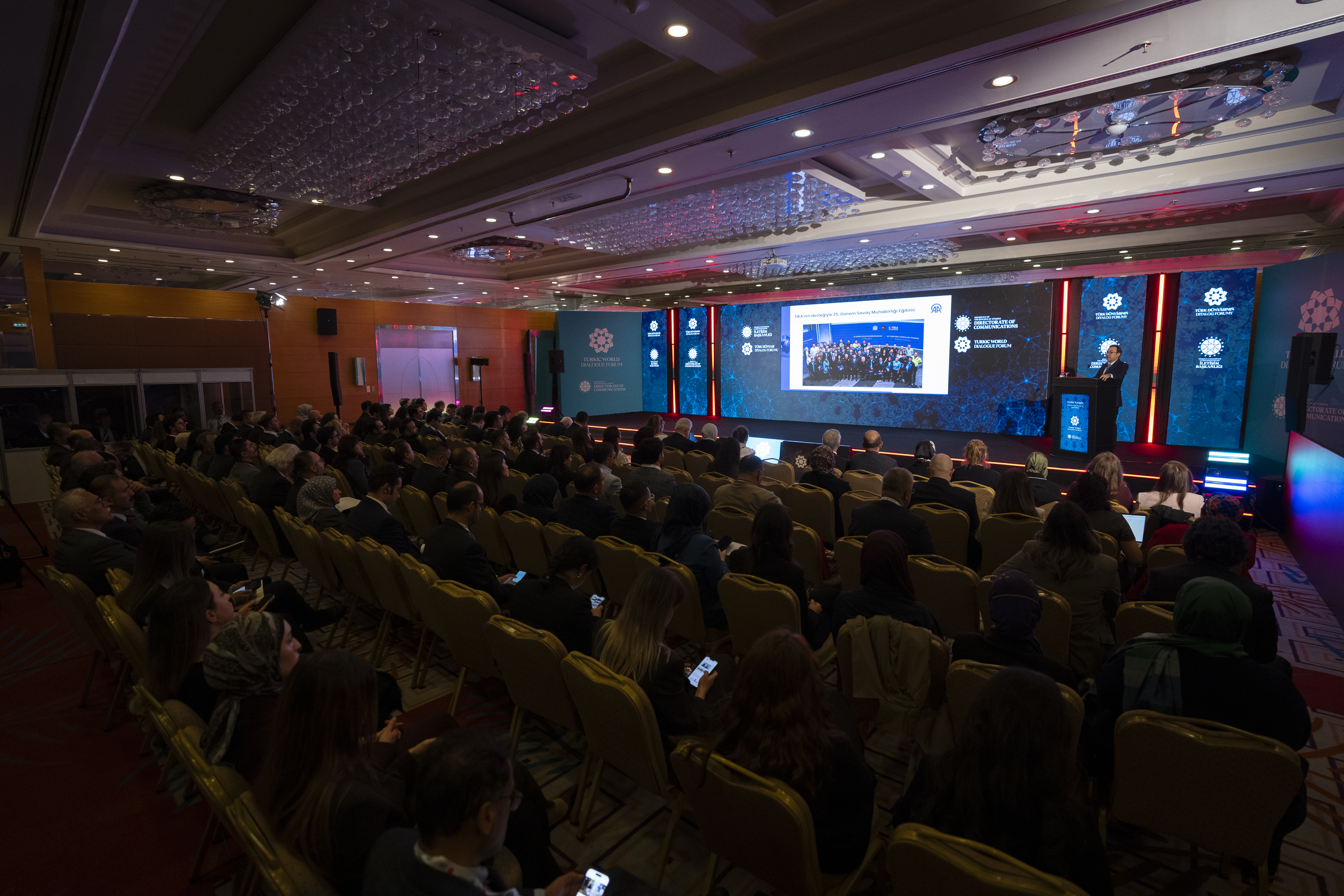
Serdar Karagöz, Chairman of the Board and Director General of Anadolu Agency (AA), spoke at a programme titled “Media Cooperation in the Turkic World: From Unity to Global Influence”, held as part of the “Turkic World Dialogue Forum” organised by the Directorate of Communications.
Recalling İsmail Gaspıralı’s words, “Unity in Language, Thought and Action”, Karagöz noted that the world, borders, and means of communication have changed over time, but Gaspıralı's idea of unity still remains relevant today. He emphasised that the theme of the Organisation of Turkic States Summit, “The Turkic Century: Unity in Language, Thought and Action”, was particularly meaningful in this respect, adding that the idea Gaspıralı had advanced more than a century ago was now reflected in the Turkic world’s shared vision for the future.
“We have a civilisational heritage spanning centuries”
Emphasising the growing strategic importance of cooperation in the media sector, Karagöz said, “Strong journalism requires strong institutions, and strong institutions develop through strong cooperation. We attach particular importance to this in the Turkic world. We share a common history. We share a common culture. Above all, we share a common language. We have a civilisational heritage spanning centuries. This heritage offers us tremendous opportunities.” Karagöz noted that Anadolu Agency, established during the most difficult days of the National Struggle, brought the struggle for independence to the world's attention and aimed to contribute to shared news consumption across the Turkic world.
Karagöz said that the Turkic peoples did not know one another well enough, which was a significant problem, and that Anadolu Agency was working to address it. Explaining that the Agency produced news on a global scale, published in 14 languages, and followed developments across different regions, he continued:
“The Turkic world occupies a very important place in our work. We have strong journalistic ties across a vast geography, from Azerbaijan to Kazakhstan, from Kyrgyzstan to Uzbekistan, and from Turkmenistan to Hungary and the Turkish Republic of Northern Cyprus. We closely follow political, economic, cultural and social developments in these countries. We produce news reports on our shared history and cultural heritage. We share our experience with media organisations in the Turkic world. We organise journalism training and develop joint projects. We regard sharing Anadolu Agency’s experience in international journalism with our colleagues in the Turkic world as an important responsibility.”
“Our goal was to establish a strong and lasting structure”
Karagöz explained that they established the Alliance of Turkic News Agencies (ATNA) in 2023 to put media cooperation in the Turkic world on an institutional footing, bringing together news agencies from Türkiye, Azerbaijan, Kazakhstan, Kyrgyzstan, and Uzbekistan to advance that cooperation. He said, “ATNA has become one of the institutional expressions of our shared history and cultural affinity in the media sector. As Anadolu Agency, we assumed the Alliance’s first rotating chairmanship. We took on an important responsibility because our goal was to establish a strong and lasting structure.”
Noting that they organised training courses, competitions and experience-sharing activities for journalists to increase the visibility of the Turkic world in international news circulation, Karagöz said,
“In this way, we transformed ATNA into a structure through which we come together around shared goals, produce work jointly and achieve tangible results. I would also like to emphasise that, in the coming period, this cooperation will achieve its objectives through new projects. For us, ATNA was a step that demonstrated our ability to come together and build an institutional structure. Through ATNA, we have once again disproved preconceived notions such as ‘Turks do not come together so easily. Turks love one another, but they cannot build institutional structures.’”
“Our language is one of the most important bonds linking our shared memory and future”
Karagöz said Anadolu Agency has organised its News Awards for the past two years and, as part of the competition, presented the Turkish Language Association Special Award for the Use of Turkish in News Reporting, describing the award as a tangible reflection of the importance it attaches to the Turkish language. Explaining that they were taking this initiative a step further, he continued,
“Starting next year, we are adding another category to the Anadolu Agency News Awards: the Turkic World News Award. In this new category, we also want to recognise original, high-quality news reports produced by journalists working in different parts of the Turkic world. In this way, we aim to strengthen our cooperation in journalism across the Turkic world and help make our shared stories more visible internationally. For our language is one of the most important bonds linking our shared memory and future.”
“Türkiye and Azerbaijan are two brotherly countries”
Karagöz stated that these realities and new developments would please friends but that there were also actors who might be uncomfortable with the growing momentum in the Turkic world and regard this unity as a threat. He said, “Those who recognise the potential of the Organisation of Turkic States may, of course, resort to various means to weaken it while it is still in its early stages, before everything has fallen into place. The method most frequently employed here is disinformation and attempts to drive a wedge between brotherly countries.” Describing such attempts as “sowing discord and damaging relations”, Karagöz continued, “We have begun to experience examples of such attempts. For instance, Türkiye and Azerbaijan are two brotherly countries. But are there not attempts to undermine this brotherhood, particularly by third parties, certain countries among those third parties and certain groups within those countries? Are there not steps aimed at damaging the friendship between the peoples of Türkiye and Azerbaijan? We cannot resolve certain matters without talking about them. So let us talk. There are those who want to set the peoples of the two countries against each other, and these are countries in this geography, in this region, outside the Turkic world. I am not talking about a single country; there are several. There are those who sow seeds of discord to damage our relations and disturb our peace.”
Karagöz said, "Our responsibility as the media is to contribute to brotherhood, strengthen the bonds between our societies, understand one another better, and establish a strong foundation for communication concerning our shared future.”
“We will be united in language, thought and action”
Karagöz, Director General of AA, noted that İsmail Gaspıralısought to establish an intellectual connection across the Turkic world through his newspaper Tercüman, which he began publishing in 1883.
Emphasising that Gaspıralı’s undertaking had been “a great ideal under the conditions of the time”, Karagöz said that they now had far more extensive infrastructure at their disposal. He highlighted Türkiye’s tremendous experience in multilingual broadcasting, saying that this had been put to the test during the Karabakh Victory. Noting that disinformation concerning the issue had circulated internationally, Karagöz described the efforts made in the media sphere as:
“At that time, Anadolu Agency covered the Karabakh Victory in 13 languages and TRT in 41 languages, standing alongside our Azerbaijani brothers and sisters, speaking with one voice and sharing the same sentiments in countering the falsehoods spread by the Armenian diaspora.”
Stating that Gaspıralı’s tried-and-tested idea of unity offered a clear direction, Karagöz said, “We will be united in language, united in thought and united in action. We will stand together in difficult times and in good times. We will warn one another against those who seek to divide us and sow discord among us, and we will remain united. As Anadolu Agency, we will continue to work in this spirit and share our experience. We will take media cooperation in the Turkic world even further. Drawing strength from our shared past, we will build a shared future.”
Serdar Karagöz thanked the Directorate of Communications, which organised the event, the Presidency's Head of Communications, Burhanettin Duran, and his team.