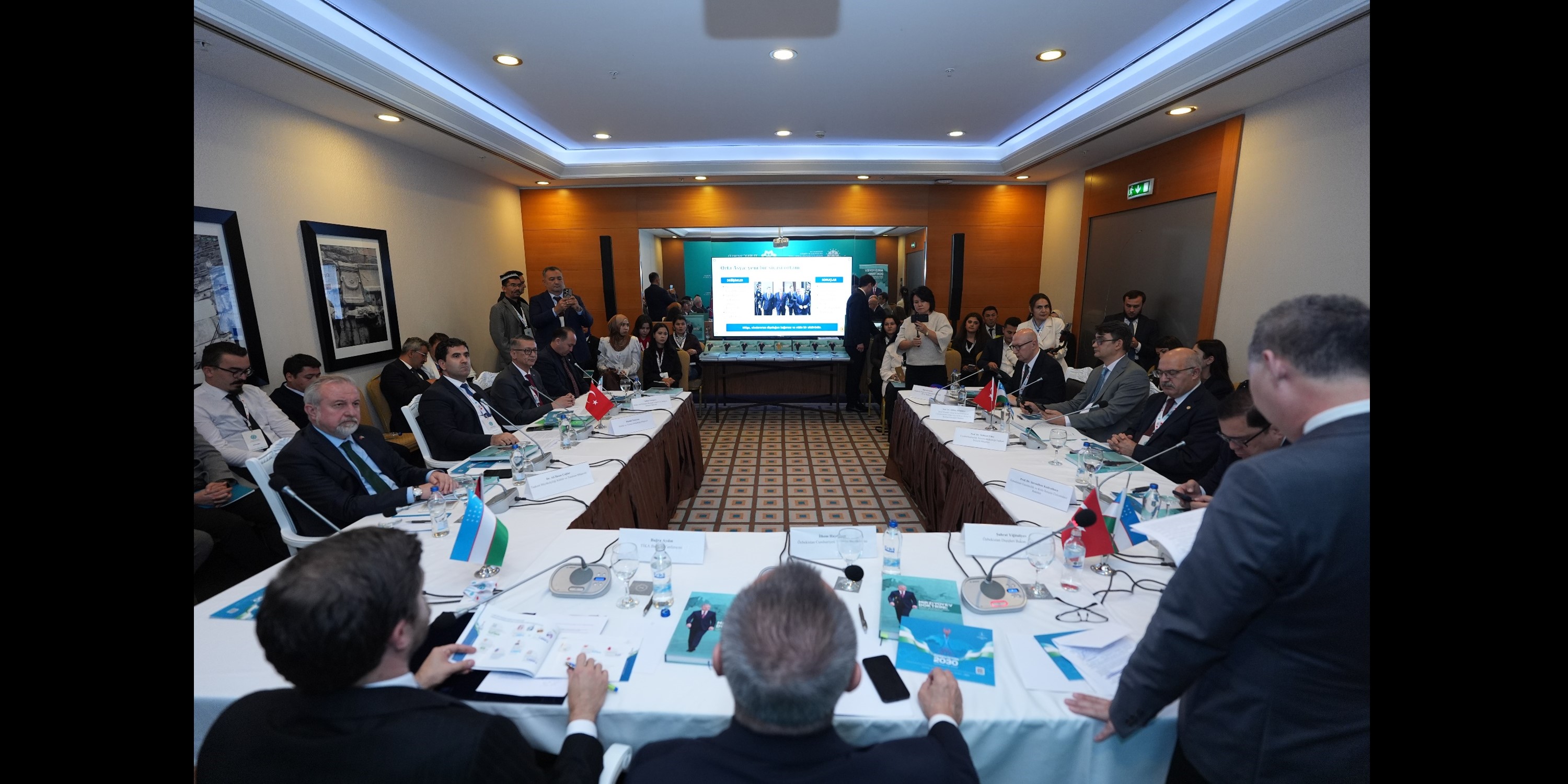
A roundtable meeting on "New Uzbekistan Towards 2030: Reform Achievements, the Uzbekistan–Türkiye Strategic Partnership and Cooperation within the Organisation of Turkic States" was held on the margins of the "Turkic World Dialogue Forum," organised by the Presidency’s Directorate of Communications in Ankara.
Moderated by Uzbekistan’s Ambassador to Türkiye, Ilhom Khaydarov, the meeting in Ankara was attended by the Vice President of the Turkish Cooperation and Coordination Agency (TİKA), Buğra Aydın; the Undersecretary of Uzbekistan’s Ministry of Foreign Affairs, Shukhrat Yigitaliyev; the Deputy Head of the Centre for Development Strategy of Uzbekistan, Tulkin Tursunov; the Rector of the University of Journalism and Mass Communications of Uzbekistan, Prof. Sherzodkhon Kudratkhodja; Dr Ali İhsan Çağlar of the Ministry of Culture and Tourism of the Republic of Türkiye; the Dean of the Faculty of Philology at Samarkand State University and an expert in Turkic languages, Prof. Dr Juliboy Eltazarov; the Deputy Director of the International Institute for Central Asia (IICA), Sherzod Fayziyev; the Adviser to the Ministry of Culture and Tourism, Hamdi Turşucu; and the Communications Counsellor at the Presidency’s Directorate of Communications in Tashkent, Prof. Mehmet Yüce.
Prior to the meeting, Khaydarov introduced his book entitled "The Mirziyoyev Doctrine: Opportunity Diplomacy in an Era of Global Instability," which examines Uzbekistan’s development trajectory in recent years, its foreign policy and its strategic objectives for the future.
Noting that the book explores the far-reaching changes in the foreign policy of New Uzbekistan over the past decade, its key priorities, tangible outcomes and future prospects, Khaydarov said, "The book offers an in-depth examination of a number of important issues, including strengthening peace and stability in Central Asia; developing good-neighbourly relations and mutual trust with neighbouring countries; establishing constructive dialogue with leading countries around the world and international partners; and shaping a distinctive approach to pursuing an open and pragmatic foreign policy."
Khaydarov added that the Turkish Cooperation and Coordination Agency (TİKA) had contributed to the preparation and publication of the book.
Book highlighted as reflecting bilateral relations
Aydın stated that the Turkish translation of the book, which examines the foreign policy approach of the President of Uzbekistan and the country’s vision for the future, would contribute to a better understanding of the shared objectives and opportunities for cooperation between the two countries.
Aydın underscored that relations between Türkiye and Uzbekistan draw strength from their shared historical, linguistic, cultural and civilisational heritage, noting that the shared historical memory extending from Samarkand to İstanbul and from Bukhara to Konya constitutes the foundation of the ties between the two countries.
Aydın expressed satisfaction with having played a role in the realisation of one of the tangible manifestations of cooperation between Türkiye and Uzbekistan, stating:
“We are implementing projects across a wide range of fields in Uzbekistan, from education and healthcare to the preservation of cultural heritage, social development, institutional capacity-building and academic cooperation. The initiatives we have undertaken since 1992 go far beyond development projects alone. Each is a long-term investment that strengthens mutual trust and solidarity between the two brotherly countries.”
Aydın voiced his hope that the book would contribute to greater mutual understanding between Türkiye and Uzbekistan and enable the two countries gain a deeper understanding of one another.
"Unprecedented level" of bilateral relations over the past decade underscored
Yigitaliyev described the book as a notable contribution to understanding the political and intellectual foundations of New Uzbekistan, stating that, over the past ten years, relations between Uzbekistan and Türkiye had reached an unprecedented level in their history, owing to the strong political will demonstrated by the leaders of both countries.
Emphasising that Uzbekistan’s foreign policy had strengthened the country’s international standing, Yigitaliyev noted that a new environment for cooperation had been fostered, particularly in Central Asia, on the basis of dialogue, trust and good-neighbourly relations, with borders being opened, transport links re-established, and trade, economic and people-to-people ties further developed.
Yigitaliyev noted that Uzbekistan’s foreign policy served not only to enhance the country’s international reputation but also constituted a strategic resource for promoting economic development and public welfare.
The contribution of Uzbekistan’s young population to national development
Emphasising the need for the two countries to maintain open dialogue through their diplomatic representatives, academics and intellectuals, Çağlar stated that Ismail Gaspıralı's principle of ‘Unity in Language, Thought and Action’ should form the foundation of relations across the Turkic world.
Highlighting the significant strides made in Türkiye–Uzbekistan relations over the past 35 years, Çağlar said that the two countries’ political, economic, social and geopolitical differences should be considered a source of strength, adding that future cooperation should be built on economic affairs, trade, investment and shared development goals.
Çağlar reported that over 300 projects had been completed in Uzbekistan through TİKA, adding that the book being introduced likewise conveyed Uzbekistan’s approach, which embodies the spirit of the Silk Road and places a priority on prosperity and cooperation.
Focusing on two strategic considerations for Uzbekistan’s 2030 and beyond agenda, Çağlar emphasised that preserving and nurturing the country’s young population would contribute to its diplomatic and economic strength while creating substantial scope for cooperation with developed countries, particularly in the technology sector.
Recalling that the Turkic world had historically served as a bridge between different civilisations, Eltazarov emphasised that Türkiye and Uzbekistan should act in the spirit of their shared heritage and contribute to greater unity and solidarity across the Turkic world.
Eltazarov argued that, by reassuming its historical role, the Turkic world could become a civilisation that serves as a bridge between different civilisations.
Call for stronger university cooperation between Türkiye and Uzbekistan
Highlighting the profound changes Central Asia had undergone since 2017 through regional dialogue, the opening of borders and expanding trade, Fayziyev said that the region had developed into a political and economic entity united by shared interests and priorities
Emphasising the need to deepen cooperation between Türkiye and Central Asia through joint initiatives involving think tanks, universities and research centres, Fayziyev stated that they were ready to undertake joint research and engage in dialogue among experts in this regard.
Fayziyev stated that Central Asia was no longer merely a geographical designation, but had evolved into an integrated political and economic space with its own voice, interests and priorities.
Turşucu noted that the recognition of Turkish as a foreign language in Uzbekistan in 2023 had marked an important development in terms of academic and professional opportunities, adding that this step should serve as a model within the Organisation of Turkic States (OTS).
Underlining the need to expand university cooperation between Türkiye and Uzbekistan, Turşucu stated that the memoranda of understanding signed between the two countries should be translated into concrete projects and joint undertakings.
Proposal for a joint mechanism to address challenges facing businesspeople in both countries
Yüce said that, in order to strengthen economic cooperation between Türkiye and Uzbekistan, a joint mechanism should be established to address the challenges faced by businesspeople in both countries and strategic investment areas should be identified.
Highlighting the importance of training a qualified workforce, promoting joint initiatives among universities and expanding reciprocal internship opportunities for students, Yüce proposed that media organisations in the two countries work together to develop joint news agency and television projects.
Yüce noted that communication channels enabling the peoples of Türkiye and Uzbekistan to gain a direct understanding of one another should be strengthened to ensure that relations between the two countries are not adversely affected by disinformation.